
Refrigerator Repair in Irvine, CA
- ⭐ 5.0★ Yelp · 5.0★ Google
- 🛡️ 90-Day Parts & Labor Warranty
- 📅 20+ Years of Experience
- 📍 Based in Irvine
Quick answer
We repair refrigerators and freezers all over Irvine, freestanding French-door and side-by-side models, counter-depth units, built-in and panel-ready refrigerators, column units, and the second fridge or freezer in the garage. We work out of Irvine, so a same-day visit is often possible, and a refrigerator that has stopped cooling gets priority. The technician quotes the repair on site before any work starts, and every repair carries a 90-day parts and labor warranty. If the fridge is warm right now, keep the doors shut, move the most perishable food to a cooler, and read what to check before you call.
When a refrigerator stops cooling, the clock starts: per USDA guidance a closed refrigerator keeps food safe for about four hours. Alpha & Omega is a family-owned repair company that brings 20+ years of repair experience to Orange County and is based in Irvine, so refrigerator calls from Woodbridge, Northwood, University Park, Turtle Rock, Woodbury, Orchard Hills, Portola Springs and the Great Park neighborhoods are local runs for us. Call (949) 267-7771 or text us the brand, the model number and what the refrigerator is doing, that lets the technician arrive with the most likely parts.
What Irvine Kitchens Have: and What Fails in Them
Irvine was built village by village over five decades, and the refrigerator in a house tends to match the era of the village. More about the neighborhoods is on our Irvine service area page.
Great Park, Portola Springs, Orchard Hills, Cypress Village, Stonegate
Most homes here were built from the 2000s on and came with a builder appliance package. The refrigerator is usually a counter-depth French-door model or a 36-inch built-in, and in upgraded kitchens a panel-ready unit or a pair of refrigerator and freezer columns hidden behind cabinet doors. These refrigerators rarely fail from wear in the first years. What we see instead are electronic and airflow problems: evaporator fans that stop, defrost sensors and heaters that let the evaporator ice over, ice makers that jam, and control boards that throw error codes. If your home is only a year or two old, check the manufacturer's warranty before paying for a repair, understanding appliance warranties explains what to look for.
Woodbridge, Northwood, Westpark and the 1980s–90s villages
Most of these kitchens have a freestanding refrigerator that has been replaced at least once, often squeezed into a cabinet opening that was sized for a smaller, older model. A tight fit matters: a refrigerator with no air gap above and behind it pushes its compressor and condenser fan harder, and the problem usually shows up on the first hot week of summer. Condenser fan motors, start relays and compressors that run nonstop are typical calls in these neighborhoods.
University Park, Turtle Rock, Culverdale, Deerfield, College Park
The first Irvine villages date from the late 1960s and 1970s, and many kitchens have been remodeled more than once. We find everything from a standard freestanding refrigerator to full remodels with a built-in unit. Built-in refrigerators are fitted to their opening, and a replacement of a different brand or size often means cabinet work. That is why repair is frequently the better choice for a built-in that is otherwise in good condition.
Apartments, condos and Irvine Company communities
Many Irvine renters live in apartment communities owned and managed by the Irvine Company or other large owners. If you rent, your lease almost always routes appliance repairs through property management, call the leasing office first, because a repair you arrange yourself may not be reimbursed. We work for homeowners, condo and townhome owners, landlords and property managers. When the owner books us, we coordinate access with the tenant and leave an itemized invoice the owner or HOA can file.
Built-In and Panel-Ready Refrigerators
A built-in or panel-ready refrigerator is not just a freestanding model with a cabinet door on it. The layout is different, and so is the repair:
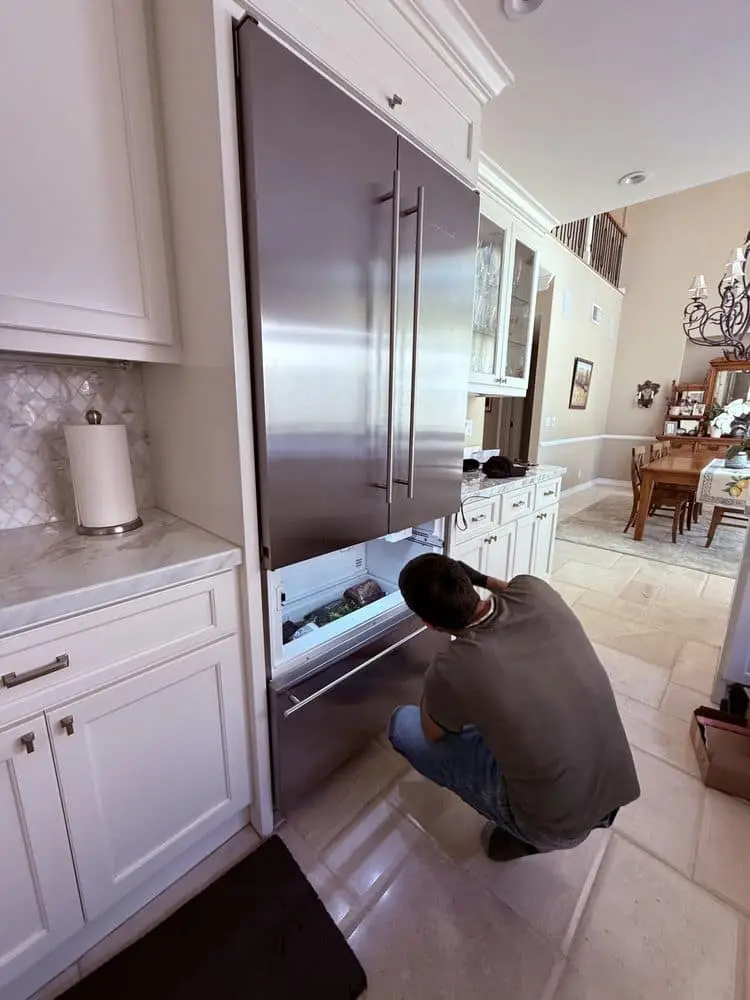
- The machinery is often on top. Many built-in models put the compressor, condenser and condenser fan in a compartment above the doors, behind the top grille. The condenser collects dust there just like one at floor level, but nobody sees it, so it rarely gets cleaned.
- Most service is done from the front. These units are designed to be serviced in place. When a unit does have to come forward, it is anchored against tipping and carries heavy custom panels, so moving it is a technician job, done with the floor and cabinets protected.
- Columns are separate appliances. A refrigerator column and a freezer column side by side each have their own compressor and controls. If the freezer column is warm and the refrigerator column is fine, the problem is in that one unit.
- Some models have two cooling systems. Certain built-ins use separate sealed systems for the fresh-food and freezer sections, so one section can fail while the other keeps working. That changes how the problem is diagnosed.
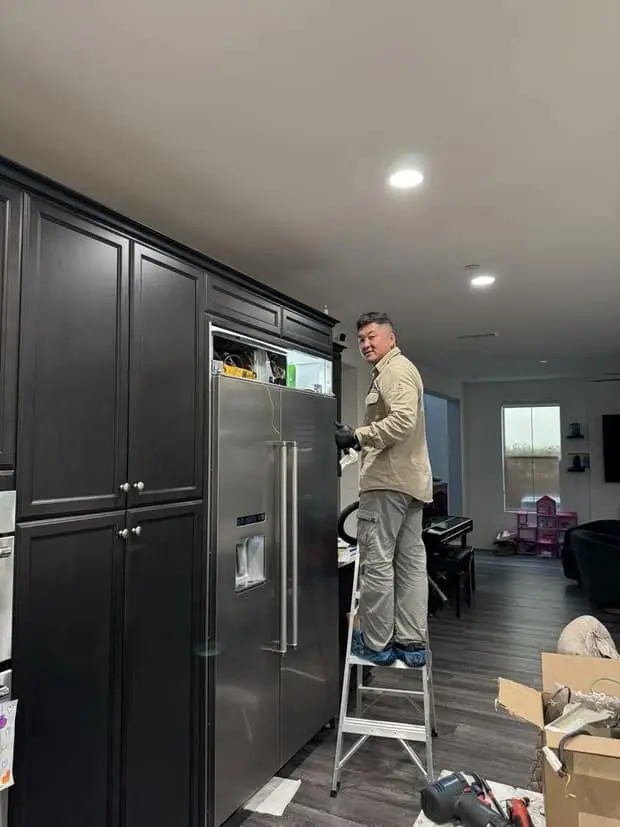
We are experienced with built-in Sub-Zero, Thermador, Viking and Miele refrigerators, and we are Factory Authorized for Liebherr, whose integrated and column models turn up in Irvine remodels. A photo of the model and serial tag saves a lot of time. On most built-ins it is inside the fresh-food section, on the ceiling or an upper side wall, or behind the top grille.
What about wine columns and refrigerator drawers?
In the remodeled kitchens around Shady Canyon, Turtle Ridge and Quail Hill, and in the upgraded Orchard Hills and Great Park homes, refrigeration is usually spread around the room instead of sitting in one cabinet. A refrigerator column and a freezer column behind panel doors, two refrigerator drawers in the island, a beverage center by the bar, a wine cabinet in the butler's pantry. Each one of those is a separate appliance with its own compressor, its own control and its own warranty.
The small units fail for a reason that has nothing to do with the brand. All that machinery is packed into a short chassis, and the condenser breathes through a narrow slot in the toe kick or a grille along the top. Push a rug against the toe kick, stack boxes in front of the grille, or let a year of dust settle in that slot, and the unit runs warm with no part broken at all. I clear the vent and watch the temperature before I quote anything on an undercounter.
Wine cabinets hold a tighter temperature band than a kitchen refrigerator, so a drift of four or five degrees is a real complaint rather than a quirk. Vibration, condensation on the glass and one warm zone in a dual-zone cabinet have their own causes, and they are covered on our wine cooler repair page. Refrigerator drawers take the most physical abuse in the kitchen: the gasket on a drawer front gets wiped, kicked and loaded against, and a drawer that no longer closes square will run warm long before anything electrical fails.
Garage Refrigerators and Freezers
A second refrigerator or a chest freezer in the garage is common in Irvine homes, especially for families who shop in bulk. A garage is a harder place for a refrigerator than a kitchen:
- Summer heat. An Irvine garage gets much hotter than the house on a warm afternoon, and even hotter on a west-facing wall. The compressor runs longer to keep up, and a marginal start relay or condenser fan fails sooner.
- Cool winter nights. Many household refrigerators are designed for indoor room temperatures. On some models with a single thermostat in the fresh-food section, a cold garage means that section stops calling for cooling, and the freezer section warms up with it. The owner's manual lists the ambient temperature range the model is designed for.
- Dust. Garages are dusty, and a clogged condenser is one of the most common reasons a garage refrigerator runs warm.
- Power. Garage outlets are often GFCI-protected. A tripped GFCI outlet, sometimes on a different wall or in a bathroom on the same circuit, can quietly shut off a freezer full of food. Plug the unit straight into the wall, not into an extension cord or power strip.
For more on freezer-specific problems, see our freezer not cooling guide, or frost building up in your freezer if the freezer still freezes but ice keeps returning. If the complaint is noise rather than temperature, refrigerator making strange noises walks through clicking, buzzing, knocking and squealing one sound at a time. And if the fridge is running too cold instead of too warm, refrigerator freezing food in the fresh-food section explains why the setting is rarely the whole story. When someone has already said the word compressor, read refrigerator compressor problems first: the start relay and overload protector fail far more often than the compressor they are bolted to. On a GE, GE Profile or Café unit where the freezer is still cold and only the fridge side is warm, this guide narrows it down before we arrive.
Why does the ice maker quit before anything else?
Irvine tap water is hard. You can see what it leaves behind on shower glass, and the water side of a refrigerator collects the same crust where you cannot see it. Scale builds on the seat of the water inlet valve until the valve stops closing cleanly, water weeps into the fill tube between cycles, and the tube freezes into a plug. After that the ice maker keeps cycling with nothing reaching the mold. Ice on the fill tube, or a thin sheet of ice on the shelf under the ice maker, is the giveaway.
What makes Irvine calls different is usually the plumbing between the wall and the refrigerator, not the refrigerator itself. Four things come up again and again:
- A reverse osmosis tap under the sink. RO is fine for a drinking glass and often cannot hold the pressure an ice maker needs, since most models want at least 20 psi at the valve. Small cubes, hollow cubes and a bin that never fills, starting right after an RO system went in, point at pressure and not at the ice maker.
- A softener that the refrigerator line never sees. Plenty of homes here had a whole-house softener added years after the house was built, and the line feeding the refrigerator is frequently tapped off a run that bypasses it. The owner assumes the water problem is handled while the inlet valve keeps scaling.
- A saddle valve left from an older remodel. Those little piercing valves on copper lines clog and then weep. When I am behind the refrigerator anyway, I would rather put in a proper quarter-turn stop than put a new fridge on a forty-year-old saddle valve.
- A line pinched during installation. In a newer house, water that has dispensed slowly since move-in day is usually a plastic supply line crimped when the refrigerator was pushed back into the opening. Nothing inside the appliance is wrong.
Filters matter more in this water than the sticker suggests. Use the filter made for your model, and do not stretch a six-month cartridge to a year because the light has not come on yet. An aftermarket cartridge that does not seat correctly restricts flow worse than an old original one, and that shows up as slow ice first. Our ice maker not working guide walks the whole chain, and refrigerator leaking water covers the leaks that start at the same valve.
Refrigerator Symptoms and What They Usually Mean
- Not cooling, but lights and display work, a dirty condenser, a stopped condenser or evaporator fan, a failed start relay, or a defrost failure that has iced over the evaporator. A compressor or sealed-system failure is possible but less common. Start with our refrigerator not cooling guide.
- Freezer cold, refrigerator warm, on most models cold air reaches the fresh-food section from the freezer through a fan and duct. Frost blocking that path, a failed evaporator fan or a stuck damper is the usual cause.
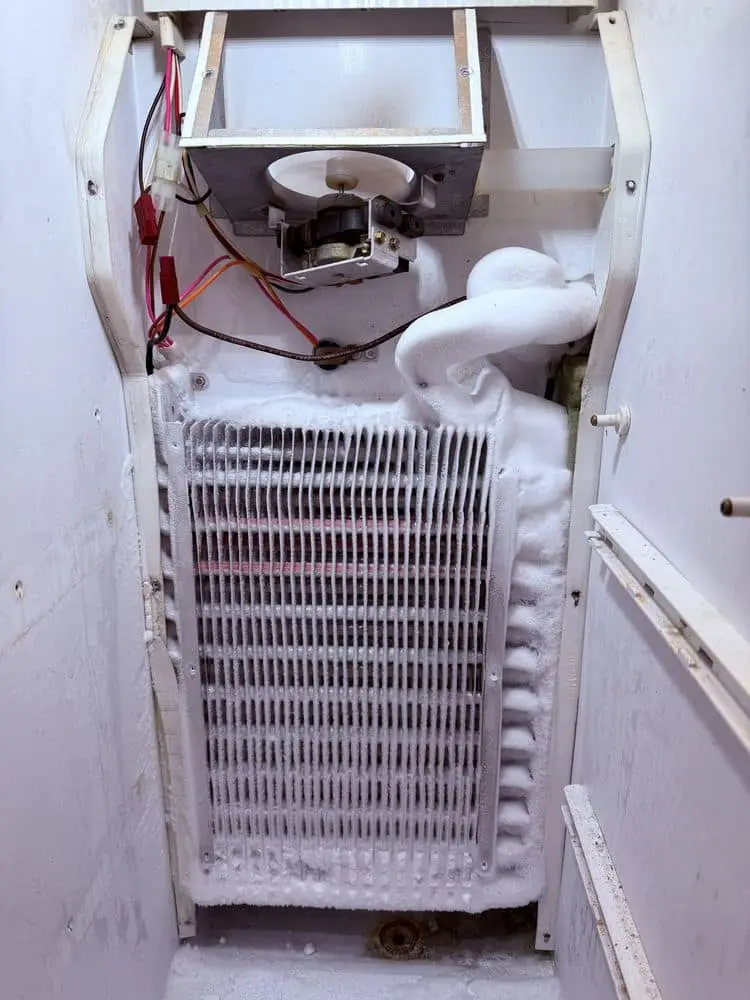
- Frost on the back wall of the freezer, the automatic defrost system is not doing its job: a defrost heater, sensor, thermostat or control.
- Water on the floor or under the crisper drawers, most often a frozen or clogged defrost drain, sometimes a water supply line or fitting. See refrigerator leaking water.
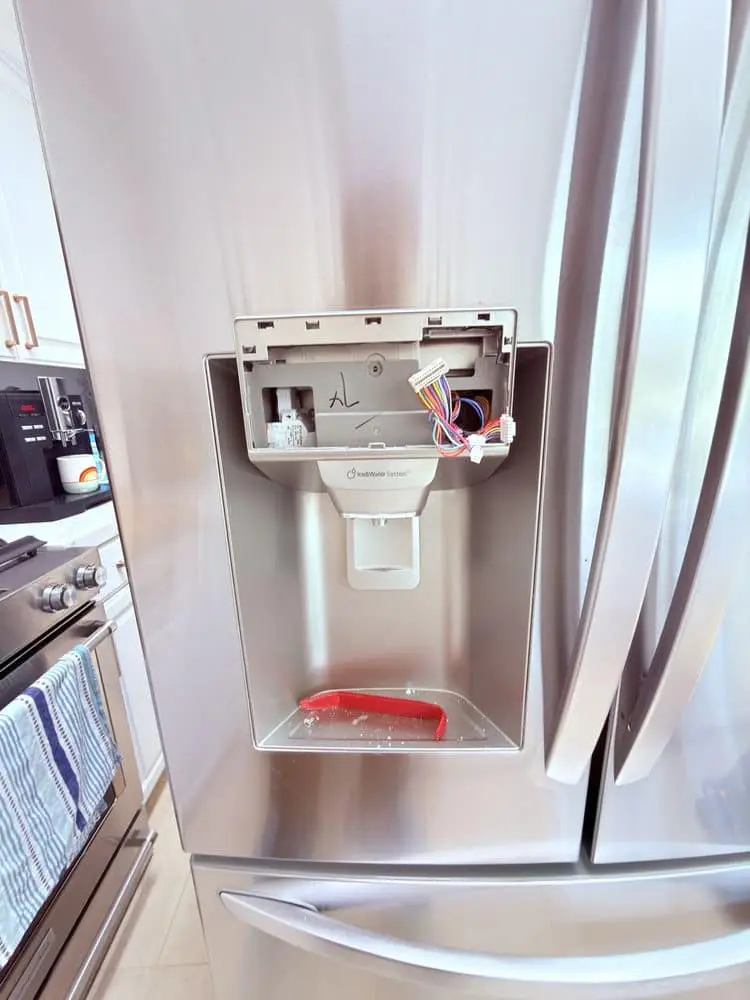
- No ice or slow ice, a frozen fill tube, a water inlet valve, a clogged water filter, or an ice maker module. See ice maker not working, and on Samsung French-door models Samsung refrigerator problems we fix most.
- Clicking, buzzing or rattling, a start relay trying to start the compressor, a fan blade hitting ice, or a loose drain pan.
- Runs all the time and still warm, can be airflow or a dirty condenser; if those are fine, it may be a refrigerant leak or a weak compressor. That is sealed system repair territory and needs a technician with the right equipment.
- Error code on the display, write it down or take a photo. Codes differ by brand and model, and the code helps us bring the right parts.
What does the code on the display mean?
Write it down or photograph it before you clear it, because many refrigerators drop the code once power is cycled. A code is a pointer, not a diagnosis. It tells us which circuit the control is unhappy about, and the newer refrigerators in Irvine's post-2000 villages throw plenty of them. Most of what we see falls into five families.
- Sensor codes. The board sees a temperature sensor reading open, shorted or impossible. The part is cheap and the job is short. Sensor values differ by model, so a reading only means something against that model's own chart, which is why we measure both sensors at a known temperature instead of trusting a number from a forum.
- Defrost codes. The control ran a defrost cycle and the evaporator never got warm enough to end it. Nine times out of ten that is the heater or the sensor that permits defrost, not the board that reported it.
- Fan codes. An evaporator or condenser fan is not reporting the speed it was told to run. On the brushless fans used in newer units, a blade frozen against ice reports exactly the same fault as a dead motor, so the ice has to come off before anyone decides which it is.
- Communication codes. The display and the main board have stopped talking. Usually a connector, a chafed harness or a door hinge that has been pinching the wiring for years.
- Compressor or inverter codes. On the inverter and linear compressors now common in LG and Samsung units, the same code can come from the inverter board, the start circuit or the compressor itself. The gap between those three in cost is large, which is where careful diagnosis earns its keep. If a technician quotes a compressor off a code without putting a meter on the inverter, get a second opinion. For LG specifically, LG refrigerator compressor failure explains what the extended coverage on the linear compressor does and does not pay for.
Many models also let us force a defrost or run a test cycle from the panel or the door switches. That answers in ten minutes what a parts swap would answer in a week, and I would rather spend the ten minutes.
What You Can Safely Check Before You Call
- The real temperature. Put an appliance thermometer in a glass of water on a middle shelf and leave it a few hours. The target is 37°F in the refrigerator and 0°F in the freezer. That number helps a lot on the phone.
- Power and GFCI outlets. Check the breaker and press the reset button on any GFCI outlet on the circuit.
- Vents inside. Make sure food is not pressed against the air vents in the freezer or fresh-food section.
- The condenser. With the refrigerator unplugged, vacuum the grille and the dust you can reach. Our refrigerator maintenance checklist shows how and how often.
- Door seals. Close a sheet of paper in the door at several spots. If it slides out with no resistance, the gasket is not sealing there.
- Settings. Check that the unit is not in showroom, demo, vacation or Sabbath mode, which can stop cooling or change how it runs.
What Not to Do
- Do not chip ice off the evaporator with a knife or screwdriver. One hole in the tubing turns a defrost repair into a sealed-system repair.
- Do not pull a built-in or panel-ready refrigerator out of its opening yourself, it is anchored, heavy and connected to a water line.
- Do not keep unplugging and replugging a refrigerator that clicks and won't start. Repeated start attempts are hard on the compressor.
- Do not use a heat gun or hair dryer on plastic liners to melt ice. Leaving the unit unplugged with the doors open, and the food moved to coolers, is safer.
- Do not buy a "recharge kit." A refrigerator that is low on refrigerant has a leak, and it needs a diagnosis, not a top-up.
Repair it or replace it?
For a freestanding refrigerator the question is mostly arithmetic: how old it is, what the part costs, and what shape the rest of the unit is in. A seven-year-old French door with a dead evaporator fan is an easy repair. The same unit at fifteen years with a leaking sealed system and rust at the liner is not, and I will tell you that on the visit rather than take the job. Our repair or replace guide shows the way we weigh it, and how long a refrigerator should last gives realistic service life by type.
Built-in and panel-ready units in Irvine change that math, and it is worth knowing before you shop. The opening was framed for one specific width and depth. The door panels were made by whoever built the kitchen. The water line, the outlet and the vent path all sit where the old unit wanted them. Swapping in a different brand usually means filler panels, a new trim kit, sometimes a cabinet maker and an electrician, and the install can cost as much as a serious repair. That is why repair stays the sensible choice on a built-in much further into its life than it would on a freestanding model.
Two more honest notes. In the older villages a 36-inch replacement rarely drops into a 33-inch opening, so measure the cabinet before the showroom measures your wallet. And parts for built-in and premium models often ship from the manufacturer rather than a local warehouse, so if a part has to be ordered we give you the expected date and book the return visit then, instead of leaving you waiting on a phone call.
Refrigerator Brands We Repair in Irvine
We are Factory Authorized for LG and Liebherr, and our technicians are Samsung-certified, see Samsung appliance repair. We are experienced with Sub-Zero, Thermador, Viking and Miele built-ins, and we professionally service GE, GE Profile, Monogram, Café, KitchenAid, JennAir, Whirlpool, Maytag, Bosch and the other major brands. If your KitchenAid runs but won't get cold, start with our KitchenAid refrigerator not cooling guide. For 36, 42 and 48 inch built-in and panel-ready units, where the doors, the hinges and the grille cause more calls than the cooling system does, see KitchenAid built-in refrigerator problems.
What actually keeps an Irvine refrigerator running?
Refrigerator maintenance has been oversold. A kitchen unit needs very little, and most of what gets recommended online is busywork. Here is the short version of what changes the outcome.
- Clean the condenser once a year. Once is enough for a unit in the kitchen. A garage unit earns two, because garage dust is a different sport. Unplug it first and vacuum what you can reach behind the grille.
- Change the water filter with the correct part. In this water, on schedule, not when the ice gets bad.
- Watch the doors. A door that no longer swings shut on its own, or a gasket that lets a sheet of paper slide out with no drag, pulls humid air in all day. That is how a healthy defrost system gets overwhelmed and ends up looking like a failure.
- Keep the vents clear. Leave the back of the top shelf and the freezer vents open. A grocery run that blocks the air outlet is the most common cause of a fresh-food section that went warm overnight for no reason.
- Pay attention to water under the crisper drawers. That is the defrost drain starting to block, and it is far cheaper to clear than to ignore until ice builds on the freezer floor.
- Put a thermometer in it twice a year. 37°F in the fresh-food section and 0°F in the freezer. A unit that has quietly drifted to 45°F is a food safety problem long before it is a repair.
Holidays are worth one sentence of planning. A refrigerator loaded for Thanksgiving runs far longer per hour than the same unit in July, and a condenser fan or a start relay that has been marginal all year tends to pick that week to quit. If you are hosting on November 26, check the temperatures a week or two ahead and take a look at your oven while you are at it. Our refrigerator maintenance checklist has the full version.
What to Expect When You Call
- Call or text (949) 267-7771. Tell us the brand, the model number, what the refrigerator is doing and your Irvine neighborhood.
- A technician diagnoses on site and quotes the repair before any work starts. Nothing is replaced until you approve it.
- Many repairs are finished on the first visit. Parts for built-in and premium models often ship from the manufacturer; if a part has to be ordered, we tell you when it is expected and schedule the return trip then.
- Every repair carries a 90-day parts and labor warranty. If the refrigerator is old enough that you are weighing the decision, our repair or replace guide shows how we think about it, and if a repair does not make sense, the technician will say so.
Our before the technician arrives checklist saves time on the visit. Hosting Thanksgiving? A full refrigerator works harder, so it is worth checking temperatures a week or two before, along with your oven.
Frequently Asked Questions
Can you repair my refrigerator in Irvine today?
Often, yes. We work out of Irvine, so Irvine addresses are the first stops on our route, and a refrigerator that has stopped cooling gets priority because food is at stake. Call (949) 267-7771 as early in the day as you can. Same-day is not guaranteed; if today is full we will tell you so and give you the first real slot.
My built-in or panel-ready refrigerator is warm but the lights and display work. What usually causes that?
On built-in units the most common causes are a condenser clogged with dust (the condenser sits behind the top or bottom grille and is easy to forget), a condenser or evaporator fan that has stopped, or a defrost problem that has iced over the evaporator. A failed sealed system is less common. The lights and display run even when the cooling side has stopped, so a lit display does not mean the refrigerator is healthy.
Can a refrigerator or freezer in an Irvine garage work properly?
It can, but a garage is harder on it than a kitchen. Many household refrigerators are designed for indoor room temperatures, so a hot summer garage makes the compressor run much longer, and on some single-thermostat models a cold winter night can let the freezer section warm up because the fresh-food side stops calling for cooling. Check the owner's manual for the recommended temperature range, keep the condenser clean, and plug it directly into the wall, not into an extension cord.
I rent from the Irvine Company or another property manager. Can I book you directly?
Call your property management office first. Most Irvine leases route appliance repairs through management, and a repair you arrange yourself may not be reimbursed. When the owner or property manager books us, we coordinate access with you and leave an itemized invoice for the owner.
Which refrigerator brands do you repair in Irvine?
All major brands. We are Factory Authorized for LG and Liebherr, our technicians are Samsung-certified, and we are experienced with built-in Sub-Zero, Thermador, Viking and Miele refrigerators. We also professionally service GE, GE Profile, Monogram, Café, KitchenAid, JennAir, Whirlpool, Maytag and Bosch.
My fridge stopped cooling: is my food safe, and how is the repair priced?
Per USDA guidance a closed refrigerator keeps food safe for about 4 hours, and a full freezer holds for about 48 hours (about 24 if half full). Keep the doors shut and call right away. The technician diagnoses the refrigerator and quotes the repair on site before any work starts, and every repair carries a 90-day parts and labor warranty.
Why does my ice maker keep failing in Irvine?
Hard water and the plumbing in front of the refrigerator. Scale builds on the water inlet valve until it stops closing cleanly, water weeps into the fill tube and freezes into a plug, and the ice maker cycles with nothing reaching the mold. Low pressure does the same thing from the other direction, and a reverse osmosis tap under the sink often cannot hold the 20 psi most ice makers want. Change the filter with the part made for your model, look for ice on the fill tube, and if the tube keeps freezing or the valve is leaking by, the valve gets replaced.
My refrigerator shows an error code. Does that mean the control board is bad?
Usually not. A code names the circuit the control is unhappy about, and sensors, heaters, fans and connectors fail far more often than boards do. A defrost code normally means the heater or the sensor, and a fan code can come from ice against a blade rather than a dead motor. Photograph the code before you clear it, because many models drop it when power is cycled, and we measure the cheap parts before anyone orders an expensive one.
My built-in refrigerator is 15 years old. Should I repair it or replace it?
On a built-in, repair stays sensible much later in life than on a freestanding unit. The opening was framed for one width and depth, the door panels were made for that kitchen, and the water line, outlet and vent path sit where the old unit wanted them, so a different brand often means filler panels, a trim kit and sometimes cabinet and electrical work. The technician will tell you on the visit if the repair does not make sense. Rust at the liner or a leaking sealed system on a very old unit is where we say replace.
Beyond Irvine
We repair refrigerators in Tustin, Lake Forest, Mission Viejo, Laguna Hills, Aliso Viejo and the rest of South Orange County, see the county-wide refrigerator repair page. In Irvine we also handle oven and range repair and AC repair. Restaurant or market? See commercial refrigeration repair in Irvine.