
Liebherr Refrigerator Repair in Los Angeles: Common Faults and What to Check
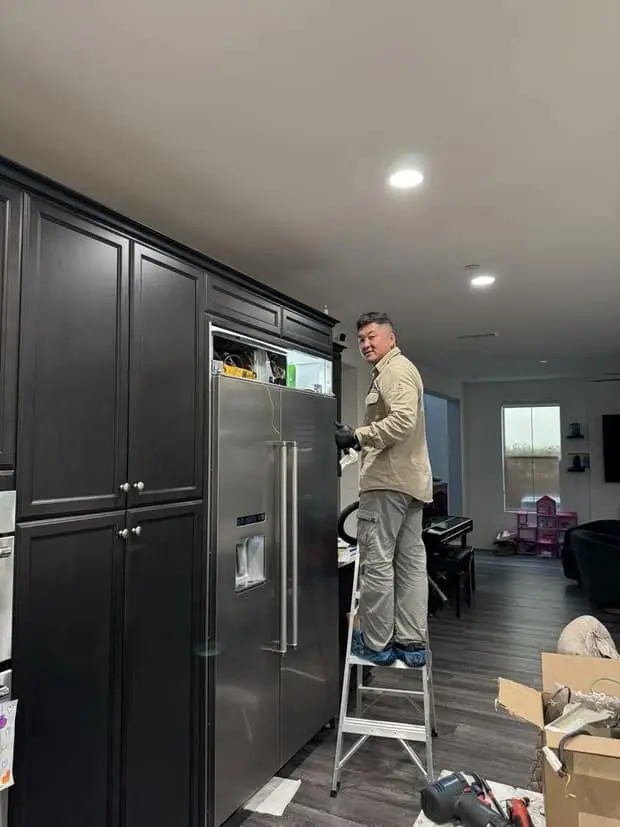
Liebherr builds a narrow, deep, very precise refrigerator, and that shows up in how it fails. It does not usually die all at once. It drifts. The temperature creeps up two degrees, then four, the compressor stops cycling off, and six weeks later somebody notices the lettuce is going over faster than it should. We service these across Los Angeles, and this guide is the order we work through a Liebherr call, what each symptom actually points at, which checks are safe at home, and which ones are not. Alpha & Omega holds factory authorization for Liebherr, so we diagnose from the brand's own documentation rather than guessing at codes.
First, which Liebherr is in the kitchen?
This matters more than people expect, because the four families fail differently and get accessed differently.
Monolith columns. The built-in line. A separate refrigerator column, freezer column or wine column, each one panel ready and set into cabinetry that was built around it. Great layout, and the catch is that every bit of service air moves through one grille. If a remodel put a decorative trim piece across that grille, the unit has been suffocating quietly since the remodel.
Fully integrated units. The 24 inch and 30 inch models that disappear behind a cabinet door. The appliance hinge carries the weight of a custom panel, and that weight is the single most common reason an integrated Liebherr stops sealing at the top corner after a few years.
Freestanding combination units. Counter depth, fridge over freezer in most cases, usually with BioFresh drawers. These breathe at the back and the toe kick, so clearance behind the unit is the thing to watch.
Under-counter and wine cabinets. Beverage centers, under-counter refrigerators, and the multi-zone wine units. They sit inside millwork with very little slack, often in an island or a bar, and heat management is the whole game.
Before you call, find the rating plate. On most Liebherr models it is inside the fresh food compartment along a side wall or behind the lowest drawer. Model and serial decide which parts come out on the truck, and on this brand a one digit difference changes the sensor.
What fails on a Liebherr, roughly in order
Owners usually brace for the compressor. In eleven cases out of twelve it is something earlier and cheaper, and the compressor only comes up after everything upstream is ruled out.
The air path. A grille loaded with dust, a toe kick vacuumed around for ten years but never through, a cabinet opening that is a half inch tight, or storage shoved against the back of a freestanding unit. All of it looks like a cooling failure and none of it is.
Door seal and door alignment. The gasket hardens and stops making a continuous line of contact, almost always at a top corner first. On panel ready doors the panel's weight does it faster. A seal that leaks a little does not make the fridge warm right away. It makes the compressor run longer, which is what eventually makes it warm.
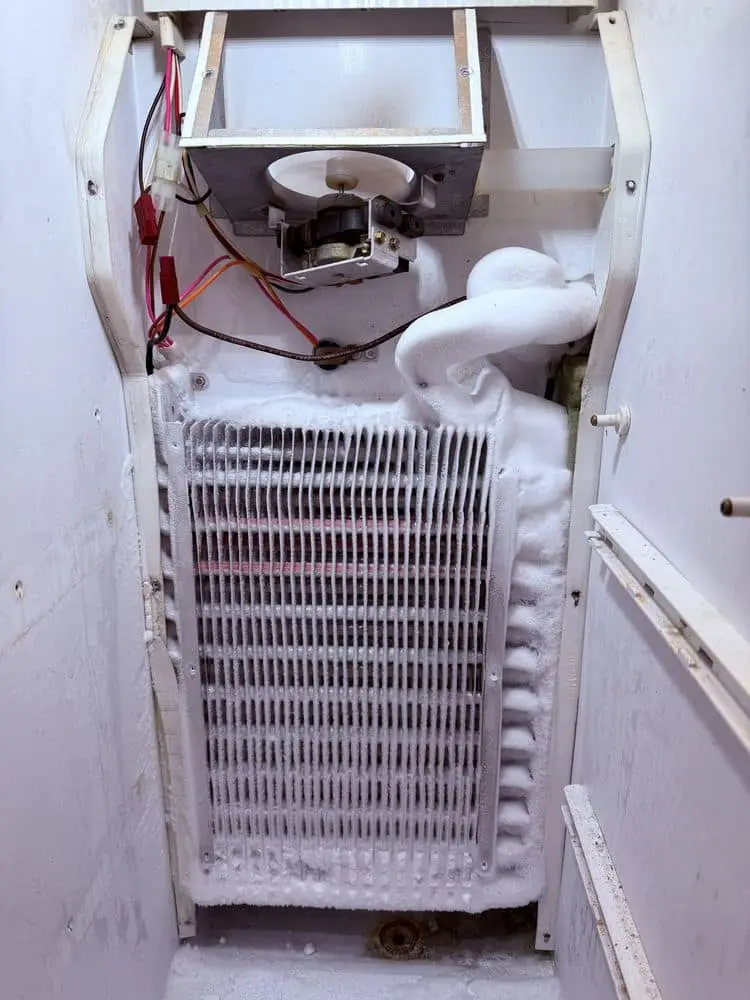
Defrost. On a NoFrost model the freezer defrosts itself on a schedule. When the heater, the defrost sensor or the control fails, ice builds on the evaporator until air cannot get through it. The classic giveaway is a freezer that still feels cold while the fridge section goes warm, because the air that cools the fridge has to cross that iced coil on single circuit models.
Fans. The condenser fan in the machine compartment and the evaporator fan behind the freezer back panel. Both announce themselves first by getting loud, then by getting slow.
Sensors. Liebherr runs tight temperature control off resistance probes. A probe that has drifted makes a completely healthy cooling system hold the wrong number with total confidence. Nothing sounds broken. The food just goes off early.
Control electronics. Less common than the internet suggests, and far more common after a power event than from age. We want to see sensor readings and wiring before anyone orders a board.
The sealed system. A leak, a restriction, or a tired compressor. Real, and worth taking seriously on a cabinet built for a long life, but last on the list for a reason.
Why the condenser takes a beating in this city
Three local conditions shorten condenser life around Los Angeles, and which one you get depends on which side of the hills you live on.
Salt air. From Santa Monica and Venice through Marina del Rey, Playa del Rey and El Segundo, down past Manhattan Beach, Hermosa Beach, Redondo Beach and Torrance to the Palos Verdes bluffs, marine air works on aluminum fins. They go chalky white. The coil does not look dirty the way a dusty coil looks dirty, it looks dull, and that oxide layer holds dust and insulates the metal. Each year it sheds a little less heat. Within a mile of the sand I would look at it yearly. Four miles inland it barely matters.
Heat. On the valley side in Encino, Tarzana, Van Nuys, Sherman Oaks, Studio City, North Hollywood, Burbank, Glendale, Pasadena, South Pasadena and La Canada Flintridge, an August kitchen runs far hotter than the design assumption. A refrigerator rejects its heat into the room it stands in. Hot room, longer run times, higher pressures, all summer. If there's a second refrigerator or a freezer in the garage, that one is doing the hardest work in the house by a wide margin, and freezer not cooling covers that case directly.
Construction dust. In the older housing stock around Mid-Wilshire, Hollywood, West Hollywood and Beverly Hills, the kitchen is almost always newer than the house. A remodel puts fine drywall and tile dust in the air for months, and it settles on the one surface in the room that is actively pulling air through itself. Add a dog and the coil loads up in a season.
One honest note about the service reminder some models show. It is a timer counting days, not a measurement of the coil. It is not evidence the coil is dirty. It is still a reasonable prompt to go and look.
Read your symptom off this table
| What you are seeing | Where we would look first |
|---|---|
| Fridge section warm, freezer still near 0°F | On a DuoCooling model, that section's own fan, defrost or sensor. On single circuit models, an iced evaporator blocking shared airflow. |
| Both sections drifting warmer over weeks, compressor never stops | Blocked or oxidized condenser, condenser fan, tight cabinet opening, grille covered by trim |
| Thick frost on the back wall of a NoFrost freezer | Defrost heater, defrost sensor or control. Never normal on NoFrost. |
| Water standing under the BioFresh drawers or on the floor | Blocked or frozen defrost drain backing meltwater into the compartment |
| Produce freezing inside a BioFresh drawer | Items against the coldest wall first, then a sensor or control holding the drawer too cold |
| Ice maker making hollow, small or no cubes | Filter past due, frozen fill tube, inlet valve, or a freezer running warmer than it reads |
| Door alarm with the door clearly shut | Something stopping the door a half inch short, a hardened gasket, or a shifted custom panel |
| Display shows an F-type code | Photograph it and call. The codes are model specific and each points at a circuit. |
| Unit went dark or acts dead after a power blip | Showroom or demo mode first, then power supply, then the control |
| Rattle or grind that changes when a door opens | Evaporator fan hitting ice or a worn bearing |
| Breaker trips when the unit starts | Leave it off and call. That is an electrical fault, not a setting. |
The defrost test you can run yourself
If you suspect defrost, there is one diagnostic that costs nothing and tells us a great deal. Empty the freezer into coolers, unplug the unit or switch it off at the control, prop both doors open and leave it for 24 hours. Towels on the floor. Then start it up again.
If cooling comes back properly, you just proved the mechanical side is fine and the ice was the problem. That is good news and it is also the diagnosis, because a healthy defrost system would not have let that ice form. When the frost returns within one to three weeks, the defrost heater, sensor or control has failed and needs replacing. Treat the manual defrost as a test, not a repair.
What you should never do is attack the ice with a screwdriver or a knife. Liebherr evaporator tubing is thin aluminum. One nick turns a defrost repair into sealed system repair, which is a different job entirely. A hair dryer is not much better, since the heat goes straight into plastic liners that were not built for it.
Water, ice and the drain
Three water problems account for nearly all the wet Liebherr calls.
Water under the drawers. Light condensation in a high humidity BioFresh setting with unwrapped produce is normal. Standing water is not. Meltwater from the normal defrost cycle is supposed to run down a channel to a tray near the compressor, where engine heat evaporates it. When that drain ices over or clogs with debris, the water has nowhere to go but into the bottom of the compartment, and from there onto hardwood.
No ice, or bad ice. Hollow and undersized cubes point at water volume, so look at the filter date and the supply valve first. No ice at all, with the arm or switch in the on position, is usually a frozen fill tube or the inlet valve. Hard water is a factor on the valley side, and scale shortens valve life. Ice maker not working walks the whole sequence.
Water on the floor behind the unit. Check the supply line and the shutoff before anything else. On a built-in that line often runs through cabinetry with one tight bend that has been slowly fatiguing since install.
Error codes, alarms and modes
When a Liebherr finds an internal fault it puts a code on the display, usually an F followed by a number on current models. Those codes are specific. Each one narrows the fault to a circuit, which is the difference between arriving with the right part and arriving twice.
Do two things with a code. Photograph it, and do not keep cycling power hoping it clears. Repeated power cycling teaches you nothing and sometimes loses the stored fault.
Before you assume the worst, rule out the innocent explanations. A temperature alarm after a big grocery run, a door left ajar during unloading, or a power interruption. Many models will show the warmest temperature the compartment reached, which is also what you need for a food safety decision. Showroom or demo mode after a power event is worth checking too, because a unit in demo mode lights up, responds to buttons and cools nothing at all. The full rundown of alarms, modes and normal versus abnormal noises is in our Liebherr owner's guide, and if the unit is simply warm, Liebherr not cooling is the step by step version of that call.
What the building does to the repair
A good share of the Liebherr kitchens we see here are in towers and hillside properties, not in simple single family houses, and the logistics show up before anyone touches a screwdriver.
Sort three things at booking. Whether the building wants a certificate of insurance on file before a technician goes up, whether the service elevator needs reserving a day ahead, and what hours the HOA allows work. Tell us and we schedule inside that window. The alternative is a technician standing in a lobby with the right part and no way upstairs. Street parking in Hollywood, West Hollywood and Beverly Hills is worth a sentence too.
The other one is access to the appliance. In a lot of these kitchens the millwork was built around the unit, and the only service access is the grille. That is normal and it is how the appliance was designed to be serviced. It does mean nobody should be dragging a column out of its opening to get behind it, including us, unless the repair genuinely requires it.
What you can safely check yourself
- Measure instead of trusting the display. A glass of water with a thermometer in it on a middle shelf, another thermometer in the freezer, read both after four hours. Around 37°F in the fresh food section and 0°F in the freezer. On plenty of calls the failed part turns out to be the sensor feeding that display.
- Find the grille and clear it. Vacuum with a brush attachment, from the front, with the unit off. Do not push anything metal between the fins and do not spray liquid into the machine compartment.
- Walk the door seal with a dollar bill. Close the bill in the gasket and pull. It should drag. Do all four sides of each door. Loose at one corner on a heavy custom panel is hinge and alignment work, not a dead gasket.
- Look inside for blocked vents. A compartment packed tight against the air outlets cannot circulate, and the sensors then read air that is not moving.
- Check the modes. Demo or showroom mode off, SuperCool and SuperFrost not left running, setpoints where you think they are.
- Listen for the two fans. One at the machine compartment, one behind the freezer back panel when a door is held closed with the switch pressed.
- Note the filter date on the water filter and the charcoal air filter if your model has one. Both have intervals in the manual and almost nobody tracks them.
- Write down what the display says before you call, including any code. It is the single most useful thing a homeowner can hand a technician.
What we would rather you left alone
- Anything inside the sealed system. Refrigerant work takes EPA 608 certification, recovery equipment and a vacuum pump. Low refrigerant always means a leak, so topping a system up just buys a second failure later.
- Chipping or melting ice off an evaporator. Thin aluminum, high stakes. Use the 24 hour test above instead.
- Pulling an integrated or column unit out of its opening. It is anchored to cabinetry, often plumbed, and heavy enough to take the flooring and a cabinet side with it.
- Live circuit testing of defrost heaters, thermistors and boards. These readings only mean anything with the unit powered, which is exactly why they are not a home job.
- Hinge and panel work on a heavy custom door. The adjustment is small and the damage from getting it wrong is cabinetry, not appliance.
- Ordering a control board off a forum post. We see this a few times a year. The board usually was not the fault, and the original problem is still there with a parts bill attached.
Wine cabinets and under-counter units
Liebherr's wine units turn up constantly in this market, in bars, islands and butler's pantries. They are refrigeration like anything else, with two differences worth knowing.
First, they live in tight millwork, so ventilation problems arrive sooner and hit harder than on a kitchen refrigerator. A wine cabinet that cannot exhaust ends up holding its zones a few degrees warm and running constantly, and the owner's first clue is the noise rather than the temperature.
Second, multi-zone units hold independent setpoints, so one zone drifting while another is perfect is a real and useful clue, the same way it is on a DuoCooling refrigerator. It points at that zone's fan, damper or sensor. Most of these also carry a charcoal filter for air quality in the cabinet, which has a replacement interval in the manual that virtually nobody follows. Wine cooler not cooling has the full sequence, and our wine cooler and under-counter refrigeration page covers what the service visit includes.
Maintenance that is actually worth booking
I am lukewarm about maintenance plans on ordinary appliances. On a Liebherr the math is different, because the repairs are not small and most of what goes wrong starts as something cheap nobody looked at.
A proper visit covers the condenser cleaned with the compartment open rather than vacuumed through a grille, both fans checked for drag and current draw, the cabinet opening confirmed for clearance, every door seal walked end to end with the doors adjusted where a panel has let them settle, measured compartment temperatures compared against setpoints and against what the display claims, the defrost drain cleared, the water line and filter checked, and the ice maker watched through a fill and a harvest.
Once a year near the coast. Inland, every two years is fine. I would not do it twice a year, and anyone selling you that is selling you a visit. The homeowner version of the list is the refrigerator maintenance checklist.
Repair or replace a Liebherr?
This one leans toward repair further than it does for most brands, and for structural reasons rather than brand loyalty. The cabinet, the doors and the cooling hardware are built to outlast the electronics inside them. Genuine parts are available for current and recent series. And on a built-in or integrated unit, replacement is a cabinetry project as much as an appliance purchase, because the opening, the panel and sometimes the countertop were all built to that specific unit.
The cases where we say otherwise are narrow. A compressor failure on a unit that has already had sealed system work. A cabinet with failed foam insulation, which shows as panels that sweat and condensation forming inside the walls of the box. Flood or fire damage behind the controls. Outside of those, repair is usually the better spend. Repair or replace lays out the general decision, how long a refrigerator should last covers expected service life, and if you are comparing built-ins rather than fixing one, Sub-Zero vs Liebherr goes through how the two are put together.
When to stop checking and call
- Frost that returns within one to three weeks of a manual defrost.
- An error code on the display, or an alarm that comes back with no groceries, no open door and no power event to explain it.
- A breaker that trips when the unit starts, or any burning or hot electrical smell.
- Water standing in the compartment or appearing on the floor.
- Clicking from the machine compartment every few minutes that ends in silence rather than a running compressor.
- A compressor that runs constantly and warms up while nothing inside gets cold. That is usually a leak or a restriction.
- Food safety runs on a clock. USDA guidance is roughly 4 hours in a refrigerator without cooling, about 48 hours in a full freezer and about 24 in a half full one, with the doors kept shut.
Where we work in Los Angeles and how to reach us
We cover Los Angeles proper including Mid-Wilshire and Hollywood, Beverly Hills, West Hollywood, Glendale, Burbank, Pasadena, South Pasadena and La Canada Flintridge, the valley side through North Hollywood, Studio City, Sherman Oaks, Encino, Tarzana and Van Nuys, and the Westside and South Bay from Santa Monica, Venice and Marina del Rey through Playa del Rey and El Segundo to Manhattan Beach, Hermosa Beach, Redondo Beach, Torrance and the Palos Verdes peninsula.
Have the model and serial number ready when you call, along with the symptom in one sentence and any code on the display. On this brand that is usually what decides whether the right part rides out on the first visit. Every repair carries a 90 day parts and labor warranty, and the technician quotes the work on site before anything starts. We are 5.0 on Yelp if you want to see how these visits tend to go. Call (949) 267-7771.
Frequently Asked Questions
Are you actually authorized by Liebherr?
Yes. Liebherr is one of the brands we hold factory authorization for, along with LG. It matters on this brand in particular because the fault codes, sensor resistance values and service procedures are model specific, and genuine parts are not interchangeable with generic equivalents. Our full brand page is Liebherr appliance repair. For the record, we do not claim authorization on brands where we do not hold it, and you should ask any company that claims it on everything which manufacturer issued it.
My fridge section is warm but the freezer is still frozen solid. What is that?
It depends on whether your model uses DuoCooling. With two separate circuits there is no shared air between the compartments, so one warm section points at that section's own evaporator fan, its defrost, or its sensor. On a single circuit model the cold air for the fridge has to cross the freezer evaporator first, so the same symptom usually means that coil has iced up and air cannot get through. Either way the condenser and the door seal get checked first, because both can imitate it.
There is frost building in my NoFrost freezer. Is a bit of frost normal?
A light dusting that comes and goes around the door opening is nothing. A layer on the back wall, or packages frosting over, means the automatic defrost is not running properly. That is a heater, sensor or control fault, and it gets more expensive the longer it runs, because the ice eventually blocks airflow entirely and the compressor runs around the clock trying to make up for it.
How often does the condenser really need cleaning in Los Angeles?
Once a year within a mile or so of the water, where marine air oxidizes the fins into a chalky layer that insulates the coil. Inland, every two years is plenty unless there's a dog, a recent remodel, or a unit in a hot garage. Twice a year is wasted effort on any of them. The reminder some models display is a day counter, not a measurement of the coil, so treat it as a prompt to look rather than proof it is dirty.
The display shows an F code. Can I clear it myself?
Photograph it first, then stop. The codes are model specific and each one narrows the fault to a particular sensor or circuit, which is exactly the information that gets the right part onto the truck. Repeatedly cutting power to clear a code can also lose the stored fault, so the technician arrives with less to work with than you had. Keep the doors shut and call with the code and the model number.
What should I have ready for a service visit in a Los Angeles condo or tower?
Model and serial number, the symptom in one sentence, any code on the display, and the building's rules. Plenty of towers on the Westside and around Mid-Wilshire want a certificate of insurance on file before a technician is allowed up, and the service elevator often needs reserving the day before. Give us the building manager's contact and the hours your HOA permits work, and we book inside that window.
Related Pages
- Liebherr Refrigerator Not Cooling: Causes and Fixes
- Liebherr Refrigerator Owner's Guide: Alarms, BioFresh and Common Problems
- Sub-Zero vs Liebherr: How They Are Built
- Factory Authorized Liebherr Repair
- KitchenAid and JennAir Built-In Repair in Los Angeles and the South Bay
- Sub-Zero and Wolf Repair in Los Angeles: What Fails First
- Thermador Freedom Column Refrigerator Problems in Los Angeles
- Viking Refrigerator and Range Problems in Los Angeles Kitchens
- Refrigerator Repair
- Sealed System & Compressor Repair
- Wine Cooler & Under-Counter Refrigeration
- Refrigerator Not Cooling: 10 Common Causes
- Freezer Not Cooling or Not Freezing
- Ice Maker Not Working
- Refrigerator Maintenance Checklist
- Repair or Replace?
- Los Angeles · Beverly Hills · West Hollywood · Santa Monica · Marina del Rey · Manhattan Beach · Hermosa Beach · Redondo Beach · Torrance · Palos Verdes · Sherman Oaks · Encino · Van Nuys · North Hollywood · Glendale · Burbank · Mid-Wilshire