
Why Is My Refrigerator Not Cooling? 10 Most Common Causes and What You Can Check
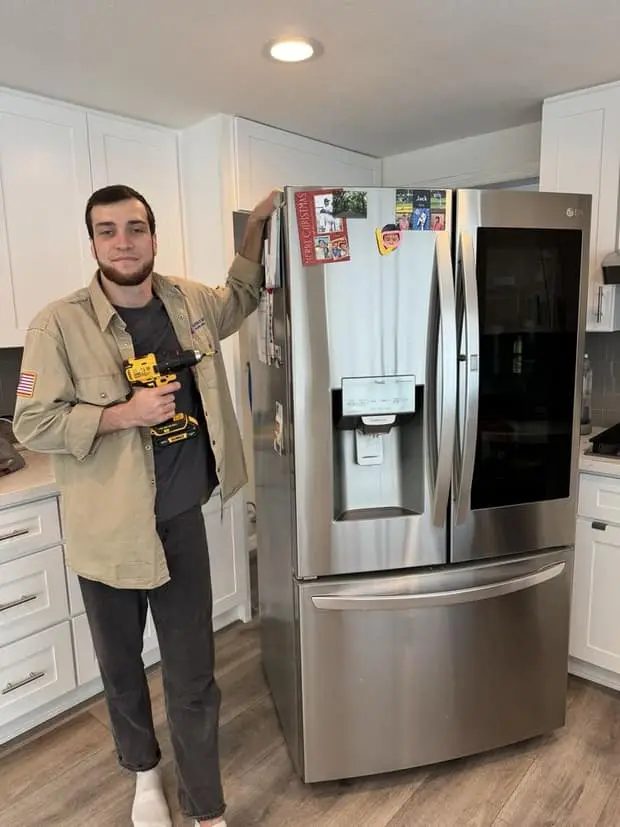
A refrigerator that is running but not getting cold is the most common call we take across Irvine, Tustin, Lake Forest and the rest of South Orange County, and it is also the one where a few minutes of checking at home most often saves a service visit. This guide walks through the ten causes we find most, in roughly the order a technician would rule them out, and explains how the symptoms tell you which cause you are looking at. Along the way we mark what is safe to check yourself and where the job becomes ours.
First, read the symptoms: what warm-where tells you
Before touching anything, note three things: which compartment is warm, whether the compressor (the black dome at the back bottom) is running and how hot it is, and what you hear. Those three observations narrow ten causes to two or three.
| What you observe | Most likely causes |
|---|---|
| Freezer cold, fridge section warm | Evaporator fan (6), frosted evaporator / defrost failure (7), damper or blocked vents (2), thermistor (8) |
| Both compartments warm, compressor hot and running constantly | Dirty condenser coils (4), condenser fan (5), door gasket or door ajar (3), overloaded box (2) |
| Both warm, compressor clicks every few minutes and stays cool or warm | Start relay / overload / compressor (9), low voltage |
| Both warm, compressor runs quietly and gets warm but nothing gets cold | Sealed-system leak or restriction (10) |
| Fridge slightly warm, cycles seem short or odd, display wrong | Settings (1), thermistor or control board (8) |
| Frost on the freezer back panel, airflow weak | Defrost system failure (7) |
| Fridge freezing food in the back or drawers | Damper stuck open, thermistor (8), gasket letting humid air in (3) |
1. Temperature settings, and a display you should not trust
It sounds too simple, but it is real: a grocery bag or a curious child nudges a dial or a touchpad, or a power blip resets a control to a default. The fresh-food compartment should be at about 37°F (3°C) and the freezer at 0°F (−18°C). Set them, then verify with an inexpensive fridge thermometer left inside for a few hours. Many refrigerators display the setpoint, not the actual temperature, and on some models the sensor that feeds the display is the very part that has failed. If the thermometer agrees with the display, move on. If the display says 37°F and the thermometer says 50°F, jump to cause 8.
Safe to check yourself: yes. Also look for a "vacation", "demo" or "showroom" mode, which keeps the lights on and the cooling off; the manual for your model shows how to exit it.
2. Blocked airflow inside the refrigerator
Most household refrigerators make cold in one place, the evaporator behind the freezer's back panel, and move it around with a fan through vents and a damper. Anything that blocks that path makes one compartment warm while the other is fine. The usual offenders are a pizza box or sheet pan pressed against the vent on the back wall of the freezer, an overpacked fresh-food section, or a bag of frozen vegetables jammed into the vent between compartments. An under-filled refrigerator also struggles, because there is no thermal mass to hold temperature between cycles.
What to check: pull food away from the vents in both compartments, leave a hand's width of space at the back wall, and give the fridge a few hours. On many models a damper between freezer and fridge can also stick shut; if you hear the fan run and the freezer is cold but no cold air comes through the fresh-food vent at all, the damper motor is a likely suspect and is a technician job.
3. Door gasket leaking, or a door that is not fully closing
A door gasket that no longer seals lets warm, humid room air pour in around the clock. The compressor runs almost continuously, frost builds on the evaporator faster than the defrost cycle can clear it, and the fridge side slowly loses the battle. Humid inland evenings in Lake Forest and Mission Viejo make this worse than most people expect.
What to check: close the door on a dollar bill at several points around the frame. If it slides out with no resistance anywhere, that section is not sealing. Wipe the gasket with warm soapy water first, because sticky residue is the most common reason a gasket fails to seat. Look for cracks, tears or a corner that has pulled out of its channel. Also check that the refrigerator is level or tilted slightly back so the doors swing closed on their own, and that a crisper drawer or shelf is not holding the door open a quarter inch. A torn or hardened gasket is a straightforward replacement.
4. Dirty condenser coils, the number one cause we find
Everything the refrigerator pulls out of the box has to be released somewhere, and that place is the condenser coil, usually under the unit behind the base grille, sometimes on the back. When the coil is wrapped in dust, pet hair and kitchen grease, it cannot shed heat. Pressure on the high side climbs, the compressor runs hot and long, and cooling falls off. On a hot day, or in a tight built-in cabinet with poor ventilation, it can stop cooling altogether. Homes with dogs or cats reach this point in a year or two.
What to check: unplug the refrigerator, remove the base grille, and look. If you see a felt-like mat over the coils, vacuum it with a crevice tool and a long coil brush, from both the front and, if possible, the back. Vacuum the condenser fan blades while you are there. Plug it back in and give it several hours. We put this on our maintenance checklist because it prevents a large share of the no-cool calls we see, and it is the first thing a technician does on arrival anyway.
5. Condenser fan motor
Next to the compressor sits a small fan that pulls air across the condenser coil and over the compressor. If it stops, the coil cannot dump heat even when it is clean. The classic pattern is a compressor that is too hot to touch, cooling that fades over an afternoon, and eventually the compressor's overload protector shutting it down until it cools, so the fridge cycles between "sort of working" and "not at all".
What to check: with the fridge running, listen and look at the back bottom. The condenser fan should be spinning whenever the compressor runs. If it is stalled, a stuck blade or debris is occasionally the culprit; more often the motor has failed. Do not run the refrigerator for long with a dead condenser fan, because you are cooking the compressor. Fan motor replacement is a routine repair.
6. Evaporator fan motor
The evaporator fan lives behind the freezer's back panel and is the fan you hear when you open the door and press the door switch. It moves cold air from the evaporator through both compartments. When it fails, the freezer often stays cold near the coil while everything else warms up, and the fresh-food section is usually the first to complain. Bearings tend to announce themselves first with a chirp, a squeal or a rhythmic scraping that changes when the door opens; a fan iced into its housing is silent.
What to check: open the freezer and press and hold the door switch (or use the model's fan test). You should hear the fan spin up within a few seconds. Silence, a hum without spinning, or scraping means the fan or its motor needs attention. If there is frost on the back panel as well, cause 7 is probably what killed it. Fan motor replacement is a routine repair; on many models the harness and the evaporator cover come off in minutes.
7. Ice buildup: the defrost system has failed
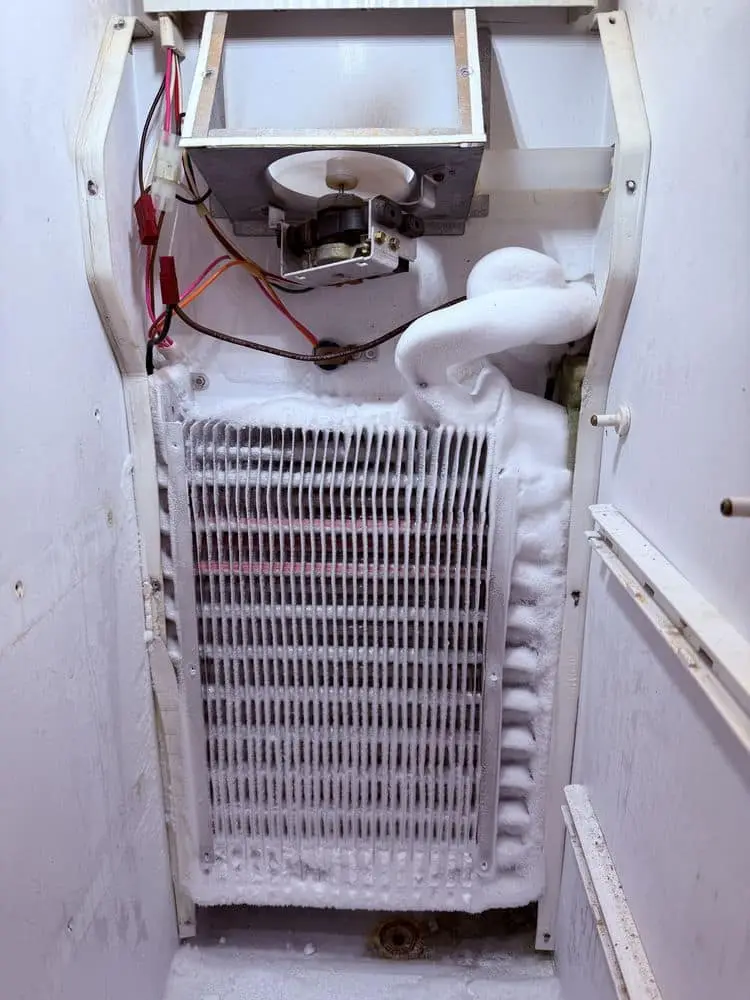
Frost-free refrigerators are not frost-free by magic. Several times a day a defrost heater under the evaporator melts the frost that normal operation deposits on the coil, and a defrost thermostat or bi-metal switch ends the cycle. When the heater, the thermostat, the timer, or the control board that runs the cycle fails, frost builds until the coil is a solid block of ice. Air can no longer pass through it, and the result is a freezer that looks cold and frosty while the fridge side goes warm.
What to check: look at the freezer's back panel. Heavy frost across it, or ice that looks like it was poured, is the signature. A useful test is a manual defrost: unplug the unit, open the doors, put towels down, and let it thaw for 24 hours. If cooling returns and then fades again over one to three weeks, the defrost system is confirmed and needs a proper repair. A manual defrost is a diagnosis, not a fix. Defrost heaters and thermostats are moderate repairs; on newer refrigerators the defrost logic lives in the main control board, which is a technician's diagnosis.
8. Thermistors, sensors and the control board
Modern refrigerators do not use a mechanical cold-control knob. Two or more thermistors report compartment temperatures to a control board, which decides when to run the compressor, the fans, the damper and the defrost cycle. When a thermistor drifts out of range, the board believes the box is cold when it is not, or the reverse, and you get a refrigerator that is warm on a thermometer while the display insists everything is fine, or one that freezes lettuce in the crisper. Boards can also lose a relay for the compressor or the fans, or drop a fan speed, which looks exactly like a mechanical fan failure.
What to check: only the comparison between the display and a real thermometer. Anything past that requires measuring thermistor resistance against the manufacturer's chart and reading the board's diagnostic mode, which we do on every no-cool visit. On brands we are factory authorized for, LG and Liebherr among them, we also have the service documentation and test modes for the specific model, which turns a guess into a measurement.
9. Compressor, start relay and overload
If the compressor never starts, nothing else matters. But a compressor that will not start is not always a bad compressor. The start relay and overload protector clipped to its side fail far more often than the compressor itself, and the symptom is the same: a click, a hum for a few seconds, another click as the overload trips, and silence, repeating every few minutes. A compressor that starts, runs and gets warm but produces no cold is a different story and belongs under cause 10.
What to check: listen. Click-hum-click every two to five minutes is the pattern to report to the technician. Do not keep the refrigerator running for days in this state. Relay and overload replacement is a modest repair. A genuinely failed compressor, especially on a basic top-freezer model over about 12 years old, is where the repair-or-replace decision is real; on a built-in, a counter-depth French-door or a premium unit it is usually still worth doing. Some LG models with linear compressors have had extended manufacturer warranty coverage on the compressor itself; we check that before quoting.
10. Sealed-system problems: leaks and restrictions
The sealed system is the refrigerant loop: compressor, condenser, capillary tube or expansion device, evaporator. Refrigerant is not consumed, so "low refrigerant" always means a leak. The tell-tale is a compressor that runs quietly, gets warm, and is joined by a partially frosted evaporator, often just the first few inches of coil while the rest stays bare, or by a condenser that is barely warm. A restriction in the capillary tube or a clogged filter-drier produces a similar picture, sometimes with frost at a single point on a tube.
What to check: nothing beyond noting the pattern. Sealed-system work requires EPA certification, recovery equipment, brazing and a vacuum pump, and it is the most involved repair a refrigerator can need. We do sealed-system repair and we are honest about when it is worth it: on a five-year-old built-in, yes; on an old basic model, often not. Either way the diagnosis comes first, because a warm compressor and a warm box is also what a failed condenser fan or a dirty condenser looks like from across the kitchen.
What you can safely check yourself, in order
- Settings, special modes, and a real thermometer in each compartment.
- Vents clear, nothing pressed against the back wall, reasonable load.
- Dollar-bill test around the gasket; wipe it; confirm the doors swing closed.
- Unplug, remove the base grille, vacuum the condenser coils and fan.
- Listen: condenser fan spinning when the compressor runs; evaporator fan running when you hold the door switch.
- Look for frost on the freezer's back panel; if present, a 24-hour manual defrost as a test.
Leave to a technician: anything involving the compressor and its electrical components, thermistor and board diagnostics, damper motors, defrost circuit testing, and everything in the sealed system. A refrigerator has 120-volt wiring in a damp environment and a pressurized refrigerant loop; the checks above are the safe boundary.
When to stop and call
- Clicking every few minutes that ends with the compressor shutting off.
- A compressor too hot to touch with no cooling.
- Any burning or electrical smell, or a breaker that trips when the refrigerator starts.
- Frost that returns within days of a manual defrost.
- Ice on a refrigerant line or an oily residue near the compressor.
- A built-in, Sub-Zero, Liebherr, Thermador or other premium unit: the parts are specific, and improvising costs more than diagnosing.
How long is the food safe?
Per USDA guidance, with the doors kept closed a refrigerator holds a safe temperature for about 4 hours; a full freezer holds for about 48 hours, a half-full one for about 24. Keep the doors shut, move the most perishable items to an ice chest if the repair will not happen the same day, and when in doubt, throw it out. If it is the freezer that is warm and the fridge is fine, the causes are different; see our freezer not cooling guide.
Preventing the next no-cool call
- Vacuum the condenser coils every 6 to 12 months, more often with pets or in a tight built-in cabinet.
- Keep an inch or two of clearance behind and above a freestanding refrigerator so the condenser can breathe.
- Wipe gaskets twice a year and replace one that has hardened or torn instead of living with a fridge that runs all day.
- Do not block the vents, and do not store hot leftovers uncovered; the extra humidity ends up as frost on the evaporator.
- Keep a thermometer in the fridge. Catching 42°F early is a fan or a coil; catching 55°F a week later is spoiled food and possibly a cooked compressor.
- After a power outage, check that the controls did not reset to a default or a demo mode.
The full schedule, monthly, twice-yearly and annual, including the defrost drain, the water filter and the top-grille ventilation on built-ins, is in our refrigerator maintenance checklist.
What we do when we arrive
Our technician measures actual compartment temperatures, reads the frost pattern on the evaporator (it reveals a great deal about what failed), tests both fans, the damper, the defrost circuit and the thermistors, checks the compressor's start components and, if the picture points there, the sealed system. You get a clear explanation and a quote before any work begins, and most refrigerator repairs are completed the same day from parts stocked on the truck. We are factory authorized for LG and factory authorized for Liebherr; for Samsung we are certified technicians; and we provide professional service for Sub-Zero, Thermador, Bosch, GE, Whirlpool, Frigidaire and most other brands found in South Orange County kitchens. See our refrigerator repair service page, or the local pages for Irvine, Lake Forest, Mission Viejo, Laguna Niguel and San Clemente.
Frequently Asked Questions
Why is my refrigerator running but not cooling?
When the compressor hums but the box stays warm, the usual causes are, in rough order of how often we find them: dust-packed condenser coils, a failed evaporator or condenser fan, frost buildup from a failed defrost system, blocked vents inside the compartments, a leaking door gasket, a bad thermistor or control board, and finally the compressor or a sealed-system fault. The first five you can check yourself; the last three need a technician.
Freezer works but the refrigerator side is warm: what does that mean?
In most refrigerators the cold is made in the freezer and blown into the fresh-food side. If the freezer is fine but the fridge is warm, suspect the evaporator fan, a frosted-over evaporator (defrost failure), a blocked or stuck damper between the compartments, or a thermistor that is reporting the wrong temperature. Check the freezer's back panel for frost and listen for the fan when the door switch is pressed.
How long can I wait before food spoils?
Keep the doors closed. According to USDA guidance, a refrigerator holds a safe temperature for about 4 hours without cooling; a full freezer holds for about 48 hours, a half-full one for about 24. Move meat, dairy and leftovers to an ice chest if the repair cannot happen the same day.
Can dirty condenser coils really stop a refrigerator from cooling?
Yes. The condenser is where the refrigerant sheds the heat it pulled out of the box. A thick blanket of dust and pet hair insulates the coil, head pressure climbs, the compressor runs hot and long, and cooling falls off, on hot days it can stop cooling entirely. Cleaning the coils is the single most useful piece of maintenance a homeowner can do.
Should I unplug the fridge for 24 hours to fix it?
A manual defrost is a useful test, not a fix. If cooling comes back after 24 hours unplugged with the doors open and then fades again within one to three weeks, the automatic defrost system (heater, defrost thermostat or bi-metal, or the control) has failed and needs to be repaired properly.
Is a refrigerator that stopped cooling worth repairing?
Usually yes for units under about 10 years old and for built-in, counter-depth and premium models. Fans, gaskets, thermistors, start relays and defrost parts are moderate repairs. A sealed-system leak or a compressor on an older basic model is where the repair-or-replace conversation gets real; a technician can tell you which one you have before any work begins.
Related Pages
- Refrigerator Repair in Orange County
- Refrigerator Repair in Irvine
- Sealed-System & Compressor Repair
- Factory Authorized LG Repair
- Factory Authorized Liebherr Repair
- KitchenAid Refrigerator Not Cooling: What Usually Fails
- Refrigerator Leaking Water
- Freezer Not Cooling or Freezing
- Frost Building Up in Your Freezer?
- Refrigerator Compressor Problems: Start Relay vs Compressor
- Refrigerator Making Strange Noises? What Each Sound Means
- Refrigerator Freezing Food in the Fresh-Food Section?
- Ice Maker Not Working
- What Drives the Cost of a Refrigerator Repair
- Refrigerator Maintenance Checklist
- Fridge Food After a Power Outage
- Samsung Refrigerator Problems We Fix Most
- How Long Should a Refrigerator Last?
- Maintenance That Prevents Most Repairs
- Irvine · Tustin · Lake Forest · Laguna Hills · Aliso Viejo · Rancho Santa Margarita · San Juan Capistrano · Dana Point