
AC Repair in Irvine, CA
- ✅ Insured · EPA 608 Universal Certified Technicians
- ⭐ 5.0★ Yelp · 5.0★ Google
- 🛡️ 90-Day Parts & Labor Warranty
- 📅 20+ Years of Experience
- 📍 Based in Irvine
Quick answer
We repair air conditioners in Irvine houses, townhomes and condos, the system that runs but blows warm air, the upstairs unit that shut itself off, the coil that froze, the outdoor unit that hums and won't start. We work out of Irvine, so a same-day visit is often possible, and the AC service call is free. Our work is limited to minor service and repairs under $1,000: capacitors, contactors, thermostats, condensate drains and float switches, coil cleaning, fan motors and leak diagnosis. New systems and replacements go through our licensed air conditioning contractor. The technician quotes the repair on site before any work starts, and every repair carries a 90-day parts and labor warranty.
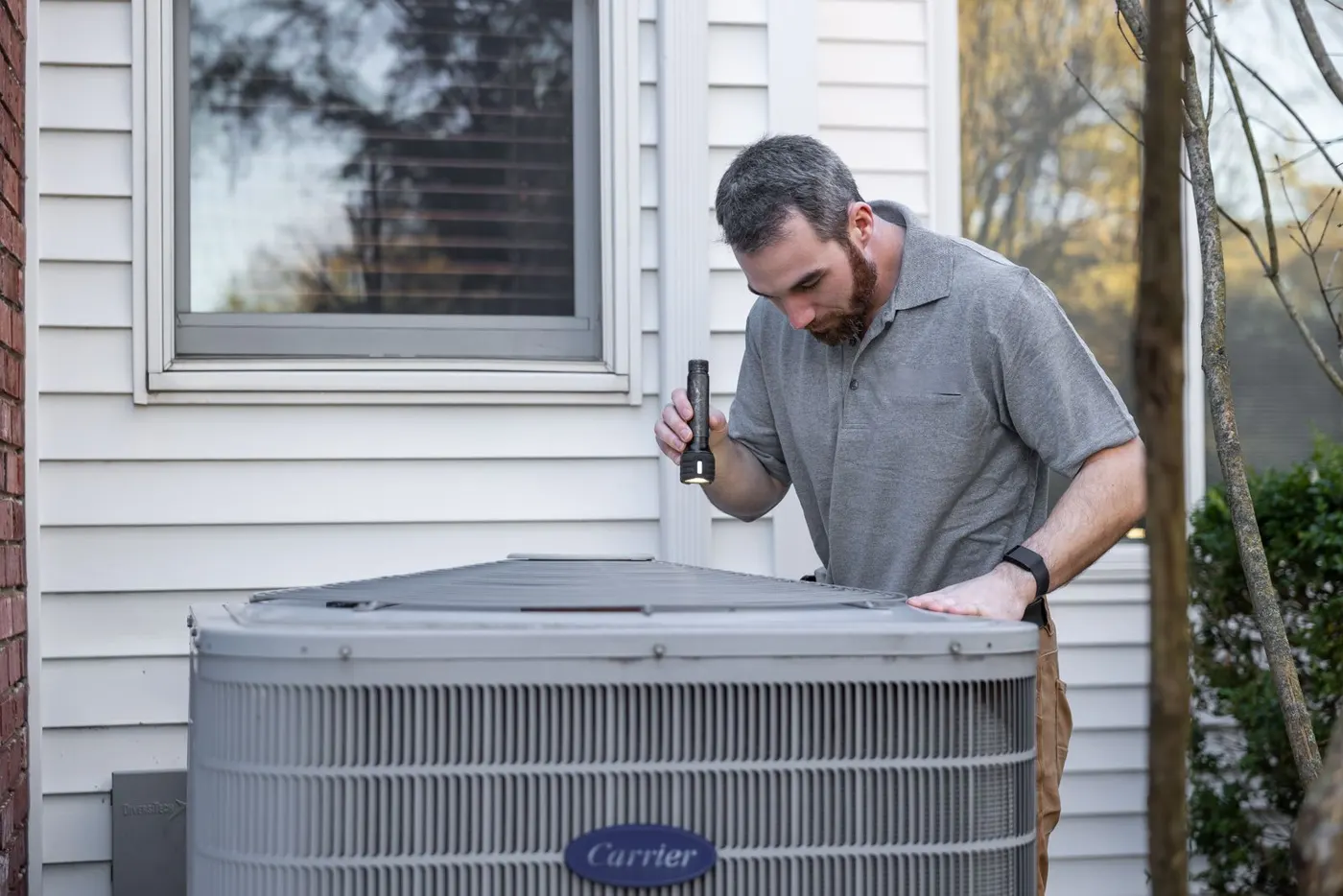
Irvine summers are mild most days, until a heat wave or a Santa Ana wind pushes inland temperatures up, and a system that has coasted all year suddenly has to run for hours. That is when weak capacitors, clogged drains and dirty coils show up. Alpha & Omega is a family-owned company that brings 20+ years of repair experience to Orange County and is based in Irvine, so AC calls from Woodbridge, Northwood, University Park, Turtle Rock, Westpark, Quail Hill, Portola Springs, Orchard Hills and the Great Park neighborhoods are local runs for us. Call (949) 267-7771 or text us what the system is doing, where the indoor unit is (attic, garage, closet) and whether it is a central system, a heat pump or a mini-split.
Where the AC Sits in Irvine Homes: and Why It Matters
The same symptom can have a different cause depending on how the home was built. More about the villages is on our Irvine service area page.
Two-story homes with an attic air handler
In many two-story Irvine homes, especially the newer villages, the furnace or air handler and the indoor cooling coil sit in the attic. That layout has a few consequences:
- Condensate has to drain a long way. The coil pulls water out of the air all day. It runs through a primary drain line, and under the unit there is usually a secondary pan. Algae and dust can clog the primary line; when water backs up into the pan, a float switch shuts the system off to protect the ceiling. The result looks like a dead AC: the thermostat calls for cooling and nothing happens, or the outdoor unit stops while the fan keeps running.
- A drip from a ceiling vent or a stain on the upstairs ceiling means water is getting past that protection. Turn the system off at the thermostat and call, see why an AC leaks water for what is going on.
- The attic is hot. On a summer afternoon the attic can be far hotter than the house, which is hard on the blower motor, its capacitor and the ducts. Early-morning appointments are easier on everyone, including the equipment.
- Upstairs rooms run warm. A crushed or disconnected attic duct, a closed damper or a clogged filter can leave the second floor warm while downstairs is fine. We check airflow before anything else, because it is often the whole story.
Condos, townhomes and apartments: Irvine Spectrum, Park Place and the villages
Irvine has a large share of attached housing: townhome rows in Woodbridge and Northwood, condo buildings around Irvine Spectrum, and high-density apartment communities such as Park Place near the Irvine Business Complex. The equipment there is different from a single-family house:
- Indoor units in closets. Many condos have a vertical air handler or furnace with a coil in a hall or utility closet. A clogged filter or a blocked return grille in a small space quickly leads to a frozen coil, see why an AC freezes up.
- Outdoor units far from the unit they serve. Condensers may sit on a shared pad, a side yard or a roof, lined up next to the neighbors'. Knowing which one is yours saves real time; if the unit is labeled, send us a photo.
- Mini-splits and heat pumps. Ductless wall units are common in additions, converted garages and some newer buildings, and many recently built homes use heat pumps for both heating and cooling.
- HOA rules. Access to roofs and common areas, work hours and parking are often set by the HOA. We plan the visit around those rules and leave an itemized invoice that the owner or HOA can file.
If you rent, including in Irvine Company communities, call the leasing office first. Most leases route AC repairs through property management, and a repair you arrange yourself may not be reimbursed. We work for homeowners, condo and townhome owners, landlords and property managers, and we coordinate access with the tenant when the owner books us.
Older homes in the first villages
In University Park, Turtle Rock, Culverdale and College Park, cooling is often a furnace in a hall closet or the garage with a coil on top and an outdoor unit in the side yard, and most systems have been replaced at least once. Typical calls are dirty coils, worn capacitors and contactors, and condensate lines that back up onto the floor.
Why the AC in a Newer Irvine Home Acts Nothing Like the Old One
Homes in Great Park, Portola Springs, Orchard Hills and the newest tracts around Solis Park are often all electric. There is no gas furnace. One heat pump outside handles cooling in August and heating in January, and the indoor box is an air handler with an electric backup element instead of a burner. What that means in winter, including why 95°F supply air is normal and Emergency Heat usually is not, is on the heating and furnace repair page. That changes both what fails and what a failure looks like from the hallway.
- Long, quiet cycles are normal. A variable-speed inverter compressor does not slam on at full output. It ramps to something like 40 percent and holds, so the system can run 40 minutes straight on a warm afternoon while the air at the vents feels cool rather than cold. That is the design. Short cycling, on and off every few minutes, is the pattern that actually means something, and our short cycling guide sorts out the causes.
- The thermostat may not be replaceable. Communicating systems send data between the thermostat and the outdoor control over a small bus instead of plain on-off wires. An off-the-shelf smart thermostat wired into those terminals leaves the system dead or stuck in one mode. We have been out to Irvine homes where the entire "broken AC" was a thermostat someone swapped last weekend. Check what the manufacturer allows for your model before you buy one.
- Fault codes hide on the boards. On many of these systems the useful code is a blinking LED on the outdoor control, or a number in the thermostat's installer menu. Count the blinks or photograph the screen before you cut power, because a reset wipes it.
- There may be no capacitor to replace. On a conventional condenser a weak run capacitor is a fast fix with the part on the truck. Inverter units drive the compressor from a board, so the equivalent failure is the drive board, and that usually lands past minor repair. We say so on the spot instead of selling you a diagnosis you cannot use.
- Vapor off the outdoor unit in winter is defrost, not a leak. A heat pump reverses itself for a few minutes to melt frost off its own coil. The fan stops, you see steam, it clunks back into heating. Nothing is wrong.
If one outdoor unit both heats and cools your house, tell us that when you call. It changes which parts we load before we leave the shop.
Two Thermostats, One System: Zoning, Dampers and the Bypass
A lot of two-story Irvine homes run a single piece of equipment across two zones. There is a thermostat upstairs, another one downstairs, a control panel near the air handler, and motorized dampers in the attic ducts that open and close to send air where it is called for. When a zone system misbehaves the symptom reads like a duct problem, and the cause is usually electrical.
- One zone never reaches its setting while the other is fine. Most often a damper motor that failed closed, or a dead zone output on the panel.
- The system shuts down early whenever only the small zone calls. With most of the ducts closed, static pressure climbs and the equipment protects itself. A bypass damper is supposed to relieve that pressure, and it drifts out of adjustment or was never set properly at install.
- Both floors run no matter which thermostat calls. A damper stuck open, or a panel configured wrong years ago and never revisited.
- Air whistling hard out of the registers that are open. Same pressure story as the early shutdown, one step earlier.
The easy checks are yours. Both thermostats need Cool mode and a setpoint below room temperature, and neither one should be sitting on a hold or an away schedule somebody set in June. A blank thermostat on one floor usually means that zone lost its 24-volt supply, often a small fuse on the zone panel. Past that it is attic work with the power off. Do not force a damper blade by hand, the linkage bends and then neither position works.
Homes without zoning have manual balancing dampers on the trunk lines instead, set once when the system went in and rarely touched since. Closing two or three downstairs registers part way can even out a warm second floor. Closing half the house does not help, it starves the blower and you lose cooling everywhere. Village-by-village notes are on our Irvine service area page.
Will a Better Filter Hurt the AC?
This question comes up on nearly every maintenance visit, most of all in the newest villages where construction dust is still settling out of the air. A higher MERV number catches finer particles and it also resists airflow more. In a 1-inch filter slot that trade goes bad quickly.
- MERV 8 to 11 is the safe range for a 1-inch filter. That is roughly what residential systems were sized around. A MERV 13 pleated filter in the same thin slot can cut airflow enough to ice the indoor coil, and a frozen coil blows warm air at the vents. See why an AC freezes up.
- Real MERV 13 filtration needs a deeper cabinet, 4 or 5 inches, with the duct connections to match. That is an equipment change rather than a repair, so it goes to our licensed air conditioning contractor.
- Check whether your house has two filters. Some Irvine homes have one behind a ceiling return grille and a second one at the air handler itself. Owners change the grille filter for years and never hear about the other, which by then is a solid mat of dust.
- The arrow on the frame points toward the blower, the direction the air travels. Installed backwards, the pleats collapse and the media tears.
- Timing. A 1-inch filter every 60 to 90 days, sooner with dogs, cats or an active construction site on the street. A 4-inch media filter runs 6 to 12 months.
A grey filter is doing its job. A filter you cannot see light through is costing you cooling.
Mini-Splits in Irvine Garages, Offices and ADUs
Converted garages, bonus rooms over the garage, home offices and detached ADUs around Irvine almost always get a ductless mini-split, because pulling a duct branch to one room from an attic system rarely works out. The units are reliable. They also fail in their own particular ways.
- Weak airflow with a sour smell. The blower inside the indoor head is a narrow drum with dozens of fins, and it slowly loads up with dust and cooking oil film. Cleaning it properly means opening the head and bagging it, not wiping the front with a rag. This is the mini-split service we do most.
- Water dripping down the wall under the head. Condensate leaves by gravity through a sleeve in the wall, so the whole drain depends on continuous downhill slope. A line crushed behind a shelf or kinked at the wall penetration backs water up into the room. Some installs use a small condensate pump instead, and pumps wear out.
- A blinking light instead of a display. Mini-splits report faults as a blink pattern on the indoor unit. Count the blinks and tell us the brand when you call.
- Cools for an hour, then goes warm. Low charge on a mini-split usually traces to a flare joint on the line set, the brass connections made by hand during install. That is a leak to find and seal, not refrigerant to add.
- It is simply in the wrong mode. The handheld remote has Dry and Fan settings that look like cooling and are not, and on a cool Irvine evening a heat setpoint below room temperature means nothing runs at all.
We service mini-splits inside the limits above: blower and coil cleaning, drains and pumps, sensors, control boards, fault codes and leak diagnosis. New line sets and new installations go through our partner.
AC Symptoms and What They Usually Mean
- Runs but blows warm air, a failed capacitor or contactor that lets the indoor fan run while the outdoor unit sits still, a dirty condenser coil, a frozen indoor coil, or a refrigerant leak. Our guide on an AC blowing warm air goes through them.
- Cools a little, never reaches the setting, airflow first (filter, return grille, ducts), then coil condition and system capacity. See AC not cooling.
- Won't turn on at all, thermostat, breaker, outdoor disconnect, or a float switch tripped by a clogged drain. The AC not turning on guide covers the free checks.
- Outdoor unit hums but the fan doesn't spin, very often a failed run capacitor or a seized condenser fan motor. Turn the system off; leaving it humming can overheat the compressor.
- Ice on the refrigerant lines or indoor coil, restricted airflow or low refrigerant. Switch cooling off and let it thaw with the fan on before anyone looks at it.
- Short cycling, starts and stops every few minutes. Causes range from a badly placed or failing thermostat to an overheating compressor, a dust-packed outdoor coil, or a float switch on a clogged attic drain. Our AC short cycling guide explains how long a normal cycle should be and how to tell the causes apart.
- The thermostat, and the faults that imitate a dead system, a blank display, a fan left on ON, a schedule nobody reset, a blown 3 amp fuse on the control board, or a smart thermostat installed without a C wire. Thermostat problems that look like a broken AC or furnace has the one test that tells them apart.
- Water near the indoor unit or on a ceiling, clogged condensate line, cracked or rusted pan, or a disconnected drain fitting.
- New noises, rattling panels, a squealing blower motor, a clicking relay. Caught early, these are usually small repairs.
- Error code on a thermostat, mini-split or heat pump, take a photo. Codes differ by brand and help us bring the right parts.
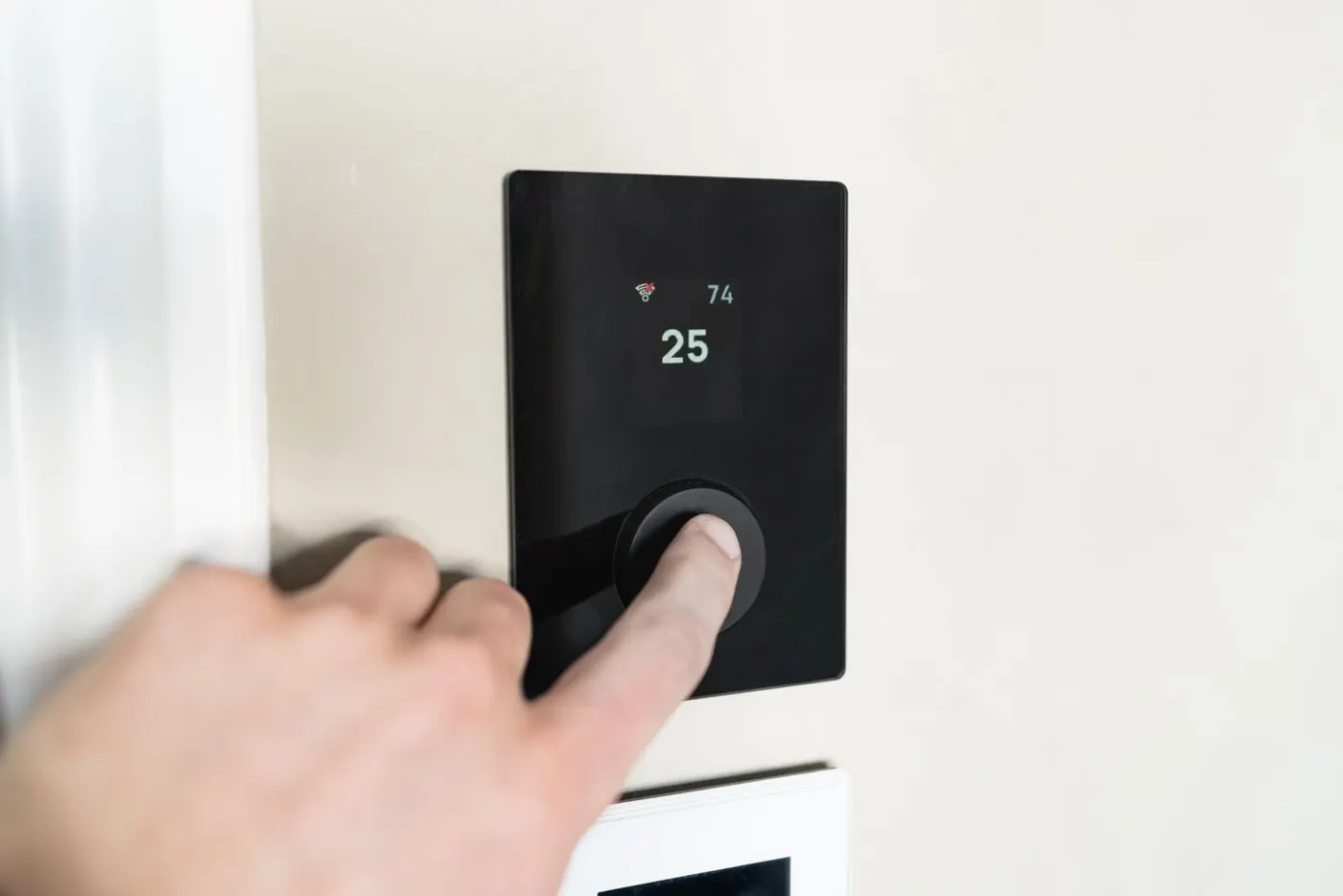
Not sure whether a symptom is urgent? Our list of heating and cooling warning signs explains which ones can wait a day and which ones mean "turn it off now."
What You Can Safely Check Before You Call
- Thermostat. Mode set to Cool, setpoint below room temperature, fan on Auto, fresh batteries if it uses them. Smart thermostats can be in an eco, away or schedule mode that overrides what you set.
- Air filter. A clogged filter is the most common cause of weak airflow and frozen coils. Filters are often behind a return grille in a hallway ceiling or wall, or at the air handler itself.
- Breakers. The indoor unit and the outdoor unit usually have separate breakers. If one has tripped, reset it once. If it trips again, leave it off and call.
- Outdoor disconnect. Many condensers have a service switch mounted next to them. Make sure it is on.
- Around the condenser. Clear leaves, stored items and overgrown plants from around the outdoor unit so it can move air.
- Supply and return vents. Open them, and move furniture or rugs that block them.
What Not to Do
- Do not open the outdoor unit or touch a capacitor. Capacitors store a charge even with the power off.
- Do not buy a refrigerant "recharge kit." A system that is low on refrigerant has a leak. Handling refrigerant is EPA-regulated, and adding it without finding the leak is not a repair.
- Do not keep running a system with ice on it, it can send liquid back to the compressor.
- Do not climb into a hot attic to clear a drain line or empty a pan. Attic joists, heat and wiring make it a real injury risk; a technician does it with the power off.
- Do not keep resetting a breaker that trips again. A repeat trip means a fault that needs a diagnosis.
Refrigerant: Leaks Get Found, Not Topped Off
Our technicians are EPA Section 608 Universal certified. An air conditioner is a sealed system, it does not use up refrigerant. If the charge is low, something is leaking, and the honest first step is to find where. Many existing systems in Irvine use R-410A, and newer equipment is moving to lower-GWP refrigerants such as R-454B and R-32, so the technician confirms which one your system uses before any refrigerant work. If the leak turns out to be in a major component and the fix would go beyond minor repair, we say so and explain your options.
What to Expect When You Call
- Call or text (949) 267-7771. Tell us what the system is doing, where the indoor unit is, and your Irvine neighborhood. A photo of the outdoor unit's label helps.
- A technician diagnoses on site and quotes the repair before any work starts. Nothing is replaced until you approve it.
- Common parts are on the truck. Many repairs, capacitors, contactors, drain clearing, float switches, are finished on the first visit. If a part has to be ordered, we tell you when it is expected and schedule the return trip then.
- Every repair carries a 90-day parts and labor warranty. If the system is near the end of its life, our repair or replace guide shows how we think about it. New systems and replacements go through our licensed air conditioning contractor; for a new system, see our partner for new heating and cooling systems.
Our before the technician arrives checklist makes the visit faster, clear a path to the attic hatch or closet, and to the outdoor unit.
Keep It From Happening Again
Most of the calls above were preventable: a drain line that was never flushed, a filter left for a year, a condenser packed with leaves. An AC maintenance & tune-up, coils, capacitor and electrical checks, condensate drain and float switch, airflow, is best done in spring, before the first heat wave. Change the filter on the schedule the manufacturer recommends, and more often if you have pets or ongoing construction nearby, which is common around the newest Irvine villages.
Fall is the right time for that work in Irvine, better than waiting for the first 95-degree afternoon in July when every heating and cooling phone in the county is ringing. The blower that moves cool air in summer is the same blower that moves heat in winter, so a bearing that is starting to squeal or a filter choking airflow shows up in both seasons. If the heat side is already acting strange, our guide on a furnace not heating walks through what to check. Our AC maintenance checklist for Southern California lists what matters in this climate and what is filler.
Frequently Asked Questions
Can you repair my AC in Irvine today?
Often, yes. We work out of Irvine, so Irvine addresses are early stops on our route. On hot days the schedule fills fast, so call (949) 267-7771 as early as you can. Same-day is not guaranteed; if today is full we will tell you and give you the first real slot.
My upstairs AC stopped and the thermostat shows nothing. Is the unit dead?
Not necessarily. In many two-story Irvine homes the air handler is in the attic, with a secondary drain pan and a float switch that cuts power to the system when condensate water backs up. A clogged condensate line that trips that switch can look exactly like a dead system. Check the breaker and the filter, then call, do not try to clear the attic drain from a ladder yourself.
My AC runs but blows warm air. What's wrong?
The usual causes are a failed capacitor or contactor on the outdoor unit, a dirty condenser coil, a frozen indoor coil from poor airflow, or a refrigerant leak. A system that is low on refrigerant has a leak, adding refrigerant without finding the leak is not a repair. Our technicians are EPA Section 608 Universal certified.
I live in an apartment near Irvine Spectrum or Park Place. Can I book you directly?
Call your leasing or property management office first. In most Irvine apartment communities the lease routes AC repairs through management, and a repair you book yourself may not be reimbursed. Condo and townhome owners can book us directly; we follow HOA rules on access and work hours.
Can you help if my Irvine air conditioner needs a new system?
No. Our AC work is limited to minor service and repairs under $1,000. If a system needs replacement, the technician will tell you so plainly, and installation is referred to our partner for new heating and cooling systems.
My new Irvine home has a heat pump instead of a furnace. Do you work on those?
Yes, inside the same limits as any other cooling work. A heat pump is the refrigeration circuit of an air conditioner plus a reversing valve, so the cooling-season faults look familiar: capacitors and contactors on conventional units, condensate and airflow problems, leaks. On inverter and communicating equipment the common failure is a control or drive board instead of a capacitor, and that can run past minor repair. The technician confirms the model and tells you where it stands before anything is replaced.
Can I put an off-the-shelf smart thermostat on my Irvine system?
On a conventional system with ordinary low-voltage wiring, usually yes, as long as there is a C wire to power it. On a communicating system, where the thermostat and the equipment trade data over a bus, no. Wiring a generic thermostat into those terminals can leave the whole system dead. Check what the manufacturer allows for your model first, and see thermostat problems that look like a broken AC.
I have two thermostats but only one AC unit. Why does only one floor cool?
That is a zoned system: one piece of equipment, motorized dampers in the attic ducts, and a control panel deciding which zone gets the air. A damper motor that failed closed, or a dead zone output on the panel, leaves one floor with no air while the other is comfortable. Make sure both thermostats are in Cool and off any hold, then call. Do not move attic dampers by hand.
Will a MERV 13 filter damage my air conditioner?
It will not wreck it outright, but in a 1-inch slot it can cut airflow enough to freeze the indoor coil, and a frozen coil blows warm air. MERV 8 to 11 is the safe range for a thin filter. True MERV 13 wants a 4 or 5 inch media cabinet, which is an equipment change rather than a repair.
Do you service ductless mini-splits in Irvine garages and ADUs?
Yes. Blower and coil cleaning, condensate drains and pumps, sensors, control boards, fault codes and leak diagnosis, all within minor service and repairs under $1,000. New line sets and new installations go through our licensed air conditioning contractor.
How is an AC repair in Irvine priced?
The technician diagnoses the system and quotes the repair on site before any work starts. Nothing is replaced without your approval, and every repair carries a 90-day parts and labor warranty.
Beyond Irvine
We also repair air conditioners in Tustin, Lake Forest, Mission Viejo and the rest of South Orange County, see the county-wide AC & air conditioning repair page and AC repair & maintenance. In Irvine we also handle refrigerator repair and oven and range repair. Restaurant, office or retail space with a rooftop unit? See commercial rooftop AC & rooftop AC repair.