
Oven & Range Repair in Irvine, CA
- ⭐ 5.0★ Yelp · 5.0★ Google
- 🛡️ 90-Day Parts & Labor Warranty
- 📅 20+ Years of Experience
- 📍 Based in Irvine
Quick answer
We repair gas and electric ovens and ranges all over Irvine, single and double wall ovens, freestanding and slide-in ranges, and the dual-fuel ranges common in newer homes around the Great Park and Portola Springs. We work out of Irvine, so a same-day visit is often possible if you call before noon. You get a free estimate over the phone, the technician quotes the repair on site before any work starts, and every repair carries a 90-day parts and labor warranty. Hosting Thanksgiving? Test the oven now, not the week of, our Thanksgiving oven checklist shows how. If the oven is completely dead, no display and no response, start with why an oven will not turn on, which covers the half-tripped 240V breaker, control lock and the five-minute reset. If the oven already will not heat, our guide to why an oven stops heating walks through igniters, elements, sensors and control boards and what you can safely check before you call. If it heats but bakes wrong, see oven temperature problems for the thermometer test that separates a calibration adjustment from a failing sensor, or run three kitchen tests that show whether your oven is lying to you first if you want a quick answer in an afternoon. And if the oven has already quit with guests on the way, what to do if your oven stops working on Thanksgiving Day has the five-minute triage list and the food-safety rules for a half-cooked bird. If your gas oven bangs when it lights or smells of gas for more than a second or two, read gas smell and delayed ignition before you run it again. And if the gas company has already been out, checked the line and told you the problem is the range, what to do after the gas company blames the appliance explains what gets tagged, what we test and what to have ready when you call. For the burners themselves, a click with no flame or a yellow flame instead of blue, see gas range burner problems. If you cook on a double wall oven or a 36 or 48-inch professional range, double oven and 48-inch range problems during holiday cooking covers what is different about two cavities sharing one board and one 240V feed: the half-tripped breaker that leaves the display on and nothing hot, convection ring elements, meat probes and the cooling blower that shuts an oven down mid-cook. And before you press the self-clean button to get the oven spotless for guests, read should you self-clean the oven before Thanksgiving. And if bake works perfectly while the broiler does nothing, that narrows things a long way: see why an oven bakes but the broiler will not work, which separates the electric broil element and its burned rear terminals from the board's broil relay, and covers the gas glow-bar igniter that still glows orange but no longer draws enough current to open the safety valve. Cooking on a Wolf? Wolf oven and range problems before the holidays goes through the glow-bar igniter, the temperature sensor, the convection fan and the broiler on dual-fuel, all-gas and built-in models. And the argument that comes up every November, whether to broil with the door open or closed, has a short answer and a longer explanation in broil with the door open or closed, including why propping the door on a closed-door oven slowly cooks the display and the control board above it.
Most Irvine ovens get light use for eleven months and then cook for eight hours straight on one Thursday in November. That is when a weak igniter or a tired bake element finally quits, and it is also the week every repair company in Orange County is booked solid. Alpha & Omega is a family-owned repair company that brings 20+ years of repair experience to Orange County and is based in Irvine, so oven calls from Woodbridge, Northwood, Turtle Rock, Woodbury, Orchard Hills, Portola Springs and the Great Park neighborhoods are local runs for us, not a trip across the county. Call (949) 267-7771 and tell us the brand, the model and what the oven is doing.
What Irvine Kitchens Have: and What Breaks in Them
Irvine grew village by village over five decades, so the kind of oven in a house is closely tied to the village it sits in. Knowing your neighborhood tells us a lot before we arrive, more on that on our Irvine service area page.
Great Park, Portola Springs, Orchard Hills, Cypress Village, Stonegate
Most of these homes were built from the 2000s on and came with a builder appliance package: a matched refrigerator, a range or a set of wall ovens, and a hood from one manufacturer. Double wall ovens and 30- or 36-inch gas and dual-fuel ranges are common. These ovens rarely wear out mechanically; what fails is electronic, temperature sensors, relays on the control board, touch panels that stop responding, convection fan motors, and door lock motors that stick after a self-clean cycle. If your home is only a year or two old, check whether the oven is still under the manufacturer's warranty before paying for a repair; understanding appliance warranties explains what to look for.
Woodbridge, Northwood, Westpark and the 1980s–90s villages
Here we see a lot of single wall ovens paired with a separate gas or electric cooking surface, and plenty of freestanding ranges that have been replaced once or twice. Many of these wall ovens are twenty-plus years old. Their failures are the classic ones: bake elements that burn through, gas igniters that weaken, oven thermostats or sensors that drift, and door hinges and gaskets that no longer seal. These are usually repairable, and repairing keeps the original cabinet cutout intact.
University Park, Turtle Rock, Culverdale, Deerfield, College Park
The first Irvine villages were built from the late 1960s through the 1970s. Kitchens have been remodeled more than once, so we find everything from original-size wall oven openings to full remodels with pro-style ranges. The practical issue in older openings is fit: modern wall ovens are not always the same size as the unit they replaced, which is one more reason repair is often the better choice than replacement.
Shady Canyon, Turtle Ridge, Quail Hill and the hillside streets
Up on the hill the kitchens get bigger and so do the appliances. We see 48-inch professional ranges with two cavities and an infrared broiler, pairs of built-in wall ovens stacked in a column, and separate steam ovens and warming drawers next to them. Parts for these rarely sit on a local shelf. They ship from the manufacturer, which is why a dead igniter on a 48-inch range in the third week of November is a very different conversation than the same part on a builder-grade range.
One more thing worth knowing about a big range. Both oven cavities, the griddle and the surface burners share one gas line and one regulator. If everything is running at once and the oven suddenly cannot hold 400°F, we check supply pressure before we condemn a valve.
Apartments and condos
Many Irvine renters live in apartment communities owned and managed by the Irvine Company or other large owners. If you rent, your lease almost always routes appliance repairs through property management, call them first, because a repair you arrange yourself may not be reimbursed. We work for homeowners, condo and townhome owners, landlords and property managers, and we coordinate access with tenants when the owner books us.
Oven Symptoms and What They Usually Mean
Gas ovens
- Slow to preheat, or 30+ minutes to reach temperature, the most common gas oven complaint we get. Most gas ovens use a glow-bar igniter that has to draw enough current to open the gas valve. As it weakens it still glows orange, but the valve opens late or not at all.
- No flame, igniter glowing, same weak igniter, less often a gas valve or a supply problem.
- Oven lights, then goes out and relights over and over, can be a borderline igniter, or normal cycling if the temperature is actually holding. An oven thermometer tells you which.
- Range burners click but won't light, wet or dirty burner caps and ports after cleaning, a cracked spark electrode, or a spark module problem.
Electric and dual-fuel ovens
- Heats only from the top, or not at all, usually a burned-out bake element. On many newer ovens the bake element is hidden under the oven floor, so you cannot see the break; it has to be tested.
- Temperature off by 25 degrees or more, a temperature sensor that has drifted, or a control that needs calibration. Many ovens allow a small offset adjustment in the settings menu; the owner's manual shows how.
- Uneven baking with convection on, a convection fan motor or convection element that has stopped.
- Dead display or error code, sometimes a power interruption or a tripped breaker, sometimes a failed control or a thermal fuse that opened after overheating, often after a self-clean cycle.
- Door locked after self-clean, a door lock motor or switch that did not release. Do not force it.
Double wall ovens
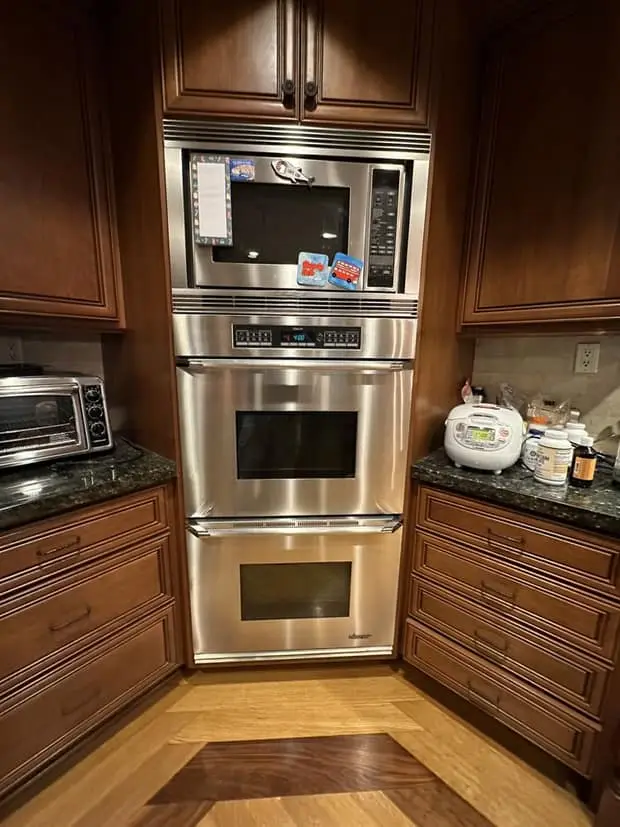
A double wall oven has two cavities, but both run from one control. When one cavity heats and the other does not, the control is usually not the problem, the element, sensor or relay for the dead cavity is. Wall ovens also have to be slid partly out of the cabinet to reach wiring and some components. That is a two-person job, and we protect the surrounding cabinetry and the floor while doing it.
Bake works but broil doesn't. What does that tell you?
Quite a lot, actually. An electric oven has a separate element for bake and for broil, and the control board switches each one through its own relay. So when bake heats normally and broil does nothing, the temperature sensor and most of the control are already proven good. We are down to the broil element, its wiring, or that one relay.
Convection works the same way. A true convection oven has a ring element around the fan at the back of the cavity plus the fan motor itself. If ordinary bake is fine but convection browns one side of a sheet pan and leaves the other pale, I'd check the fan motor before the element.
Air fry mode is the one that confuses people. On most ranges sold in the last five years there is no extra heater behind it. Air fry is the convection fan running fast while the elements cycle hard, which is exactly why it smokes when fat drips onto the oven floor. Smoke on air fry is not a broken oven. A sheet pan under the basket fixes it.
Write down which modes work and which don't before you call. That one sentence often decides what part rides on the truck.
What does the error code on my oven mean?
There is no universal list, and anyone who tells you otherwise is guessing. F3 on one brand is a shorted temperature sensor and on another it is the door latch. A code only means something next to the model number, so photograph the display and the model tag together.
Almost every code we see does fall into one of four groups.
- Temperature sensor open or shorted. The most common family by a wide margin. A standard oven sensor reads around 1,080 ohms at room temperature and climbs as the cavity heats. Out of range in either direction and the control shuts the cycle down rather than guess at the temperature.
- Door latch or lock. The motor that drives the lock has switches that report where the latch actually is. When those switches and the control disagree, the oven either refuses to start or refuses to unlock. This one shows up most often in the hour after a self-clean cycle.
- Over-temperature. The control saw a temperature it should never see, usually because a relay stuck closed and fed an element current nobody asked for. Stop using the oven until that is diagnosed.
- Communication. On ovens with a separate touch panel and main board, the two talk over a short ribbon cable or harness. A code here is often a connector or the harness, not either board.
Before you call, shut the breaker off for five minutes and put it back. A code that clears and never comes back was a glitch. A code that returns at the same point in the cycle is a part, and now we know roughly which one. If the oven is dead instead of complaining, start with our guide to an oven that will not turn on.
Steam ovens: usually the water, not the oven
Steam and steam-assist ovens turned up in a lot of Irvine kitchens built after 2010, either as a standalone unit beside the wall oven or as a steam mode inside a built-in. Some fill from a reservoir you slide out of the front panel. Some are plumbed to the water line under the counter.
Irvine tap water is hard. You can see what it leaves on shower glass, and the inside of a steam oven collects the same white crust. Scale builds up in the steam generator and on the water level sensor, and most of these ovens count cycles and then lock steam out until the descale program has been run. Owners read that lockout as a dead appliance and call us. Often the fix is a descale with the solution the manufacturer specifies, not a part at all.
Two things to stay away from. Don't pour household vinegar into a steam generator because the manual never said to, and don't start a descale program with the reservoir full of plain tap water when it asks for solution. Either one can turn a maintenance job into a real repair. If the oven has already stopped making steam, drips from under the door, or throws a water-level code with a full reservoir, that is a service call.
The newest Irvine kitchens have no gas at all. What fails instead?
We walk into more and more Irvine kitchens where there is no gas line anywhere near the range. Newer streets around the Great Park, Solis Park and the later Portola Springs phases came through all-electric, so the cooking appliances are an electric wall oven, an electric or induction range, or both.
That changes the list of things that can break. There is no glow-bar igniter and no gas valve, which takes the two most common gas oven failures off the table. What's left is simpler and usually cheaper to fix.
- The bake element. On most ovens built in the last fifteen years it's hidden under the oven floor, so you can't see the break the way you could on an exposed coil. A healthy element measures in the neighborhood of 20 to 40 ohms. An open one reads nothing at all, and the oven either never heats or heats only from the broil element on top, which is why the top of a casserole browns while the bottom stays raw.
- A relay on the control board. Electric ovens switch a lot of current. The relay contacts are the part that wears, and the symptom is mode-specific: bake dead while broil works, or convection dead while bake is fine.
- The thermal fuse or thermal cutoff. A one-shot safety part. When it opens, the oven can look completely dead with the clock still lit. It almost never opens for no reason, so we look for what overheated it before we put a new one in.
- The convection fan motor. All-electric ovens lean on convection harder because the manufacturer is trying to match the recovery an open gas flame used to give. The motor runs more hours, and the bearings tell you about it before they quit.
On induction ranges the oven cavity underneath is an ordinary electric oven with ordinary electric oven problems. The induction surface is a separate story: it has its own power board and its own cooling fan, and when a zone cuts out under load it's usually one of those two rather than the coil itself.
One complaint comes up on nearly every one of these calls, and it isn't a fault. People who moved from a gas range say the new electric oven preheats slowly. It does. An electric oven brings the walls and racks up to temperature with elements rather than a flame, and the preheat beep goes off when the air in the cavity hits the setpoint, not when the oven is actually saturated with heat. If your pies brown unevenly, give it another ten or fifteen minutes past the beep before the first tray goes in. That's not a repair, it's how the appliance works.
The self-clean cycle ran, and now the oven is dead
This is the call we get most in the second half of November, and it's the most avoidable one on the list. Self-clean is pyrolysis. The oven locks the door and runs the cavity up to roughly 800 to 900°F to burn residue to ash. Nothing about that is gentle, and it's a stress test on every heat-sensitive part at once.
Four things fail during or right after a self-clean, in the order we see them:
- The thermal fuse opens and the oven stops heating, sometimes with the display still on, sometimes completely dark.
- The door stays locked. The lock motor and its position switches sit right above the cavity and take the full heat soak. The control won't release a door it can't confirm is cool and unlatched.
- The bake element cracks. Elements near the end of their life often go on the cool-down, not the heat-up.
- The control board quits. Hours of heat rising into the panel is hard on relays and solder joints, and this is the expensive one.
If the door is locked right now, don't pry it and don't take the oven apart. Let it cool all the way down, which can take two hours or more, then cut the breaker for five minutes and put it back. Most locks release once the control sees a safe temperature and reboots. If it's still latched after that, the lock assembly or its switch needs replacing, and that's a parts call.
My honest advice for this week: skip self-clean until December. A cold oven, a plastic scraper and a baking soda paste left on the glass and floor overnight gets a kitchen presentable without betting the holiday on a thermal fuse. If your oven has a steam clean or quick clean option, that one runs near 250°F and is a much smaller gamble. We wrote the full reasoning in should you self-clean the oven before Thanksgiving. And if the cycle already ran and the oven won't heat, start with why an oven stops heating so you can tell us on the phone which parts are already ruled out.
The app says the oven is preheating, but the oven is cold
Most ovens sold into new Irvine homes in the last five or six years have Wi-Fi. LG, Samsung, GE Profile and Café all put a module in the control panel, and the app will happily report a state the oven isn't in. Before you book a repair, it's worth knowing which problems are the appliance and which are the network.
A few things we run into regularly:
- Remote start has to be armed on the oven. Safety rules don't let an app light an oven that nobody checked. On most models someone has to press a remote-enable button at the panel first, and that arming expires. The app sends the command, the oven ignores it, and the screen in your hand shows what it last thought was true.
- The module is 2.4 GHz only. Mesh systems that publish 2.4 and 5 GHz under one network name are the usual reason an oven that worked for a year suddenly can't be found. Nothing in the oven failed.
- A power blip drops the connection. After an outage the clock may need setting before the oven accepts a bake command at all, app or no app.
- A firmware update left the panel unresponsive. Breaker off for five minutes, breaker on. If the panel comes back, you're done.
Here's the part that matters. A cold oven is a cold oven no matter how cheerful the app is, and we don't diagnose from a phone screen. If the oven won't hold 350°F with a thermometer on the middle rack, the problem is in the oven, and the app is a distraction. If it holds temperature fine from the panel and only the app misbehaves, that's a network or module issue and not something worth paying a technician to chase.
One safety note while we're here. Don't use remote preheat on an oven with anything inside it, including the racks you shoved a sheet pan onto last night.
What You Can Safely Check Before You Call
- The breaker. Electric wall ovens and ranges run on a dedicated 240-volt circuit. A half-tripped double breaker can leave the display lit while the oven will not heat.
- Control lock, delay start and Sabbath mode. Any of these can make a working oven look dead. Check the manual for your model.
- The clock after a power outage. On some electronic ovens a flashing clock after an outage has to be set before the oven will accept a bake command.
- The real temperature. Put an inexpensive oven thermometer on the middle rack, bake at 350°F for 20–30 minutes, and read it. That single number tells us a lot on the phone.
- Burner caps and grates on a gas range, a cap that is off-center after cleaning is a common reason a burner won't catch.
What Not to Do
- Do not try to light a gas oven by hand, and do not keep retrying an oven that is not lighting.
- If you smell gas, don't use light switches or the range. Leave the house and call SoCalGas from outside.
- Do not run a self-clean cycle in the weeks before Thanksgiving. The extreme heat is exactly what finishes off a weak thermal fuse, door lock or control.
- Do not line the oven floor with foil, it blocks airflow and skews the temperature the sensor reads.
- Do not open the control panel or pull a wall oven out of its cabinet yourself. Live 240-volt wiring and gas connections are technician work.
Thanksgiving in Irvine: Book Early
Oven repairs are rarely complicated. What makes them stressful in late November is the calendar. Common parts for mainstream brands are usually available within a few days. Parts for built-in and premium ovens often ship from the manufacturer, and distributors slow down around the holiday. A repair that is routine on November 1 becomes a scramble on the Monday before Thanksgiving.
A simple plan: run the test in October or early November, full preheat to 350°F, an hour of baking, a check with a thermometer, and a look at how evenly a sheet pan of bread browns. If anything looks off, call then. Our guide to preparing your oven for Thanksgiving covers the full checklist, including why the refrigerator deserves a look too, see our refrigerator maintenance checklist.
Who pays for this repair: the builder, the manufacturer, or a home warranty?
Irvine has more nearly-new houses than almost anywhere in the county, and a lot of our oven calls here come from kitchens that are two or three years old. Sorting out who the claim belongs to takes one phone call and can save the whole repair, so do it before you book anyone.
Four situations cover almost every Irvine kitchen:
- The home is new and the appliances came with it. The builder's warranty covers the house. The oven itself is covered by the manufacturer, usually for a year of parts and labor from delivery or close of escrow. Start with the manufacturer. For LG and Bertazzoni we're factory authorized, so you can ask them to route the job to us.
- You bought the appliance yourself and added a retailer plan. Those plans name who may do the work. Paying us directly and claiming it back afterward almost never works, so read the plan first.
- You bought a resale home with a home service contract. These are common on Irvine resales. The contract holder chooses the contractor and sets the terms, so call them first for the same reason.
- No coverage, or coverage expired. Then it's a straightforward repair. Free estimate on the phone, the technician quotes it on site before any work starts, 90-day parts and labor warranty on what we do.
Have the model and serial number ready either way, plus the delivery or escrow date. On a wall oven the tag is on the frame where the door closes. On a range, pull out the bottom drawer.
One thing worth saying out loud in the third week of November. A warranty claim adds steps: the manufacturer or contract company assigns the job, the servicer schedules, the part has to be signed off. That can run longer than a direct repair. If coverage has days left on it, use it. If the oven is out of warranty and Thanksgiving is the deadline, don't spend three days on hold to find out. Our guide to appliance warranties goes through what these plans actually cover, and repair or replace covers the other half of the decision.
Oven Brands We Repair in Irvine
We are Factory Authorized for Bertazzoni and LG, and our technicians are Samsung-certified, see Samsung appliance repair. Irvine's higher-end kitchens bring us plenty of built-in ovens and pro-style ranges: we are experienced with Thermador, Viking and Miele, and we professionally service Wolf, Dacor, Monogram, GE and GE Profile, Café, JennAir, KitchenAid, Whirlpool, Bosch and the other major brands. A photo of the model tag helps us bring the right part the first time. On most wall ovens the tag is on the oven frame, visible when the door is open. On many ranges it is behind the storage or warming drawer.
What to Expect When You Call
- Call or text (949) 267-7771. Tell us the brand, the model, what the oven is doing and your Irvine neighborhood. You get a free estimate over the phone.
- A technician diagnoses on site and quotes the repair before any work starts. Nothing is replaced until you approve it.
- Most oven repairs are finished on the first visit. If a part has to be ordered, we tell you when it is expected and schedule the return trip then.
- Every repair carries a 90-day parts and labor warranty. If the oven is old enough that you are weighing the decision, our repair or replace guide shows how we think about it.
Our before the technician arrives checklist saves time on the visit.
Frequently Asked Questions
Can you repair my oven in Irvine today?
Often, yes. We work out of Irvine, so Irvine addresses are the first stops on our route. If you call (949) 267-7771 before noon, a same-day window is usually open. It is not guaranteed, the weeks before Thanksgiving fill up, and if today is full we will tell you so and give you the first real slot.
The upper oven of my double wall oven works but the lower one doesn't. Is it the control board?
Not usually. Both cavities share one control, so when one cavity heats normally the control is at least partly working. The more common causes are a failed bake or broil element, a temperature sensor, or a relay for that one cavity. A technician confirms which by testing the parts before anything is ordered.
My gas oven takes 30 minutes or more to preheat. What is wrong with it?
On most gas ovens that is a weakening glow-bar igniter. The igniter has to draw enough current to open the gas valve; as it ages it still glows, but the valve opens late or cycles off. It is one of the most common oven repairs we do in Irvine in the fall. Do not try to light the oven by hand.
Is it worth repairing a built-in wall oven instead of replacing it?
Often it is. A wall oven is fitted to a cabinet cutout, and a new model may not fit the old opening without cabinet work. Elements, igniters, sensors and door locks are routine repairs. If the repair does not make sense for the age and condition of the oven, the technician will tell you before any work starts.
How much does oven repair cost in Irvine, and is it guaranteed?
We give a free estimate over the phone, and the technician quotes the repair on site before any work starts, so you approve the price first. Every repair carries a 90-day parts and labor warranty.
My oven bakes fine but the broiler is dead. Is that a big repair?
Usually not. Bake and broil are separate elements with separate relays, so an oven that bakes correctly has already proven the sensor and most of the control board. That leaves the broil element, its wiring or one relay, and all three are routine parts. The technician tests which it is on site and quotes it before anything is replaced.
My oven is showing an error code. Can I keep using it until you get here?
Depends on the code. Shut the breaker off for five minutes first, and if the code clears and the oven holds temperature it was most likely a glitch. If the code mentions over-temperature, or the oven ran away past the setpoint, leave it off until a technician has looked at it. Photograph the display and the model tag and read us both when you call.
My steam oven says it needs descaling and now it won't make steam. Is it broken?
Probably not. These ovens count steam cycles and lock the function out until the descale program runs, and Irvine's hard water gets them there faster than the manual suggests. Run the descale with the solution the manufacturer specifies, not vinegar. If it still refuses to make steam after a proper descale, or it leaks, then something in the water circuit or the generator needs service.
I ran the self-clean cycle and now the oven won't heat or the door won't open. What now?
Very common after a self-clean, because the cycle runs the cavity to roughly 800 to 900°F and that heat finds the weakest heat-sensitive part. Usually it's the thermal fuse, the door lock motor or a relay on the board. Let the oven cool completely, then cut the breaker for five minutes and restore it. Most locks release after that. If the oven still won't heat or the door is still latched, it needs a part, and we would rather you call than take the panel off.
My new Irvine house has no gas line. Is an electric oven harder to repair?
No, it's usually simpler. With no igniter and no gas valve, the failures come down to the bake or broil element, a relay on the control board, the temperature sensor, the thermal fuse or the convection fan motor. Those are routine parts. The one thing to expect is slower preheat than the gas oven you had before, which is normal for electric and not a fault.
The app says my oven is preheating but it's cold. Is the oven broken?
Maybe not. Most ovens need remote start armed at the panel before an app can light them, and the app shows the last state it knew when the module drops off the network. Try it from the oven's own panel with a thermometer on the middle rack. If it reaches and holds 350°F, the appliance is fine and you have a Wi-Fi problem. If it doesn't, that's a service call and the app isn't the issue.
Beyond Irvine
We repair ovens and ranges in Tustin, Lake Forest, Mission Viejo, Laguna Hills, Aliso Viejo and the rest of South Orange County, see the county-wide oven and range repair page. In Irvine we also handle refrigerator repair, AC repair and commercial refrigeration.