
GE Refrigerator Not Cooling but the Freezer Works: What Usually Fails
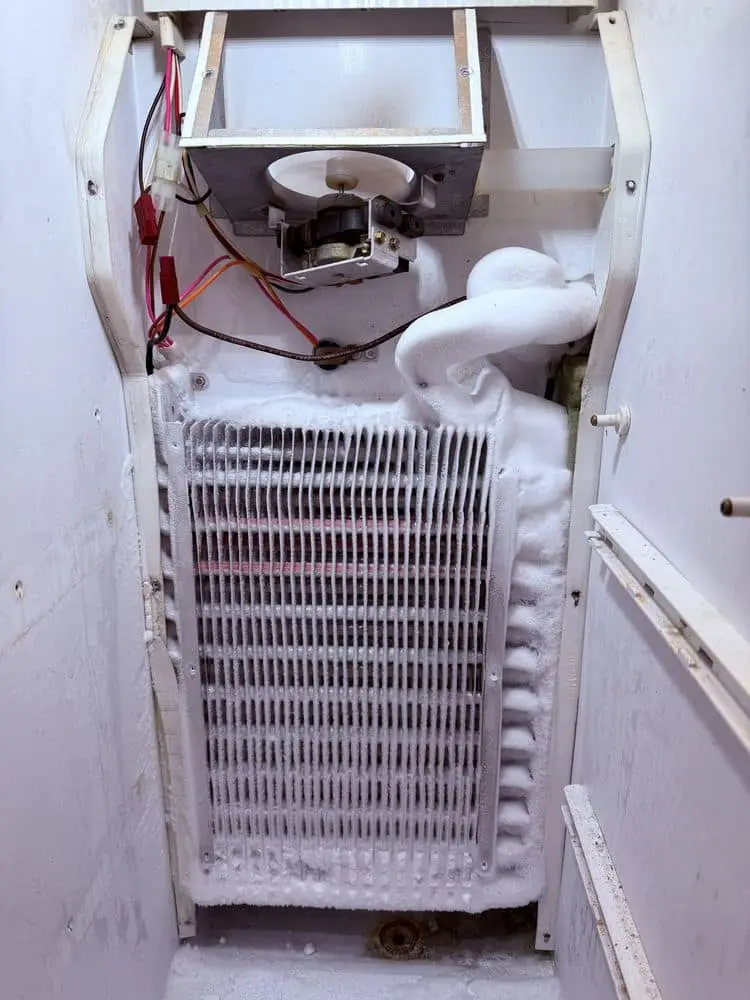
This is one of the most common refrigerator calls we take in Irvine, Tustin and Lake Forest, and it is also one of the easiest to narrow down from the kitchen floor before anyone picks up a tool. The symptom is specific, and specific symptoms are good news. A GE refrigerator that cools nothing at all could be a dozen things. A GE refrigerator whose freezer is still holding ice cream solid while the milk upstairs goes warm has a much shorter list.
How a GE refrigerator moves cold, and why one side can fail alone
Here is the layout on the large majority of GE, GE Profile and Café refrigerators, whether they are top-freezer, side-by-side or French door. There is one sealed refrigeration system and one evaporator coil, and that coil lives behind a plastic panel at the back of the freezer. The compressor pumps refrigerant through it, the coil gets cold, and an evaporator fan pulls freezer air across it. Part of that air stays in the freezer. The rest travels through a duct into the fresh food compartment, often past a damper that opens and closes to control how much gets through.
That single-evaporator design is why a cold freezer plus a warm fridge is such a useful clue. The compressor is running. Refrigerant is circulating. The coil is getting cold enough to keep a freezer at 0°F. Everything on the "making cold" side of the machine is doing its job. What has broken is the "delivering cold" side, and that side is made of a fan, a duct, a damper, a defrost circuit and a couple of sensors. All of them are repairable parts, and none of them is the compressor.
A small number of premium French-door and built-in models, including the Monogram columns, run separate cooling circuits for the two compartments. On those the diagnosis is different, because a warm fresh food section can mean that compartment has its own fault entirely. If your unit is a built-in column or a panel-ready Monogram, say so when you call and we will plan the visit around it.
Read the symptom first
Before you take anything apart, spend ten minutes gathering facts. Put a real thermometer in a glass of water on the middle fridge shelf and leave it a few hours. Open the freezer and look at the back panel. Press the door switch and listen. What you find narrows the list fast.
| What you see or hear | What it usually points to |
|---|---|
| Freezer at 0°F, fridge 45 to 55°F, no air at all from the fresh food vent | Evaporator fan motor stopped, or the coil is iced over |
| Freezer back panel frosted white, fan silent or chirping | Defrost failure: heater, defrost thermostat or bi-metal, or control board |
| Fan clearly running, you can feel air in the freezer, but nothing upstairs | Damper stuck shut, or the duct is blocked by frost or packed food |
| Fridge warm, display insists it is 37°F | Thermistor reading wrong, or the board acting on a bad reading |
| Cooling fades over an afternoon, compressor too hot to touch | Condenser side: dirty coil or a dead condenser fan |
| Cools fine for one to three weeks after an unplug, then warms again | Defrost system, confirmed. It is not the fan |
| Light frost only near the freezer door, rest of the coil clear | Door gasket leaking, or a door not latching |
1. The evaporator fan motor stopped
This is the first thing we check, because it produces exactly this symptom and it fails often. The fan sits behind the freezer back panel next to the coil. If it stops, the freezer still gets cold by sheer proximity to the evaporator, but nothing is pushing air up the duct, so the fresh food section slowly drifts up to room-ish temperature.
What to check: open the freezer and press and hold the door switch or plunger so the refrigerator thinks the door is shut. On most GE models the evaporator fan spins up within a few seconds and you can hear air moving behind the panel. Silence means the fan, its wiring or ice locking the blade. A rhythmic chirp or tick means the blade is striking frost, and that sends you to the defrost section below rather than to the fan.
Fan motor replacement is a routine job. The part is behind the panel, the panel is behind the shelving and sometimes behind the ice maker, and the whole thing is held together with screws and clips that get brittle with age. Plan on the technician bringing the motor and the connector.
2. The defrost system quit and the coil is a block of ice
GE refrigerators are frost-free by machinery, not by magic. Several times a day a heater under the evaporator melts off the frost that normal operation deposits, and a defrost thermostat or bi-metal ends the cycle once the coil warms. The control board runs the schedule. When the heater opens, when the bi-metal fails, or when the board stops calling for defrost, frost keeps building until air cannot pass through the coil at all.
At that point the fan is often still running and still trying. You may hear it. It just has nothing to move. The freezer stays cold because it is sitting right against a block of ice, and the fridge side goes warm. This is the single most common cause we find behind the "freezer fine, fridge warm" complaint on GE units.
What to look for: remove the freezer contents and look at the back panel. Frost spreading out from the panel seams, a panel that is cold and sweating, or visible ice through the vents all point here. If you take the panel off and the coil is encased in clear hard ice rather than carrying a light fuzz, that is a defrost failure, not a door problem. Our guide on frost building up in a freezer goes through the frost patterns in more detail.
What not to do: no hair dryer, no heat gun, no screwdriver chipping at the coil. The evaporator is thin aluminum tubing with refrigerant in it, and one punctured fin turns a moderate repair into a sealed-system job. We have been called out to exactly that more than once.
3. The damper or the duct between the compartments
Most GE side-by-side and French-door models meter cold air into the fresh food section through a damper, which on newer units is a small motorized flap driven by the board. If it sticks shut, or if the motor fails, or if the board stops commanding it, the freezer is perfect and the fridge gets nothing.
What to check: find the fresh food air vent, usually at the top or upper rear of the compartment, and hold the back of your hand in front of it with the door switch pressed. If the fan is clearly running in the freezer but you feel no air at that vent, the damper or the duct is the suspect. Before blaming the part, pull food away from the vent. A tall container or a stack of takeout boxes jammed against the outlet does the same thing for free, and in a full holiday refrigerator it happens more than you would think.
Damper assemblies are a technician part on most models because of where they sit and how they wire in. A duct packed with frost is a different matter, and it usually means you are back at the defrost system.
4. A thermistor reporting the wrong temperature
GE boards decide when to cool based on thermistors, small temperature sensors clipped into each compartment. If the fresh food thermistor drifts and tells the board the compartment is already at 37°F, the board sees no reason to open the damper or run the fan any harder, and the fridge sits warm while the display looks perfectly normal.
This is why we keep telling people not to trust the panel. Many GE displays show the setpoint rather than the measured temperature, and on some models the sensor feeding that display is the very part that failed. Put a glass of water with a thermometer on the middle shelf for four hours. If the thermometer says 50°F and the panel says 37°F, you have learned something real.
Testing a thermistor means reading its resistance at a known temperature against the manufacturer's chart. That is a meter job, not a kitchen job, but it is quick for a technician and the part itself is inexpensive.
5. The main control board
Boards get blamed early and deserve it late. On a GE refrigerator the board runs the defrost schedule, the damper, the fans and the display, so a board fault can imitate almost anything on this page. That is exactly why it should be the last thing tested, not the first. We have replaced plenty of fan motors and defrost heaters behind someone else's "it must be the board" diagnosis.
A technician puts the board into its service mode, commands each output and watches what responds. If the board calls for the fan and the fan does nothing, the fan is at fault. If the board never calls at all, the board is. Guessing at that sequence with a parts-store board is an expensive way to find out you were wrong.
6. Doors, gaskets and the things that are not the refrigerator's fault
Not every warm fridge is a broken part. A fresh food door that is not fully latching, a gasket that has hardened and no longer seals, or a door alarm that has been going off unnoticed will all let warm humid room air in around the clock. The system runs almost continuously, frost builds faster than the defrost cycle can clear it, and the fridge side loses the fight first.
What to check: close the door on a dollar bill and pull. If it slides out with no drag, that section of the gasket is not sealing. Walk the whole perimeter of both doors. Look for a gasket that has gone stiff, torn at a corner, or pulled out of its channel. Also check that a door bin or a tall bottle is not holding the door open a quarter inch, which is invisible from across the room and common after a grocery run.
Replacing a gasket is worth doing rather than living with. A refrigerator that runs all day to fight a leaking seal is also a refrigerator that ices up its evaporator and eventually brings you right back to section 2.
Dirty condenser coils: usually both sides, sometimes just the fridge
The classic dirty-condenser symptom is both compartments warm and a compressor too hot to touch. But in the early stage it often shows up as a warm fresh food section with a freezer that still holds, because the freezer gets first claim on whatever cold is being made. If your unit has pets in the house, a tight toe grille or a bottom-mounted condenser, check this before anything else.
What to check: unplug the refrigerator, pull the base grille, and look. A felt-like gray mat over the coil is what you are looking for. Vacuum it with a crevice tool and a long coil brush, from the front and from the back if you can reach, and vacuum the condenser fan blades while you are in there. Plug it back in and give it several hours before judging. This is the single most useful piece of maintenance a homeowner can do, and it is the first thing our technician does on arrival anyway. The schedule is in our refrigerator maintenance checklist.
GE Profile, Café and Monogram: what changes
The diagnosis above holds across the GE family, because the airflow architecture is shared. What differs is access and extras. GE Profile and Café French-door models carry more boards, more sensors and sometimes a second fan, which means more things to test but also better fault reporting once a technician is in the service mode. Monogram built-ins and columns breathe through a cabinetry grille that packs with dust and cooking film, and on the column pairs each unit is its own machine, so a warm refrigerator column tells you nothing about the freezer column standing next to it.
Model and serial are usually on a label inside the fresh food compartment, commonly on the left side wall or behind the crisper drawers. Read that number to us on the phone. It tells us whether your unit has a damper, how the back panel comes off, and which parts to put on the truck. We provide professional GE, GE Profile, Café and Monogram repair, and the full brand page is at GE appliance repair.
The unplug test, and what the answer tells you
You will see "unplug it for 24 hours" repeated all over the internet as a fix. It is not a fix. It is a diagnostic, and a good one.
Move the food to a cooler, empty the freezer, leave both doors open and the refrigerator unplugged for roughly 24 hours. Put towels down, because a fully iced evaporator holds more water than people expect. Then plug it in and watch what happens over the next few weeks.
- It cools normally for one to three weeks, then goes warm again. That is a defrost system failure, confirmed. Heater, bi-metal or board. Call rather than repeating the defrost, because every cycle of this is a few more weeks of a compressor running flat out.
- It never cools properly even right after the defrost. Then ice was not what was blocking the air. Look at the fan and the damper.
- It cools fine and stays fine for months. A one-off, usually a door left ajar or a power event. Worth noting the date in case it comes back.
Telling us which of those three happened saves real time on the visit. It is the most useful sentence a customer can open with.
What you can safely check yourself, in order
- Verify the actual fridge temperature with a thermometer in a glass of water, not with the display.
- Check both doors close fully, and run the dollar-bill test around both gaskets.
- Pull food away from the fresh food vent and from the freezer back panel. Leave a hand's width of clearance.
- Press the freezer door switch and listen for the evaporator fan. Note silence, a chirp, or clear running.
- Look at the freezer back panel for frost at the seams or ice visible through the vents.
- Unplug, pull the base grille, and vacuum the condenser coil and the condenser fan blades.
- If you have the stomach for it, run the 24-hour defrost test and record what happens afterward.
That is the whole safe list. Everything past it means voltage, refrigerant or a meter, and that is where we come in.
What only a technician should do
- Test the defrost heater, the bi-metal and the board outputs with a meter on a live circuit.
- Read thermistor resistance against the model's chart and decide whether the sensor or the board is lying.
- Replace the evaporator fan motor, the damper assembly or the defrost heater behind the back panel.
- Anything involving the sealed system. That is EPA 608 territory, with recovery, a new filter drier, nitrogen brazing, a deep vacuum and a weighed charge. See sealed system repair for what that work actually involves.
Worth saying plainly: a cold freezer with a warm fridge almost never turns out to be a sealed-system fault. If someone quotes you a compressor on this symptom without showing you the frost pattern and the fan test first, get a second opinion.
Is the food still safe?
Per USDA guidance, with the door kept closed a refrigerator holds a safe temperature for about 4 hours without cooling. Above 40°F for longer than that, perishable food should go. The freezer side is not your problem here, but if it ever becomes one, a full freezer holds for roughly 48 hours and a half-full one for about 24.
Practical move while you wait for the visit: move the meat, dairy and leftovers to an ice chest, leave the rest, and stop opening the door to check. If this started after an outage rather than on its own, our guide on fridge food after a power outage covers that case specifically.
Keeping it from coming back
- Vacuum the condenser coil every 6 to 12 months, more often with pets. Once a year is enough for most homes, twice if there is a dog.
- Keep a thermometer in the fresh food section. Catching 42°F early is a fan. Finding 55°F a week later is spoiled food and a compressor that has been running nonstop.
- Do not block the fresh food vent or the freezer back panel. The week before Thanksgiving is when this bites, and a packed refrigerator is the most common version of it.
- Wipe the gaskets twice a year and replace one that has hardened instead of living with it.
- If you hear the evaporator fan chirping or ticking, deal with it then. That sound is the blade touching frost, and it is an early defrost warning with weeks of margin in it.
When to call
Call once the fresh food section is above 45°F and a few hours of attention have not moved it, once frost returns within three weeks of a manual defrost, or once the fan is audibly hitting ice. Also call if the display and a real thermometer disagree by more than a few degrees, because that one is not going to resolve on its own.
Our technician measures actual compartment temperatures, reads the frost pattern on the evaporator, which tells a great deal about what failed, tests both fans, the damper, the defrost circuit and the thermistors, and only then looks at the board. You get the diagnosis explained and a quote before any work begins, and most refrigerator repairs are finished the same day from parts on the truck. Repairs carry a 90-day parts and labor warranty.
We work the Irvine to San Clemente corridor out of an Irvine base, with local pages for Tustin, Lake Forest, Mission Viejo and Laguna Niguel. We are Factory Authorized LG Repair and Factory Authorized Liebherr Repair, our technicians are Samsung-certified, and we provide professional GE, GE Profile, Café, Monogram, Whirlpool, KitchenAid, Bosch and Sub-Zero repair.
If the GE is warm right now, keep the doors shut and call (949) 267-7771 with the model number and whichever of the symptoms above matches. We are 5.0 on Yelp if you want to see how these visits tend to go.
Frequently Asked Questions
Why is my GE refrigerator warm when the freezer is still cold?
On nearly every GE refrigerator the cold is produced in one place, the evaporator coil behind the freezer back panel, and a fan blows part of that air into the fresh food section. If the freezer holds 0°F and the fridge sits at 45 to 55°F, cooling itself is working and the air is not reaching the upper compartment. The four causes we find most are a stopped evaporator fan motor, a frosted-over coil from a failed defrost system, a stuck damper or blocked duct between the compartments, and a thermistor reporting the wrong temperature to the control board.
Should I unplug my GE refrigerator for 24 hours?
It is a test, not a repair. Empty the freezer, leave both doors open and the unit unplugged for about 24 hours so any ice on the evaporator melts, then plug it back in. If the fridge side cools normally for one to three weeks and then goes warm again, the automatic defrost system has failed: the heater, the defrost thermostat or bi-metal, or the control that runs the cycle. That pattern is worth telling the technician on the phone because it shortens the visit.
How do I know if the GE evaporator fan is the problem?
Open the freezer and press and hold the door switch or plunger so the unit thinks the door is closed. On most models the evaporator fan should spin up within a few seconds and you will hear air moving behind the back panel. Silence points at the fan motor, its wiring, or ice locking the blade. A loud chirp or a rhythmic ticking usually means the blade is striking frost, which sends you back to the defrost system rather than the fan itself.
Is a frosted GE evaporator coil a defrost failure or a door problem?
Both leave frost, but the pattern differs. A hard, clear sheet of ice that encases the whole coil and the surrounding foam is a defrost failure, meaning the heater, the bi-metal or the board. Light fuzzy frost concentrated near the door opening, with the rest of the coil clear, usually means humid room air is leaking past a tired gasket or a door that is not latching. Check the gasket with a dollar bill before assuming the defrost system is at fault.
Can dirty condenser coils cause a warm GE fridge with a cold freezer?
They can, in the early stage. As a packed condenser loses capacity the system runs longer and longer, and the freezer keeps winning because it gets first claim on the cold air. The fresh food section is the first to slip. Pull the base grille with the refrigerator unplugged, vacuum the coil and the condenser fan blades, give it several hours and check again with a thermometer. If both compartments are warm and the compressor is too hot to touch, the condenser side is almost certainly involved.
Is a GE refrigerator that stopped cooling on one side worth repairing?
Usually yes. The parts involved in a warm fridge with a working freezer, evaporator fan motors, defrost heaters and thermostats, damper assemblies and thermistors, are moderate repairs and all of them are available for GE, GE Profile and Café units. The repair-or-replace conversation only gets real with a sealed-system leak or a failed compressor, and that is not what a cold freezer plus a warm fridge normally points to. A technician can tell you which one you have before any work begins. Our repair or replace guide shows how we weigh it.
Related Pages
- Refrigerator Repair in Orange County
- Refrigerator Repair in Irvine
- GE, GE Profile & Monogram Repair
- Why Is My Refrigerator Not Cooling? 10 Common Causes
- Frost Building Up in Your Freezer?
- Refrigerator Compressor Problems
- KitchenAid Refrigerator Not Cooling
- Samsung Refrigerator Problems We Fix Most
- Refrigerator Maintenance Checklist
- Fridge Food After a Power Outage
- Which Refrigerator Brand Would a Repair Tech Buy?
- Sealed System & Compressor Repair
- Irvine · Tustin · Lake Forest · Mission Viejo · Laguna Niguel · Aliso Viejo · San Juan Capistrano · San Clemente