
Oven & Range Repair in Tustin, CA
- ⭐ 5.0★ Yelp · 5.0★ Google
- 🛡️ 90-Day Parts & Labor Warranty
- 📅 20+ Years of Experience
- 📍 Based in Irvine, minutes from Tustin
Quick answer
We repair gas, electric and dual-fuel ovens and ranges in both Tustin ZIP codes, 92780 and 92782, and in North Tustin up the hill. Wall ovens and doubles, freestanding and slide-in ranges, the old drop-ins in the 1960s tracts, and the 36 and 48 inch pro-style ranges in Cowan Heights and Lemon Heights kitchens. We work out of Irvine and come up Jamboree and Irvine Boulevard several times a day, so a morning call usually gets a same-day window. You get a free estimate over the phone, the technician quotes the repair on site before anything is touched, and every repair carries a 90-day parts and labor warranty.
Hosting Thanksgiving this year? Run the oven hard once in October. Our Thanksgiving oven checklist walks through the test, and it takes about an hour of your time.
Most ovens in this city bake a casserole now and then for eleven months, and then cook for eight hours straight on one Thursday in November. That's the day a tired igniter or a cracked bake element finally gives up. It's also the week every repair company in Orange County is booked. Alpha & Omega is a family-owned shop that brings 20+ years of repair experience to Orange County, based in Irvine, so an oven call from Old Town or Tustin Ranch is a short run for us. Call (949) 267-7771 and have the brand and the model number ready.
Which oven do you have? In Tustin that depends on the decade
Tustin was built in waves, and each wave left a different kind of cooking equipment behind. Knowing the neighborhood tells us a lot before we pull into the driveway. There's more on how the city breaks down on our Tustin service area page.
Old Town and the streets off Main and El Camino Real
The 1920s through 1950s houses here have been remodeled once or twice, sometimes three times. What that means for us is a mix: a 2015 slide-in range sitting in a kitchen whose gas line and 120-volt outlet date to a much older era. Gas ranges dominate. The common calls are a burner that clicks and won't catch, a glow-bar igniter that has gone slow, and oven doors that no longer seal because the hinges have been sprung by thirty years of use. Kitchens in these houses are small, so a freestanding range usually has to come out through a doorway, and we plan for that.
Tustin Meadows, Peppertree, Laurelwood and Tustin Village
These 1960s and 70s slab tracts are on their second or third set of appliances. A good number still have the original cutout geometry: a 30-inch opening for a drop-in or slide-in range whose lip rests on the countertop, or a single wall oven in a 24 or 27 inch cabinet opening. That's the practical reason we push repair here. Modern replacements don't always match the old opening, and a mismatch turns an appliance purchase into counter and cabinet work. Elements, igniters, sensors, valves and spark modules are ordinary parts, and fitting one leaves your counter alone.
Tustin Ranch
Late 1980s and 1990s construction with big kitchens, usually a single or double wall oven plus a separate cooking surface. Those wall ovens are now 25 to 35 years old, which is exactly the age where failures start arriving in sequence: a bake element, then the temperature sensor, then the door latch. The good news is these are all standard parts and the ovens are mechanically simple. The bad news is nobody thinks about a 30-year-old oven until the turkey is thawing.
Tustin Legacy, Columbus Square, Columbus Grove, Greenwood, Levity
Built on the old MCAS Tustin land in the 2010s and 2020s, mostly all-electric around heat pumps, with builder appliance packages where the refrigerator, the ovens and the hood all came from one manufacturer. These ovens rarely wear out. They fail electronically. Touch panels that stop registering a press, relays on the control board, convection fan motors, temperature sensors that drift, and door lock motors that stick after a self-clean cycle. If the house is only a year or two old, check the manufacturer warranty before you pay anybody, including us. Our page on appliance warranties explains what to look for on the paperwork.
North Tustin, Cowan Heights, Lemon Heights
Up the hill the lots get big and the kitchens get serious. Double wall ovens, 48-inch pro ranges with a griddle, warming drawers, steam-assist ovens, and often a second oven in a butler's pantry. Pro ranges are built to be worked on, and parts are available, but the diagnosis takes longer because there's more of everything: six or eight burners, two cavities, two convection fans. We budget more time for a first visit in these homes rather than rushing it.
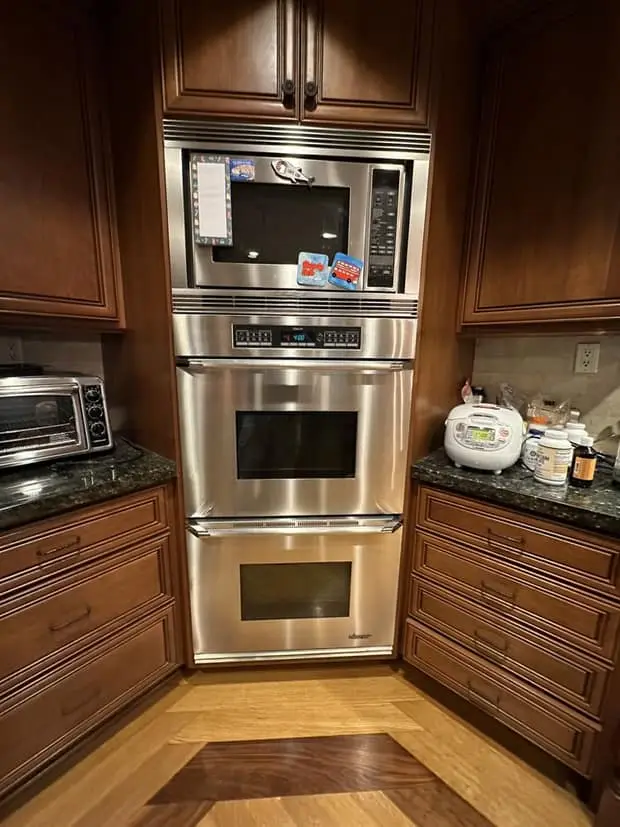
Why won't my gas oven heat?
Nine times out of ten it's the igniter, and it's usually still glowing when you look at it. A glow-bar igniter has to draw enough current, roughly 3.2 to 3.6 amps on most models, to open the safety valve. As the bar ages its resistance climbs, the current drops, and the valve opens late or stops opening at all. The bar still glows orange, so it looks fine from the front. That's why a weak igniter gets misdiagnosed as a gas problem.
- Takes 30 minutes or more to preheat. Weakening igniter, far and away the most common gas oven call we get in the fall.
- Igniter glows, no flame ever arrives. Same part, further gone. Less often the safety valve.
- Lights, goes out, relights, over and over. Could be a borderline igniter. Could be normal cycling if the temperature is actually holding. An oven thermometer settles it in twenty minutes.
- A bang or a whoomp when it lights. Stop using the oven and read gas smell and delayed ignition first. Delayed ignition means gas is pooling before it catches.
- Burners click but won't light. Usually a burner cap sitting off-center after cleaning, a wet or clogged port, or a cracked spark electrode. Gas range burner problems covers the safe checks.
If SoCalGas has already been out, checked the line and told you the appliance is the problem, what to do after the gas company blames the appliance explains what gets red-tagged and what we test when we arrive.
Electric and dual-fuel: what we actually find
- No heat at all, or heat only from the broil element. A burned-out bake element. On a lot of newer ovens the bake element is hidden under the oven floor, so you can't see the break and it has to be tested.
- Off by 25 degrees or more. A temperature sensor that has drifted. Most oven sensors read around 1,080 ohms at room temperature, and a sensor that reads well off that number is the answer. Many ovens also have a calibration offset in the settings menu, and the manual shows how to reach it. Oven temperature problems has the thermometer test that tells a calibration issue from a failing sensor.
- Uneven baking, worse with convection on. A convection fan motor or a convection element that has quit. The oven still heats, so it doesn't feel like a failure.
- Dead display, no response. Breaker first, then a thermal fuse that opened, then the control board. Why an oven won't turn on walks it in order.
- Door locked and won't release after self-clean. A door lock motor or switch that didn't finish its travel. Don't force it, you'll break the latch assembly and turn a small part into a big one.
The full walkthrough of heat failures, igniters through control boards, is in why an oven stops heating.
Why does my electric oven trip the breaker?
This one worries people, and it should get attention, but the cause is usually mechanical rather than mysterious. A bake or broil element is a steel tube with a coiled wire inside, packed in magnesium oxide. When the tube cracks or burns through, that wire can touch the tube, and the tube is grounded to the oven body. It is a dead short, and the breaker does exactly what it was installed to do.
The pattern narrows it down fast. A breaker that goes the instant you press bake points at the bake element or its wiring. One that goes only on broil points at the broil element. A breaker that holds for twenty minutes and then lets go, the same way every time, usually means an element that shorts once it expands with heat, or a wire at the back of the oven whose insulation has cooked off against a sharp edge. In the 1960s and 70s tracts around Tustin Meadows and Peppertree we also find the original terminal block behind the range burned and pitted, which heats up the connection instead of the oven.
One reset to confirm what you saw is reasonable. After that, stop. Repeated resets on a shorted element push heavy current through a connection that is already failing, and the damage spreads from one element to the wiring and the block behind it. Leave the breaker off and have it tested.
Convection is on, but nothing bakes any faster
Convection is not one part. On most ovens it is a fan in the back wall, a motor behind it, and on true convection a third heating element wrapped around the fan opening. Any one of the three can quit while the oven still looks healthy, because bake and broil run on their own circuits and keep working.
If you hear the fan and food still takes conventional time, the convection element is the suspect. If you hear nothing at all with convection selected, it is the motor, its capacitor on some models, or the relay on the board that feeds it. A rhythmic tick or a scrape means the blower wheel has loosened on the shaft or is touching the baffle. Fix that one early. A wobbling wheel takes the motor bearing with it.
Worth knowing before the holiday: convection roasting usually runs about 25°F below the recipe and finishes sooner, so a dead convection element shows up as a bird that is not done on schedule rather than as an error code on the display. If you cook on two racks at once, double ovens and holiday cooking covers how to stage it when one cavity or one fan is out of service.
One cavity works, the other doesn't. Is the board bad?
Probably not. A double wall oven has two cavities running off one control. If one cavity heats normally, the control is at least partly alive, so the odds favor the element, the sensor or the relay for the dead cavity. I'd test those three before I'd quote a board.
Double ovens do have to come partly out of the cabinet to reach the wiring and some components. That's a two-person lift on most models, and we lay protection on the floor and the cabinet faces before anything moves.
My oven shuts itself off in the middle of a long bake
Three different things cause this, and they are easy to tell apart once you know what to watch.
- The 12-hour automatic shutoff. Most ovens built since the 1990s turn themselves off after 12 hours of continuous cooking, by design. Nothing is broken. If you are doing an overnight brisket, the manual shows how to defeat it, and Sabbath mode holds the oven on and skips the shutoff entirely.
- A thermal cutoff doing its job. Ovens carry a one-time thermal fuse or a resettable limit switch near the top of the cavity. Blocked vents, a self-clean cycle run recently, or a cooling fan that has stopped will push cabinet temperature high enough to open it. A limit switch closes again once things cool, so the oven works an hour later and then repeats the trick next time. That repeat pattern is the clue.
- A relay or a cracked solder joint on the control board. Heat cycling fatigues the solder at the bake relay. The oven runs, the joint opens as the board warms, the oven quits, and after it cools it starts again. In the newer Tustin Legacy and Columbus Square kitchens this is the most common version of the complaint, because those ovens are electronically controlled and mechanically fine.
What helps us most is timing. Write down how long it ran before it died, whether the display showed a code or went blank, and whether it came back on its own. Fifteen minutes of notes can save an hour of a technician trying to make an oven fail on command.
Hard water and steam ovens
Tustin tap water is hard, and that matters for one piece of cooking equipment in particular. Steam and steam-assist ovens fill from a reservoir or a plumbed line, and the scale builds inside the boiler and the water lines. The oven gives you less steam, then it throws a water or descale fault, then the pump or the level sensor fails. These ovens have a descale cycle for exactly this reason, and on Tustin water it's worth running on the short interval in the manual rather than the long one. We see the same scale pattern on refrigerator water valves here, which is covered on our Tustin refrigerator repair page.
Can I calibrate the oven myself, and should I?
Yes on most ovens, and sometimes you should. Nearly every electronic oven has a temperature offset in the settings, usually limited to about 35°F in either direction, and the manual for your model lists the key sequence. If a thermometer on the middle rack settles 15 to 25°F under the set point and stays there, an offset is a fair fix and it costs you nothing.
Where it goes wrong is using the offset to paper over a fault. A failing temperature sensor does not read low by a steady amount, it drifts, so you end up entering a new offset every few weeks. A worn gasket or a sprung hinge lets heat out, and no offset fixes a cavity that cannot hold what it makes. A wide swing, 60°F or more between the heat cutting in and out, is a sensor or control problem rather than a calibration problem.
Here is the test I would run first, because it answers both questions at once. Thermometer on the middle rack, set 350°F, wait for the preheat tone, then read it every five minutes for half an hour. A steady gap means calibrate. A number that wanders means something has failed. The three experiments in is your oven lying to you take about an hour of kitchen time and will tell you which one you are dealing with.
What you can safely check before you call
- The breaker. Electric ovens and ranges run on a double-pole 240-volt breaker. One half can trip while the other holds, which leaves the display lit and the oven cold. Flip it fully off, then on.
- Control lock, delay start, Sabbath mode. Any of the three makes a working oven look broken. The manual for your model shows the key combination.
- The clock, if the power went out. Some electronic ranges will not accept a bake command until the time is set.
- The real temperature. Put a cheap oven thermometer on the middle rack, bake at 350°F for 25 minutes, read it. That one number saves us time on the phone.
- Burner caps and grates on a gas range. Seat the cap properly and let the ports dry if you've just cleaned them.
What not to do
- Don't light a gas oven by hand, and don't keep retrying an oven that won't catch. Each attempt puts more unburned gas in the cavity.
- If you smell gas, don't touch light switches. Get out and call SoCalGas from outside the house.
- Don't run self-clean in the weeks before Thanksgiving. The cycle runs the cavity near 900°F, and that heat is what finishes off a weak thermal fuse, door lock or control. Should you self-clean before Thanksgiving goes through it, and the short answer is no.
- Don't line the oven floor with foil. It blocks airflow and skews what the sensor reads.
- Don't pull a wall oven out of its cabinet or open the control panel. Live 240-volt wiring and gas connections are technician work.
When the power goes out in the foothills
North Tustin, Cowan Heights and Lemon Heights lose power more often than the flats, between wind events and utility shutoffs during fire weather. Ovens notice. A hard power loss during a bake cycle can leave a blank panel, a stuck latch or a cleared clock, and a surge on the way back up can take out the control board or open a thermal fuse. Before you assume the worst, cycle the breaker fully and set the clock. If the panel is still dark after that, something electrical needs testing, and that's a service call rather than a reset.
Oven maintenance that is actually worth your time
An oven needs very little, and a lot of what gets recommended online is busywork. Four things matter.
- Wipe spills while they are still soft. Sugar and grease that carbonize on the cavity floor hold heat, smoke on the next bake, and eventually push people toward the self-clean cycle, which is where ovens die. Warm water and a cloth, ten minutes after the oven cools.
- Close the door on a sheet of paper once a year. If the paper slides out with no drag, the gasket or the hinge needs attention. A door that leaks heat makes the oven run longer, brown unevenly toward the front, and work the element harder than it should.
- Check the real temperature once a year. Thermometer, middle rack, 350°F. Ovens drift slowly and your cooking quietly adjusts, right up until a recipe that matters comes out wrong.
- Keep the vents clear. A range vents through the back panel or under the console, a wall oven through the trim above the door. A towel hung over the handle or pans stacked against the back wall traps heat exactly where the thermal fuse can see it.
Gas ranges get one more. Pull the burner caps and grates a few times a year, check that the ports are open, and make sure each cap sits flat and centered going back on. Most no-light calls in clean kitchens are a cap that landed slightly off. The rest of the house is covered in our appliance maintenance checklist.
Thanksgiving in Tustin: the calendar is the real problem
Oven repairs are rarely complicated. What makes them stressful in late November is scheduling. Parts for mainstream brands usually land in a few days. Parts for built-in and pro-style ovens often ship from the manufacturer, and distributors slow right down the week of the holiday. A repair that's routine on November 1 becomes a scramble on the Monday before Thanksgiving, which in 2026 falls on November 23.
So test it now. Full preheat to 350°F, an hour of baking, a thermometer on the middle rack, and a sheet pan of biscuits to see whether the browning is even front to back. If anything looks off, call then, while the schedule still has room. And if it has already quit with guests on the way, what to do if your oven stops working on Thanksgiving Day has the triage list and the food-safety rules for a half-cooked bird.
Oven brands we repair in Tustin
We are Factory Authorized for Bertazzoni and LG, and our technicians are Samsung-certified, see Samsung appliance repair. The hillside kitchens bring us plenty of built-ins and pro ranges, and we are experienced with Thermador, Viking and Miele. We also work on Thor Kitchen and ZLINE ranges, which show up a lot in remodeled Tustin kitchens. We professionally service Wolf, Dacor, Monogram, GE and GE Profile, Café, JennAir, KitchenAid, Whirlpool, Maytag, Electrolux, Bosch and the other major brands. Text us a photo of the model tag and we have a better chance of bringing the right part the first time. On wall ovens the tag is usually on the oven frame, visible with the door open. On ranges, look behind the storage or warming drawer.
What happens when you call
- Call or text (949) 267-7771. Tell us the brand, the model, what the oven is doing and which part of Tustin you're in. You get a free estimate over the phone.
- A technician diagnoses on site and quotes the repair before any work starts. Nothing gets replaced until you say yes.
- Most oven repairs finish on the first visit. If a part has to be ordered we tell you when it's expected and book the return trip right then.
- Every repair carries a 90-day parts and labor warranty. If the oven is old enough that you're weighing the decision, our repair or replace guide shows how we think it through.
Five minutes with our before the technician arrives checklist makes the visit shorter.
Frequently asked questions
Can you get to Tustin the same day for an oven repair?
Usually, if you call in the morning. We're based in Irvine and run Jamboree and Irvine Boulevard into 92780 and 92782 several times a day, so Tustin is one of the easier cities on our route. November is the exception. The two weeks before Thanksgiving fill up, and if the day is full we say so on the phone instead of booking you into a window we can't keep.
My range sits in an old drop-in cutout from the 1970s. Can it be repaired instead of replaced?
Almost always worth trying first. A drop-in rests on the countertop lip in a cutout sized for that model, and the selection of modern drop-ins is thin. Replacing one often turns into counter and cabinet work. Igniters, elements, sensors, spark modules and valves are routine parts, so repairing what you have leaves the counter alone.
One burner on my pro-style range won't stay lit. Does the whole range need work?
No. On a sealed-burner range each burner has its own electrode and its own path through the spark module or the safety valve. A burner that lights and then drops out points at that burner: a dirty or cracked electrode, a clogged port, or a weak thermocouple on ranges that still use standing pilots. The other burners and the oven are separate systems.
The power went out and now my oven display is blank. Is the control board dead?
Not necessarily. Start at the breaker, because one half of a double-pole 240-volt breaker can trip while the other stays closed. Then check whether the clock needs setting. If the breaker is fine and the panel is still dark, a surge during the outage can take out the board or open a thermal fuse, and that needs testing.
My electric oven trips the breaker when it preheats. Can I keep resetting it?
Reset it once to confirm what you saw, then leave it off. A breaker tripping on a heat call almost always means an element has cracked and shorted to its own grounded tube. Every reset after that sends heavy current through wiring and a terminal block that are already stressed, and a straightforward element job can turn into wiring and connection work.
My oven turned itself off while dinner was in. Does that mean it is broken?
Not always. If it had been running close to 12 hours, that is the automatic shutoff working as designed. If it quit after an hour or two and came back once it cooled, a limit switch or a cracked solder joint on the bake relay is the likely cause, and both are repairable. Note how long it ran and whether the display went blank or showed a code before you call.
Can I just set the oven 25 degrees higher instead of fixing it?
If the gap is steady, use the calibration offset in the settings instead and the display will tell you the truth. If the gap keeps changing, adding degrees hides a failing sensor or a leaking door, and you will be guessing at every recipe. Run a thermometer on the middle rack for half an hour, and the behavior of the number tells you which one you have.
The burners on my range work but the oven will not heat. Is that two repairs?
It is one repair, and the working burners are good news. On a gas range the surface burners run off their own valves and spark module, while the oven has a separate safety valve, igniter and sensor. On an electric range the surface elements and the oven elements are on different circuits from the same board. A dead oven with a live cooktop points at the oven side only, most often the igniter on gas or the bake element on electric.
What does oven repair cost in Tustin, and is the work guaranteed?
You get a free estimate over the phone, and the technician quotes the repair on site before any work starts, so you approve the price before anything is touched. Every repair carries a 90-day parts and labor warranty.
Beyond Tustin
We repair ovens and ranges in Irvine, Lake Forest, Mission Viejo, Laguna Hills, Aliso Viejo and the rest of South Orange County. The county-wide page is oven and range repair. In Tustin we also handle refrigerator repair, AC repair and commercial refrigeration for the restaurants in Old Town and at The District.