
AC Repair in Tustin, CA
- ✅ Insured · EPA 608 Universal Certified Technicians
- ⭐ 5.0★ Yelp · 5.0★ Google
- 🛡️ 90-Day Parts & Labor Warranty
- 📅 20+ Years of Experience
- 📍 Irvine-Based, in Tustin Daily
Quick answer
We repair air conditioners and heat pumps across both Tustin ZIPs and up the hill in North Tustin: Old Town, Tustin Meadows, Peppertree, Tustin Ranch, Tustin Legacy, Columbus Square, Greenwood and the Cowan Heights and Lemon Heights streets. The calls split by decade. Tustin Ranch sends us thirty-year-old condensers and clogged attic drains. Tustin Legacy sends us heat pump and communicating-thermostat faults. Old Town sends us retrofit systems that were squeezed into a house built before anyone cooled houses here.
Our shop is in Irvine, minutes up Jamboree, so Tustin is on the route every day and a morning call usually gets a same-day window. The AC service call is free. Our work stays inside minor service and repairs under $1,000: capacitors, contactors, thermostats, condensate drains and float switches, coil cleaning, fan motors, leak diagnosis. New systems and replacements go to our licensed HVAC partner. The technician quotes the repair on site before anything is touched, and every repair carries a 90-day parts and labor warranty.
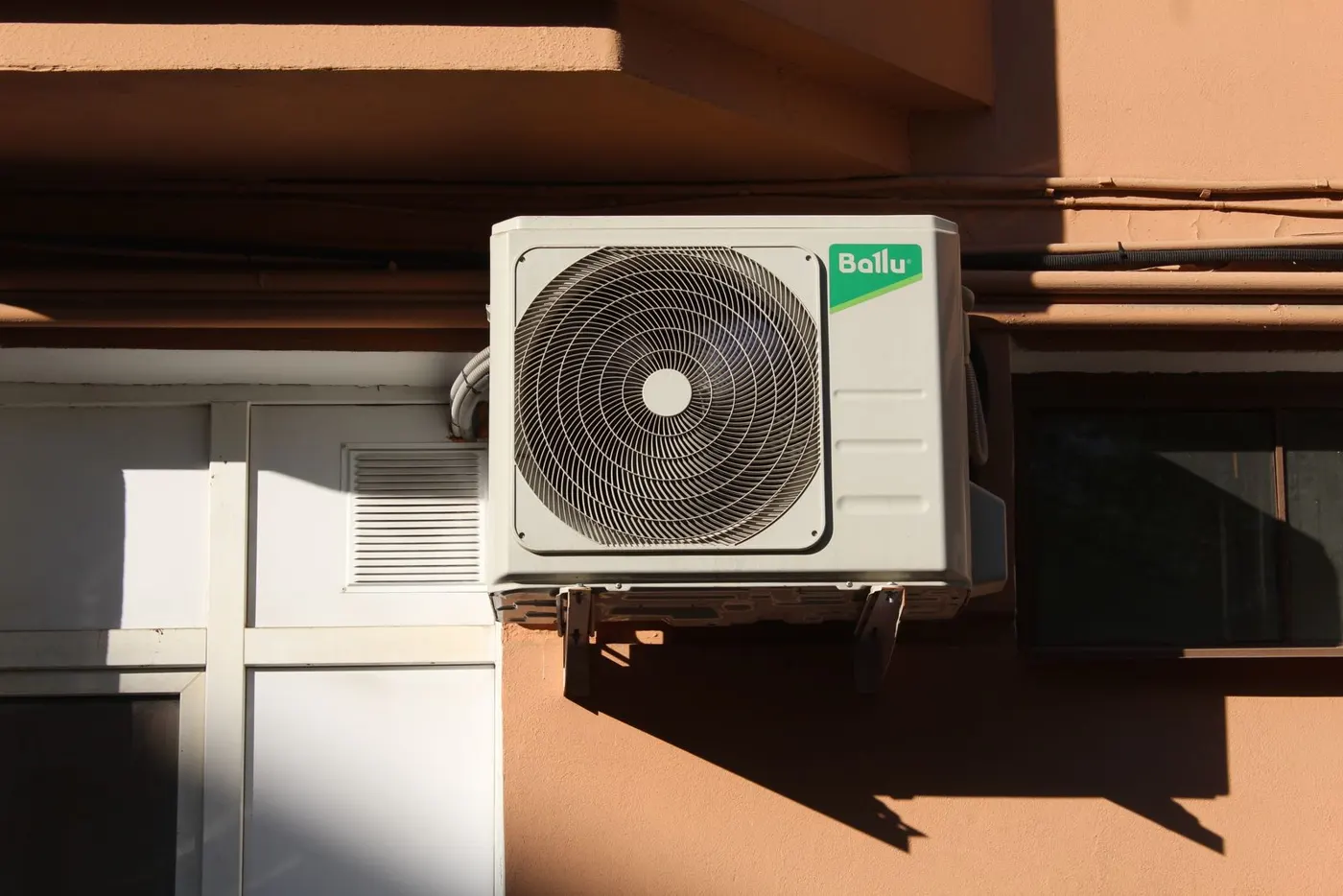
Tustin sits far enough inland that the marine layer burns off by mid-morning most of the summer. The equipment runs longer here than it does in the beach cities, and a part that is 80 percent healthy in May gets found out in August. Then October arrives, the Santa Anas pack the condenser coil with grit, and a system that was coping quits coping. Alpha & Omega is family-owned, based in Irvine, and in 92780 and 92782 most days. Call (949) 267-7771 and tell us three things: what the system is doing, where the indoor unit sits (attic, hall closet, garage), and whether you have central air with a gas furnace, a heat pump, or a mini-split.
Where the AC Sits in Tustin Homes, and Why It Matters
Tustin is a city you can read by decade, and the decade usually tells us the fault before we open anything. There is more on the neighborhoods on our Tustin service area page.
Tustin Ranch: systems that are now 25 to 35 years old
Tustin Ranch went up in the late 1980s and 1990s with full central air from day one, the air handler and cooling coil in the attic, the condenser in a side yard. Those original systems are now at the age where parts fail in a sequence rather than one at a time. We find run capacitors that measure low on a hot afternoon and fine in the morning, contactors with pitted and welded points, condenser fan motors with dry bearings, and blower wheels loaded with enough dust to throw them out of balance.
The other Tustin Ranch standard is the attic condensate path. The coil pulls water out of the air all day, down a primary drain line, with a secondary pan and a float switch underneath as the backstop. Dust and algae slime the primary line shut, water rises in the pan, the float switch kills the system. From inside the house that reads as a dead air conditioner: the thermostat calls for cooling and nothing happens, or the indoor fan runs while the outdoor unit never starts. If you see a brown ring spreading on a bedroom ceiling instead, water already got past the backstop. Shut the system off at the thermostat and call. Why an AC leaks water explains what is happening up there.
Attics in these two-story homes get genuinely hot through July and August. We book attic work early in the day when the schedule allows, for the technician and for the equipment.
Tustin Legacy, Columbus Square, Columbus Grove and Greenwood: heat pumps, not furnaces
The homes built on the old MCAS Tustin land in the 2010s and 2020s mostly cool and heat with an electric heat pump. One outdoor machine does both jobs, and it fails in ways a furnace-plus-AC pair never does. Mechanical closets in these houses are tight, the thermostats talk to the equipment over a data line rather than a simple set of on-off wires, and the first thing you see is often a code on a screen instead of an obvious symptom. The section below covers what those faults actually are.
Old Town and the 1960s tracts: cooling that was added later
Old Town bungalows from the 1920s through the 1950s were not built with air conditioning, and the Tustin Meadows, Peppertree, Laurelwood and Tustin Village slab tracts from the 1960s and 70s mostly had it added too. Retrofits leave their fingerprints. Returns are undersized, because nobody adds a big return grille to a finished house if they can avoid it. Duct runs take the path that was available rather than the path that was right, so one bedroom at the end of the line never cools. Added ducts in a shallow attic get stepped on and crushed. And where ducting a room was impossible, there is a mini-split on the wall or a window unit, often feeding a converted garage, an office or an addition.
Two things we check first in these houses. Filter and return airflow, because a starved coil freezes and then the house gets warm while the machine keeps running. And the condensate pump, if there is one. Retrofit air handlers and wall-mounted mini-splits often cannot drain by gravity, so a small pump with a float lifts the water out. When that pump clogs or its float sticks, a good mini-split shuts down and shows a code, and a basic one overflows onto the floor.
Condos and townhomes along Newport, Red Hill and Seventeenth
- Indoor units in closets. A vertical air handler in a narrow utility closet has very little room for return air. One clogged filter or a blocked louvered door freezes that coil fast, see why an AC freezes up.
- Outdoor units lined up on a shared pad or roof. Knowing which condenser is yours saves us real time. If it carries a unit number, send a photo when you call.
- HOA rules set the access. Roof hatches, work hours and parking are the association's call. We plan around them and leave an itemized invoice the owner or the HOA can file.
Renting? Call the leasing office or property manager first. Most leases route AC repair through management, and a repair you arrange on your own may not be reimbursed. We work for homeowners, condo owners, landlords and property managers, and we coordinate access with the tenant when the owner books.
North Tustin, Cowan Heights and Lemon Heights
Up the hill the lots get large and the houses spread out, which usually means long duct runs, sometimes two separate systems, and zone dampers on the newer installs. Long runs lose capacity at the far end, so the complaint is almost always one wing or one upstairs room rather than the whole house. A stuck zone damper or a failed zone board imitates a refrigerant problem closely enough that people spend money on the wrong thing. We check airflow and damper position before anyone talks about charge. These streets also sit closer to the brush, so expect the outdoor coil to load up faster than it does down in the flats.
Heat Pump Faults That Don't Look Like AC Faults
If your house is in Tustin Legacy, Columbus Square, Columbus Grove, Greenwood or Levity, it is probably a heat pump. Here is what we actually find, and what it looks like from the living room.
- A reversing valve stuck between modes. This valve is what makes one machine do both jobs. When it hangs up, you get cool air on a heat call or warm air on a cool call, and switching modes at the thermostat sometimes frees it for a day. That is the tell.
- A defrost board or coil sensor gone bad. In heating the outdoor coil ices over on purpose and the board runs a defrost cycle to clear it. A failed board or sensor leaves the unit iced on a cool morning and the heat drops off.
- Auxiliary heat strips running when they should not. Most of these homes have electric resistance strips for backup, and a thermostat set wrong or a stuck relay runs them instead of the compressor. The house stays warm and the electric bill roughly doubles. People call about the bill, not the equipment.
- Communicating thermostat faults. These systems share data over two wires, so a corroded connector, a pinched wire or a blown control-board fuse shows up as a dead thermostat or a fault code, not as a broken compressor. Thermostat problems that look like a broken AC or furnace has the test that separates them.
- Normal behavior that feels broken. A heat pump in heating mode delivers air at roughly 95 to 105°F at the register, where a gas furnace delivers 120 to 140°F. Hold your hand over a vent and it feels lukewarm. That is the technology, not a fault. Same with the newer inverter-driven units, which are supposed to run long and slow at low speed rather than snapping on and off.
Photograph any code on the thermostat or on the outdoor unit before you call. Codes are brand-specific, and a photo often decides which part rides out on the truck.
Is a 1990s R-22 System in Tustin Ranch Still Worth Repairing?
Usually, yes, and here is the honest split. Capacitors, contactors, fan motors, blower motors, float switches, thermostats and control boards do not care which refrigerant is inside the system. Those are the majority of failures at 25 to 35 years, they are normal repairs, and replacing a worn capacitor on a system that is otherwise fine is not throwing money away.
Where it changes is a leaking evaporator coil or a dead compressor. R-22 has not been produced or imported in the United States since 2020, so what is left is reclaimed stock, and the cost of charging a large leak reflects that. At that point a repair stops being minor service anyway, and we put the two options side by side instead of guessing for you. Our repair or replace guide shows how we weigh it, and what drives the cost of an AC repair in Orange County covers what actually moves the number.
Santa Ana Winds and the Condenser
October and November are the two months when a Tustin condenser goes from fine to struggling in under a week. The wind drives dust, grit and dry leaf litter straight into the coil, where it mats against the fins. A blocked coil cannot reject heat, head pressure climbs, the system runs and runs without reaching the setpoint, and on the hottest afternoon it either trips the compressor overload or starts short cycling on its high-pressure switch. From the house it reads as a failing compressor. Most of the time it is a coil that needs washing and a fan that needs freeing. Our AC short cycling guide shows what a normal cycle length looks like.
After a wind event, go look at the outdoor unit. Clear whatever has piled against the sides, pull the obvious debris out by hand with the power off, and cut back any plant that has grown within a couple of feet of the cabinet. On a coil that is only dusty, a garden hose rinse from the outside in with the breaker off is a reasonable homeowner job. If the fins are packed solid or bent, leave it alone. A coil hit with the wrong nozzle gets worse, not better.
Wind brings power flickers too. A compressor that tries to restart against pressure right after an outage can trip a breaker or finish off a weak capacitor. If the power blipped and the AC has not come back, check the breaker once and the outdoor disconnect switch, then call.
AC Symptoms and What They Usually Mean
- Runs but blows warm air, a failed capacitor or contactor letting the indoor fan run while the outdoor unit sits dead, a dirty condenser coil, a frozen indoor coil, or a refrigerant leak. Our guide on an AC blowing warm air walks through them in order.
- Cools some, never reaches the setting, airflow first (filter, return grille, crushed duct), then coil condition and charge. See AC not cooling.
- Won't start at all, thermostat, breaker, outdoor disconnect, or a float switch tripped by a clogged attic drain. The AC not turning on guide covers the free checks.
- Outdoor unit hums but the fan doesn't turn, usually a failed run capacitor or a seized fan motor. Shut it off. Leaving it humming cooks the compressor.
- Ice on the refrigerant lines or the indoor coil, restricted airflow or low charge. Turn cooling off, leave the fan on, let it thaw before anyone opens anything.
- Upstairs hot, downstairs fine, in a two-story Tustin Ranch or Tustin Legacy home the upstairs runs are the longest and they sit in the hottest part of the attic, so any loss of blower strength, duct leakage or charge shows there first.
- Water near the indoor unit or a stain on a ceiling, clogged condensate line, a rusted or cracked secondary pan, a drain fitting that came apart, or a condensate pump that quit.
- New noises, a rattling panel, a squealing blower bearing, a clicking relay that will not settle. Caught early these stay small repairs.
- A code on a thermostat, heat pump or mini-split, photograph it before you reset anything.
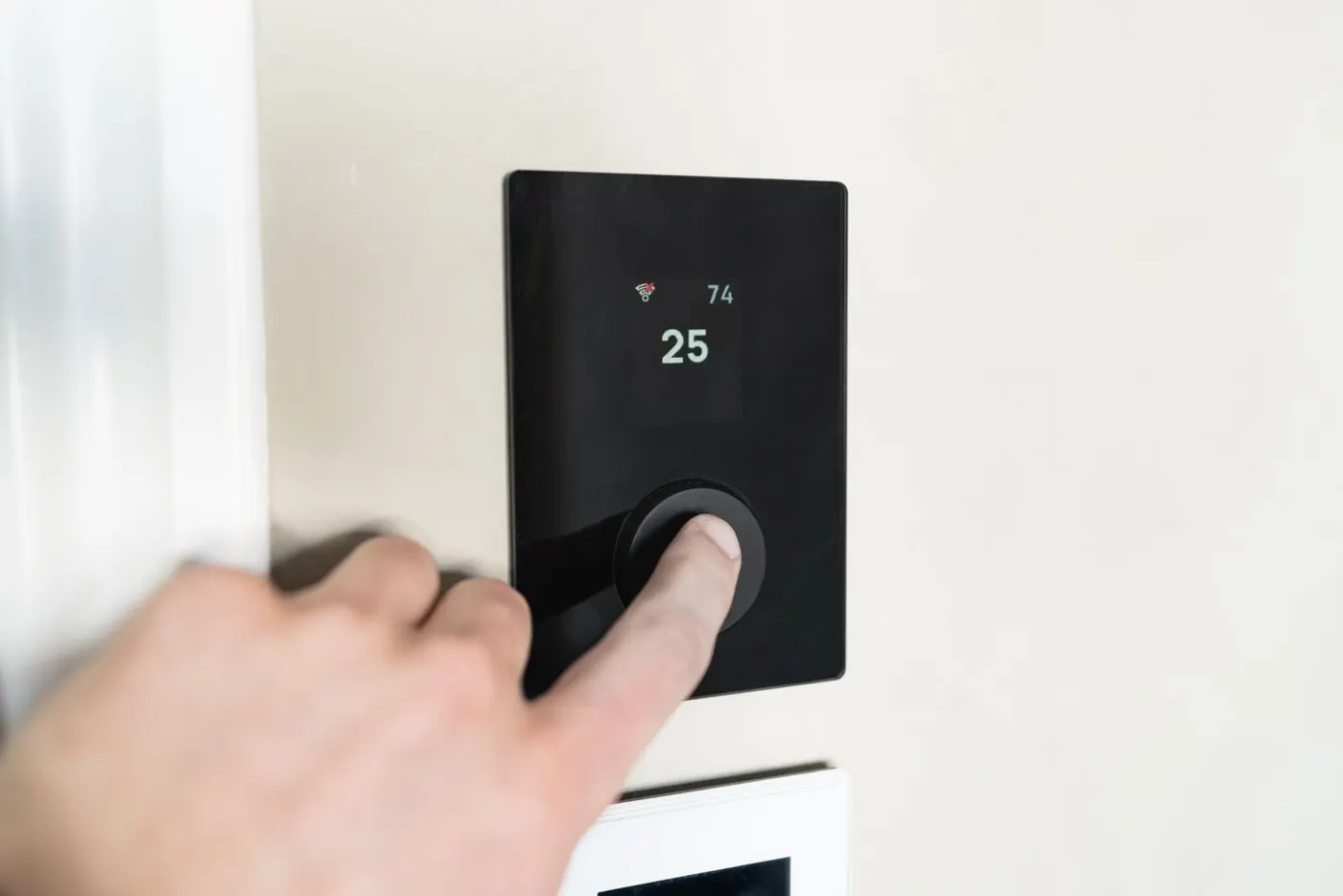
Not sure whether what you are hearing can wait until tomorrow? Our list of HVAC warning signs sorts the ones that can from the ones that mean shut it off now.
What You Can Safely Check Before You Call
- Thermostat. Mode on Cool, setpoint below room temperature, fan on Auto, fresh batteries if it takes them. Smart and communicating thermostats sit in eco, away and schedule modes that quietly override whatever you just pressed.
- Air filter. The single most common cause of weak airflow and frozen coils. In the two-story tracts it is usually behind a return grille in a hallway ceiling or wall, not at the unit.
- Breakers. Indoor and outdoor normally have separate ones. Reset a tripped breaker once. If it trips again, leave it off and call.
- Outdoor disconnect. Most condensers have a service switch on the wall beside them. Make sure it is on.
- Around the condenser. Clear leaves, bark, stored items and overgrown plants so the unit can actually move air.
- Vents. Open the supply registers and pull rugs and furniture off the returns.
What Not to Do
- Do not open the outdoor unit or touch a capacitor. It holds a charge after the power is off.
- Do not buy a refrigerant recharge can. Low charge means a leak, and handling refrigerant is EPA-regulated.
- Do not run a system with ice on it. That can send liquid refrigerant back to the compressor.
- Do not climb into a hot attic to clear a drain or bail a pan. Joists, heat and wiring make that a real injury risk, and a technician does it with the power off.
- Do not keep resetting a breaker that trips again. A repeat trip is a fault, not a nuisance.
- Do not switch a heat pump back and forth between heat and cool to "unstick" it more than once. If that is what it takes, the reversing valve needs looking at.
Refrigerant: Leaks Get Found, Not Topped Off
Our technicians are EPA Section 608 Universal certified. An air conditioner is a sealed system and does not consume refrigerant. If the charge is low, it is leaking, and the first honest step is finding where. Tustin covers the whole range: 1990s Tustin Ranch systems on R-22, the bulk of the city on R-410A, and recent Tustin Legacy equipment on lower-GWP refrigerants such as R-454B or R-32. The technician confirms which one is in your system before any refrigerant work, because the gauges, the oil and the parts are not interchangeable. If the leak is in a major component and the fix would run past minor service, we say so plainly.
What to Expect When You Call
- Call or text (949) 267-7771. Describe the symptom, say where the indoor unit sits, and name your neighborhood. A photo of the outdoor unit's data label helps us load parts.
- The technician diagnoses on site and quotes the repair before any work begins. Nothing gets replaced until you approve it.
- Common parts ride on the truck. Capacitors, contactors, float switches, drain clearing and coil washing usually finish on the first visit. Heat pump boards and communicating thermostats are more often an order, and we tell you when the part lands and book the return then.
- Every repair carries a 90-day parts and labor warranty. If the system is at the end of its life our repair or replace guide shows how we weigh it, and replacements go to our partner for new heating and cooling systems.
Our before the technician arrives checklist speeds the visit up. In Tustin homes the main thing is clearing a path to the attic hatch or the mechanical closet, and to the outdoor unit.
Keep It From Happening Again
Most of the emergency calls above were preventable. A drain line nobody had ever flushed. A filter in place for a year. A condenser buried in bark. An AC maintenance and tune-up covers the coils, the capacitor and electrical checks, the condensate drain and float switch, and airflow, and spring is the time for it, before the first real heat. On a Tustin Ranch system past twenty-five years a spring check is worth more than it is on a new one, because it catches the weak capacitor in April instead of on the first 95°F Saturday. Change the filter on the manufacturer's schedule, sooner with pets, and once a year on the coil is enough for most homes here. Twice if you are up near the brush in Cowan Heights or Lemon Heights. The Southern California AC maintenance checklist lays out the year.
Frequently Asked Questions
Can you repair my AC in Tustin today?
Often, yes. Tustin is minutes from our Irvine base and it is on the daily route, so it gets some of our fastest response times. On heat-wave days the schedule fills by mid-morning, so call (949) 267-7771 early. Same-day is not guaranteed. If today is full we say so and give you the first real slot.
My Tustin Legacy home has a heat pump instead of a furnace. Do you work on those?
Yes, in both heating and cooling modes. Reversing valves, defrost boards and sensors, auxiliary heat strips, and the communicating thermostats these homes use. Our technicians hold EPA Section 608 Universal cards. The work stays inside minor service and repairs under $1,000, and a new system or full replacement goes to our licensed HVAC partner.
Why is my upstairs so much hotter than downstairs?
In a two-story Tustin Ranch or Tustin Legacy home the upstairs ducts are the longest runs and they sit in an attic hotter than the house, so any loss of blower strength, duct leakage or charge hits the second floor first. Start with the filter and the return grille. A proper diagnosis measures airflow at the registers, checks duct condition in the attic, then verifies charge, and the fix is often smaller than people expect.
My AC quit and the thermostat is blank. Is the system dead?
Probably not. With the air handler in the attic there is a secondary pan and a float switch that cuts the system off when condensate backs up, and a clogged drain line tripping that switch looks exactly like a dead air conditioner. A blown low-voltage fuse on the control board does the same thing. Check the breaker and the filter, then call. Do not go up a ladder to clear an attic drain yourself.
My Tustin Ranch system is from the 1990s and uses R-22. Should I keep repairing it?
For most faults at that age, yes. Capacitors, contactors, fan motors, blower motors and control boards are the bulk of the failures and none of them depend on the refrigerant. Where it changes is a leaking evaporator coil or a dead compressor, because R-22 has not been produced in the United States since 2020 and reclaimed stock is expensive. At that point we lay the repair next to replacement and give you a straight recommendation.
Should I rinse off my outdoor unit after a Santa Ana?
Yes, if it is only dusty. Shut off the breaker and the outdoor disconnect, pull the loose bark and leaves out by hand, then rinse the coil gently with a garden hose from the outside in. No pressure washer, it bends the fins and makes the airflow worse. If the fins are packed solid, leave it for the tune-up.
Can you replace my system if it is beyond repair?
No. Our AC work is limited to minor service and repairs under $1,000. If the system needs replacing the technician will tell you plainly, and installation goes to our partner for new heating and cooling systems.
How is an AC repair in Tustin priced?
The technician diagnoses the system and quotes the repair on site before any work starts. Nothing is replaced without your approval, and every repair carries a 90-day parts and labor warranty.
Beyond Tustin
We also repair air conditioners in Irvine, Lake Forest, Mission Viejo and the rest of South Orange County, see the county-wide AC & air conditioning repair page and HVAC repair & maintenance. In Tustin we also handle refrigerator repair and oven and range repair. Restaurant, market or retail space with a rooftop unit? See commercial HVAC & rooftop AC repair and commercial refrigeration repair in Tustin.