
Is Your Oven Lying to You? 3 Kitchen Tests to Run Before Thanksgiving
Most people find out their oven is off at the worst possible moment, which is roughly 2pm on Thanksgiving with a 20-pound bird in it. That is a bad time to learn anything. The three tests below take an afternoon, cost almost nothing, and they are fun enough that kids will want in on the bread one. Run them this week and you will know exactly what you are cooking with.
Quick framing before you start. Your oven display shows the setpoint. It is the temperature the control board is trying to hold, based on one sensor in one place in the cavity. It is not a readout of the air around your turkey. On a healthy oven those two numbers are close. On a tired one they are not, and nothing on the panel will ever tell you.
Test 1: the bread slice map
This is the one worth showing people. It answers a question a thermometer cannot: is the heat even, or does your oven have a scorching back-right corner and a lazy front-left one?
What you need: enough cheap white sandwich bread to cover one rack, edge to edge. Six to nine slices on a standard rack, more on a 36-inch range. Plain white bread browns more evenly than sourdough or whole wheat, so it reads better.
How to run it:
- Pull every rack except one and put that one in the middle position.
- Preheat to 350°F. When the tone sounds, wait another fifteen minutes. The tone fires when the sensor hits the number, not when the oven walls and racks have caught up, and that lag is why so many home tests give garbage results.
- Lay the slices directly on the rack in a single layer, no pan, no parchment. Note which way is front.
- Shut the door and watch through the glass. Somewhere between 4 and 8 minutes the first slices start to color. Do not walk away. Bread goes from toasted to smoking faster than you think, and this test is not worth a fire.
- Pull the whole rack out when the darkest slices are a solid brown, and photograph it from above before anyone eats the evidence.
How to read it: an even oven gives you slices that are all within a shade or two of each other, usually a touch darker at the back. That back-is-darker gradient is normal on nearly every oven and is not a fault. What you are hunting for is a slice that is nearly black next to one that is still pale, or a whole dark stripe along one wall. That is a real hot spot and it changes how you cook, not whether you need a repair.
If you want the full map, run it a second time on the lowest rack position. Hot spots often live near the bake element or the gas burner at the bottom of the cavity, and the pattern down there can look nothing like the middle.
What you do with the answer is simple. Rotate the pan halfway through on anything that bakes longer than 25 minutes, and keep the dish you care most about out of the dead corner. People have been rotating pans for a century and it works.
Test 2: thermometer on the rack against the number on the screen
This is the test that produces an actual number, and it is the only one of the three that tells you whether you need a technician.
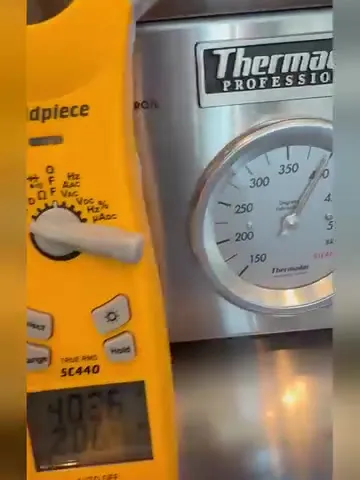
What you need: a standalone oven thermometer. A dial type that hangs on a rack is fine and widely available. A probe thermometer rated for oven use works too and is easier to read through glass.
How to run it:
- Hang or stand the thermometer in the center of the middle rack, away from the walls and not touching metal.
- Set the oven to 350°F and leave the door shut.
- Wait for the preheat tone, then wait another 20 to 30 minutes. This matters more than anything else in the test. An oven that has only just hit its setpoint has not stabilized.
- Read the thermometer through the glass. Then read it again every five minutes for twenty minutes and write down what you see.
How to read it: you are looking at two things, the average and the swing.
The swing is normal and people panic about it for no reason. Residential ovens hold temperature by cycling the heat on and off, so the air temperature rises and falls around the setpoint in a slow wave. Twenty to thirty degrees either side of the target over a cycle is ordinary behavior on a standard home oven. If your readings bounce between 330 and 375°F and average out near 350, that oven is fine.
The average is the part that matters. Add your readings up, divide, and compare to 350. Within about 15°F, you have a healthy oven and you can stop here. Off by 15 to 25°F and you have a known quantity, which is almost as good as accurate, because now you can cook around it. Off by more than 25 to 30°F in either direction, and something has drifted far enough that it is worth attention before the holiday.
One more thing to watch for, and this is the result that actually worries me: an oven where the readings never settle into a pattern. If it reads 300°F, then 390, then 310, with no rhythm to it, that is not a calibration problem. That looks like a sensor or a control issue, and it is a different conversation.
If your number comes back bad, the diagnosis side of this, what the calibration offset really does, how sensors drift, weak igniters, failing elements and door leaks, is all laid out in our guide to oven temperature problems before Thanksgiving. No point repeating it here.
Test 3: sugar on foil, for anyone who owns no thermometer
Be clear about what this one is. It is a rough, approximate check, it is a nice thing to show a curious nine-year-old, and it does not replace test 2. The thermometer is the instrument. This is a party trick that happens to be informative.
The idea: table sugar does not have a clean melting point the way water has a freezing point. Sucrose starts to break down and go liquid somewhere around 366°F, and the exact figure shifts with purity, with how fast you heat it, and with how long it sits. So sugar is not a precision instrument. What it can do is answer one yes-or-no question: did the inside of my oven get meaningfully above the mid-300s?
How to run it:
- Fold a square of aluminum foil into a small tray with turned-up edges, maybe three inches across. The edges matter, because melted sugar runs.
- Put a teaspoon of plain white granulated sugar in the middle. Set the tray on a baking sheet so nothing drips onto the oven floor, and put the sheet on the middle rack.
- Set the oven to 375°F and wait for the tone plus fifteen minutes.
- Look through the glass every few minutes. Stay in the kitchen. Sugar goes from melted to smoking to burnt in a hurry, and burnt sugar makes a smell that outlasts the holiday.
- Pull the sheet once the sugar has clearly gone liquid, or at the twenty-minute mark if it has not. Let the foil cool all the way before touching it, because molten sugar holds heat and sticks to skin.
How to read it: sugar that melts into a clear syrup at a 375°F setting means the cavity is getting above roughly 366°F, which is consistent with an oven that is at or slightly above its setpoint. Sugar that stays dry and granular after twenty minutes at 375 is a flag. It suggests the cavity never got near 366°F, which on a 375 setting means the oven is running meaningfully cold. Sugar that melts and goes dark brown within a couple of minutes suggests the opposite, an oven overshooting its target.
Then go buy a thermometer and run test 2, because "meaningfully cold" is not a number anyone can repair.
What your results mean, side by side
| What you observed | What it points to | What to do next |
|---|---|---|
| Bread evenly browned, maybe slightly darker at the back | Normal airflow and a healthy cavity | Nothing. Rotate pans on long bakes out of habit |
| One slice nearly black, a neighbor still pale | A genuine hot spot, common on older and on very wide cavities | Cook around it, rotate pans, keep the pie out of that corner |
| A dark stripe along one wall or the back | Uneven heat distribution, sometimes a convection fan not running | Listen for the fan on convection. If it is silent, mention it when you call |
| Thermometer averages within 15°F of the setpoint | Healthy oven | Done. Cook with confidence |
| Thermometer consistently 15 to 25°F off, steady | Drift. Often correctable with the built-in calibration offset | Check your manual for the offset setting, then re-test |
| Thermometer more than 25 to 30°F off, steady | Beyond what most offsets can absorb. Sensor, igniter or element | Get it looked at before the holiday |
| Readings jump with no pattern, 300 then 390 then 310 | Sensor or control behaving badly, not a calibration issue | Call. An offset will not fix this and may hide it |
| Takes far longer than 15 minutes to reach 350°F | Weak element, weak igniter, or heat escaping past the door | Note how long preheat takes and tell us |
| Sugar still granular after 20 minutes at 375°F | Cavity is running well under the setpoint | Confirm with a thermometer before anyone touches anything |
What these tests cannot tell you
Worth being honest about the limits, because a confident wrong conclusion is worse than no test at all.
- They do not identify the failed part. An oven running 40°F cold could be a drifted sensor, a bake element that is losing output, a gas igniter too weak to open the valve on time, a bad door seal, or a board acting on bad data. The tests tell you there is a problem. They do not name it.
- They say nothing about broil. Broil is a separate element or burner on its own circuit. An oven can bake perfectly and have a dead broiler.
- They do not check the self-clean cycle, and I would not test that one before a holiday anyway. Running self-clean the week before Thanksgiving is one of the better ways to turn a working oven into a locked one, which is why we wrote a whole guide on skipping it.
- They cannot see a gas problem. If you smell gas, or the burner lights with a bang instead of a soft whoosh, stop the tests. That is covered in gas oven smells or pops when it lights, and a strong smell means leave the house and call the gas utility from outside.
What you can safely do yourself after a bad result
- Re-run the thermometer test with the oven fully cold at the start and nothing else in the cavity. Half of all alarming results come from a test run on a rushed preheat.
- Check the door. Close it on a strip of paper and pull. If it slides out freely at any point around the perimeter, the gasket is letting heat out. Look for a gasket that has hardened, torn or pulled out of its channel, and check that the door is not sitting slightly open on sagging hinges.
- Look at the calibration offset in your settings menu. Most brands bury an adjustment there, often reachable by holding Bake for several seconds. If someone adjusted it years ago and forgot, that alone can explain a steady 20 or 30 degree error. Reset it to zero and re-measure before you adjust it the other way.
- Clear out the clutter. Foil on the oven floor, a stone left on the bottom rack, a sheet pan parked under the bake element. All of them change how heat moves and all of them can create a hot spot you then blame on the oven.
- Watch an electric bake element heat up with the oven on bake and nothing in it. It should glow an even orange along its whole length. Dark sections, blisters or a split are a clear answer. Look, do not touch.
That is the safe list. Everything past it involves live voltage, a gas valve, or a meter, and it belongs to somebody with the tools.
What only a technician should do
- Read the temperature sensor's resistance against the manufacturer's chart and decide whether the sensor drifted or the board is misreading a good sensor.
- Measure igniter current draw on a gas oven. A glowing igniter is not a working igniter. If it cannot pull enough current, the safety valve never opens and the oven runs cold or not at all.
- Test bake and broil elements and the relays on the control board under load.
- Replace a door gasket, adjust or replace hinges, or deal with a cavity that will not hold heat.
- Anything behind the back panel of a 240V electric range or anywhere near the gas supply line.
Gas or electric, both get fixed
Saying this plainly because people ask. We repair gas ovens and electric ovens, dual-fuel professional ranges, freestanding and slide-in ranges, single and double wall ovens, and convection and non-convection cavities. The tests above work the same on all of them. What differs is what fails: on gas the usual suspects are the igniter and the safety valve, on electric it is elements, relays and sensors.
We are Factory Authorized Bertazzoni Repair, Factory Authorized Thor Kitchen Repair and Factory Authorized ZLINE Repair, and we provide professional Thermador, Wolf, Viking, Dacor, Bosch, KitchenAid, GE, Whirlpool, Samsung, LG and Frigidaire oven and range repair. Full details on the oven and range repair page.
How to keep an oven honest
- Leave the oven thermometer in there permanently. It costs nothing to glance at, and you will catch drift the month it starts instead of the afternoon it ruins something.
- Wipe spills while the cavity is warm rather than banking them for a self-clean cycle later. Carbon buildup is what makes self-clean so hard on the oven.
- Do not line the oven floor with foil. It reflects heat back at the bottom element and at the sensor, and it is a reliable way to create the hot spot you will find in test 1 next year.
- Give the preheat the extra fifteen minutes before anything goes in. Free, and it fixes more "bad oven" complaints than any part we sell.
- Run the thermometer test twice a year. Pick dates you will remember, like the week before Thanksgiving and some random week in spring.
When to call
Call if the thermometer average is more than 25 to 30°F from the setpoint, if the readings have no stable pattern, if preheat to 350°F takes much longer than about fifteen minutes, if you see or smell anything gas related, or if the bread test comes back so uneven that no amount of pan rotating saves it.
On the visit our technician measures the real cavity temperature over a full heating cycle, checks the sensor against its chart, tests the igniter or the elements under load, and looks at the door seal and hinges before anyone talks about parts. You get the diagnosis explained and a quote on site before any work starts, and repairs carry a 90-day parts and labor warranty.
We work out of Irvine and cover the corridor down to San Clemente, with local oven and range pages for Irvine, Tustin and Lake Forest, plus Mission Viejo, Laguna Niguel, Aliso Viejo and the rest of South Orange County. If a test came back ugly, call (949) 267-7771 with your brand and model number and what the thermometer read. We are 5.0 on Yelp if you want to see how these visits usually go.
Frequently Asked Questions
How far off can an oven be and still be considered normal?
An average cavity temperature within about 15°F of the setpoint is normal and nothing to act on. You should also expect the temperature to swing roughly 20 to 30°F either side of the target during a cycle, because home ovens hold heat by switching it on and off rather than holding it steady. The number that matters is the average over several readings, not any single reading. More than 25 to 30°F off on average is where it stops being normal.
Does the bread test actually work, or is it just a social media thing?
It works for what it measures, which is evenness, not accuracy. A rack covered in white bread at 350°F gives you a visual map of where your oven runs hot and where it runs cool, and that map is genuinely useful when you are deciding where to put the pie. What it cannot do is tell you the oven's actual temperature. For that you need a thermometer. Run both.
Why does sugar melt around 366°F, and how reliable is that?
Table sugar is sucrose, and unlike water it does not have one sharp melting point. It begins breaking down and turning liquid in the neighborhood of 366°F, and the exact temperature shifts with purity, heating rate and how long it has been sitting in the heat. Treat it as a yes-or-no signal about whether the cavity got above the mid-300s, nothing finer. An oven thermometer is the tool that gives you a number you can repair against.
My oven is off by 30 degrees. Can I just use the calibration setting?
Sometimes, and sometimes that is the wrong move. The offset tells the board to add or subtract a fixed number of degrees from whatever the sensor reports. If the sensor is accurate and the whole cavity simply runs a little cool, an offset is the right fix and most brands allow an adjustment in the range of about 30 to 35 degrees. If the sensor itself has drifted, an offset papers over the fault at one temperature while the error grows at others, and it hides a problem that keeps getting worse. If your readings are unstable, do not use the offset at all.
When should I run these tests before Thanksgiving?
Two weeks out. The tests themselves take an afternoon, but the point of doing them is to leave yourself room. If the result sends you looking for a repair, the week of the holiday is the busiest week of the year for every appliance company in Orange County, and parts availability tightens up at the same time. Testing on the Tuesday before Thanksgiving gives you the information with none of the time to use it.
Can I do these tests on a gas oven, or only electric?
All three work on both. The bread test, the thermometer test and the sugar test are measuring air temperature in the cavity, and the cavity does not care how the heat was made. What changes is the likely cause behind a bad result. Gas ovens usually fail at the igniter or the safety valve, electric ovens at the bake element, the relay or the sensor. We repair both, along with dual-fuel professional ranges.
Related Pages
- Oven Temperature Problems That Can Ruin Thanksgiving Dinner
- How to Prepare Your Oven for Thanksgiving
- Oven Not Heating? Igniter, Element, Sensor and Board
- Oven Won’t Turn On? Dead Display, Control Lock and Breaker Checks
- Should You Run Oven Self-Clean Before Thanksgiving?
- Double Oven & 48-Inch Range Problems During Holiday Cooking
- Gas Oven Smells Like Gas or Pops When It Lights?
- Gas Range Burner Problems
- What to Do If Your Oven Stops Working on Thanksgiving Day
- Oven & Range Repair in Orange County
- Oven & Range Repair in Irvine
- Irvine · Tustin · Lake Forest · Mission Viejo · Laguna Niguel · Aliso Viejo · San Juan Capistrano · San Clemente