
Oven & Range Repair in Mission Viejo, CA
- ⭐ 5.0★ Yelp · 5.0★ Google
- 🛡️ 90-Day Parts & Labor Warranty
- 📅 20+ Years of Experience
- 📍 Based in Irvine, 20 minutes down the 5
Quick answer
We repair gas, electric and dual-fuel ovens and ranges across both Mission Viejo ZIP codes, 92691 and 92692. Original freestanding ranges in the first Mission Viejo Company tracts, 27-inch wall oven stacks in the single-story homes of Casta del Sol and Palmia, 1990s double ovens in Pacific Hills and Painted Trails, and the LG, Samsung and KitchenAid units that went into kitchens remodeled in the last fifteen years. We run a south county route daily and we're 20 to 25 minutes away on the 5 or the 241, so a morning call usually gets a same-day window. Free estimate over the phone, the technician quotes the repair on site before anything is touched, and every repair carries a 90-day parts and labor warranty.
Hosting Thanksgiving? Run the oven hard in the first week of November, while the schedule still has room. Our Thanksgiving oven checklist walks through the test in about an hour.
Most of the ovens we open in this city are older than the people cooking on them expect. Mission Viejo was built in waves from the late 1960s into the 1990s, and a lot of those kitchens have been remodeled once, around twenty years ago. So the appliance is either close to original or it's a mid-grade unit from a 2005 kitchen job, and both of those are at the age where parts start going. Alpha & Omega is a family-owned shop with 20+ years in Orange County, based in Irvine, and Mission Viejo is on our daily south county run. Call (949) 267-7771 with the brand and the model number in hand.
Which Mission Viejo kitchen are we walking into?
Telling us the neighborhood narrows the diagnosis before we reach the driveway, because the whole city went up in batches. Our Mission Viejo service area page covers the rest of what we do here.
Deer Springs, Aliso Villas, Deane Homes, Cordova and the first tracts
Single-story slab homes from roughly 1966 to 1975, laid out with a 30-inch gas range against the wall and no wall oven at all. Almost all of them are on their second or third range. The repairs are the ordinary ones: a glow-bar igniter that takes twenty-five minutes to open the gas valve, a surface burner that clicks without catching, a door that no longer seals at the top corner.
What makes these houses different is what's behind the appliance. Gas shutoff valves of that era are often painted over and stiff. The 240-volt receptacles in the ones that went electric are frequently the old three-slot type, which matters if you're shopping for a replacement range. More on that below, because it catches people every year.
Casta del Sol and Palmia
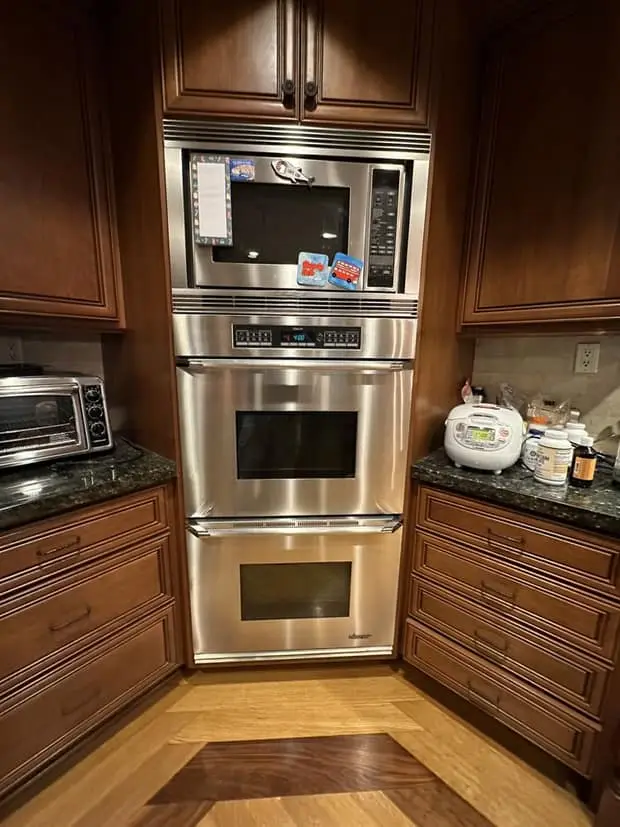
Age-restricted, single story, and the kitchens are the most interesting ones we see here. A good number still have the original wall oven, usually a 27-inch single or a 27-inch stack in a cabinet by the hallway, sometimes with the burner surface across the room on a peninsula. Those ovens are forty years old and they often work, because they've been used lightly.
Lightly used is not the same as young. The igniter still ages, the door gasket still goes hard, and the bake element still corrodes at the terminal where it passes through the back wall. What we see in these homes is an oven that bakes a casserole fine and then fails on the first six-hour day of the year. If you're hosting family this November, that's the oven I'd test early.
We work in both communities regularly, so we know the gate procedure and the parking. Ask for a morning slot if the gatehouse needs a name on the list.
Mission Viejo North, Stoneridge, Canyon Crest and the 1980s streets
Two-story homes from about 1978 to 1990, built on the slopes above Marguerite and up near Saddleback College. Here the layout changes: an electric wall oven in a 27 or 30 inch cabinet opening, a separate gas burner surface, and a vent hood that actually ducts outside. Those ovens are now 35 to 45 years old and they fail in sequence rather than all at once. Bake element, then temperature sensor, then the door latch, usually in that order over a few years.
Mechanically they're simple, and the parts that break are still made. The frustrating part is that nobody thinks about a 1985 wall oven until the turkey is already thawing in the refrigerator.
Pacific Hills, Painted Trails and the 1990s homes
Bigger kitchens, and the first generation of double wall ovens and 36-inch ranges in this city. Add a warming drawer in the nicer plans. Two cavities means two bake elements, two sensors, two convection fans and one control board running most of it, so we schedule more time for a first visit instead of rushing the call. If you cook both cavities at once in November, read double oven and range holiday cooking before the day.
When one cavity heats and the other is dead, the control is at least partly alive. That puts the odds on the element, the sensor or the relay for the dead cavity, and I'd test those three before anyone quotes you a board. Double ovens do have to come partway out of the cabinet to reach the wiring, which is a two-person lift on most models.
Townhomes and condos off Marguerite, Alicia and Jeronimo
Galley kitchens, narrow doorways, and a slide-in or freestanding 30-inch range squeezed between cabinets. The repair itself is normal. The access is the part worth planning. We pull the range out on hardboard or a blanket so the vinyl or tile doesn't scar, and on a tight galley we take the oven door off first to get a clean look at the back of the cavity. Tell us if guest parking needs a permit and we'll bring what we need in one trip.
The oven that sits cold for eleven months
This is the pattern in Mission Viejo more than in the newer cities around it. Plenty of homes here cook on the stovetop most of the year and use the oven hard twice, at Thanksgiving and at Christmas. People assume an appliance that gets used that little should last forever. It doesn't work that way, and the reasons are worth knowing.
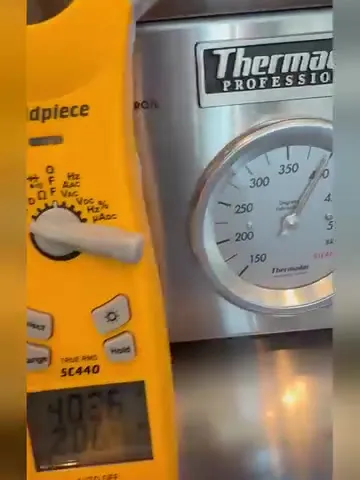
- Glow-bar igniters degrade on hours, but they also age on the shelf. The silicon carbide bar gets more resistant over time, so it draws less current. Below roughly 3.2 to 3.6 amps on most models it still glows orange and still fails to open the safety valve. A light-use oven gets there slower, not never.
- Door gaskets go hard with age, not with cycles. The braided rope seal loses its spring and flattens at a corner. On a short bake you'd never notice. On a six-hour roast the lost heat shows up as a cold top rack.
- Old grease is the fuel for a self-clean failure. Twenty years of residue plus a 900-degree cycle is how a tired thermal fuse or door lock finally quits. That's why running self-clean the week before the holiday is the worst possible timing.
- Temperature sensors drift a few degrees a year whether you cook or not. Two decades of slow drift reads as an oven that used to be fine and now browns everything on the bottom.
- Mice and spiders find a cold oven. In the hillside tracts backing onto open space we do find nesting material in the burner compartment under a range that hasn't run in months. It smells on the first long bake and it belongs out of there before the day.
None of that means your oven is about to break. It means the first long run of the season is the real test, and it's better to do that test in early November than on the morning of the holiday. Twenty minutes with an oven thermometer tells you most of it, and this test shows how.
Still cooking on a standing pilot range?
A handful of the original tracts here still have one, usually in a house that stayed with the same owner for decades. There's no igniter at all. A small pilot flame burns continuously under the oven floor, and the oven thermostat is a capillary tube with a fluid-filled bulb clipped inside the cavity, not an electronic sensor and a control board.
They're repairable and they're honest machines. What goes wrong is specific:
- The pilot blows out or burns yellow. Usually a clogged pilot orifice or a draft. It needs cleaning and adjusting, not a new part.
- The oven runs hot or cold by a wide margin. The capillary bulb has slipped out of its clip, or the thermostat has lost its charge. A slipped bulb is a two-minute fix that gets blamed on the oven being worn out.
- The oven won't hold at all. That's the thermostat or the safety valve, and for some of these ranges those parts now only exist as used stock. We check availability before quoting, and if nothing is out there we say so instead of selling you a diagnosis you can't act on.
- Gas smell with no flame. Stop. Turn the gas off at the valve behind the range, open a window, and keep the light switches alone. What to do about a gas smell or a pop covers the order.
My honest view on these: if the fault is pilot adjustment, a thermostat bulb or a burner, fix it. If the thermostat body is gone and no part exists, the range has reached the end, and a modern one will be safer and cheaper to run.
Three wires or four: why a new electric range won't just plug in
This comes up every year in the older Mission Viejo tracts, and it has nothing to do with the appliance being faulty. Electric range circuits installed before the mid 1990s typically landed on a three-slot receptacle, where the metal frame of the range shared the neutral. Since 1996 the code has called for a four-wire circuit with a separate ground. Every new range ships to match the newer wiring.
So you buy a range, the delivery crew looks at the wall, and the cord doesn't fit. Here's what's actually involved:
- A matching three-wire cord can be fitted to most new ranges, and a bonding strap inside the terminal block has to be set correctly for that configuration. It is the manufacturer's own instruction, printed on the back of the range, and it has to be followed exactly.
- Nobody should cut, clip or ignore the fourth wire to make a plug fit. That defeats the ground.
- If you want the circuit brought up to four wires, that's a job for a licensed electrician, not for us. We repair the appliance. We'll tell you plainly which one you're looking at.
A related one, and the single most common false alarm we get from these homes: an electric range or wall oven runs on a double-pole 240-volt breaker, and one half can trip while the other half holds. The display stays lit, the clock keeps time, the burners may still work, and the oven stays stone cold. Switch the breaker fully off, then back on, before you call anyone. Why an oven won't turn on runs through the rest in order.
Symptom to likely cause
This is the short version of how we sort an oven call on the phone. It's not a repair manual, it's the order we'd check things in.
| What you notice | Most likely causes |
|---|---|
| Gas oven takes 25 minutes or more to start heating, igniter glows the whole time | Weak glow-bar igniter drawing too little current, less often the gas safety valve |
| Igniter glows, flame never arrives at all | Same igniter further gone, or a safety valve that no longer opens |
| A pop or a whoomp when the gas oven lights | Delayed ignition from a weak igniter or a blocked burner port. Stop using the oven |
| Electric oven dead, no heat from bake, broil still works | Open bake element, often broken where it passes through the back wall |
| Everything comes out pale, or 25 degrees or more off the setpoint | Temperature sensor drift, calibration offset set by a previous owner, door not sealing |
| Oven heats, convection makes no difference | Convection fan motor, convection ring element, blade loose on the shaft |
| Clock and display lit, oven never heats, burners fine | One leg of the 240-volt supply lost at the breaker, control relay, thermal fuse |
| Oven shuts itself off partway through a long bake | Cooling fan not running and the control overheating, a failing relay, a sensor reading out of range |
| Door locked after a self-clean cycle and won't release | Door lock motor or switch that didn't finish travel, thermal fuse, board. Don't force it |
| Heat rolls out the front and the kitchen gets hot | Flattened gasket, sprung hinge springs, inner glass pack out of position |
| Burner clicks but won't light | Burner cap seated off-center after cleaning, damp or clogged port, cracked spark electrode |
| One cavity of a double oven heats, the other is dead | Element, sensor or relay for the dead cavity. The board is the last suspect, not the first |
Two of those deserve their own reading. An oven that won't heat and an oven that holds the wrong temperature are different problems with different parts, and people often start down the wrong one. For burner complaints on a gas range, gas range burner problems goes deeper.
Gates, HOAs and how the visit actually works here
More of Mission Viejo sits behind a gate or inside an association than most of the corridor, and in Casta del Sol and Palmia there's often a resident who wants the diagnosis explained properly rather than handed over as a part number. That's fair, and it changes how we schedule.
- Gate access. If the gatehouse needs a name on a list or a call-box authorization, tell us when you book. A technician sitting at a call box is time out of your window.
- Written quote on site. The technician diagnoses, then quotes the repair before any work starts. Nothing gets replaced until you say yes, and you get the price in writing, not a verbal number.
- Protection first. Hardboard or blankets under the appliance, cabinet faces covered. Older tile and vinyl floors chip easily, and a range foot will find the weak spot.
- Brand warranty paperwork. If the oven is still inside a manufacturer warranty, we'll tell you that instead of charging you for it. How appliance warranties work explains what tends to be covered past year one.
- Plain language. You should finish the visit knowing which part failed, why, and what it would take to avoid it next time.
What you can safely check before you call
- The breaker, all the way off and back on. On a 240-volt oven, half a tripped double-pole breaker leaves the panel lit and the cavity cold.
- Control lock, delay start and Sabbath mode. Any of the three makes a healthy oven look broken, and all three get switched on by accident while cleaning the panel. Your manual has the key combination.
- What the oven is actually doing. Put a cheap oven thermometer on the middle rack, set 350°F, read it after 25 minutes. That one number saves real time on the phone.
- The door seal. Shut a sheet of paper in the gasket at a few points and pull. If it slides out with no grip along the top, the door isn't sealing.
- Burner caps and grates on a gas range. Seat the cap square on the burner and let the ports dry if you've just washed them.
- The model tag. On a wall oven it's on the frame, visible with the door open. On a range, look behind the storage or warming drawer. Text us a photo of it and we have a much better chance of arriving with the part.
Five minutes with the before the technician arrives checklist usually shortens the visit.
What not to do
- Don't light a gas oven by hand, and don't keep retrying one that won't catch. Every attempt puts more unburned gas in the cavity.
- If you smell gas, leave the switches alone, get outside, and call SoCalGas from there. If they test the line and tell you the appliance is at fault, here's what happens next.
- Don't run self-clean in the weeks before a holiday. The cycle takes the cavity close to 900°F, and that heat is what finishes off a tired thermal fuse, door lock or board. Why self-clean before Thanksgiving backfires has the details.
- Don't line the oven floor with foil. It blocks airflow and skews what the sensor reads.
- Don't force a door that locked during self-clean. You'll turn a latch motor into a latch assembly and a panel.
- Don't pull a wall oven out of its cabinet or open the control panel. Live 240-volt wiring and gas connections are technician work.
Is it worth repairing an original wall oven here?
Usually yes, and the reason has more to do with the cabinet than the oven. Openings cut in the 1970s and 1980s were framed for the oven that went in them, and a lot of Mission Viejo kitchens tiled the counter and scribed the trim right up to the appliance. A cabinet framed for a 27-inch oven takes a 27-inch oven. Today's selection in that size is thin, the depths don't match, and the replacement that looks simple on the showroom floor turns into cabinet work, tile work and a kitchen out of service for a week.
So before you shop, measure. Cutout width, height, depth from the cabinet face to the back wall, and where the 240-volt junction box or whip sits. Photograph the data plate while the door is open. A double stack is harder still, because the current ovens in that nominal size often sit an inch or two off in height.
Against all that, the parts that fail on these ovens are ordinary. Bake element, broil element, temperature sensor, thermal fuse, door latch, hinge, convection fan motor. When one of those is the fault, repair wins on money and on time.
Where I'd tell you to replace: a cracked cavity liner, a failed board on a model where no board exists new or rebuilt, or a third separate failure inside a year on an oven past forty. Our repair or replace guide shows how we weigh it.
Between holidays, what's actually worth doing
Short list. Most oven maintenance advice is make-work.
- Check the door seal once a year. The paper test above. A flattened gasket is cheap and it cures temperature complaints people blame on the sensor.
- Verify the temperature once a year with a thermometer on the middle rack. Drift is gradual, which is exactly why you don't notice it.
- Clean spills when they happen, not with a 900-degree cycle. If you do use self-clean, do it in January, not November.
- Wipe the burner ports and seat the caps after any stovetop cleaning on a gas range.
- If you have a steam or steam-assist oven, descale it on schedule. Mission Viejo water is hard, and scale in a steam generator is the single most common reason those stop making steam. Skipping two cycles of descaling is how a repair gets created.
- Leave the vent path clear. On a wall oven the cooling vent is usually a slot above or below the door. Blocking it with a towel rail or a bank of baking sheets makes the control run hot.
The same hard water that scales a steam oven is what we see in ice makers and water valves across this city, covered on our Mission Viejo refrigerator repair page.
Thanksgiving in Mission Viejo: test it the first week of November
Oven repairs are rarely complicated. What makes them stressful in late November is the calendar. Parts for mainstream brands usually land in a few days. Parts for built-in and pro-style ovens often ship from the manufacturer, and the week of the holiday the carriers are slow and the suppliers are closed. An igniter that would have been a one-visit job on November 5 can turn into a cold oven on the 26th.
The test takes about an hour. Preheat to 350°F, leave it an hour, thermometer on the middle rack, then bake a sheet of biscuits and look at whether the browning is even front to back. Run the broiler for five minutes. If you cook on two cavities, run both. Anything that looks off, call while the schedule still has room. If it all behaves, you've lost an hour and gained a quiet week. What to do if the oven quits on the day is worth skimming either way.
Oven brands we repair in Mission Viejo
We are Factory Authorized for LG and Bertazzoni, and our technicians are Samsung-certified, see Samsung appliance repair. Between them that covers most of what went into remodeled kitchens here over the last fifteen years. We also work on Thor Kitchen and ZLINE ranges, which show up in recent remodels off Alicia and Jeronimo. In the larger Pacific Hills and Canyon Crest kitchens we're experienced with Thermador, Viking and Miele built-ins. Wolf, Dacor, Monogram, GE and GE Profile, Café, JennAir, KitchenAid, Whirlpool, Maytag, Electrolux and Bosch we service professionally. Older Magic Chef, O'Keefe and Merritt and Hotpoint ranges from the first tracts we'll look at, and we'll tell you honestly whether the part still exists.
What happens when you call
- Call or text (949) 267-7771. Tell us the brand, the model, what the oven is doing and which part of Mission Viejo you're in. The estimate over the phone is free, and mention the gate if there is one.
- A technician diagnoses on site and quotes the repair before any work starts. Nothing gets replaced until you approve it.
- Most oven repairs finish on the first visit. If a part has to be ordered we tell you when it's expected and book the return trip right then.
- Every repair carries a 90-day parts and labor warranty. If the oven is old enough that you're weighing it up, we'll give you a straight recommendation rather than a sales pitch.
Frequently asked questions
How soon can you get to Mission Viejo for an oven repair?
We run a south county route every day and Mission Viejo is 20 to 25 minutes from our Irvine base on the 5 or the 241, so a morning call usually gets a same-day window in 92691 or 92692. November is the exception. The two weeks before Thanksgiving fill up, and if the day is full we say so instead of booking a window we cannot hold. Tell us at booking if a gatehouse needs your name on a list.
My range is from the 1970s and has a pilot light instead of an igniter. Can it still be repaired?
Often yes. A clogged pilot orifice, a draft putting the pilot out, or a capillary thermostat bulb that has slipped out of its clip in the cavity are all fixable, and the last one is a small job that gets blamed on the range being worn out. Where it gets hard is the thermostat body and the safety valve, because for some of these ranges those parts only exist as used stock now. We check availability before quoting, and if nothing is out there we tell you rather than selling you a diagnosis you cannot act on.
The new electric range I bought has four wires and my outlet has three slots. What do I do?
That is the age of the circuit, not a fault in the range. Electric range circuits installed before the mid 1990s usually landed on a three-slot receptacle, and the code has called for a separate ground since 1996, so every new range ships to match the newer wiring. A matching three-wire cord can be fitted to most new ranges, with the bonding strap in the terminal block set exactly as the manufacturer prints on the back of the appliance. Nobody should cut or ignore the fourth wire to make a plug fit. If you want the circuit brought up to four wires, that is work for a licensed electrician, not for us.
Do you work in Casta del Sol and Palmia?
Yes, regularly. We follow the gate and association procedures, we quote the repair in writing on site before any work starts, and the technician explains which part failed and why rather than handing over a part number. A lot of the ovens in both communities are original 27-inch units that still work, so the question is usually what one part is needed, not whether the oven is finished.
My oven has barely been used since last Thanksgiving. Why would it fail now?
Because several of the parts that fail age on time rather than on use. A glow-bar igniter gets more resistant over the years, so it still glows orange while drawing too little current to open the gas valve. Door gaskets go hard and flatten whether you cook or not. Temperature sensors drift a few degrees a year. A short bake hides all three. A six-hour roast does not, which is why the first long run of the season is the real test and why we tell people to do that test in early November.
Can I run self-clean before Thanksgiving to get the oven ready?
I would not. The cycle takes the cavity close to 900°F, and in an oven with twenty years of residue in it that heat is what finishes off a tired thermal fuse, door lock motor or control board. We get those calls every November. Wipe the spills by hand before the holiday and save self-clean for January, when a failure is an inconvenience instead of a ruined dinner.
My kitchen is a tight galley in a townhome off Marguerite. Is that a problem for the repair?
No, it just changes how we set up. We slide the range out on hardboard or blankets so the floor does not scar, and in a narrow galley we take the oven door off first to get a clear reach into the back of the cavity. Tell us if guest parking needs a permit, because that is the one thing that costs us a second trip.
What does oven repair cost in Mission Viejo, and is the work guaranteed?
The estimate over the phone is free, and the technician quotes the repair on site before any work starts, so you approve the price before anything is touched. Every repair carries a 90-day parts and labor warranty.
Beyond Mission Viejo
We repair ovens and ranges in Irvine, Tustin, Lake Forest, Laguna Hills, Laguna Niguel, Aliso Viejo, Rancho Santa Margarita and the rest of South Orange County. The county-wide page is oven and range repair. In Mission Viejo we also handle refrigerator repair, AC repair and commercial refrigeration for the kitchens at Kaleidoscope, The Shops at Mission Viejo and along Marguerite Parkway.