
Wolf Oven and Range Problems Before the Holidays: Igniters, Convection Fans, Sensors
Wolf ranges and built-in ovens are the kitchen centerpiece in a lot of Irvine homes, and they are also the appliance people lean on hardest for about three weeks a year. A Wolf that has been quietly drifting since spring will still cook a weeknight chicken. It will not cook a 20-pound turkey and four side dishes the same way. That gap between "fine" and "fine under load" is why our oven and range repair calendar in Irvine, Tustin and Lake Forest fills up in the second week of November every year.
This guide walks through what actually fails on Wolf cooking equipment, how the symptoms separate one cause from another, what you can safely check at home, and what should be tested now rather than discovered on Thanksgiving morning. We provide professional Wolf repair across South Orange County, and we are not a Wolf dealer or a factory authorized service center for the brand. What follows is what we see on the bench and in kitchens.
First, know which Wolf you have
Three different machines get called "my Wolf," and they fail in three different ways.
- Dual-fuel range. Gas burners on top, electric oven below. The oven has a hidden bake element under the cavity floor, a broil element up top, and a convection fan with a ring element around it. Needs a 240-volt circuit as well as gas.
- All-gas range. Gas burners and a gas oven. The oven burner is lit by a glow-bar igniter, and an infrared broiler sits at the top of the cavity on many models. The electrical draw is small, so the range runs on a regular household circuit.
- Built-in wall oven, including the M Series and the older L Series. All electric, often installed as a double oven, frequently paired with a separate cooktop. Same element and sensor logic as the dual-fuel oven, different control generation.
The model and serial number are on a plate you reach by opening the oven door and looking along the left or right frame, and on a range you may need to pull the lower panel or the drawer. Have that number when you call. On these machines the part number for a sensor or an igniter changes between model generations, and the number decides what rides out on the truck.
Symptom to likely cause
| What you observe | Most likely causes |
|---|---|
| Gas oven takes 20 or 30 minutes to start heating, igniter glows the whole time | Weak glow-bar igniter (low current draw), occasionally the gas safety valve |
| Loud pop or thump when the gas oven lights | Delayed ignition from a weak igniter or a dirty burner port. Stop using the oven |
| Oven reaches temperature but food browns unevenly, convection does nothing | Convection fan motor, convection ring element, fan blade loose on the shaft |
| Everything bakes dark on the bottom or pale on top, every time | Temperature sensor drift, calibration offset, bake element partly failed (electric) |
| Broiler weak, browns one half of the pan | Infrared broiler burner ports blocked (gas), broil element open at one end (electric), door not closing square |
| Oven dead, burners light fine | Breaker or a lost leg of the 240-volt supply, control board relay, thermal fuse |
| Display lit, oven never reaches setpoint, long preheat | Sensor circuit, element, relay, door seal and hinge |
| Surface burner clicks but will not light | Moisture around the spark electrode, burner cap misaligned, spark module |
| Oven locked after a self-clean cycle and will not release | Door lock motor or switch, thermal fuse, control board |
| Heat rolls out the front, kitchen gets hot, cycles run long | Door gasket flattened, hinge springs tired, door glass pack out of alignment |
The glow-bar igniter: the single most common Wolf gas oven failure
In a gas oven, nothing opens the gas valve except the igniter. The two are wired in series. Current flows through the igniter, it heats up, and only when it draws enough current does the bimetal in the safety valve open and release gas to the burner. Common hot-surface igniters need to pull somewhere in the range of 3.2 to 3.6 amps to do that reliably.
Here is the part that fools people. A silicon carbide igniter gets more resistive as it ages, so it draws less current, but it still glows bright orange. The homeowner looks in, sees a glowing element, and concludes the igniter is fine. Meanwhile the valve is opening 40 seconds late, then 90 seconds late, then not at all. The slow preheat you have been tolerating since September is the igniter telling you it has a few weeks left.
The delayed ignition version is worse. Gas accumulates in the burner tube while the valve waits, then lights all at once with a bang that you feel through the floor. If your Wolf has done that even once, stop using the oven and have it looked at. We wrote a separate guide on gas ovens that pop or smell like gas because it comes up often enough to deserve one.
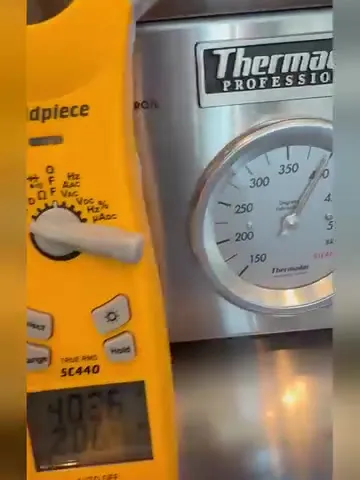
What a technician does: clamps an ammeter around the igniter lead and reads the actual draw during a call for heat. That number is the answer. No amount of looking at the glow substitutes for it. Replacing the igniter means pulling the oven bottom, and the new element is brittle silicon carbide that cracks if you touch the hot zone with a bare finger, so it is not a parts-store guess.
Temperature sensors and why your oven lies
Wolf ovens do not have a mechanical thermostat with a capillary bulb. A resistance temperature detector, a thin probe sticking into the upper rear of the cavity, changes resistance with temperature, and the control board reads it. When the probe drifts, the board is not wrong, it is misinformed. You set 350°F and the board faithfully holds whatever the bad probe calls 350.
A drift of 25 to 50 degrees is enough to ruin pie crust and leave the center of a stuffed bird short of safe temperature while the skin looks finished. It creeps in slowly, so people adapt without noticing, adding ten minutes here, moving a rack there.
What you can check: put an oven thermometer on the center rack, set 350°F, and let the oven run 20 minutes past the preheat beep so the cycle settles. Read it without opening the door if your thermometer is visible through the glass. Compare. Our oven accuracy test walks through the whole thing with the numbers to look for.
Many Wolf ovens include a temperature offset adjustment in the control menu, which shifts the oven's idea of a setpoint by a fixed amount. The manual for your specific model shows whether yours has it and how to reach it. Use it for a genuine small offset. Do not use it to paper over a 60-degree gap, because at that point something has failed and the offset just moves the failure around.
The convection fan, and the ring element behind it
Convection is a fan plus a heating element arranged in a ring around that fan at the back wall of the cavity. Air is pulled in through the center, heated as it passes the ring, and pushed back out around the perimeter. When this system works, a Wolf cooks three racks evenly. When it does not, the oven still hits temperature and you blame the recipe.
Fan motors fail in two ways. The bearings go first and announce themselves: a hum, a rhythmic rubbing, or a rattle that changes as the oven heats and metal expands. Or the motor simply stops, and the only sign is that convection mode now bakes exactly like regular bake. The ring element can also open up while the fan still spins. Food circulates air that is not being heated at the back, and you get that familiar pattern where the front of the sheet pan browns and the back stays pale.
What you can check: with the oven cold and empty, run a convection mode for a minute and listen at the door. The fan should be audible and steady. Then bake a single sheet of cookies in convection and look at the pattern across the pan. Uneven color across a flat pan of identical dough is real data.
Leave to a technician: everything behind the rear cavity panel. The fan motor shaft, the ring element terminals and the high-limit wiring all live there, and on a built-in the oven usually has to come out of the cabinet to reach them.
Broilers: the part everyone tests last and needs first
Nobody broils in July. Then the holidays arrive and suddenly the broiler has to finish a crust, brown a casserole top and crisp skin. On Wolf all-gas models the broiler is usually an infrared ceramic burner at the top of the cavity, and it should glow evenly across its whole face. Dark patches mean blocked ports, usually from a spill that boiled over months ago and baked on. Uneven glow equals uneven browning, every time.
On dual-fuel and built-in electric ovens the broil element is a conventional heating element, and when it opens at one end you get exactly half a pan of color. You can see that one with the oven door open for the first few seconds of a broil cycle: look for a section that stays dark while the rest goes orange.
Test it now. Put a slice of bread on a sheet pan, broil it, and look at the toast pattern. That is the cheapest diagnostic in this entire guide and it takes four minutes.
Doors, hinges and gaskets
A Wolf oven door is heavy, and the hinges carry a lot of cycles. When the hinge springs weaken the door sits slightly proud at the top, the gasket no longer compresses evenly, and hot air escapes. The oven compensates by running longer and cycling more, the kitchen gets warm, and the top rack is never quite right.
What you can check: close the door on a strip of paper at several points around the frame and pull. It should drag at every point. Where it slides free, the seal is open. Look at the gasket for flat spots, hardened sections or a corner pulled out of its channel. Check that the door does not drop or bounce when you close it.
Hinge replacement is a technician job on these, partly because a loaded hinge spring can snap closed hard, and partly because the door and glass pack have to come apart and go back square or the seal problem comes right back.
Surface burners that click but will not light
Wolf uses spark ignition on the sealed gas burners. A burner that clicks without lighting is most often wet or dirty around the electrode, or sitting with the burner cap slightly off its seat after a cleaning. Both are fixable at the counter.
What you can check: turn the knob off and let the clicking stop. Lift the cap, make sure the groove and the cap are dry and free of crumbs, and seat the cap flat so it does not rock. Let everything air dry fully after a wash before you try again. If the burner still will not light, or if the ports look clogged, that is where to stop. Our gas burner guide covers the yellow-flame and low-flame versions of this in more detail.
Stop and call if the range sparks with every knob off, if all burners click together constantly, or if there is a gas smell that does not clear in a second or two as the burner catches. Strong gas smell means leave the house and call the gas utility from outside first.
Please do not run self-clean this month
Self-clean takes the cavity far above any temperature it sees in normal cooking and holds it there for hours. That heat is a stress test, and it finds the weakest component: the door lock motor that was already slow, the thermal fuse that was near its limit, a relay on the control board. A surprising share of the "oven died and the door is locked shut" calls we take in late November started as somebody tidying up before guests arrived.
If the oven needs a deep clean, run it several weeks out, with the windows open and the house ventilated, and scrape heavy spills by hand first so the cycle has less to burn off. We explain the timing and the safer alternative in self-clean before Thanksgiving.
What you can safely check yourself, in order
- Oven thermometer on the center rack at 350°F, read 20 minutes after the preheat beep.
- Time the preheat and write the number down. On a gas oven, note how long the igniter glows before the burner catches.
- Bread test under the broiler, look at the browning pattern.
- Convection mode with a single sheet of cookies, look at the pattern across the pan.
- Paper test around the door gasket at six or eight points.
- Burner caps seated flat and dry, electrodes clean and dry.
- Check that the breaker for a dual-fuel oven or built-in has not tripped, and that the range or oven is actually level.
Leave to a technician: igniter current measurement and replacement, gas valve work, anything behind the rear cavity panel, element and sensor testing, hinge replacement, spark module and control board diagnosis, and any job that requires pulling a built-in out of its cabinet. A professional range has gas piping and 240-volt wiring within inches of each other, and the checks above are the safe boundary.
When to stop using it and call
- A pop or bang when the gas oven lights.
- Gas smell that lingers rather than clearing in a second or two.
- Burning or electrical smell, discolored wiring, or a breaker that trips when the oven heats.
- The range sparks with all knobs in the off position.
- The oven is locked after a self-clean cycle and will not release.
- Preheat that takes more than about twice as long as it used to.
The two-week-out holiday check
Here is what we would do on our own range in the middle of November, in about an hour total.
- Run the four tests above: thermometer, preheat timing, broiler bread, convection cookies.
- Pull the racks and wash them, wipe out the cavity by hand, no self-clean.
- Check the door seal and the way the door closes.
- Wash and dry the burner caps, seat them properly, confirm every burner lights within a few clicks.
- Verify the oven vent at the back of the cooktop is not blocked by a trivet or a pan.
- If you use a meat probe, test it in boiling water and in ice water before it goes into a turkey.
- Book anything that fails those tests now, while there is still a parts window. The week of Thanksgiving, every pro-range technician in the county is booked.
Our oven prep guide covers the general version of this for any brand, and double ovens and 48-inch ranges goes into the problems specific to two cavities and a large cooktop.
Is it worth repairing an older Wolf?
Usually, and more often than with mass-market ranges. These are built to be serviced: igniters, sensors, elements, fan motors, spark modules, hinges and gaskets are discrete replaceable parts rather than sealed assemblies. A repair on a 12 or 15-year-old Wolf is rarely in the same conversation as replacing it, because replacing a pro range is not just the range, it is the gas line, the electrical, the hood and often the cabinet opening.
The harder cases are a discontinued control board on a very old model, or a unit where three systems have gone at once. The technician tells you which one you have before any work starts, and quotes it on site. If it turns into a broader decision, our repair or replace guide lays out how we think about it.
Where we work and how to reach us
We are in Irvine daily, with Tustin and Lake Forest on the same routes, and we run the corridor south through Mission Viejo, Laguna Hills, Laguna Niguel, Aliso Viejo, Rancho Santa Margarita, San Juan Capistrano, Dana Point and San Clemente. We provide professional Wolf repair, along with Sub-Zero, Thermador, Viking, Miele, JennAir and KitchenAid service, and we are factory authorized for Bertazzoni, Thor Kitchen and ZLINE on the cooking side.
When you call, have the model and serial number ready and tell us three things: dual-fuel, all-gas or built-in, what the oven does on a 350°F preheat, and whether anything smells or sounds wrong. That sentence usually decides which parts come out on the truck. Every repair carries a 90-day parts and labor warranty, and the technician quotes the work on site before anything starts. We are 5.0 on Yelp if you want to see how these visits go. Call (949) 267-7771.
Frequently Asked Questions
Why does my Wolf gas oven take so long to preheat?
On an all-gas Wolf oven the usual reason is a tired glow-bar igniter. The igniter is wired in series with the gas safety valve, and the valve only opens once the igniter draws enough current, typically somewhere around 3.2 to 3.6 amps on common hot-surface igniters. As the element ages it still glows bright orange but draws less, so the valve opens late or not at all. A long glow before the burner catches, or a soft thump when it finally lights, is the warning that comes before a no-heat call. A technician measures the current with a clamp meter instead of guessing from the glow.
My Wolf oven browns unevenly. Is the thermostat bad?
Wolf ovens do not use a mechanical thermostat. A temperature sensor, an RTD probe in the cavity, reports resistance to the control board, which decides when to call for heat. Uneven browning more often comes from the convection fan or its ring element than from the sensor: if the fan stalls or the ring element has opened, the oven still reaches temperature but stops circulating. Check with an oven thermometer on the center rack first. If the number is close to the setpoint but one side of the pan browns and the other does not, look at the fan, not the sensor.
Can I run self-clean on a Wolf oven the week before Thanksgiving?
We would not. Self-clean pushes the cavity far above normal baking temperature, and that heat is what finds a weak door lock motor, a tired thermal fuse or a relay on the control board. The oven goes in dirty and comes out locked and dead. If the oven needs cleaning, do it several weeks ahead so there is time to fix anything the cycle exposes, and wipe out heavy spills by hand first.
The burners on my Wolf range light but the oven is dead. What does that mean?
On a dual-fuel Wolf the cooktop burners are gas and the oven is electric, and they are fed differently. Burners that light while the oven stays cold and the display is dark often means the oven side lost power: a tripped breaker or a dropped leg of the 240-volt supply. If the display is lit and the oven simply never heats, the problem is inside the oven, usually an element, a relay on the board, or the sensor circuit. Check the breaker first, then call.
My Wolf range clicks and clicks but a burner will not light. What should I do?
Turn the knob off and let the sparking stop. The most common cause is moisture or spillover around the igniter or a burner cap that is sitting crooked after cleaning. Let everything dry completely, seat the cap flat in its groove, and try again. Continuous clicking with every burner, clicking when all knobs are off, or a gas smell means stop using the range and call. Never wet an igniter to clean it while the range has power.
Is a 15-year-old Wolf range worth repairing?
Usually yes. Wolf builds these with serviceable parts, and igniters, sensors, elements, fan motors, hinges, gaskets and spark modules are all replaceable at a cost that is nowhere near the cost of a new pro range plus the cabinetry and gas work around it. The conversation gets harder only when a part has been discontinued for a very old model or when several systems have failed at once. The technician tells you which situation you are in before any work starts.
Related Pages
- Oven Bakes but the Broiler Won’t Work? Gas and Electric Causes
- Oven & Range Repair in Orange County
- Oven & Range Repair in Irvine
- Oven & Range Repair in Tustin
- Oven & Range Repair in Lake Forest
- Oven Not Heating: Igniter, Element, Sensor
- Oven Temperature Problems Before Thanksgiving
- Is Your Oven Lying? The 30-Minute Test
- How to Prepare Your Oven for Thanksgiving
- Should You Self-Clean Before Thanksgiving?
- Double Oven & 48-Inch Range Problems at the Holidays
- Gas Burner Won't Light or Burns Yellow?
- Gas Oven Smells Like Gas, or Pops When It Lights
- Oven Won't Turn On
- If the Oven Stops Working on Thanksgiving
- Repair or Replace?
- Professional Thermador Repair
- Professional Viking Repair
- Irvine · Tustin · Lake Forest · Mission Viejo · Laguna Hills · Aliso Viejo · Laguna Niguel · San Clemente