
Refrigerator Repair in Tustin, CA
- ⭐ 5.0★ Yelp · 5.0★ Google
- 🛡️ 90-Day Parts & Labor Warranty
- 📅 20+ Years of Experience
- 📍 Minutes Away in Irvine
Quick answer
We repair refrigerators and freezers in both Tustin ZIP codes, 92780 and 92782, and in North Tustin up the hill. We work out of neighboring Irvine, so a morning call usually gets a same-day visit, and a refrigerator that has stopped cooling gets priority. In Tustin the most common calls are ice makers and water valves worn down by hard water, garage refrigerators and freezers that fall behind in summer heat, and built-in units in the larger hillside kitchens. The technician quotes the repair on site before any work starts, and every repair carries a 90-day parts and labor warranty.
Tustin's housing runs from 1920s bungalows in Old Town to homes finished in the last few years at Tustin Legacy, and the refrigerator in the kitchen usually tells you which decade the house is from. What the whole city shares is hard tap water and inland summer heat, and those two things are behind a large share of the refrigerator calls we run here. Call (949) 267-7771 or text us the brand, the model number and what the refrigerator is doing, so the technician can bring the most likely parts. The neighborhoods themselves are described on our Tustin service area page.
Hard Water: Ice Makers, Water Valves and Dispensers
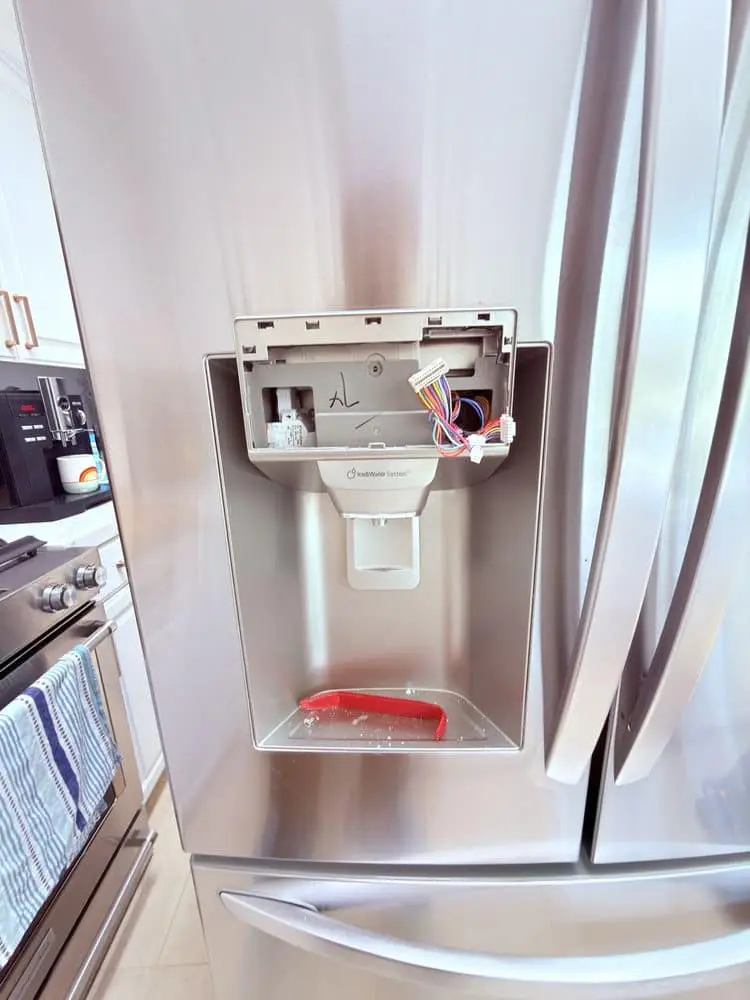
This is the refrigerator problem we see most in Tustin, and it rarely starts as "the ice maker is broken." It starts with ice that tastes off or a dispenser that pours slowly, then cubes that come out small or hollow, then a bin that empties and never refills. Here is what is going on behind it:
- The water inlet valve scales up. Minerals in hard water build up on the valve seat until it no longer closes fully. Water then weeps into the fill tube between fill cycles.
- The fill tube freezes shut. That weeping water freezes where the tube enters the freezer. Once it is a solid plug, the ice maker cycles but gets no water. Ice on the fill tube, or a thin sheet of ice under the ice maker, is the typical sign.
- The filter is overdue. A filter that is months past its change date restricts flow, and the ice maker gets less water than it needs on every fill. With hard water, filters load up faster than the calendar on the box suggests.
- The dispenser drips or leaks. A valve that does not seat can also leave the door dispenser dripping, or leave water at the back of the unit where the supply line connects.
What you can do first: replace the water filter with the correct part for your model, and look for ice in the fill tube behind the ice maker. If a new filter does not help, or the fill tube keeps freezing, the inlet valve usually has to be replaced. Our ice maker not working guide walks through the checks.
What Tustin Kitchens Have: and What Fails in Them
Tustin Legacy, Columbus Square, Columbus Grove, Greenwood, Levity
These homes on the former MCAS Tustin land were built from the 2010s on, mostly with builder appliance packages, very often LG or Samsung French-door and counter-depth refrigerators with in-door ice and water. In units this new we rarely see worn-out mechanical parts. We see ice maker and dispenser problems, evaporator fans that stop, defrost faults that ice over the evaporator, and error codes from the control board. We are Factory Authorized for LG and our technicians are Samsung-certified, see Samsung appliance repair. If the home is only a year or two old, check the manufacturer's warranty first: understanding appliance warranties explains what to look for.
Tustin Ranch
Tustin Ranch was built in the late 1980s and 1990s, with large kitchens and three-car garages. Most original refrigerators have been replaced by now, often with a bigger French-door model pushed into an opening that was sized for something smaller. A refrigerator with no room to breathe above and behind it works its compressor and condenser fan harder, and it tends to show the problem on the first hot week of summer. The garage in these homes very often has a second refrigerator or a chest freezer, more on that below.
Old Town, Tustin Meadows, Peppertree, Laurelwood
Old Town (92780) has the oldest houses in the city, and the tracts around Tustin Meadows, Peppertree and Laurelwood date from the 1960s and 1970s. These kitchens are on their second or third refrigerator. Typical calls are condenser fan motors, start relays, defrost failures and door gaskets that no longer seal. In older homes the water line to the ice maker is sometimes a thin plastic or copper line on a saddle valve, if it leaks, turn it off and have the connection looked at rather than tightening it harder.
North Tustin, Cowan Heights, Lemon Heights
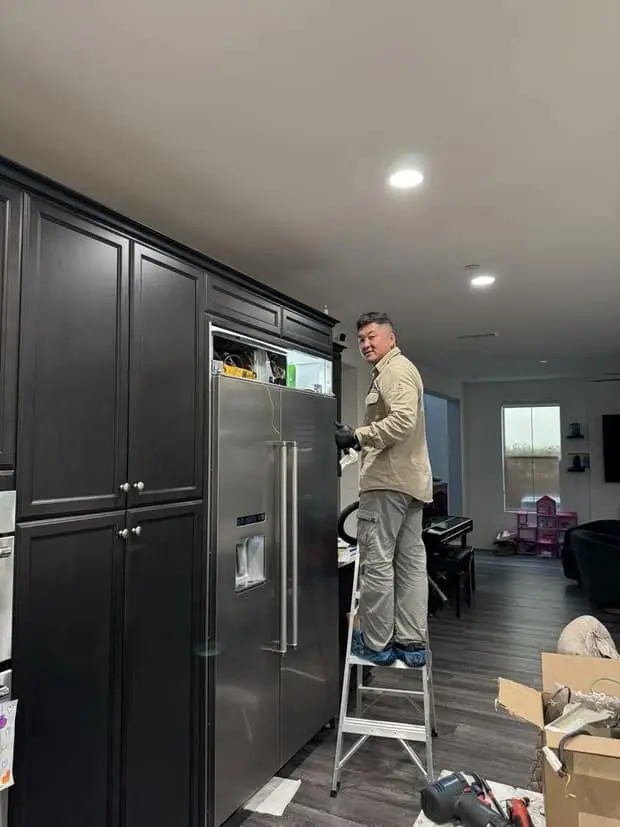
Up the hill the lots are bigger and so are the kitchens. Built-in refrigerators, separate refrigerator and freezer columns and wine columns are common. On many built-in models the compressor and condenser sit behind a grille at the top or bottom, out of sight, and a condenser full of dust makes the unit run warm long before anything actually breaks. We are experienced with built-in Sub-Zero, Thermador, Viking and Miele refrigerators, and we are Factory Authorized for Liebherr. If a Sub-Zero is warm, Sub-Zero refrigerator not cooling covers the common causes. A built-in unit is anchored to the cabinetry and tied into a water line, so it should not be pulled out by the homeowner.
Apartments and condos
Tustin has a lot of rental housing along Newport Avenue, Red Hill Avenue and Seventeenth Street and in the newer communities at Tustin Legacy. If you rent, call your property manager first, most leases route appliance repairs through management, and a repair you book yourself may not be reimbursed. We work for homeowners, landlords and property managers; when the owner books us, we coordinate access with the tenant and leave an itemized invoice for the owner.
Garage Refrigerators and Freezers in Tustin
Tustin sits far enough inland that the marine layer burns off early, and a closed garage gets much hotter than the house on a summer afternoon. That is hard on the second refrigerator or chest freezer out there:
- Heat. Most household refrigerators are designed for indoor room temperatures. In a hot garage the compressor runs nearly nonstop, and a weak start relay or condenser fan fails sooner. A unit can run all day and still let the freezer warm up.
- Dust and wind. Garages are dusty, and in Santa Ana wind season, usually October and November, grit and leaf litter get blown under the door. A clogged condenser is one of the most common reasons a garage unit runs warm.
- Power. Garage outlets are often GFCI-protected. A tripped GFCI, sometimes on another wall or in a bathroom on the same circuit, can quietly switch off a freezer full of food. Plug the unit straight into the wall, not into an extension cord or power strip.
- Garage-rated or not. The owner's manual lists the ambient temperature range the model is designed for. A unit that is clean, has a working fan and still cannot hold temperature in August may simply be outside that range, or may have a sealed-system problem that needs a diagnosis.
More in our freezer not cooling guide.
Does a Refrigerator Need Its Own Outlet?
It should have one, and in Tustin that depends almost entirely on when the house was built. Homes at Tustin Legacy and Columbus Square were wired to current code, so the refrigerator sits on its own branch circuit behind the unit. Houses in Old Town, Tustin Meadows and Peppertree were wired long before anyone owned a 1,100-watt microwave, and the kitchen often runs on one or two circuits shared with the countertop outlets.
That matters on a service call more than people expect. Here is what we actually find:
- A shared circuit that trips. The refrigerator is fine until someone runs the microwave and the toaster oven together, the breaker opens, and nobody notices until the freezer is soft the next morning. The refrigerator did not fail. The circuit did.
- Nuisance GFCI trips. Kitchen and garage receptacles are GFCI protected now, and the switching electronics in a variable-speed inverter compressor can leak just enough current to annoy a sensitive GFCI. If a newer LG or Samsung keeps tripping the same outlet and nothing else does, that is an electrical question, not a compressor question.
- Extension cords and power strips. A long, thin cord drops voltage, and a compressor that tries to start on low voltage draws more current and heats the start winding. Surge strips with overload cutoffs also like to shut off a refrigerator at the worst moment. Plug it into the wall.
- Loose or scorched receptacles. In the oldest houses we sometimes pull the unit out and find a back-wired outlet with heat marks on the brass. That gets fixed by an electrician before the refrigerator goes back in.
We are appliance technicians, so we test the outlet and tell you what we measure. If the problem is the wiring and not the refrigerator, we say so and you call an electrician instead of buying a part you don't need. After any outage or breaker trip, our refrigerator after a power outage guide covers what to check before assuming the unit is dead.
Refrigerator Symptoms and What They Usually Mean
- Not cooling, but lights and display work, a dirty condenser, a stopped condenser or evaporator fan, a failed start relay, or a defrost failure that has iced over the evaporator. A compressor or sealed-system failure is possible but less common. See refrigerator not cooling.
- Freezer cold, refrigerator warm, on most models the fresh-food section is cooled by air from the freezer. Frost blocking that path, a failed evaporator fan or a stuck damper is the usual cause.
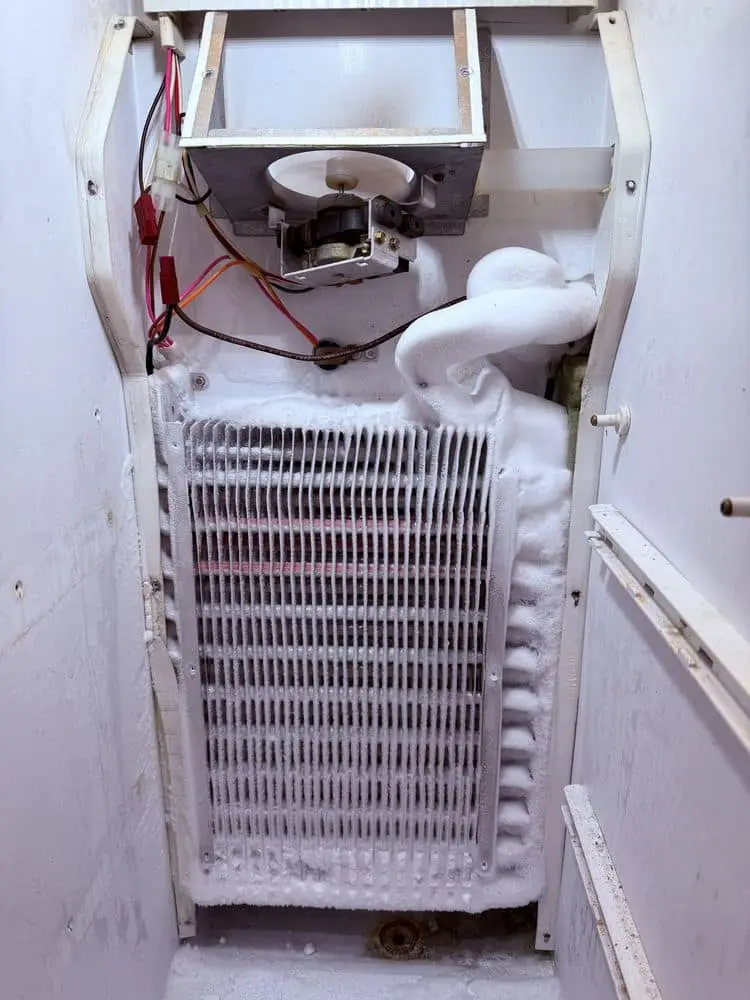
- Frost on the back wall of the freezer, the automatic defrost system is not working: a defrost heater, sensor, thermostat or control.
- Water on the floor or under the crisper drawers, a frozen or clogged defrost drain, or on the water side a supply line, fitting or inlet valve. See refrigerator leaking water.
- Small, hollow or no ice, in Tustin, check the filter and the fill tube first; then the inlet valve or the ice maker module.
- Clicking every few minutes and not cooling, often a start relay or overload trying to start the compressor. Do not keep unplugging it and plugging it back in.
- Runs all the time and still warm, airflow or a dirty condenser first; if those are fine, a refrigerant leak or a weak compressor is possible. That is sealed system repair and needs a technician with the right equipment.
- Error code on the display, take a photo of it. Codes differ by brand and model, and the code helps us bring the right parts.
Why Is My Refrigerator Making That Noise?
Half the noise calls we run turn out to be normal, and the other half are a fan or a relay that is about to leave you with warm food. The sound itself narrows it down fast, so try to describe it on the phone.
- A hum that rises and falls and never fully stops. That is a variable-speed inverter compressor, standard on LG, Samsung and Bosch for years now. People notice it after replacing an older refrigerator that cycled hard on and hard off. Nothing is wrong.
- Buzz for three or four seconds, a click, silence, then the same again. The compressor is trying to start and failing. Usually the start relay, sometimes the compressor itself. Don't keep cycling the power to force it, every attempt heats the windings.
- Chirping, squealing or a steady tick from the back of the freezer. Open the freezer door. On most models that cuts power to the evaporator fan, so if the noise stops with the door open and returns when you push the door switch, you have found it. Either the fan bearing is dry or the blade is hitting frost from a failing defrost system.
- Rattle or a vibration you feel through the floor. Something loose, usually the drip pan, or the cabinet touching the wall, or a condenser fan blade clipping lint. Level the unit first and give it an inch of air at the back.
- Cracking and popping, mostly at night. Plastic liners and shelf rails expanding and contracting, and it gets louder right after a defrost cycle. Annoying, not a fault.
- Gurgling or a sound like water boiling. Refrigerant moving through the evaporator. Normal.
- A single bang in the wall when the ice maker fills. Water hammer. The inlet valve slams shut against a rigid copper line. Not harmful to the refrigerator, but it tells you the ice maker is still filling, which is useful information when you are chasing an ice problem.
The one sound to act on quickly is the buzz-click pattern, because a refrigerator stuck in a start-and-fail loop is minutes to hours away from being warm. Our refrigerator making noise guide goes through the rest sound by sound.
The Display Says 37°F, So Why Is the Food Spoiling?
Because on most refrigerators that number is the setting you asked for, not a reading of the air inside. The control shows the target and holds it based on one or two thermistors mounted at specific spots in the cabinet. If a thermistor has drifted, or if it happens to sit in the one spot that still gets cold air, the display can read 37°F while the milk on the door shelf sits at 46°F.
Measure it before you conclude anything. Put an appliance thermometer in a glass of water on a middle shelf and leave it four hours or more, and put a second one between frozen packages in the freezer. Water averages out the swings that happen every time the door opens, which is why a thermometer sitting in open air gives you a number that changes every few minutes and tells you very little.
Then compare:
- Thermometer agrees with the display and food still spoils fast. Look at habits and airflow. Warm leftovers put in uncovered, a packed shelf against the back wall vent, a door that gets opened thirty times during a party, or produce stored in the wrong humidity setting.
- Thermometer reads warmer than the display by five degrees or more. Something real is off: a drifting thermistor, a stuck air damper between the freezer and the fresh-food section, or an evaporator partly blocked with frost. A technician reads the sensor's resistance and compares it against the chart for the model, which is the only way to tell a bad sensor from a bad board.
- Freezer is at 0°F but the refrigerator is in the forties. Classic airflow problem rather than a cooling problem. On nearly every modern refrigerator the fresh-food side gets its cold air from the freezer, so a stopped evaporator fan, a frosted-over evaporator or a stuck damper warms one side while the other stays fine.
The numbers worth remembering: 37°F in the refrigerator, 0°F in the freezer, and 40°F is the line food safety people draw. If your thermometer sits above 40°F, treat it as a repair and not a settings adjustment.
What You Can Safely Check Before You Call
- The real temperature. Put an appliance thermometer in a glass of water on a middle shelf for a few hours. The target is 37°F in the refrigerator and 0°F in the freezer.
- Power. Check the breaker and press reset on any GFCI outlet on the circuit.
- The water filter. If ice or water is the problem, check when the filter was last changed and replace it with the correct part.
- The condenser. With the refrigerator unplugged, vacuum the grille and the dust you can reach. Our refrigerator maintenance checklist shows how.
- Vents and door seals. Make sure food is not blocking the air vents inside, and close a sheet of paper in the door at several spots, if it slides out with no resistance, the gasket is not sealing there.
- Settings. Check that the unit is not in showroom, demo, vacation or Sabbath mode.
What Not to Do
- Do not chip ice off the evaporator or the fill tube with a knife or screwdriver. One hole in the tubing turns a simple repair into a sealed-system repair.
- Do not pull a built-in or panel-ready refrigerator out of its opening yourself.
- Do not keep a leaking water line under pressure, turn off the supply valve until it is fixed.
- Do not use a heat gun or hair dryer on plastic liners to melt ice.
- Do not buy a refrigerant "recharge kit." A refrigerator that is low on refrigerant has a leak and needs a diagnosis, not a top-up.
Refrigerator Brands We Repair in Tustin
We are Factory Authorized for LG and Liebherr, and our technicians are Samsung-certified. We are experienced with Sub-Zero, Thermador, Viking and Miele built-ins, and we professionally service GE, GE Profile, Monogram, Café, KitchenAid, JennAir, Whirlpool, Maytag, Bosch and the other major brands.
Will the Refrigerator Hold Up Through Thanksgiving?
Thanksgiving is November 26 this year, and the refrigerator calls start the weekend before. A full refrigerator is not the problem. Once the food is cold, all that mass actually helps hold temperature. What hurts is loading warm dishes all at once, opening the doors every few minutes for two days, and packing the shelves so tight that the vent at the back wall is covered.
That last one causes more holiday failures than any broken part. On a French-door model the cold air enters through a duct in the upper back wall, and a sheet pan or a tall stockpot pressed against it shuts off the fresh-food section while the freezer stays perfectly cold. The fix costs nothing. Leave two inches in front of the vents.
If you want the refrigerator checked before the holiday, do it in the next two weeks rather than during Thanksgiving week. Parts distributors close for the holiday, so a part that normally arrives next morning can take until the following Monday. Worth doing now:
- Verify the temperature with a thermometer, not the display. Four hours in a glass of water on a middle shelf.
- Vacuum the condenser. Once a year is enough for most homes in Tustin, and now is a good time for it since the unit is about to work harder than it has all year.
- Change the water filter. A guest-heavy weekend is when a tired filter shows up as a half-empty ice bin.
- Make ice early. Most in-door ice makers produce two to three pounds a day, which is nowhere near what a dozen guests go through. Bag ice ahead and store it in the freezer or the garage unit.
- Check the door gaskets with the paper test. A gasket that lets conditioned air leak at the top corner is the reason some refrigerators ice up only in the holiday weeks.
On the day itself, cool hot stock and gravy in shallow containers on the counter before they go in, and get them refrigerated within two hours. A six-quart pot of 190°F stock set straight onto a shelf raises the whole compartment for hours and puts everything else near the 40°F line. While you are at it, test the oven too, our prepare your oven for Thanksgiving checklist and oven and range repair in Tustin cover that side of the kitchen.
What to Expect When You Call
- Call or text (949) 267-7771. Tell us the brand, the model number, what the refrigerator is doing and your Tustin neighborhood.
- A technician diagnoses on site and quotes the repair before any work starts. Nothing is replaced until you approve it.
- Many repairs are finished on the first visit. Water valves, fans, relays and defrost parts for common models are often on the truck; parts for built-in and premium models may have to be ordered, and we tell you when they are expected.
- Every repair carries a 90-day parts and labor warranty. If the refrigerator is old enough that you are weighing the decision, our repair or replace guide shows how we think about it, and if a repair does not make sense, the technician will say so.
Our before the technician arrives checklist saves time on the visit.
Frequently Asked Questions
How fast can you get to a refrigerator in Tustin?
Usually the same day if you call in the morning. We work out of Irvine, minutes from Tustin up Jamboree and Irvine Boulevard, and we are in 92780 and 92782 several times a day. A refrigerator that has stopped cooling gets priority because food is at stake. Same-day is not guaranteed; if today is full we tell you so on the phone and give you the first real slot.
My ice maker makes small, hollow cubes and then stops. Is the ice maker broken?
In Tustin it is more often the water supply than the ice maker itself. Hard water scales the water inlet valve until it no longer closes cleanly, so water dribbles into the fill tube between cycles and freezes into a plug; an overdue filter starves the flow in the same way. Replace the filter first and look for ice in the fill tube. If the valve is leaking by or the fill tube keeps freezing, the valve needs to be replaced.
My refrigerator is leaking water onto the floor. What should I check?
Turn off the water supply valve to the refrigerator if it has an ice maker or dispenser, and wipe up the water so nobody slips. Then look where the water shows up: water under the crisper drawers usually means a frozen or clogged defrost drain; water behind the unit or under it near the back points to the supply line, the inlet valve or a cracked fitting. Do not pull a built-in unit out yourself.
My garage freezer in Tustin can't keep up in summer. Is it broken?
Sometimes it is simply working outside its design range. A closed Tustin garage can stay above 100°F on a hot August afternoon, and a standard refrigerator or freezer cannot shed heat into air that hot, so it runs nonstop and still warms up. Clean the condenser, leave space around the unit and plug it straight into the wall. If it still cannot hold temperature, a condenser fan, start relay or the sealed system needs a diagnosis.
Which refrigerator brands do you repair in Tustin?
All major brands. We are Factory Authorized for LG and Liebherr, our technicians are Samsung-certified, and we are experienced with built-in Sub-Zero, Thermador, Viking and Miele refrigerators. We also professionally service GE, GE Profile, Monogram, Café, KitchenAid, JennAir, Whirlpool, Maytag and Bosch.
How is the repair priced, and is it guaranteed?
The technician diagnoses the refrigerator and quotes the repair on site before any work starts, so nothing is replaced until you approve it. Every repair carries a 90-day parts and labor warranty. If the refrigerator is a year or two old, check the manufacturer's warranty before paying for anything.
Is a constant humming noise from my refrigerator normal?
On anything built in the last several years, usually yes. Inverter compressors run at low speed almost continuously instead of switching fully on and off, so the refrigerator hums more of the time but more quietly. The pattern to worry about is different: a buzz for a few seconds, a click, silence, then the same cycle again. That is the compressor failing to start, and it needs attention the same day because the food is on a clock.
Can I plug my refrigerator into an extension cord or a surge protector?
Plug it straight into a wall outlet. A long or thin cord drops voltage, and a compressor starting on low voltage pulls more current and heats its start winding. Surge strips with overload cutoffs will also shut a refrigerator off and stay off, which is how people come home to a warm freezer. If the only outlet behind the unit is already shared with the countertop circuit, that is worth having an electrician look at, common in Old Town and the 1960s Tustin tracts.
Should I turn the refrigerator colder before Thanksgiving?
No. Set it to 37°F in the refrigerator and 0°F in the freezer and leave it there. Turning the dial colder does not make the unit cool faster, it just runs the compressor longer and can freeze the produce on the top shelf. What actually helps is keeping the back wall vents clear, cooling hot dishes in shallow containers before they go in, and making ice a few days ahead.
Beyond Tustin
We repair refrigerators in Irvine, Lake Forest, Mission Viejo, Laguna Hills and the rest of South Orange County, see the county-wide refrigerator repair page. In Tustin we also handle AC repair and oven and range repair. Restaurant or market? See commercial refrigeration repair in Tustin.