
Sub-Zero and Wolf Repair in Los Angeles: What Fails First in Premium Kitchens
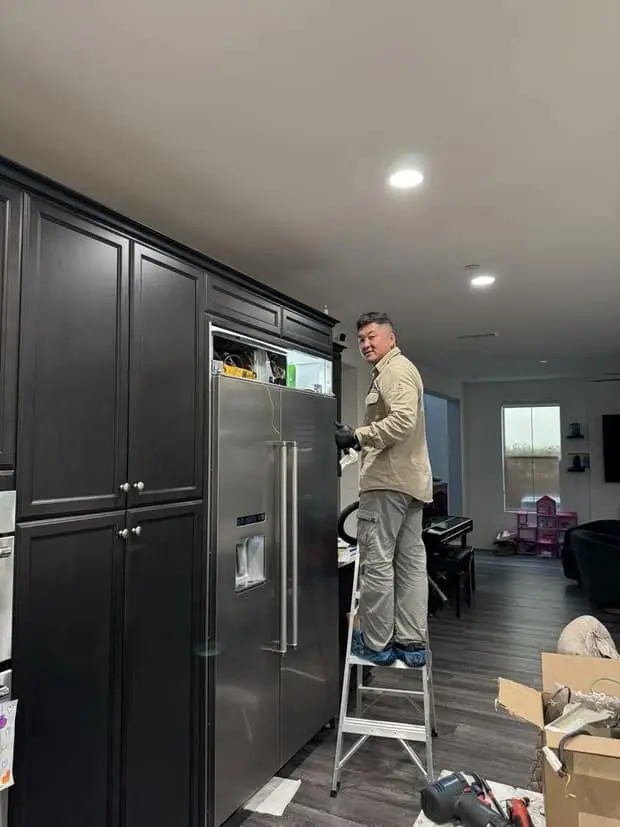
A lot of kitchens we walk into in Los Angeles are built around the same pair: a Sub-Zero built-in on one wall and a Wolf range or a Wolf wall oven on the other. Two different machines, two different failure patterns, and one service call that usually ends up covering both because nobody wants to book twice. This guide is the order we find things in, what each symptom points at, which checks are safe to do yourself, and which ones are not. We service Sub-Zero and Wolf with long professional experience. We are not authorized by either manufacturer and we will not say otherwise.
What fails first, and roughly when
Owners tend to brace for the worst. A built-in refrigerator that costs what a car costs makes people assume the compressor when the fridge drifts warm. In practice the failures arrive in a fairly predictable order, and the cheap stuff comes first.
Early years. What we see in a kitchen under five years old is usually installation, not wear. A built-in squeezed into an opening that is a half inch too tight. A custom door panel heavy enough that the door never quite settles square. A water line to the ice maker that was kinked behind the cabinet at install. None of that is a broken part. All of it shortens the life of real parts.
Five to ten years. This is gasket and igniter territory. Refrigerator door seals go hard and stop making a continuous line of contact, usually at a top corner first. Gas oven igniters weaken. Condenser coils that have never been cleaned are now carrying a felt layer of dust and, near the coast, a chalky oxide film. Condenser fan motors start to drag.
Ten to fifteen years. Defrost components, evaporator fans, temperature sensors that read a few degrees off, oven convection motors, door hinges and springs on heavy Wolf doors. Control boards start showing up here too, often after a power event rather than from age alone.
Fifteen and up. Now the sealed system is on the table, meaning a refrigerant leak, a restriction, or a tired compressor. Even then it is worth checking everything above first, because a condenser nobody has touched in fifteen years will fake most of the same symptoms.
Sub-Zero: two systems in one cabinet
The thing that trips up generalist technicians on a Sub-Zero built-in is dual refrigeration. Most built-in models run two separate sealed systems, one for the fresh-food side and one for the freezer, each with its own evaporator and its own compressor. The design keeps freezer odors out of the fresh food and holds humidity better in the refrigerator section.
For diagnosis it means the usual shortcut does not apply. On an ordinary refrigerator, warm fridge with a working freezer normally points at air not moving from one compartment to the other. On a dual-refrigeration Sub-Zero there is no shared air path to blame. A warm fresh-food side is that side's own evaporator fan, its own defrost, its own thermistor, or its own sealed system. A warm freezer with a cold fridge is the mirror image.
What still applies to both sides is the condenser, because it is shared. If the condenser cannot shed heat, both circuits suffer and the one carrying the bigger load usually shows it first. Our deeper walkthrough of that sequence is in Sub-Zero refrigerator not cooling, and if you are weighing brands rather than fixing one, Sub-Zero vs Liebherr compares how the two are built.
The condenser is the part Los Angeles punishes
Three local conditions shorten condenser life here, and which one applies depends on which side of the hill you live on.
Salt air. From Santa Monica and Venice down through Marina del Rey, Playa del Rey, El Segundo, Manhattan Beach, Hermosa Beach, Redondo Beach, Torrance and along the Palos Verdes bluffs, marine air works on aluminum. The fins develop a chalky white oxide that holds dust and acts like a blanket. The coil does not look dirty in the ordinary sense, it looks dull, and it sheds heat worse every year. A block or two from the water this is worth a yearly look. Three miles inland it barely registers.
Heat. On the valley side, in Encino, Tarzana, Van Nuys, Sherman Oaks, North Hollywood, Burbank and Glendale, a summer kitchen sits far warmer than the design assumption. The condenser rejects heat into the room, so a hot room means longer run times and higher head pressure all summer. If there is a second refrigerator or a freezer in the garage, that one is doing the hardest work in the house. A garage over 100°F is ordinary here, and freezer not cooling covers that case specifically.
Dust, hair and remodels. In the older housing around Mid-Wilshire, Hollywood, West Hollywood and Beverly Hills, the kitchen is usually newer than the house. A remodel puts fine drywall and tile dust into circulation for months, and new trim or a new panel at the grille can narrow the air path the appliance was sized for. Add a dog and the coil loads up fast.
A Sub-Zero will try to tell you. The service or vacuum condenser reminder on the display is a timer, not a measurement, so it is not proof the coil is dirty. It is still a decent prompt to go and look.
Wolf ranges and ovens: the real failure list
Wolf gear is built heavy and most of it fails in boring ways. Here is what actually comes up.
The bake igniter. On a gas oven the igniter is a glow bar wired in series with the gas safety valve. The valve is held shut until the igniter draws enough current through that circuit, so an igniter that has aged and lost draw will still glow a convincing orange while never opening the valve. The symptom builds over months. First the oven takes longer to light, then it takes several minutes, then there is a faint smell of unburnt gas at startup, then one day nothing. If your surface burners work fine and the oven does not, this is the first suspect, because the burners run off a separate spark system.
Surface burners that click and click. Continuous sparking after the burner has lit is almost always moisture or a burner cap sitting slightly off its seat. Let everything dry, lift the cap off and reseat it square. If the clicking continues on a dry range, or if a burner lights with a pop rather than a quiet whoosh, stop and call. Gas range burner problems goes through the full sequence, and gas smell and popping covers the ones that are not DIY.
Temperature drift. Set 350°F, bakes at 315°F. The oven sensor is a resistance probe, and as it drifts the control happily holds the wrong temperature. Nothing looks broken and the cakes come out wrong. A separate oven thermometer on the middle rack for twenty minutes tells you more than the display ever will. We wrote the test out in is your oven lying to you.
Convection fan. A motor that has started to drag gets loud first and slow second. Uneven browning front to back usually turns out to be the fan or the door, not the element.
Doors, hinges and springs. Wolf doors are heavy. The hinges carry that weight through thousands of cycles and eventually the door hangs a hair low or stops pulling flush at the top. Heat escapes, the oven over-runs trying to hold setpoint, and the top of the roast cooks slower than the bottom. The fix is hinge and spring work, not a new oven.
Control boards and displays. Less common than the internet suggests, and more common after a power outage. Before anyone orders a board we want to see the sensor reading and the wiring checked, because a bad sensor can look exactly like a bad board.
Our general walkthroughs for the heating side are oven not heating and oven temperature problems, and with the holidays close, preparing an oven for Thanksgiving is the one worth reading in November.
Read your symptom off this table
| What you are seeing | Where we would look first |
|---|---|
| Sub-Zero fresh-food side warm, freezer still at 0°F | That side's evaporator fan, defrost, or thermistor. Condenser checked first either way. |
| Both Sub-Zero compartments warm, machine compartment hot, compressor never stops | Condenser coil loaded or oxidized, condenser fan, blocked grille or a tight opening |
| Frost creeping around the freezer back panel, weak airflow | Defrost heater, defrost thermostat, sensor or control |
| Water in the bottom of the fresh-food compartment | Blocked defrost drain |
| Ice maker makes hollow, small or no cubes | Filter past due, inlet valve, frozen fill tube, freezer running too warm |
| Wolf oven lights slowly, then not at all, burners fine | Bake igniter losing current draw, then the safety valve |
| Oven set to 350°F, food says otherwise | Oven temperature sensor drift, door seal, hinge sag |
| Uneven browning front to back with convection on | Convection fan motor, baffle, door not pulling flush |
| Surface burner clicks constantly after lighting | Moisture or a misaligned burner cap first, then the spark module |
| Burner lights with a bang, or gas smell that does not clear | Stop. Shut the gas off at the appliance if you safely can, ventilate, and call. |
| Breaker trips when the refrigerator or oven starts | Leave it off and call. Electrical fault. |
The building matters more here than people expect
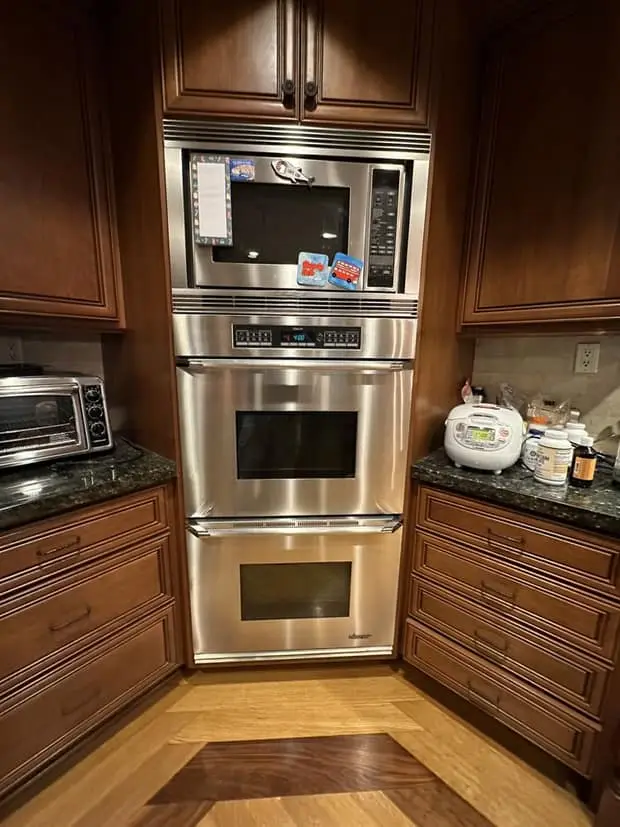
Half the premium kitchens we see in this part of town are not in houses. A built-in column in a tower off Wilshire, a Wolf range in a condo near the beach, and the repair has a logistics problem bolted onto it before anyone touches a screwdriver.
Three things are worth sorting at booking rather than at the door. Whether the building wants a certificate of insurance on file, whether the service elevator needs reserving a day ahead, and what hours the HOA allows work. Tell us at booking and we schedule inside that window. The alternative is a technician standing in a lobby with the right parts and no way upstairs.
The other one is access to the appliance itself. In a lot of older buildings the kitchen was fitted around the refrigerator and the only service access is the grille. That is fine, it is how built-ins are meant to be serviced, but it means nobody should be dragging the unit out to get behind it.
What you can safely check yourself
- Measure, do not trust the display. Glass of water with a thermometer in it, one on a middle shelf and one in the freezer, read after four hours. Target around 37°F in the fresh-food section and 0°F in the freezer. On more than a few calls the failed part turns out to be the sensor behind that display.
- Pull the grille and look at the condenser. On a built-in that grille comes off by hand or with a couple of screws. Vacuum with a brush attachment. Do not push metal between the fins and do not spray anything wet into the compartment.
- Dollar-bill test the door seals. Close a bill in the gasket and pull. It should drag. Walk it around all four sides of each door. Loose at one corner on a heavy panel door is hinge and alignment work, not a dead gasket.
- Listen for the fans. Condenser fan at the machine compartment, evaporator fan behind the freezer back panel.
- Put a thermometer in the oven. Middle rack, preheat to 350°F, wait twenty minutes, read it. Write the number down before you call. It tells us whether we are chasing a sensor or something else.
- Dry and reseat a clicking burner cap. Range off and cold. Lift it, dry everything, set it back square.
- Check the water filter date and the supply valve before blaming the ice maker. Ice maker not working has the rest of that sequence.
What we would rather you left to a technician
- Anything downstream of the gas valve. Igniter replacement on a gas oven means disconnecting a live gas circuit and proving the safety valve afterward. It is not a parts swap you want to learn on.
- Anything inside the sealed system. Refrigerant work needs EPA 608 certification, recovery equipment and a vacuum pump. Low refrigerant always means a leak, so topping a system off just buys a second repair. Sealed system repair explains what the work involves.
- Pulling a built-in out of its opening. It is anchored to the cabinetry, plumbed, and heavy enough to take the floor and the cabinet with it.
- Live-circuit testing of defrost heaters, thermistors and control boards. These measurements only mean anything with the unit powered.
- Chipping ice off an evaporator coil. One slip with a screwdriver through an aluminum tube turns a defrost repair into a sealed-system repair. Unplug with the doors open for 24 hours instead, and treat it as a test rather than a fix. If the cooling comes back and fades again within a few weeks, the defrost system has failed.
Maintenance that is actually worth booking
On ordinary appliances I am lukewarm about maintenance plans. On a Sub-Zero and Wolf kitchen the math is different, because the repairs are not small and most of what goes wrong starts as something cheap that nobody looked at.
A visit on this pair covers the condenser coil cleaned properly with the compartment open, the condenser and evaporator fans checked for current draw and dragging bearings, the cabinet opening confirmed for clearance, both door seals walked end to end and the doors adjusted where a heavy panel has let them settle, real compartment temperatures compared against setpoints, the water line and filter date, the ice maker fill and harvest, and the defrost drain cleared. On the Wolf side it is the oven temperature read against a calibrated thermometer, the igniter checked for draw rather than glow, burner caps and ports cleaned and seated, the convection fan listened to, and the oven door hinges and seal checked.
Once a year is the right interval near the coast. Inland, every two years is fine for the refrigerator. I would not do it twice a year. Once, done properly, is enough. The homeowner version of the fridge list is in the refrigerator maintenance checklist, and the whole-kitchen version is the appliance maintenance checklist.
Repair or replace
For this pair the answer leans toward repair more than it does for most brands. A Sub-Zero built-in is designed so the cabinet and the sealed system outlast the electronics, parts for the common series are still available, and replacing a column is a cabinetry project as much as an appliance purchase. The same logic covers a Wolf range, where the body and the burners usually outlive three or four rounds of igniters and sensors.
The cases where we say otherwise are narrow. A compressor failure on a unit that has already had sealed-system work. A cabinet with failed foam insulation, which shows up as panels that sweat and condensation forming inside the walls of the box. An oven with fire or flood damage behind the controls. Outside of those, the repair is nearly always the better spend. Repair or replace walks the decision out in general terms, and how long a refrigerator should last puts numbers on expected service life.
When to stop checking and call
- A gas smell that does not clear within a minute or two of ventilating. Leave, then call the gas utility before you call us.
- A burner or oven that lights with a bang instead of a soft whoosh.
- Any burning or hot-electrical smell from either appliance.
- A breaker that trips on startup, or a GFCI that will not stay reset.
- Clicking from the refrigerator every few minutes that ends with the compressor going quiet.
- Frost that returns within one to three weeks of a manual defrost.
- Both compartments warm with a compressor that runs and warms up but nothing gets cold. That is usually a leak or a restriction.
- Food safety is on a clock. USDA guidance is roughly 4 hours of safe temperature in a refrigerator without cooling, about 48 hours in a full freezer and about 24 in a half-full one, doors kept shut.
Where we work in Los Angeles and how to reach us
We cover Los Angeles proper including Mid-Wilshire and Hollywood, Beverly Hills, West Hollywood, Glendale, Burbank, Pasadena, South Pasadena, La Canada Flintridge, the valley side through North Hollywood, Studio City, Sherman Oaks, Encino, Tarzana and Van Nuys, and the Westside and South Bay from Santa Monica, Venice and Marina del Rey down through El Segundo, Manhattan Beach, Hermosa Beach, Redondo Beach and Torrance to the Palos Verdes peninsula.
When you call, have the model and serial number ready. On a Sub-Zero built-in the plate is usually inside the fresh-food compartment on the upper left wall or behind the grille, and on a Wolf range it is often behind the kick panel or inside the oven door frame. Tell us the brand, the model, and the symptom in one sentence. That is normally what decides which parts ride out on the truck the first time. Every repair carries a 90-day parts and labor warranty and the technician quotes the work on site before anything starts. We are 5.0 on Yelp if you want to see how these visits usually go. Call (949) 267-7771.
Frequently Asked Questions
Are you authorized by Sub-Zero or Wolf?
No. We service both brands with long professional experience and we describe it that way on purpose. We hold factory authorization for LG and Liebherr, our technicians are Samsung-certified, and for Sub-Zero, Wolf, Thermador, Viking and the rest we say experienced rather than authorized. If a company tells you it is authorized for every brand on your street, ask which manufacturer issued it.
My Wolf oven takes forever to light but the surface burners are fine. What is that?
On a gas oven that is the bake igniter almost every time. The igniter is a glow bar wired in series with the gas safety valve, and the valve only opens once the igniter draws enough current. As the igniter ages it still glows orange but draws less, so the oven takes longer and longer to light, then eventually never does. A glowing igniter is not proof of a good igniter. The surface burners are a separate spark system, which is why they keep working.
My Sub-Zero fridge side is warm but the freezer is fine. Is that the sealed system?
Not necessarily, and on a Sub-Zero built-in the question is different than on an ordinary refrigerator. Most Sub-Zero built-ins use dual refrigeration, meaning the fresh-food side and the freezer have their own evaporator and their own compressor. One warm compartment points at that compartment's own circuit: its evaporator fan, its defrost, its sensor, or its sealed system. It is a real possibility, but we rule out the condenser, the fan and the defrost first.
Does ocean air really hurt a built-in refrigerator?
It does, slowly, and mostly at the condenser. Salt-laden air oxidizes the aluminum fins into a chalky coating that holds dust and insulates the coil, so the unit sheds heat less efficiently every year. A block from the sand in Santa Monica, Venice, Manhattan Beach, Hermosa Beach, Redondo Beach or along the Palos Verdes bluffs it is worth looking at the coil yearly. Three miles inland it matters much less.
Is a twenty-year-old Sub-Zero worth repairing?
Usually yes, and that is not the answer we give for every brand. The cabinet, the doors and the sealed system on a Sub-Zero built-in are designed to outlast the electronics inside them, parts are still available for the common series, and replacing a built-in column means cabinetry work on top of the appliance. The cases where we say otherwise are a compressor failure on a unit that has already had sealed-system work, or a cabinet with failed foam insulation, which shows up as sweating panels and condensation inside the walls of the box.
What should I have ready when I book a visit in a Los Angeles condo or apartment?
The model and serial number of each appliance, the symptom in one sentence, and the building rules. Many towers on the Westside and in Mid-Wilshire want a certificate of insurance on file before a technician is allowed up, and the service elevator often has to be reserved the day before. Give us the building manager's contact and the hours your HOA allows work, and we schedule inside that window. Street parking in Hollywood, West Hollywood and Beverly Hills is worth a sentence too.
Related Pages
- KitchenAid and JennAir Built-In Repair in Los Angeles and the South Bay
- Viking Refrigerator and Range Problems in Los Angeles Kitchens
- Professional Sub-Zero Refrigerator Repair
- Sub-Zero Refrigerator Not Cooling: 600/700 Series, BI and PRO 48
- Sub-Zero vs Liebherr: How They Are Built
- Liebherr Refrigerator Repair in Los Angeles: Common Faults
- Thermador Freedom Column Refrigerator Problems in Los Angeles
- Oven & Range Repair
- Oven Not Heating: Igniters, Elements and Sensors
- Gas Range Burner Problems
- Is Your Oven Lying to You? The Thermometer Test
- Refrigerator Repair
- Sealed System & Compressor Repair
- Wine Cooler & Under-Counter Refrigeration
- Refrigerator Maintenance Checklist
- Repair or Replace?
- Los Angeles · Beverly Hills · West Hollywood · Santa Monica · Manhattan Beach · Redondo Beach · Torrance · Sherman Oaks · Encino · Glendale · Burbank · Mid-Wilshire