
KitchenAid and JennAir Built-In Refrigerator Repair in Los Angeles and the South Bay
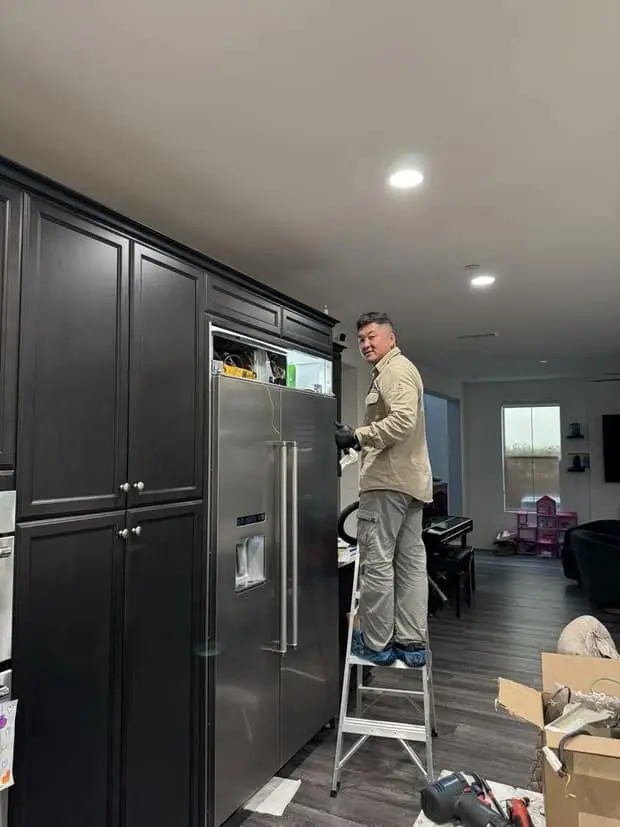
Walk through a remodeled kitchen in Los Angeles and you will see a lot of panel-ready refrigeration that nobody can name from across the room. A 42-inch built-in side-by-side in a Beverly Hills flat. A 36-inch built-in French door in a rebuilt bungalow near Mid-Wilshire. A pair of columns in a Manhattan Beach walk street house where the kitchen is the whole ground floor. Two of the badges behind those panels, more often than people realize, are KitchenAid and JennAir.
Owners usually treat them as two unrelated appliances. They are not. Both brands belong to Whirlpool Corporation, and their built-in refrigeration is built on shared architecture. Same basic cabinet approach, same top machine compartment, same style of electronic control, same defrost logic, same panel-ready door hardware philosophy. JennAir sits above KitchenAid on trim, interior finish and the range of design options. Underneath, a technician diagnoses them the same way.
That is the useful part of this guide. If you know how one of them fails, you know how the other one fails. We service both with long professional experience, and we are not authorized by either manufacturer.
Two badges, one engineering family
The practical consequences of that shared platform are worth spelling out, because they change what you should expect from a repair visit.
Parts are easier to get than the badge suggests. Owners of JennAir built-ins often assume they bought something exotic and that a fan motor will take six weeks. In practice the fans, thermistors, defrost components, ice maker assemblies and door hardware draw on a parts system shared across the company's built-in lines. We stock or source most of what fails on these units the same way we do for KitchenAid.
The diagnostic order is identical. A warm cabinet on either brand sends us down the same chain: grille and condenser, condenser fan, evaporator fan, defrost, thermistor, control, sealed system. Nothing about the JennAir trim level changes the physics.
What genuinely differs is the interior and the controls. JennAir's built-in refrigeration leans into its dark Obsidian interior on a number of models, with the lighting designed around a black cabinet instead of a white one. That is a styling choice with one service consequence: a dim or failed LED strip is far more noticeable in a black interior, and people report it as a fault earlier. JennAir also splits its design language into two expressions, the stainless RISE look and the dark NOIR look, which matters when you are ordering a grille or a handle and the finish has to match.
None of that changes the repair. It changes which part number goes on the order.
Which unit do you actually have?
Before anything else, work out what is in the opening, because the layout decides the diagnosis far more than the brand does.
Built-in side-by-side, 42 or 48 inches wide. Freezer on the left, fresh food on the right, usually with a through-the-door ice and water dispenser. One evaporator, in the freezer. Air crosses to the fresh food side through a damper.
Built-in French door, usually 36 inches. Two fresh food doors on top, a freezer drawer below. Also one evaporator in most cases, with an internal dispenser or none at all.
Columns, 24, 30 or 36 inches. An all-refrigerator or all-freezer cabinet, each a complete standalone appliance with its own compressor and its own defrost cycle. Two columns side by side are two machines, not one machine with two halves. If one is warm and the other is fine, the healthy one tells you nothing except that your power is on.
Freestanding or counter-depth, wearing a stainless front. Different animal. The coils are at the back or underneath, service access is from the rear or the base, and most of what follows about the top grille does not apply.
The rating plate on a built-in is normally inside the cabinet on an upper side wall, sometimes on the ceiling of the fresh food compartment, occasionally behind the grille. Photograph it. Model and serial decide which fan, which board and which gasket we put on the truck, and on these units the generation matters.
The grille at the top is the entire ventilation system
A freestanding refrigerator rejects heat into a room with air on three sides of its coil. A built-in rejects heat through one opening and nowhere else. On KitchenAid and JennAir built-ins that opening is the grille across the top of the cabinet, and behind it sits the condenser, the condenser fan and usually the main control.
As designed, that works. It stops working when the opening changes, and in Los Angeles the opening changes constantly, because the kitchen is almost always newer than the house. We see this most in the older stock around Mid-Wilshire, Hollywood, Hancock Park and the flats below Beverly Hills, where a 1920s or 1940s house has been through two or three kitchens. Somebody adds a decorative trim board in front of the grille. Somebody builds a soffit down to meet the cabinet run. Somebody swaps the grille for a solid panel because the original did not match the new finish. Each one is a small aesthetic decision. Together they strangle the only air path the appliance has.
Then there is what lands on the coil. Fine drywall and tile dust circulates for months after a remodel and settles into the condenser fins, where cooking oil mist turns it into a felt mat. Wiping at the grille does nothing for that. It has to come off with the compartment open.
If your unit sits above a wall oven or next to a range, add heat soak to the list. A condenser pulling in air that has just come off a hot oven vent works harder for the same result, and over years that shows up as shortened compressor life rather than a dramatic failure.
What the ocean does to a condenser, and what the valley does
This is the part that is specific to where you live, and it is not a minor effect.
Near the water, from Santa Monica and Venice through Marina del Rey, Playa del Rey and El Segundo, down past Manhattan Beach, Hermosa Beach and Redondo Beach to Torrance and up onto the Palos Verdes peninsula, marine air oxidizes aluminum fins. The coil turns a dull chalky grey. It does not look dirty, which is exactly the problem. Homeowners glance at it, see no visible dust, and move on. A chalky coil sheds heat worse every year, and the first measurable symptom is run time creeping up long before anything gets warm.
Open windows make it faster. A house two blocks from the sand in Hermosa that lives with the doors open eight months a year puts far more salt through that compartment than a sealed house in Torrance a few miles inland.
On the valley and foothill side the failure mode is different. In Encino, Tarzana, Van Nuys, Sherman Oaks, North Hollywood, Studio City, Burbank, Glendale, Pasadena and La Canada Flintridge, the enemy is plain heat. A kitchen that sits in the high 80s for weeks at a stretch pushes head pressure up and run time with it. The appliance was designed around a room that does not stay that hot that long. Add a condenser that has not been cleaned since the remodel and the margin disappears.
Hard water is the valley's second contribution. Scale builds in the inlet valve and the fill tube over years, and the ice maker is where you notice it first.
Doors, panels and the settle nobody sees
More of our built-in calls start at the door than at any electronic part, and the reason is weight.
A panel-ready door carries a full-height cabinet panel made from the same material as the rest of the kitchen. That panel can be heavy hardwood. The hinge has to swing it inside an opening with almost no side clearance and still pull the gasket flat against the cabinet. Over a few thousand cycles the door settles, usually by two or three millimeters, and the gasket stops making continuous contact at the upper outside corner.
Nothing looks wrong. The door closes, the magnet catches, the owner notices nothing for months. What shows up instead is a secondary symptom. Fuzzy frost in one corner of the freezer, always the same corner. A fresh food compartment that is a few degrees warm with produce going off early. Condensation on the face of the wood panel, which people read as a leak and which is really warm room air meeting a cold surface.
The test takes thirty seconds. Close a dollar bill in the gasket and pull it out, and do it at six or eight points around all four sides of each door. It should drag everywhere. Where it slides out clean, the seal is not touching. One corner loose with the rest holding is a door adjustment. Every edge loose with rubber that feels hard and shiny is a gasket that is finished.
Do not try to adjust a loaded panel door yourself. The panel is heavy, the opening has no clearance, and a door that drops mid-adjustment takes the hinge and often the cabinet next to it.
Freezer cold, fridge warm, and what it means on each layout
This is the single most common complaint we take on these units, and the answer depends entirely on the layout you worked out earlier.
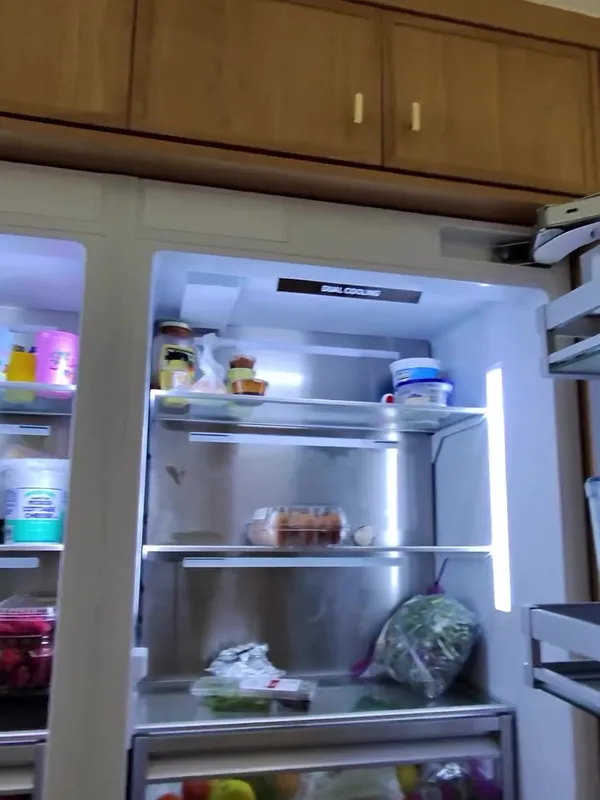
On a built-in side-by-side or French door there is one evaporator, and it lives in the freezer. A fan blows air across it and a duct carries that cold air to the fresh food compartment through a damper. So a cold freezer with a warm fridge means cold air is not arriving. In order of how often we find it: the evaporator fan has failed or is dragging, the evaporator is iced over because defrost has quit, the damper is stuck closed, or a thermistor is reporting a temperature that is not real.
It is rarely the compressor. A failing compressor or a refrigerant leak takes both compartments with it, slowly. If your freezer is still holding zero, the sealed system is doing its job.
On a column, none of the above applies, because there is no shared air. One warm column is one broken appliance and gets diagnosed on its own from the top of the chain.
A quick way to separate a fan problem from a defrost problem: open the freezer and listen. Most of these units run the evaporator fan whenever the compressor runs and stop it when the door opens, so hold the door switch in with a finger and listen for air movement behind the rear panel. Silence with a cold freezer and a warm fridge points at the fan or at ice sitting on top of it. Our general walkthrough of the whole chain is refrigerator not cooling, and the brand-specific version is KitchenAid refrigerator not cooling.
Defrost: the most common deeper fault
Every one of these refrigerators grows frost on the evaporator and runs a defrost cycle to melt it off. A heater warms the coil, a sensor or thermostat decides when to stop, and the meltwater runs down a drain into a pan near the compressor, where it evaporates.
Three things break in that chain and each one looks the same from the outside. The heater opens up and stops producing heat. The sensor lies to the board about coil temperature. Or the control never calls for defrost at all.
What the owner sees is a slow decline. Airflow fades over three or four weeks, the fresh food side drifts a couple of degrees warm, then a lot warm, and the freezer eventually follows. Pull the rear panel in the freezer and you find hard clear ice packed across the coil rather than the light even frost that belongs there.
There is a homeowner test, and it is a diagnostic rather than a fix. Empty the unit, unplug it, leave the doors open for 24 hours with towels down, then plug it back in. If cooling returns and then fades again over the following weeks, the defrost system has failed and you just reset the clock. Treat it as information, not a repair.
The drain is the separate failure in the same system. Block it and meltwater has nowhere to go but the cabinet floor, where it shows up as a puddle under the bottom drawer or a thin sheet of ice under it. People blame the water line and the filter. It is usually the drain. Freezer frost buildup reads the frost patterns in detail, and refrigerator leaking water covers the water side.
One thing not to do: never chip ice off an evaporator with anything metal. The tubing is thin aluminum, one slip turns a defrost repair into a sealed system repair, and that is a different conversation entirely.
Ice makers and dispensers
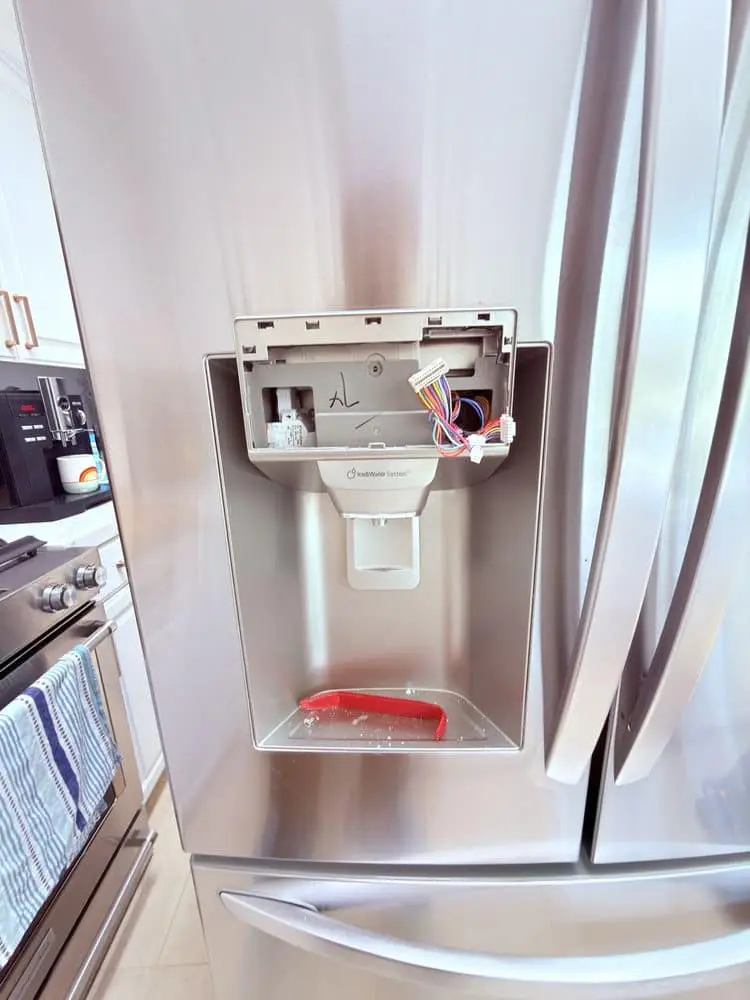
If a built-in has an ice maker, that ice maker will generate more service calls than the rest of the appliance combined. The physics are against it. A small water line, a fill tube running through a freezing compartment, and a mechanism that has to release ice on a schedule.
We check things in a boring order and it is nearly always one of the first three.
A frozen fill tube. Water dribbles instead of filling, freezes in the tube, and the next fill backs up over the mold. You get a mound of ice at the back and no cubes in the bin. Thawing it buys a week. Finding out why the valve dribbled is the real repair, and that is usually a weak inlet valve or low pressure at the line.
Water supply and filter. A filter past its interval restricts flow, and these systems want steady pressure to fill the mold properly. Hollow cubes, undersized cubes and a mold that only half fills all point here. If the house has a reverse osmosis tank feeding the refrigerator line, pressure downstream of that tank is often too low for the ice maker to work right, and that is a plumbing decision rather than an appliance fault.
The bin and its sensor. Most built-in ice makers stop when a beam or an arm says the bin is full. A bin pushed back crooked, a bag of frozen food leaning on the arm, a dusty sensor eye, and the machine simply stops. Nothing is broken. It believes you.
After that come the mold heater, the harvest motor and the module, and those are technician work. Ice maker not working walks the full sequence.
One detail worth knowing: a freezer running a little warm, say 8°F instead of 0°F, will usually keep food frozen and quietly stop making ice properly, because the harvest cycle needs the mold to reach a release temperature on time. Poor ice production is often the first visible symptom of a temperature problem, not an ice maker fault at all.
Controls, modes and the alerts that are not faults
These units run a real electronic control, and a few of its features produce calls that are not repairs.
Showroom or demo mode. Built for dealer floors. Lights work, the display works, the compressor never starts. A unit bought as a floor model, or one that had a control reset done in an odd order, can land in it. Nothing is broken and nothing gets cold.
Sabbath mode. Disables lights, alarms and display response on purpose. People switch it on by accident and then report that the refrigerator has stopped responding.
Fast cool or max cool left on. Useful after loading the unit for a party, wasteful if it stays on for a month, and on the fresh food side it will freeze the lettuce. Most controls time it out on their own. Not all of them do.
The filter reminder. It is a calendar, not a measurement. It has no idea whether your filter is restricted. It knows how long since somebody reset it.
Connected alerts. On models joined to the house WiFi, a door-ajar or high-temperature alert on your phone is genuinely useful. Write down the time it fired and what the display read when you got home. An alarm at 3am during a defrost cycle and an alarm at 6pm after a long door-open are two completely different diagnoses.
There is no reset that repairs anything. Pulling power for a few minutes clears a confused control and nothing else. If the symptom comes back within a day, the control was not the problem.
Read your symptom off this table
| What you are seeing | Where we would look first |
|---|---|
| Freezer cold, fresh food side warm, side-by-side or French door | Evaporator fan, iced evaporator from failed defrost, stuck damper, thermistor |
| Both compartments slowly warming over days | Condenser matted or oxidized, condenser fan, grille blocked, then sealed system |
| Machine compartment at the top very hot, long run times | Grille airflow and condenser cleaning, condenser fan current draw |
| Coil looks chalky grey rather than dusty, coastal home | Salt corrosion on the fins, coil needs proper cleaning with the compartment open |
| Frost in one corner of the freezer, same spot every time | Door settle under panel weight, gasket not touching at that corner |
| Condensation on the face of the custom panel | Door alignment and gasket contact, plus room humidity |
| Hard clear ice across the back wall, airflow fading over weeks | Defrost heater, defrost sensor or control |
| Puddle under the bottom drawer | Blocked defrost drain |
| Hollow, small or no ice | Frozen fill tube, filter past due, inlet valve, low line pressure, bin sensor blocked |
| Interior LED dead on a dark Obsidian interior | LED module or its harness, visible far earlier than on a white interior |
| Lights and display fine, nothing cools, unit silent | Showroom or demo mode, before anything else |
| Compressor hums, clicks off after a few seconds, repeats | Start components or the compressor. Technician. |
| Breaker trips on start, or a burning smell | Leave it off and call. Electrical fault. |
What you can safely check yourself, in order
- Measure, do not read the display. Put a thermometer in a glass of water on a middle shelf and read it after four hours. Around 37°F in the fresh food compartment, 0°F in the freezer. A surprising number of our calls end at a thermistor that was telling the board a comfortable lie.
- Walk both gaskets with a dollar bill. All four sides, several points each. Note which corner lets go. That one detail often decides whether we bring a gasket or just adjust the door.
- Pull the top grille and look at the condenser. Vacuum with a brush attachment. Chalky grey fins mean corrosion rather than dirt, which is worth telling us on the phone. Do not push anything metal between the fins and do not spray liquid into that compartment.
- Check that nothing new blocks the grille. Trim added during a remodel, a decorative panel, a soffit, a basket parked on top.
- Listen in two places. At the grille for the condenser fan, and inside the freezer with the door switch held in for the evaporator fan. Silence from either is worth reporting.
- Check the filter date and the shutoff valve before blaming the ice maker, and make sure the bin sits square with nothing leaning on the fill arm.
- Rule out the modes. Showroom, Sabbath, fast cool. Two minutes with the owner's manual saves a service call.
- Clear the drain opening only if you can see it and reach it without tools. Warm water, nothing sharp.
- Give the unit room to recover. After any of the above, leave it 24 hours before deciding whether it worked. These cabinets are heavily insulated and they come back slowly.
What we would rather you left to a technician
- Hinge and panel bracket adjustment on a loaded door. Heavy panel, no clearance, and a dropped door damages more than the appliance.
- Anything inside the sealed system. Refrigerant work needs EPA 608 certification, recovery equipment and a vacuum pump. Low refrigerant always means a leak, so topping it up without finding the leak just buys a second repair. Sealed system repair explains what the work actually involves.
- Live testing of defrost heaters, thermistors and control boards. Those readings only mean anything with the unit powered, and that is not a homeowner job.
- Chipping ice off an evaporator. One slip through thin aluminum tubing and you have a sealed system failure.
- Pulling a built-in out of its opening. It is anchored to the cabinetry, usually plumbed, and heavy enough to damage the floor and the cabinet run on the way out.
Maintenance that is actually worth booking
I am lukewarm about maintenance plans on ordinary appliances. On built-ins the math is different, because the expensive failures here almost all start as something cheap that nobody looked at. A door that settled. A coil that stopped breathing. A drain that silted up.
A proper visit on one of these covers the condenser cleaned with the compartment open rather than wiped at the grille, both fans checked for current draw and dragging bearings, the opening confirmed for clearance, both doors walked end to end on the gasket and adjusted where the panel has pulled them down, real cabinet temperatures compared against setpoints, the defrost drain cleared, the water line and filter interval checked, and the ice maker watched through a full fill and harvest instead of glanced at.
How often depends on where you live, and this is one case where the coast genuinely needs more. Within a mile or two of the ocean, once a year. Inland on the valley side, every two years is plenty. Twice a year is wasted money anywhere. The homeowner version of the list is the refrigerator maintenance checklist, and the whole-kitchen version is the appliance maintenance checklist.
Repair or replace a built-in?
For a built-in the answer leans toward repair much harder than it does for a freestanding refrigerator, and the reason is the cabinetry rather than the appliance.
The unit went into an opening built to its exact dimensions. Its doors wear panels made to match the rest of the kitchen. The water line and the power were run for that specific install. Replacing it is a carpentry project with an appliance purchase attached, and a different model rarely drops into the same hole without trim work.
So a hinge, a gasket, a fan, a defrost heater, a thermistor, a control board or an ice maker assembly is nearly always worth doing on a cabinet that is otherwise sound. The cases where we say otherwise are narrow. A second sealed system failure on a cabinet that has already had one. Failed foam insulation in the cabinet walls, which shows up as panels that sweat constantly and condensation forming inside the structure rather than on the shelves. Those two are real, and when we see them we say so.
Repair or replace works the general decision through, and how long a refrigerator should last puts service-life numbers beside it. If you are comparing built-in brands rather than fixing one, Sub-Zero vs Liebherr covers how two of the alternatives are built.
When to stop checking and call
- Any burning or hot-electrical smell from the cabinet or the top compartment.
- A breaker that trips when the unit starts.
- A hum followed by a click every few minutes, ending in silence.
- Frost that comes back within one to three weeks of a manual defrost.
- A cabinet that stays warm while the compressor runs and the machine compartment gets hot. That is usually a leak or a restriction.
- Water running down behind the toe kick, or appearing between two columns installed side by side.
- Food safety runs on a clock. USDA guidance is roughly 4 hours of safe temperature in a refrigerator with no cooling, about 48 hours in a full freezer and about 24 in a half-full one, with the doors kept shut.
Where we work in Los Angeles and how to reach us
We cover Los Angeles proper including Mid-Wilshire and Hollywood, Beverly Hills, West Hollywood, Glendale, Burbank, Pasadena, South Pasadena and La Canada Flintridge, the valley side through North Hollywood, Studio City, Sherman Oaks, Encino, Tarzana and Van Nuys, and the Westside and South Bay from Santa Monica, Venice and Marina del Rey through Playa del Rey and El Segundo down to Manhattan Beach, Hermosa Beach, Redondo Beach, Torrance and the Palos Verdes peninsula.
When you call, have the model and serial ready off the plate inside the cabinet. Tell us the brand, the width, whether it is a side-by-side, a French door or a column, and the symptom in one sentence. That is usually what decides which parts ride out on the truck the first time. If the unit is in a building with rules, say so at booking. A certificate of insurance on file, a service elevator reserved the day before, the hours the HOA allows work. We schedule inside that window rather than sending a technician to stand in a lobby.
Every repair carries a 90-day parts and labor warranty, and the technician quotes the work on site before anything starts. If you want to see how these visits go, we are 5.0 on Yelp. Call (949) 267-7771.
Frequently Asked Questions
Are KitchenAid and JennAir built-in refrigerators the same appliance underneath?
Not identical, but they come from the same company and the same built-in engineering family. Both brands belong to Whirlpool Corporation, and their built-in refrigeration shares architecture: a machine compartment and condenser at the top of the cabinet behind a removable grille, electronic control with a thermistor in each compartment, a timed or adaptive defrost cycle, and panel-ready doors built for flush cabinetry. JennAir sits above KitchenAid on trim, interior finish and design range. For a technician that overlap is good news. The diagnostic order is the same on both, and parts availability on a JennAir is better than owners usually expect.
Why does my built-in refrigerator run hot and long in a South Bay kitchen?
Usually the condenser, and near the coast it is often not dirt. Marine air oxidizes the aluminum fins into a dull chalky layer that holds dust and insulates the coil, so the coil can look reasonably clean and still shed heat badly. From Santa Monica and Venice through Marina del Rey, El Segundo, Manhattan Beach, Hermosa Beach, Redondo Beach and Torrance we see that pattern constantly. Add a blocked top grille after a remodel and the machine compartment has no way to dump heat at all. Pull the grille, look at the fins, and if they are chalky rather than dusty the coil needs proper cleaning with the compartment open.
My KitchenAid built-in freezer is cold but the refrigerator side is warm. What is that?
On a built-in side-by-side or French door that layout has one evaporator in the freezer and a fan that pushes cold air across to the fresh food side through a damper. Cold freezer with a warm fridge means that air is not arriving. The usual causes, in the order we check them, are a failed evaporator fan, an evaporator iced over because defrost has quit, a damper stuck closed, or a thermistor reading wrong. It is rarely the compressor, because a failing compressor takes both compartments with it.
The custom panel on my JennAir door does not sit flush anymore. Does the door need replacing?
Almost never. A full-height cabinet panel is heavy, and after a few thousand cycles the door settles a couple of millimeters on the hinge. The gasket stops touching at the upper outside corner and warm room air leaks in all day. What you notice is frost in one spot in the freezer, a unit that runs much longer than it used to, or condensation on the face of the panel itself. The repair is hinge and panel bracket adjustment, plus a gasket if the rubber has gone hard and shiny. Caught early it is a short visit.
Are you authorized by KitchenAid or JennAir?
No, and we will not pretend otherwise. We service KitchenAid and JennAir with long professional experience. We hold factory authorization for LG and Liebherr, and our technicians are Samsung-certified. We are not authorized by KitchenAid, JennAir, Sub-Zero, Wolf, Viking or Thermador, and we say experienced instead. If a company claims factory authorization for every premium brand in your kitchen, ask which manufacturer issued it and in what year.
Is it worth repairing a built-in refrigerator rather than replacing it?
For a built-in the answer leans toward repair much harder than it does for a freestanding fridge, and the reason is the cabinetry rather than the appliance. The unit was fitted into an opening built to its exact dimensions, the doors wear panels made to match the rest of the kitchen, and the water line and power were run for that specific install. Replacing it turns into a carpentry project with an appliance purchase attached. A hinge, gasket, fan, defrost heater, thermistor, control board or ice maker assembly is nearly always worth doing. The cases where we advise otherwise are narrow: a second sealed system failure on the same cabinet, or failed foam insulation in the cabinet walls.
Related Pages
- Professional KitchenAid Appliance Repair
- KitchenAid Built-In Refrigerator Problems: 36, 42 and 48 Inch Units
- KitchenAid Refrigerator Not Cooling: What Usually Fails
- JennAir Refrigerator Not Freezing or Running Warm
- Thermador Freedom Column Problems in Los Angeles
- Viking Refrigerator and Range Problems in Los Angeles Kitchens
- Sub-Zero and Wolf Repair in Los Angeles: What Fails First
- Refrigerator Not Cooling: 10 Common Causes
- Freezer Frost Buildup: Reading the Pattern
- Ice Maker Not Working
- Refrigerator Leaking Water
- Refrigerator Repair
- Sealed System & Compressor Repair
- Refrigerator Maintenance Checklist
- Los Angeles · Beverly Hills · West Hollywood · Mid-Wilshire · Santa Monica · Marina del Rey · Manhattan Beach · Hermosa Beach · Redondo Beach · Torrance · Palos Verdes · Sherman Oaks · Encino · Van Nuys · North Hollywood · Glendale · Burbank