
JennAir Refrigerator Repair in The Meadows, Lake Forest: Not Freezing, Running Warm, Maintenance
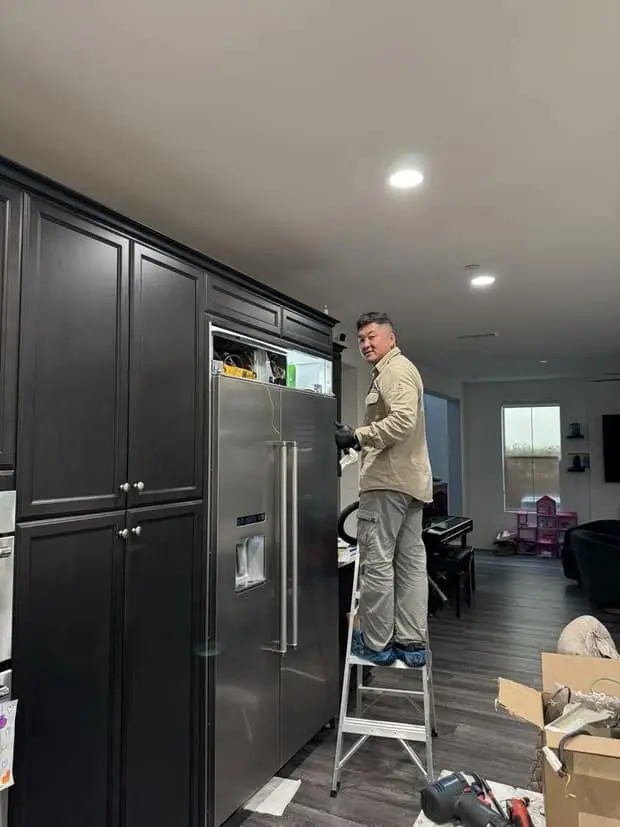
The Meadows is one of the larger newer communities in Lake Forest, in the 92630 ZIP, and most of it went up between roughly 2017 and 2024. A lot of those homes came with JennAir kitchen packages, so when a refrigerator call comes in from that part of the city it is often a JennAir, and often the same handful of faults. This guide covers what actually fails on them, which symptoms point where, what you can safely check before you pick up the phone, and what a maintenance visit covers. We service JennAir professionally. We are not a JennAir authorized servicer and we will not pretend otherwise.
What is usually in these kitchens
JennAir refrigeration in a house this age falls into two groups, and the group changes the diagnosis.
Built-in and panel-ready units sit flush with the cabinetry, often with a custom door panel matched to the kitchen, and they are anchored to the surrounding cabinets. The condenser and the machine compartment are usually at the top behind a grille, sometimes at the bottom. These are the units people most often misdiagnose at home, because the back of the refrigerator is inaccessible and the owner assumes there is nothing to clean. There is. It is just at the grille.
Freestanding French-door and counter-depth models slide into an opening and vent at the bottom front or the back. Same cooling principles, easier access, and in a tight cabinet opening they can still suffocate.
JennAir is a Whirlpool Corporation brand and shares a lot of engineering with KitchenAid, which is useful in practice. Many of the parts, the control logic and the diagnostic routines look familiar to a technician who works on both. If your symptom is specifically a unit that runs but will not get cold, our KitchenAid refrigerator not cooling guide walks the same sequence in more detail.
Freezer not freezing: what we check, in order
This is the single most common JennAir complaint we get from this part of Lake Forest. Ice cream goes soft, the ice in the bin fuses into a block and then the bin stops refilling, and the freezer sits somewhere in the teens or twenties instead of 0°F.
Condenser first. The condenser is where the refrigerant gives up the heat it pulled out of the food. Blanket it in dust and it cannot. Head pressure climbs, the compressor runs longer and hotter, and the first compartment to lose the fight is usually the freezer. On a built-in, pop the grille and look. If you see a gray felt mat instead of metal fins, you have found at least part of your problem.
Then the condenser fan. It sits in the machine compartment next to the compressor. With the grille off and the unit running you should hear it and feel moving air. Silence plus a hot compartment is a failed fan motor most of the time, and it will cook the compressor eventually if nobody fixes it.
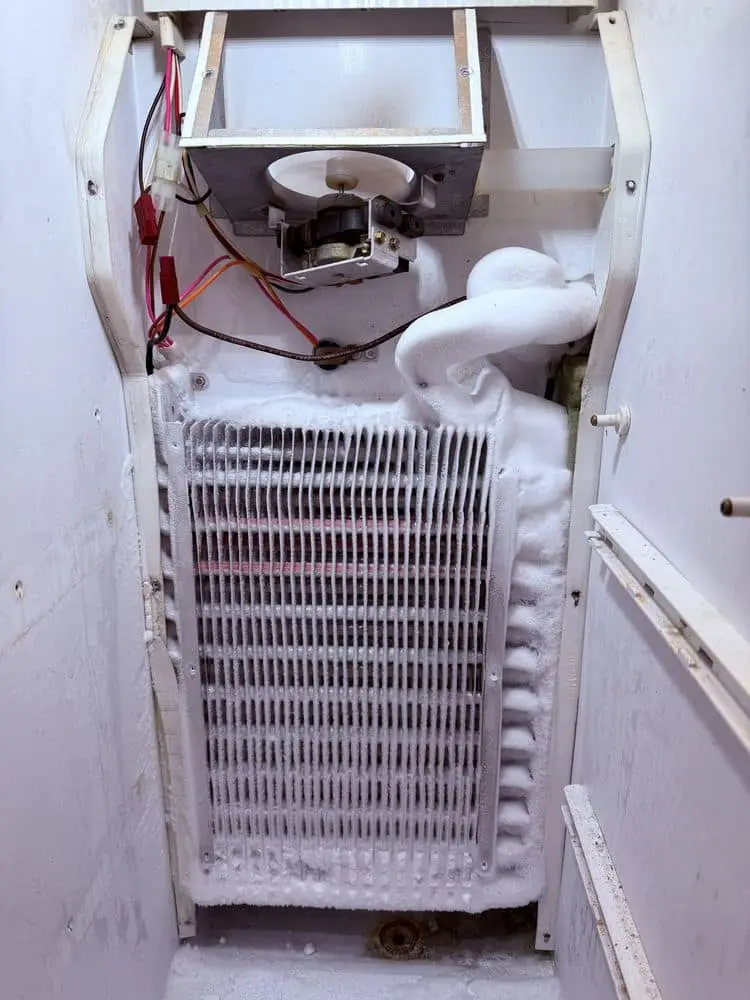
Then frost on the evaporator. Pull the freezer drawer or baskets and look at the back panel. A thin even rime is normal. A sheet of ice, or frost creeping out around the panel edges, means the defrost system is not clearing the coil. Could be the defrost heater, the bi-metal or defrost thermostat, a sensor, or the control. Once the coil is buried in ice, air cannot move across it and the whole box loses temperature even though the compressor never stops.
Then the evaporator fan. It lives behind that same panel and pushes cold air into both compartments. If it has stopped, you get a freezer that is cold near the coil and warm everywhere else, and a fresh-food side that goes warm first.
Then the doors. On panel-ready units the custom door panel adds weight that the hinge has to carry. Over several years a door can settle just enough that the gasket stops making a continuous seal at the top corner. Humid air leaks in, frost builds, and the unit runs constantly without ever catching up.
Sealed-system faults, meaning a refrigerant leak or a restriction, are real but they are not where you start. We get there after the airflow side comes back clean.
Running warm with a hot machine compartment
Warm air off the grille is normal. That is the refrigerator doing its job. What is not normal is metal that is genuinely hot to the touch plus a cabinet that will not hold temperature, especially if the compressor never shuts off.
That pattern is a condenser-side problem nearly every time. Dust on the coil, a dead condenser fan, or a cabinet opening that is not giving the unit the clearance its installation instructions call for. The third one catches people out after a remodel, when new trim or a new panel narrows the air path at the grille. A built-in refrigerator is sized for a specific opening with specific clearances, and if it cannot inhale and exhale, it will run warm no matter how healthy the parts are.
One more thing worth checking in this neighborhood: if the kitchen has a second refrigerator or a freezer out in the garage, that unit is fighting a much harder battle. Lake Forest garages run well over 100°F on a bad afternoon. Our freezer not cooling guide covers the garage case specifically.
Read your symptom off this table
| What you are seeing | Where we would look first |
|---|---|
| Freezer warm, refrigerator side still cold | Defrost failure icing the evaporator, evaporator fan, dirty condenser |
| Refrigerator warm, freezer still freezing | Evaporator fan, blocked air vents inside, damper, thermistor |
| Both compartments warm, machine compartment hot, compressor never stops | Condenser coil loaded with dust, condenser fan, blocked grille or tight opening |
| Both warm, compressor clicks every few minutes and goes quiet | Start relay, overload, or the compressor itself. Technician job. |
| Frost around the freezer back panel, weak airflow from the vents | Defrost heater, defrost thermostat or bi-metal, defrost sensor, control board |
| Water pooling in the bottom of the fresh-food compartment | Blocked defrost drain, usually clears with service |
| Ice maker makes hollow, small or no cubes | Water filter past due, inlet valve, frozen fill tube, freezer temperature too warm |
| Unit runs constantly, gasket feels loose at one corner | Door alignment and hinge adjustment on a heavy panel-ready door |
| Breaker trips when the refrigerator starts | Stop. Leave it off and call. Electrical fault. |
Why new houses are hard on condensers
This is the part specific to The Meadows and the other newer tracts off Bake Parkway, and it surprises owners every time. A new house produces an enormous amount of very fine dust. Drywall sanding, flooring and tile cuts, paint sanding, and then the landscaping going in outside. That dust is finer than ordinary household dust and it stays in circulation long after the trades have gone, settling into carpet, AC ducts and cabinet voids, then getting stirred up again every time someone walks through.
A refrigerator runs several hours a day and pulls room air across its condenser the entire time. It is, functionally, an air filter that nobody ever changes. In a house that is five years old the coil can already look worse than one in a twenty-year-old kitchen, and the owner has done nothing wrong.
Here is the practical version. In a new build or after any significant remodel, have the condenser checked at the end of the first year instead of waiting the two to three years we would normally suggest. After that, once a year is plenty. I would not clean it twice a year. Once, done properly, is enough.
Ice makers, water and the filter nobody remembers
Ice complaints are the second most common refrigerator call we take in Lake Forest, and most of them are not a broken ice maker. Lake Forest water is hard. Scale builds up in the water inlet valve until it no longer seats cleanly, the fill tube weeps and eventually freezes into a plug, and a filter months past its date starves the flow.
Work through it in this order. Check the filter date and change it if you cannot remember doing it. Confirm the freezer is actually at 0°F, because a freezer sitting at 15°F will not harvest ice properly no matter how good the ice maker is. Look for a plug of ice in the fill tube. Confirm the water supply valve under the sink or in the wall is fully open.
If the cubes are hollow or half-size, that is almost always flow, not the ice maker. If the ice maker fills but never harvests, that is the module or the thermostat and it is ours. Our ice maker guide goes through the full sequence, and if water is ending up somewhere it should not, refrigerator leaking water covers the drain and the supply line.
What you can safely check yourself
- Verify with a real thermometer. Put one in a glass of water in the fresh-food compartment overnight and one in the freezer. The display shows the setpoint on many models, and sometimes the sensor feeding that display is the failed part. Target 37°F in the refrigerator and 0°F in the freezer.
- Open the grille and look at the condenser. On a built-in that is the top or toe grille and it usually comes off by hand or with a couple of screws. Vacuum what you can reach with a brush attachment. Do not poke metal tools between the fins and do not spray water into the compartment.
- Listen for the fans. Condenser fan at the machine compartment, evaporator fan behind the freezer back panel. Press the door switch to keep the unit running with the door open and listen.
- Do the dollar-bill test on each door. Close a bill in the seal and pull. It should drag. Walk it around all four sides of both doors. Loose at one corner on a panel-ready door is a hinge and alignment issue, not a dead gasket.
- Check the vents inside. A stack of frozen pizzas against the back wall vent in the freezer blocks the air path into the fresh-food side. It happens more than you would think right before a holiday.
- Check the filter date and the water supply.
- Look for a demo or showroom mode. On a house that was a model home or had an appliance swapped late in construction, this one is worth two minutes. The lights work, the cooling does not. The model manual shows the exit sequence.
What we would rather you left to a technician
- Pulling a built-in or panel-ready unit out of its opening. It is anchored, it is plumbed, and it is heavy enough to take the flooring and the cabinet with it.
- Anything inside the sealed system. Refrigerant work requires EPA 608 certification, recovery equipment and a vacuum pump. There is no homeowner version of it, and topping off a system that leaks just means paying twice.
- Testing the defrost heater, the bi-metal, the thermistors or the control board. These are live-circuit measurements on a unit that cannot simply be unplugged for the test to mean anything.
- Compressor start components. The start relay and overload sit on a compressor that can hold a charge.
- Forcing ice off an evaporator coil. A screwdriver or a pick through an aluminum evaporator tube turns a defrost repair into a sealed-system repair. We have seen it. Use the manual defrost method instead, which is unplugging the unit with the doors open for 24 hours, and understand that it is a test, not a fix. If the cooling comes back and then fades again in one to three weeks, the defrost system has failed and needs proper repair.
Maintenance: the visit that prevents most of this
Most of what is above is preventable, and on built-in refrigeration it is worth preventing, because the repairs are not small ones. A maintenance visit on a JennAir runs through the following.
- Clean the condenser coil and the grille area properly, with the machine compartment open rather than a vacuum pass at the opening.
- Check the condenser fan and the evaporator fan for current draw and for bearings that are starting to drag.
- Confirm the cabinet opening still gives the unit the clearance it needs, which matters after any cabinet or trim work.
- Check both door seals the whole way around and adjust door alignment where a heavy custom panel has let the door settle.
- Read the real compartment temperatures against the setpoints and compare them with what the display claims.
- Check the water line, the shutoff, the filter date and the ice maker fill and harvest.
- Clear the defrost drain path, which is the cause of most mystery water in the bottom of a fresh-food compartment.
If you have a JennAir or any built-in refrigerator in The Meadows and nobody has looked at it since the house was finished, that is the visit to book. Call (949) 267-7771 and ask for a refrigerator maintenance visit. The refrigerator maintenance checklist is the homeowner version of the same list, and the broader appliance maintenance checklist covers the rest of the kitchen.
When to stop checking and call
Some symptoms are worth a few minutes of your own time. These are not.
- The breaker trips when the refrigerator starts, or a GFCI will not stay reset.
- Any burning or hot-electrical smell. Unplug it if you can reach the plug safely, and call.
- Clicking every few minutes that ends with the compressor going silent.
- Frost that comes back within one to three weeks of a manual defrost.
- Both compartments warm with a compressor that runs quietly and warms up but nothing gets cold, which usually means a sealed-system leak or restriction. Sealed system repair explains what that work involves.
- Food safety is on the clock. USDA guidance is about 4 hours of safe temperature in a refrigerator without cooling, about 48 hours in a full freezer and about 24 in a half-full one, with the doors kept closed.
Where we go and how to reach us
We cover The Meadows and the rest of Lake Forest refrigerator repair, including Baker Ranch, Foothill Ranch, Portola Hills, Serrano Highlands and the older 92630 tracts, and we are in Irvine daily on the way through. Refrigerator repair in Irvine, Tustin, Mission Viejo, Laguna Hills, Rancho Santa Margarita and the corridor down to San Clemente are all on the same routes.
When you call, have the model and serial number ready. On a JennAir built-in they are usually on a plate inside the fresh-food compartment along the upper left wall or behind the grille. Tell us the brand, the model, which compartment is warm, and whether the machine compartment is hot. That one sentence often decides which parts ride out on the truck. Every repair carries a 90-day parts and labor warranty, and the technician quotes the work on site before anything starts. We are 5.0 on Yelp if you want to see how these visits usually go. Call (949) 267-7771.
Frequently Asked Questions
Why is my JennAir freezer not freezing but the refrigerator side still feels cold?
That combination usually means the evaporator is still making some cold but cannot make enough, or the air is not moving the way it should. The three causes we find most are a condenser that cannot shed heat because the coil or the grille is loaded with dust, a defrost failure that has let frost build over the evaporator coil, and an evaporator fan that has stopped or is running slow. Less often it is a door that is not sealing, a thermistor reporting the wrong temperature, or a sealed-system fault. Clear the grille and check the door seal yourself, then have the fan and defrost circuit tested.
My JennAir refrigerator runs warm and the area near the compressor is hot. Is that normal?
Warm air coming off the machine compartment is normal, because that is where the refrigerator dumps the heat it pulled out of the food. Hot metal plus a box that will not hold temperature is not. It points at the condenser side: a coil packed with dust, a condenser fan that has stopped, or a grille and cabinet opening that cannot get enough air. On a built-in JennAir the condenser is usually behind the top or toe grille rather than at the back of the unit, so that is where the dust collects.
Why do refrigerators in newer Lake Forest homes get dirty condensers so quickly?
Fine construction dust. Drywall sanding, flooring cuts and landscaping leave an airborne dust that is much finer than ordinary household dust, and it keeps circulating for a long time after the work is finished. A refrigerator pulls room air across its condenser all day, so it acts like a filter nobody empties. In a newly built or recently remodeled kitchen we suggest checking the condenser at the end of the first year rather than waiting the usual two to three.
Can I pull my built-in JennAir refrigerator out to clean behind it?
No, and please do not try. A built-in or panel-ready unit is anchored to the surrounding cabinetry, usually plumbed to a water line, and heavy enough to damage the floor and the cabinet if it tips or drags. Everything a homeowner needs to reach is behind the removable grille at the top or bottom. If something needs doing further in than the grille, that is a service call.
Is Alpha & Omega authorized by JennAir?
No. We are experienced with JennAir refrigerators and we service them professionally, and we say it that way on purpose. We hold factory authorization for LG and Liebherr, our technicians are Samsung-certified, and for every other brand we describe our relationship as experience rather than authorization.
What does a JennAir refrigerator maintenance visit actually include?
Cleaning the condenser coil and the grille area, checking the condenser and evaporator fans, confirming the cabinet opening has the airflow clearance the unit needs, checking the door seals and door alignment, reading the actual compartment temperatures against the setpoints, inspecting the water line and the water filter date, checking the ice maker fill and harvest, and clearing the drain path that causes most interior water. The technician tells you what is worth doing and quotes anything beyond the visit before starting.
Related Pages
- KitchenAid Built-In Refrigerator Problems: 36, 42 and 48 Inch Units
- Refrigerator Repair in Lake Forest
- Appliance & AC Repair in Lake Forest
- KitchenAid & JennAir Appliance Repair
- KitchenAid Refrigerator Not Cooling: What Usually Fails
- Why Is My Refrigerator Not Cooling? 10 Most Common Causes
- Freezer Not Cooling or Not Freezing
- Frost Buildup in the Freezer
- Ice Maker Not Working
- Refrigerator Maintenance Checklist
- Refrigerator Making Noise
- Sealed System & Compressor Repair
- Irvine · Tustin · Lake Forest · Mission Viejo · Laguna Hills · Rancho Santa Margarita · Aliso Viejo · San Clemente