
Frost Building Up in Your Freezer? Causes, What to Check and When It Means a Defrost Failure
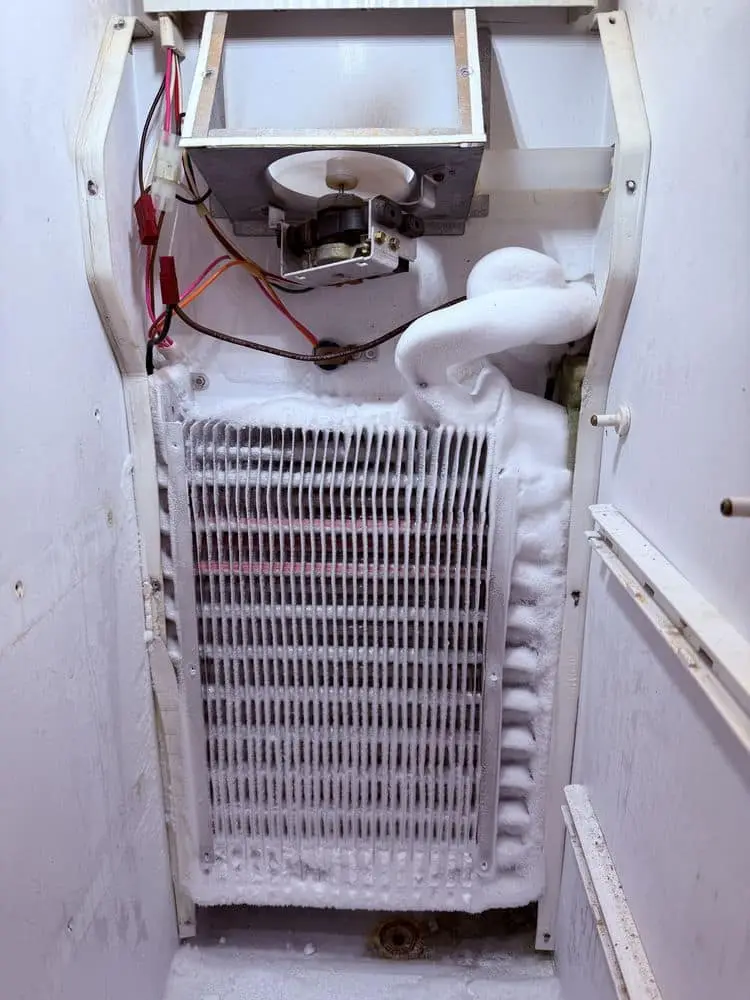
Frost in the freezer is one of those problems homeowners live with far longer than they should. The freezer still freezes, so it feels cosmetic — you scrape a little ice off the shelf, push the packages back in, and move on. Then one of three things happens: the fresh-food section above starts running warm, the fridge develops a buzz that stops when you open the door, or you finally look behind the back panel and find a solid block of ice where the cooling coil should be. By then the compressor has been running nearly nonstop for weeks.
We see this pattern constantly across Irvine, Tustin and Lake Forest, and the good news is that the diagnosis is unusually readable: the location and texture of the frost tell you what failed before anyone opens a panel. This guide explains how a frost-free freezer is supposed to work, how to read your own frost pattern, what you can safely check, and where the job becomes a technician's.
First: “frost-free” does not mean frost never forms
It helps to understand what the appliance is actually doing, because the name is misleading. Inside almost every modern freezer there is an evaporator coil hidden behind the rear panel. Refrigerant boils inside that coil and pulls heat out of the compartment; a fan blows freezer air across it. Any moisture in that air — from food, from packages, from the room every time you open the door — condenses and freezes on the coil, because the coil is the coldest surface in the box. That is unavoidable physics, and it happens in every freezer ever built.
What makes a freezer “frost-free” is that it removes that frost on a schedule. A small electric heating element sits in or against the evaporator. Every several hours the control shuts down the compressor and energizes that heater for roughly twenty to thirty minutes. The frost melts, the meltwater runs down into a trough, through a drain tube in the back wall, and out to a pan near the compressor where the compressor's own heat evaporates it. Then cooling resumes. Done correctly, you never see it happen.
So a frost problem is always one of two failures of that arrangement:
- Too much moisture is entering for a normal defrost cycle to clear — the cycle is working, but it is outmatched.
- The defrost cycle is no longer happening — the heater, the thermostat that controls it, the sensor, the timer or the control board has failed, and frost simply accumulates cycle after cycle.
The frost pattern separates them, which is why we ask about it on the phone.
Read the frost: what each pattern means
| What you see | Most likely causes |
|---|---|
| Hard, clear sheet of ice on the rear panel; vents iced over; freezer still cold but fridge above is warming | Defrost heater (3), defrost thermostat / bi-metal (4), defrost sensor (6), adaptive defrost control or timer (5) |
| Light, fuzzy, snow-like frost on packages, shelves and the walls near the door | Door seal or door ajar (1), door habits and humid air (2), warm food loaded uncovered |
| Ice slab on the freezer floor or under the bottom drawer; sometimes water under the crisper in the fridge | Clogged defrost drain (7) |
| Ice around the ice maker, or a frozen chunk hanging off the fill tube | Ice maker fill tube or water inlet valve (8) |
| Buzzing or rattling that stops the moment you open the door | Evaporator fan blade striking ice — a symptom of any of the defrost failures above |
| Even frost everywhere, chest or upright garage unit with a dial | Manual-defrost freezer with no defrost system at all (9) — normal, needs periodic defrosting |
| Frost or sweating around the door frame / between doors on a built-in | Mullion or perimeter door heater, or humidity control setting (10) |
1. A door that is not sealing — the most common cause of all
Before anything electrical, check the door. A freezer door that is held open a quarter of an inch by a drawer, a package of chicken or a misaligned bin lets a slow stream of room air in continuously. That air is warm and carries moisture; the moisture freezes onto the first cold surface it finds. This is the single most common reason a homeowner calls about frost, and it is also the cheapest thing to fix.
What to check: close the door on a dollar bill at several points around the frame — top, bottom, both sides, and especially the corners. If the bill slides out with no drag anywhere, that section is not sealing. Wipe the gasket with warm soapy water first; sticky residue is the most common reason a good gasket stops seating. Look for cracks, hardened sections, or a corner that has pulled out of its channel. Check that the unit is level or tilted very slightly back so the door swings closed on its own, and that the freezer basket or drawer is fully pushed in. On French-door models, watch the left door's flip mullion — if it does not fold flat, the doors cannot seal against each other.
Gasket replacement is a straightforward repair and worth doing rather than living with a freezer that frosts and a compressor that never stops.
2. Humid air and how the freezer gets used
Even with a perfect seal, a freezer can be given more moisture than its defrost cycle can clear. Long open-door sessions while deciding what to cook, loading warm or uncovered food, storing items in loose or torn bags, and a full-house entertaining weekend all push extra humidity inside. Coastal South Orange County makes this slightly worse than inland: the marine layer that rolls over Dana Point and San Clemente on summer mornings means the kitchen air itself is often carrying more moisture, and garage freezers in Lake Forest or Mission Viejo deal with an even wider daily swing.
Frost from this cause is soft and fuzzy, sits on food and on surfaces near the door, and builds slowly. It is not a component failure. It is worth correcting, though, because it accelerates freezer burn and makes the compressor work longer.
3. Defrost heater failure
Now the component failures. The defrost heater is a resistance element — often a glass tube or a metal rod — clipped to the evaporator coil. When it opens up electrically, the control still calls for defrost on schedule, but nothing melts. Frost then accumulates every cycle with nothing to remove it, and over the following weeks it grows from a haze to a solid sheet.
The tell is the sequence: the freezer works fine, then the refrigerator section above starts running warm even though the freezer is still cold, then airflow from the vents weakens. That order — freezer fine, fridge warm — is what a blocked evaporator looks like on most single-evaporator refrigerators, because the cold air for both compartments is made in the freezer and blown up or across. Our refrigerator not cooling guide covers that whole-appliance picture in more detail.
A defrost heater is a technician's job. It is buried behind the rear panel, wired into a live circuit, and it sits inches from the aluminum evaporator tubing. It also has to be tested, not guessed at — replacing a heater when the thermostat is the actual failure gets you a repeat visit in a month.
4. Defrost thermostat or bi-metal failure
The defrost thermostat (commonly called the bi-metal) is a small temperature-sensitive switch clamped to the evaporator. Its job is simple: allow the heater to run only while the coil is cold, and cut it off once the coil has warmed past a set point so the heater does not cook the compartment. When a bi-metal fails open, the heater never gets power — the symptoms are identical to a dead heater, which is exactly why both need to be tested rather than assumed.
This is one of the least expensive parts in a refrigerator and one of the most common defrost failures we find. It is also a good illustration of why an accurate diagnosis matters more than a fast one: heater, bi-metal and control produce the same visible symptom and are three completely different repairs.
5. Defrost timer or adaptive defrost control board
Older refrigerators use a mechanical defrost timer — a small motor-driven cam that rotates continuously and switches the appliance into defrost every so many hours. When the timer motor seizes or its contacts burn, the cycle stops happening.
Most refrigerators built in the last twenty years instead use adaptive defrost control, where the main control board decides when to defrost based on how long the compressor has been running, how often the doors have opened, and how long the last defrost took to satisfy. It is more efficient, and it fails differently: a board can lose the defrost relay specifically while everything else on the appliance still works normally. The freezer keeps freezing, the lights and display are fine, and the only evidence is ice quietly building up behind the panel.
Board-level diagnosis means measuring whether the heater is actually receiving voltage during a commanded defrost. That requires forcing the appliance into defrost — through a service mode, a diagnostic sequence, or direct measurement — with the unit energized. It is not a homeowner procedure.
6. Defrost sensor / thermistor reporting the wrong temperature
Many current models add a thermistor at the evaporator so the control can tell whether defrost actually succeeded. A thermistor that has drifted can convince the board the coil is already warm, so defrost is cut short or skipped entirely. On several brands this also sets a fault code, which is genuinely useful information — if your refrigerator is displaying a code, note it down before doing anything else and mention it when you call. It often shortens the diagnosis considerably.
7. Clogged defrost drain — ice on the freezer floor
Here the defrost cycle is working correctly and the failure is downstream. Meltwater is supposed to leave through a small drain tube behind the evaporator. That tube clogs with food debris, or — very commonly — it freezes shut, often because a small factory heat-transfer clip inside it has fallen out of place. Once it clogs, each defrost cycle's meltwater has nowhere to go. It refreezes at the bottom of the compartment, layer after layer, until there is a solid slab under the bottom drawer.
On top-freezer and many bottom-freezer refrigerators, the overflow eventually finds its way out along a seam and appears as water under the crisper drawers or on the kitchen floor — which is why this same failure shows up in our refrigerator leaking water guide. If you have both ice in the freezer floor and water in the fridge, the drain is your answer.
Clearing a drain properly means getting behind the panel, thawing the tube along its full length, flushing it and confirming the flow reaches the drain pan — plus replacing the drain clip if the model uses one. Pouring hot water down a visible drain hole usually clears only the top inch, and the ice returns within days.
8. Ice maker fill tube or water valve
Not all freezer ice is frost. If the buildup is concentrated around the ice maker, or there is a distinct frozen column hanging from the fill tube at the back wall, you are looking at water arriving where and when it should not. A water inlet valve that seeps after it closes will drip continuously into the ice maker area; a partially frozen fill tube causes an overfill that spills down the wall and freezes. Either way, the ice is clear and glassy rather than frosty, and it tends to be localized instead of covering the whole compartment. Our ice maker guide covers this cluster of symptoms in detail.
9. Manual-defrost freezers: it is not broken
Chest freezers and many compact and garage uprights have no defrost system at all. They are manual-defrost by design: they run a simple cold-wall evaporator, they are very efficient, and frost accumulates evenly until you defrost the unit yourself. If your garage freezer has a plain dial and no vents blowing air inside, this is normal behavior, not a fault — plan to empty and defrost it when the frost reaches roughly a quarter inch. Frost thicker than that meaningfully reduces capacity and efficiency.
The one thing worth checking on a garage unit is whether the lid or door is still sealing after years of heat cycling, and whether the unit is level enough that the lid closes fully under its own weight. Extreme garage heat is a separate issue that affects cycling rather than frost; we cover it in the freezer not cooling guide.
10. Door and mullion heaters on built-ins
Built-in and premium column units — Sub-Zero, Thermador, Liebherr, Viking and similar — run low-wattage heaters around door perimeters and mullions to stop condensation from forming on those surfaces. When one of those circuits fails, you get frost or sweating specifically around the frame rather than inside the compartment. Some models also have an energy-saver or humidity setting that disables those heaters; if frost around the frame appeared right after someone changed a setting, check there first. Beyond the setting, this is a technician diagnosis — these circuits are integrated into the door harness and the control.
What you can safely check yourself
- Verify the actual temperature. Put a real thermometer in the middle of the freezer, not against a wall, and give it several hours. A freezer should hold near 0 °F. A freezer that is well below zero and frosting is behaving differently from one that is drifting up to 15 °F.
- Do the dollar-bill test at six or eight points around the door, and clean the gasket before judging it.
- Look at the frost itself. Hard clear sheet on the rear panel, fuzzy snow near the door, or a slab on the floor — that single observation puts you in one of three very different repair categories.
- Listen with the door closed, then open it. Buzzing or rattling that stops when the door opens is the evaporator fan hitting ice.
- Check the vents. Make sure packages are not stacked against the air outlets, and that nothing is blocking the return opening at the bottom of the compartment.
- Note any fault codes on the display before you reset or unplug anything.
- Check the drain pan underneath, if you can reach it safely from the front. A bone-dry pan on a refrigerator that has been running for weeks suggests meltwater is not reaching it.
The 24-hour manual defrost: a diagnostic, not a repair
Emptying the freezer, unplugging it and leaving the doors open overnight with towels down will clear the ice and restore normal operation. That is genuinely useful — but treat it as a test, and watch the calendar afterward:
- Frost returns in one to three weeks: the automatic defrost system is not running. Heater, bi-metal, sensor or control. This needs a technician; repeating the manual defrost just delays the same repair while the compressor runs itself hard in between.
- Stays clear for months: the original problem was moisture getting in. Focus on the gasket, the door alignment and how the freezer is loaded and opened.
- Ice reappears on the floor specifically: the drain is clogged, not the defrost circuit.
Plan around food safety while you do it. Per USDA guidance a full freezer holds a safe temperature for about 48 hours unopened, a half-full one for about 24 — but a freezer you have deliberately opened and unplugged is not holding anything. Move food to an ice chest or a second freezer.
What only a technician should do
The line is straightforward here. Reading the frost, testing the seal, checking vents and running a manual defrost are yours. Everything behind the rear panel is ours:
- Removing the evaporator cover and thawing the coil without damaging the tubing or the liner.
- Electrically testing the defrost heater, the bi-metal and the thermistor rather than replacing parts on suspicion.
- Forcing a defrost cycle through the control's service mode and confirming the heater actually receives voltage.
- Clearing and re-heating the defrost drain along its full length, and replacing the drain clip where the model uses one.
- Diagnosing an adaptive defrost board, and separating a failed board from a failed component the board is reporting on.
- Anything involving the sealed system — if the frost pattern is partial and unusual (frost on part of the coil only, with the rest bare), that can indicate a refrigerant charge problem rather than a defrost problem, and it is diagnosed very differently. See our sealed-system and compressor repair page.
Preventing frost from coming back
- Wipe the gaskets a couple of times a year with warm soapy water, and replace a gasket that has hardened, torn or lost its magnetic grip rather than living with it.
- Keep food in sealed containers or proper freezer bags — uncovered and loosely wrapped items release moisture continuously.
- Cool leftovers before they go in, and do not block the vents with a wall of packages.
- Keep the freezer reasonably full but not packed. A full freezer holds temperature better; an overpacked one blocks return airflow and encourages frost.
- Vacuum the condenser coils twice a year. It will not stop frost directly, but a clean condenser means shorter compressor runs and a defrost cycle that has less accumulated frost to clear.
- After a power outage, confirm the controls did not reset to a default or a showroom/demo mode.
- On a manual-defrost garage or chest unit, defrost on a schedule once frost reaches about a quarter inch.
The full monthly, twice-yearly and annual routine — including the defrost drain, water filter and built-in top-grille ventilation — is in our refrigerator maintenance checklist.
When to call
Call rather than keep defrosting manually if any of these apply: frost returns within weeks of a full manual defrost; the refrigerator section is running warm while the freezer is still cold; you hear the fan striking ice; there is a slab of ice on the freezer floor or water appearing under the crisper drawers; the compressor is running almost continuously; or a fault code is showing. Each of those means a component has failed, and running the appliance in that state costs you in energy and in compressor life.
Stop immediately and call if the breaker trips when the refrigerator starts, if you smell anything burning, or if the compressor is extremely hot to the touch with no cooling. Those are electrical or sealed-system symptoms, not frost symptoms.
What we do when we arrive
Our technician starts by reading the frost pattern and measuring actual compartment temperatures, then opens the evaporator cover — the ice itself is evidence, and where it formed narrows the cause immediately. From there we test the defrost heater, the bi-metal, the thermistor and the control's defrost output, check the drain path end to end, inspect the evaporator fan and the door seal, and verify the condenser side. You get a clear explanation of what failed and a quote before any work begins, and most refrigerator and freezer repairs are finished the same day from parts stocked on the truck. All work carries a 90-day parts and labor warranty.
We are factory authorized for LG and factory authorized for Liebherr; for Samsung we are certified technicians; and we provide professional service for Sub-Zero, Thermador, Viking, Bosch, GE, Whirlpool, Frigidaire and most other brands found in South Orange County kitchens. See our refrigerator & freezer repair service page, or the local pages for Irvine, Tustin and Lake Forest — and check whether you are in our service area.
Frequently Asked Questions
Why does frost keep building up in a frost-free freezer?
A frost-free freezer melts the frost off its evaporator coil automatically several times a day. Frost that keeps coming back means either more humid air is entering than the system can handle — a door left ajar, a worn gasket, a blocked defrost drain — or the automatic defrost cycle is no longer running because the defrost heater, the defrost thermostat or bi-metal, the defrost sensor or the control board has failed. Where the frost forms tells you which of the two it is.
Frost on the back wall of the freezer versus frost on the food — is there a difference?
Yes, and it is the most useful clue you have. A thick sheet of ice on the back panel, where the evaporator lives, points at the defrost system. Light fuzzy frost on packages, shelves and the walls near the door points at humid air getting in — a door seal, a door left ajar, or frequent long openings. Ice on the freezer floor or under the bottom drawer usually means a clogged defrost drain.
Will unplugging the freezer for 24 hours fix the frost?
It clears the ice, so the freezer works again for a while — but it is a test, not a repair. If the frost returns within one to three weeks, the automatic defrost system has failed and needs to be diagnosed properly. If it stays clear for months, the original cause was humid air getting in and you should be looking at the door seal and door habits instead.
Is frost in the freezer actually a problem, or just cosmetic?
It becomes a real problem. Frost on the evaporator coil insulates it and blocks the airflow that cools both the freezer and, on most refrigerators, the fresh-food section above or beside it. The compressor then runs longer for less cooling, energy use climbs, food develops freezer burn, and eventually the evaporator fan blade starts hitting ice — which is the buzzing or rattling noise that stops when you open the door.
Should I scrape the ice out of my freezer?
Do not chip at it with a knife, screwdriver or ice pick. The evaporator tubing and the freezer liner sit directly under that ice, and a puncture in the tubing turns a defrost repair into a sealed-system repair. Let the ice melt with the freezer unplugged and the doors open, or use warm — not boiling — water and towels.
How long does a defrost system repair usually take?
Most defrost repairs are a single visit. The technician has to thaw the evaporator before the new heater, thermostat or sensor can go in, so the appointment runs longer than a typical call, and the freezer needs several hours afterward to pull back down to temperature. Our technician quotes the job on site before any work begins.
Related Pages
- Refrigerator & Freezer Repair in Orange County
- Refrigerator Repair in Irvine
- Refrigerator Repair in Tustin
- Refrigerator Repair in Lake Forest
- Sealed-System & Compressor Repair
- Freezer Not Cooling or Freezing
- Why Is My Refrigerator Not Cooling?
- Refrigerator Leaking Water
- Ice Maker Not Working
- Refrigerator Maintenance Checklist
- Factory Authorized LG Repair
- Factory Authorized Liebherr Repair
- Irvine · Tustin · Lake Forest · Mission Viejo · Laguna Hills · Aliso Viejo · Dana Point · San Clemente