
Heating and Furnace Repair in Irvine and South Orange County
- ⭐ 5.0★ Yelp · 5.0★ Google
- 🛡️ 90-Day Parts & Labor Warranty
- 📅 20+ Years of Experience
- 🔥 Gas Furnaces, Heat Pumps & Wall Furnaces
Quick answer
We handle minor heating service and repairs in Irvine, Tustin, Lake Forest and the rest of South Orange County. Gas furnaces in attics, closets and garages, heat pumps running in heating mode, older wall furnaces, and the air handler side of a split system. Most no-heat calls here land on a short list: a cracked hot surface igniter, a flame sensor with a film on it, a pressure switch held open by a full condensate trap, a thermostat that lost its batteries or its wiring, a blower that will not start on a tired capacitor, or a filter nobody has changed since spring. Those are jobs under $1,000 in labor and materials. A new system, a full replacement, ductwork or a cracked heat exchanger goes to our licensed heating and air contractor, WY&G Inc, so it is permitted and done to code. The technician diagnoses the system and quotes the work on site before anything starts, and repairs carry a 90-day parts and labor warranty.
Heating in Orange County is a short season and a strange one. A furnace here might run three hundred hours between November and March, while the same model in Denver runs that in a month. People assume light use means a long easy life, and it does for the metal. It does not for the parts that take a beating every time the thing lights.
That is why our phone pattern is so predictable. The first night the low drops into the low forties, usually somewhere in the second week of November, we get a run of calls from houses where the heat worked fine in March and does nothing now.
Call or text (949) 267-7771 and tell us the brand, roughly how old it is, where the unit sits, and what it actually does when you turn the heat up. Those four answers decide which parts we put on the truck.
What We Handle and What We Hand Off
Worth being clear about this before you read any further, because it saves people a phone call.
We do minor heating service and repair. Thermostats and thermostat wiring, hot surface igniters, flame sensors, pressure switches, limit and rollout switches, door switches, inducer and blower motors, run capacitors, relays and sequencers, condensate drains and overflow switches, filters, registers and airflow complaints, plus seasonal tune-ups. Jobs under $1,000 in labor and materials.
We do not sell or install systems. A replacement, a new furnace or heat pump, ductwork, a sealed combustion conversion or a cracked heat exchanger is work for a licensed heating and air contractor, and ours is WY&G Inc. They size it with a load calculation, pull the permit and stand behind it. We stay on the repair and maintenance side, which is most of what people actually need in November.
One honest note on that split. A company that only sells systems has a reason to find a reason. We do not install, so when we tell you a part fixes this furnace, nothing downstream of that is riding on it.
What Kind of Heat Does Your House Have?
This changes the diagnosis more than the brand does, and a lot of people are not sure which one they own.
Gas furnace with a shared duct system. The common setup in South County tract homes. The furnace sits in an attic, a hallway closet or the garage, shares the blower and ducts with the air conditioner, and the outdoor condenser does nothing in winter. If your heat makes a soft whoosh and then the vents get hot, this is you.
Heat pump. Same ducts, same blower, no burners. The outdoor unit runs in winter and moves heat into the house instead of out of it. Standard on the newer all-electric builds, which in Irvine means much of Great Park, Portola Springs, Eastwood and the newer Cypress Village phases. Heat pumps bring their own set of complaints, covered further down.
Wall furnace or floor furnace. No ducts at all, a grille in a hallway wall or in the floor, usually in Old Town Tustin and the older pockets around it. Simple machines. Parts are a different story and we say so on the phone.
Rooftop package unit. Heating and cooling in one cabinet on the roof, common on condos and townhomes off Alton, Barranca and Jeronimo. Access matters here, since some HOAs want notice before anyone goes up.
Not sure? Turn the heat on and walk outside. If the outdoor box is running, you probably have a heat pump. If it is silent and the vents are hot, you have a furnace. The air conditioning repair page covers the same equipment from the cooling side.
Why Heaters Here Fail on the First Cold Night
Three reasons, and none of them are bad luck.
The hot surface igniter is a thin silicon nitride or silicon carbide element that glows orange to light the burners. It wears by heat cycle, not by hours, and it gets more brittle every time it heats and cools. One that worked in March can crack sitting still and then glow weakly or not at all. We see more of these in the first two weeks of real cold than in the rest of the season combined.
The flame sensor is a single rod sitting in the burner flame. It proves to the control board that there is actually fire before the gas valve stays open, and it does that by passing a tiny current, a couple of microamps on a clean rod. A summer of dust and a film of oxide drops that to a fraction, the board does not see flame, and it shuts the gas off a few seconds after lighting. The classic symptom is a furnace that lights, runs five or six seconds, then quits and tries again.
Then there is everything that sat idle. Blower bearings stiffen. A condensate trap on a high-efficiency furnace dries out, leaves sediment behind, and plugs. Rodents and dust get into an attic cabinet. None of that announces itself in July.
What It Is Doing and What That Points To
| What you see or hear | What we look at first |
|---|---|
| Nothing at all, no fan, no sound, no display | Breaker, the service switch next to the unit, the blower door or panel switch, the furnace fuse on the board |
| Fan runs, air is cold, burners never light | Thermostat set to heat and the fan on AUTO, igniter, gas supply, pressure switch and condensate trap |
| Lights, runs five to ten seconds, shuts down, retries | Flame sensor, then gas pressure and burner condition |
| Three tries, then nothing for an hour | Soft lockout on the control board. The board is telling you it failed to prove flame three times |
| Runs a while, then shuts off hot and the fan keeps going | High limit switch tripping, which is nearly always airflow: filter, closed registers, crushed flex duct, blower wheel |
| Lukewarm air and very long cycles | Whether it is a heat pump at all, then charge and defrost, then airflow |
| Squeal, grind or a rumble on startup | Blower bearings or wheel, inducer motor, or a capacitor that no longer gets the motor up to speed |
| Water stain on a ceiling under an attic unit | Condensate drain, secondary pan and the overflow switch that should have shut the system down |
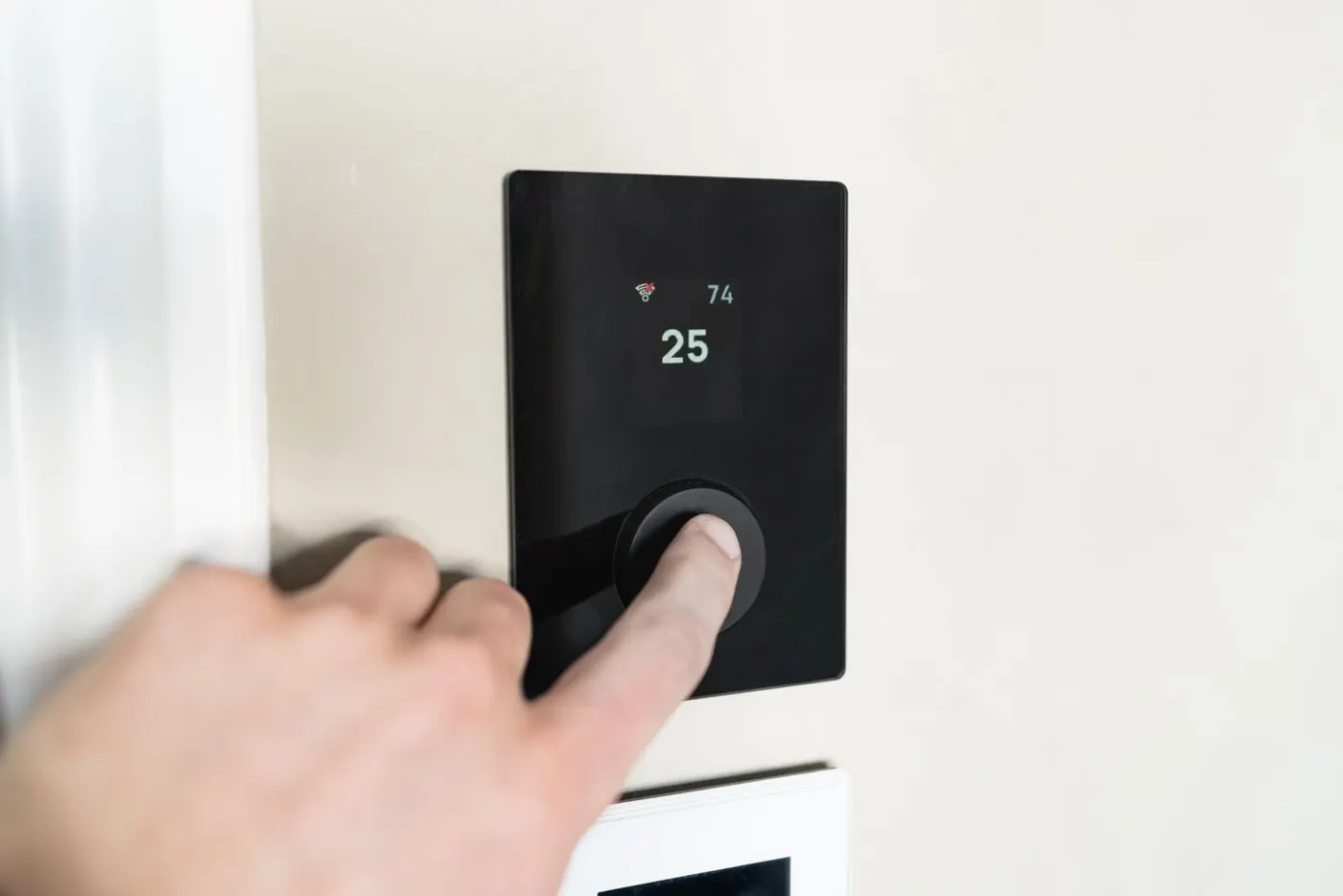
| Thermostat screen blank or rebooting | Batteries, the common wire, and the furnace door switch that cuts power when a panel is off |
| Heat only works when someone stands at the thermostat | Thermostat wiring at the plate or a chewed wire in the attic run |
Our guide to a furnace not heating walks the same list in order with the checks for each step, and thermostat problems covers the control side in detail.
Checks Worth Doing Before You Call
- Thermostat first. Mode on Heat, setpoint a good five degrees above the room, fan on AUTO rather than ON. Fresh batteries if it takes them. A blank screen after a battery change usually means the common wire, not the thermostat.
- Pull the filter and look through it at a light. If you cannot see light, that is your airflow problem and possibly your limit trip.
- Check the breaker and the switch next to the unit. Attic furnaces have a light switch on a joist or near the platform that looks like it belongs to the light. People flip it changing a bulb.
- Make sure the access panel is seated. There is a door switch behind it, and a panel left a quarter inch proud kills everything.
- Open the closed registers. Bedrooms get shut off in summer and nobody reopens them. Two closed rooms is often enough to trip a limit.
- Count the blink code. Many boards flash through a small window. Count the pattern, write it down, and tell us. It narrows the job before we arrive.
- Watch one full cycle and time it. How long from the call for heat to a sound, how long to warm air, and how long until it quits. That timeline is half the diagnosis.
- Reset once, not six times. If it locks out again after one reset, the furnace has found a real fault and more resets will not change its mind.
And what not to do:
- Do not tape, jumper or bypass a switch that keeps tripping. Limit switches, rollout switches, pressure switches and condensate switches are there to shut a gas appliance down for a reason.
- Do not run the system with the blower panel off. The door switch exists because an open cabinet can pull combustion air the wrong way.
- Do not sand a flame sensor with coarse paper or clean it with anything oily. It gets cleaned, not reshaped.
- Do not store boxes against an attic or closet furnace. It needs combustion air and service clearance, and the closet is not a closet.
- Do not stack a high MERV filter on an older blower because a store told you to. A furnace from the nineties with a PSC motor can lose a quarter of its airflow that way and trip on limit all winter.
Stop and Make the Call
Most no-heat problems can wait for morning. These cannot.
If you smell gas, leave the house and call 911 and the gas company from outside, with the number off your gas bill. Do not go looking for the source, do not flip switches, and do not try the furnace one more time to see.
If a carbon monoxide alarm sounds, get everyone out and call 911. California has required CO alarms in homes with gas appliances since 2011, and a furnace closet is the reason the law exists. If your house has gas heat and no CO alarm, buy one tonight. It costs less than a filter.
Soot or black streaks around the burner compartment, a flame that rolls out toward you when the burners light, a loud pop or boom at ignition, or rust flakes and water inside the cabinet all mean shut it off at the thermostat and leave it off. Those are combustion problems, and the honest answer on some of them is that the system needs a contractor rather than a part. We will tell you that on site and put you in touch rather than sell you a repair that does not fix it.
Heat Pumps, Defrost and the Lukewarm Air Complaint
Heat pumps are a growing share of our winter calls, mostly because the newer Irvine villages are full of them and the systems behave nothing like a furnace.
A heat pump delivers air in the 90°F to 105°F range. Your hand is around 90°F, so the air feels cool while the house is actually warming. A gas furnace puts out 120°F to 140°F, which is why anyone moving from one to the other thinks the new system is broken. Nothing is wrong with air that reads 98°F at the register.
Long run times are also normal. A heat pump is sized to run, not to blast and stop. Short cycling on a heat pump in winter is the symptom worth worrying about.
Then there is defrost. On a cold damp morning the outdoor coil can frost over, and the system reverses itself for a few minutes to melt it, which looks like steam coming off the unit and sometimes comes with a thump when the reversing valve shifts. People call that in as a failure. It is the equipment doing its job. What is not normal is a coil carrying a solid cap of ice through the afternoon.
Auxiliary heat is the other one. Most heat pumps have electric strip heaters for the cold end, and a thermostat set to Emergency Heat runs those alone while the heat pump sits idle. The house gets warm and the electric bill is memorable. If someone flipped it to Emergency last winter and nobody flipped it back, that is a one-minute fix. And if the strips are running because the heat pump cannot keep up, we check charge, airflow and defrost rather than leaving the house on strip heat all season. Low refrigerant on a heat pump means a leak, same as it does in July, and it needs a diagnosis rather than a top-up.
Filters and Airflow, the Boring Half of These Calls
A good share of what gets reported as a broken heater is a system suffocating.
Heat has to leave the heat exchanger as fast as the burners put it in. Choke the airflow and the metal climbs until the high limit opens, so the burners stop and the blower keeps running. You feel cool air and hear the fan, so you call it a no-heat problem. The furnace is protecting itself.
One-inch filters want changing every two or three months in this climate, and faster in a house with dogs or a remodel underway. The four or five-inch media cabinets go longer, six months to a year, but people forget they exist entirely. Write the date on the frame with a marker when you put it in. It beats trying to remember.
Check the temperature rise if you want a real number. The rating plate on a furnace lists an allowable rise, often something like 40 to 70 degrees. Measure the supply air near the unit, measure the return, and subtract. Over the top of the range means airflow. Under the bottom means the furnace is underfiring or moving too much air. We take that reading on every heating call before we start replacing anything, and our AC maintenance and tune-up visits cover the same airflow work on the cooling side.
Closed registers, a collapsed flex duct in the attic, a disconnected return boot and a blower wheel packed with dust all land in the same place. Those are airflow jobs, not furnace jobs, and the fix is usually cheap.
Repair or Replace, and Who Does Which
Here is how we actually call it.
A furnace under about fifteen years old with an igniter, flame sensor, switch, capacitor, motor or thermostat fault gets repaired. Those parts are stocked, the labor is straightforward, and nothing about the rest of the system is at the end of its life.
A furnace in its twenties with one failed part still usually gets repaired, and we say so even though a replacement is the more profitable advice. An old furnace with a cheap part broken is an old furnace with a cheap part broken.
A cracked heat exchanger is the line. That is not a repair, it is a combustion safety problem, and the system gets shut down and replaced. Same answer for a cabinet that has rusted through, or a unit where the parts have been discontinued and nothing cross-references. At that point WY&G takes it, quotes it in writing, sizes it properly and pulls the permit. We have no stake in that quote.
Wall furnaces sit in their own category. They are simple and worth servicing while parts exist, and when they stop existing we tell you plainly instead of chasing a part for three weeks. Our repair or replace guide lays out the arithmetic we use, and warning signs before a system fails is the one to read if the heat still works but something feels off.
Where We Work
We are based in Irvine and run South County routes daily. Irvine gives us the most heating calls of any city we serve, and the split follows the build date. Woodbridge, Northwood, University Park, Turtle Rock and El Camino Real have gas furnaces from the eighties and nineties, often in an attic or a hallway closet, and that is where igniters, flame sensors, limit trips and tired blower capacitors come from. Great Park, Portola Springs, Eastwood and the newer Cypress Village phases are heat pumps and condensing furnaces with control boards, condensate switches and thermostats that want a common wire. Different calls, same streets, ten minutes apart.
In Tustin, Tustin Ranch and Tustin Legacy look like the newer Irvine villages. Old Town is the other end of the range, with wall furnaces, floor furnaces and small attic units squeezed into houses that predate central air. We handle what is serviceable there and are upfront when a part no longer exists.
In Lake Forest, including Foothill Ranch and Portola Hills, the attic furnace is close to standard and those attics sit further inland, so the dust load and the summer heat on the cabinet are both higher. Rodent damage to thermostat wiring in attic runs shows up more here than it does near the coast.
Past the main three we cover Mission Viejo, Laguna Hills, Laguna Woods, Laguna Niguel, Aliso Viejo, Laguna Beach, Ladera Ranch, Rancho Santa Margarita, San Juan Capistrano, Dana Point and San Clemente. Closer to the water the heating season is milder and shorter, which means the equipment runs even less and the first cold night catches even more of it. The full list with ZIP coverage is on the service areas page, and Irvine, Tustin and Lake Forest each have their own page for the cooling side of the same system.
Restaurant, office suite or storefront with a rooftop unit? That work runs through commercial rooftop AC service.
What to Expect When You Call
- Call or text (949) 267-7771. Brand and rough age, where the unit sits, what it does through one full cycle, and the blink code if you can see one.
- A technician diagnoses on site and quotes the repair before any work starts. Nothing gets replaced until you approve it.
- Many repairs finish on the first visit. Igniters, flame sensors, switches, capacitors, thermostats and filters ride on the truck. Blower motors and control boards for specific models are usually ordered, and we tell you when they are due.
- If it turns out to be bigger than a repair, you get that answer straight, with WY&G handling replacement work under their own license and permit.
- Every repair carries a 90-day parts and labor warranty.
While you wait with no heat, close off rooms you are not using, leave the interior doors open where you do want the air to move later, and keep space heaters off extension cords and away from bedding. If the system locked out, leave it locked out rather than resetting it through the evening. The before the technician arrives checklist covers the rest.
Frequently Asked Questions
Do you repair furnaces, or only air conditioners?
Both, within limits we are straight about. We handle minor heating service and repairs: thermostats, hot surface igniters, flame sensors, pressure and limit switches, rollout switches, blower and inducer motors, run capacitors, condensate drains and overflow switches, filters and airflow problems, and seasonal tune-ups. Those are jobs under $1,000 in labor and materials. A new system, a full replacement, ductwork or a cracked heat exchanger is a different kind of job, and it goes to our licensed heating and air contractor, WY&G Inc, so it is permitted and done to code. If what you have is a small repair, you are not paying for a replacement quote to find that out.
The heat has not run since March. Is it worth having it looked at before it gets cold?
Yes, and November is the right month for it. A furnace in Orange County runs a few hundred hours a year, so the parts fail by cycle count and by sitting still, not by mileage. Seven idle months let dust settle on the burners, stiffen the blower bearings, and leave a film on the flame sensor. A tune-up is checking the igniter, cleaning the flame sensor, pulling the blower wheel if it needs it, replacing the filter, watching a full ignition cycle, and reading the temperature rise against the rating plate. We would rather find a weak igniter on a 65°F afternoon than at nine on the first 42°F night.
Why does the heat smell like burning dust the first time it runs?
Because it is burning dust. Dust settles on the heat exchanger over a summer of sitting idle, and the first few cycles cook it off. The smell should fade within twenty or thirty minutes of running and not come back. What is not normal: a sharp acrid smell like hot electrical insulation, a smell that gets stronger instead of weaker, or any smell of gas. Shut the system off at the thermostat for the first two. For gas, leave the house, then call 911 and the gas company from outside. The number is on your gas bill.
The air from the vents is barely warm and the system runs for an hour. Is something broken?
Depends on what is making the heat. A gas furnace should deliver air well above body temperature, usually in the 120°F to 140°F range at a register near the unit, and a long run with lukewarm air means weak firing or an airflow problem. A heat pump is different by design. It delivers 90°F to 105°F air and runs long cycles, which feels cool on your hand even while the house is warming. Many of the newer all-electric homes in Great Park and Portola Springs are heat pumps, so this is the single most common complaint we talk people out of. Check the outdoor unit. If something out there is running when the heat is on, you have a heat pump.
How fast can someone get out when the heat is off?
Same day in most cases on the South County corridor, and we are honest on the phone when the day is already full rather than booking you and sliding. We are based in Irvine and run Irvine, Tustin, Lake Forest and the corridor down to San Clemente every day. If the house has no heat and overnight lows are in the forties, say so when you call and we will work it into the route ahead of jobs that can wait.
What do you need from me on the phone?
Four things, and they decide which parts ride on the truck. The brand and approximate age off the label inside the access door. Where the unit lives, attic, closet, garage or a wall. Exactly what it does during one full cycle, meaning what you hear, what lights, and how long before it quits. And the blink code if there is a small LED visible through the viewport, counted as a pattern, like three short flashes then a pause. A photo of the rating plate texted over is worth more than any description, ours included.
Related Pages
The cooling side of the same equipment is on the air conditioning repair page, with city pages for Irvine, Tustin, Lake Forest and Mission Viejo. For a seasonal check rather than a repair, see AC maintenance and tune-up. To work through a no-heat problem yourself, start with furnace not heating, then thermostat problems and the Southern California maintenance checklist. New systems, replacements and ductwork are handled by WY&G Inc. If the complaint is really an oven rather than a furnace, oven and range repair is the page you want.