
Refrigerator Making Strange Noises? What Each Sound Means (Clicking, Buzzing, Knocking, Squealing)
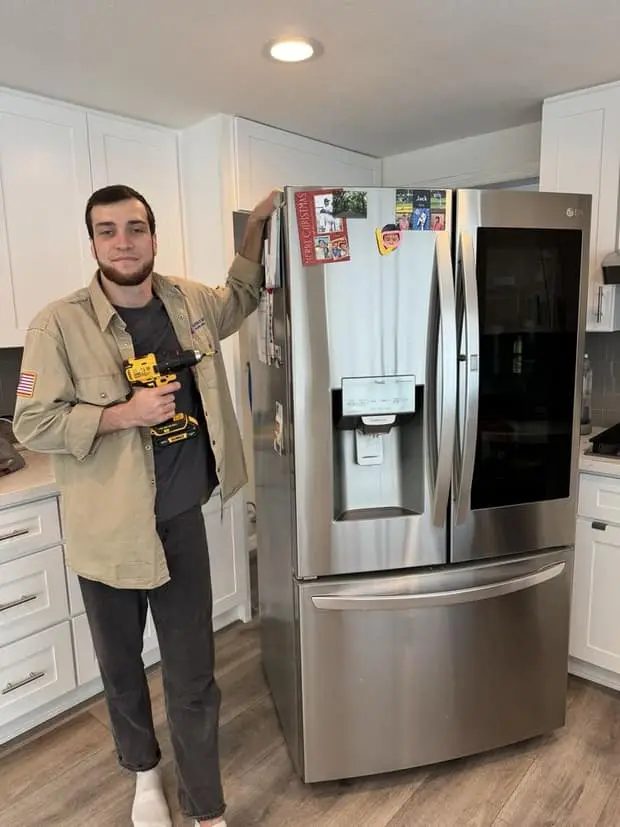
Noise is the one refrigerator symptom people describe to us over the phone better than any other. Nobody can say how cold their crisper is, but everybody can say "it buzzes for about ten seconds, then it stops, then it starts again." That description is worth more than it sounds. A refrigerator is a small machine with a short list of moving parts, and each one fails with its own voice.
We take these calls all week across Irvine, Tustin and Lake Forest, and the pattern holds. A buzz that quits when the door opens is one part. A click every three minutes is a different part. A squeal is a third. This guide walks the sounds one at a time, tells you which ones are just the appliance doing its job, shows you the checks that are safe to do yourself, and says plainly where the work stops being a homeowner job.
What is actually in there making noise?
Before the symptom list, the short anatomy. It makes everything below easier to follow.
- The compressor. Bottom rear of the cabinet, in a black steel shell. It pumps refrigerant and produces a steady low hum. On older models it switches hard on and off. On inverter and linear compressors, the kind LG and Samsung have used for years, it ramps its speed up and down and the pitch shifts with it.
- The condenser fan. Also at the bottom rear, next to the compressor, blowing air across the condenser coil. It runs whenever the compressor runs. Built-ins often have this fan up top behind the grille instead.
- The evaporator fan. Hidden behind the rear panel inside the freezer. It pushes cold air through the freezer and up into the fresh-food section. On most models it stops when you open a door, and that single fact is the best diagnostic tool you have.
- The start relay and overload. A small plug-on part clipped to the side of the compressor. It gets the compressor spinning and protects it if it can't.
- The water inlet valve and ice maker. Solenoid valve at the back, ice maker in the freezer. Between them they produce most of the clunks, thuds and buzzes that people mistake for something breaking.
- The cabinet, the drip pan and the floor. Not a component, but responsible for a surprising share of rattles.
Which sounds are normal?
Worth clearing these first, because a modern refrigerator is noisier in more ways than the one your parents had, and none of it is a fault.
- Gurgling and trickling after the compressor shuts off. Refrigerant equalizing through the tubing. Sounds like water moving because it more or less is.
- Popping and cracking. Plastic liners and shelves expanding and contracting as the temperature swings. Loudest in a cabinet that was recently loaded with warm groceries.
- A short sizzle or hiss every several hours. The defrost cycle. Meltwater dripping onto a warm defrost heater. If you hear this and nothing else, the defrost system is doing exactly what it should.
- A clatter and thump from the freezer. Ice harvesting into the bin, then the fill valve opening for the next batch. Roughly every couple of hours.
- A pitch that rises and falls instead of clicking on and off. That's an inverter or linear compressor modulating. It is normal and it is why these refrigerators are quieter overall.
- A brief loud hum right at startup that settles within a second or two. Starting torque.
My rule of thumb after years of these calls: if the sound has always been there and the food is cold, leave it alone. New sounds are the ones that mean something.
Match the sound to the part
| What you hear | Most likely causes |
|---|---|
| Buzzing or rattling that stops the second you open the freezer door | Evaporator fan blade striking ice, failed defrost system behind it, cracked or loose fan blade |
| Click, then a hum for a few seconds, then silence, repeating every 2 to 5 minutes. Fridge is warming | Start relay failing, compressor overload tripping, seized or shorted compressor |
| A single sharp click every so often, everything still cold | Normal thermostat or control relay, damper door actuating, defrost timer advancing |
| Loud humming or vibration from the bottom rear that continues with the doors open | Condenser fan motor bearing, fan blade hitting debris, compressor mounting grommets hardened, dirty condenser coil |
| Squeal, chirp or high whine, intermittent, often worse when cold | Evaporator fan motor bearing (stops with door open) or condenser fan motor bearing (doesn't) |
| Knocking or banging, a few hits then quiet | Ice maker harvest, water hammer in the supply line, condenser fan blade striking a wire or debris, loose compressor mount |
| A buzz from the back lasting 5 to 15 seconds, on a schedule | Water inlet valve energizing, usually with the water supply off or the filter clogged so no water flows |
| Whole cabinet rattles or vibrates against the wall | Leveling feet, drip pan loose in its track, rollers, floor deflection, items on top of the unit |
| Compressor runs almost constantly, louder than it used to be | Dirty condenser coil, door seal leaking, frost blocking the evaporator, low refrigerant charge from a leak |
Buzzing or rattling that stops when you open the door
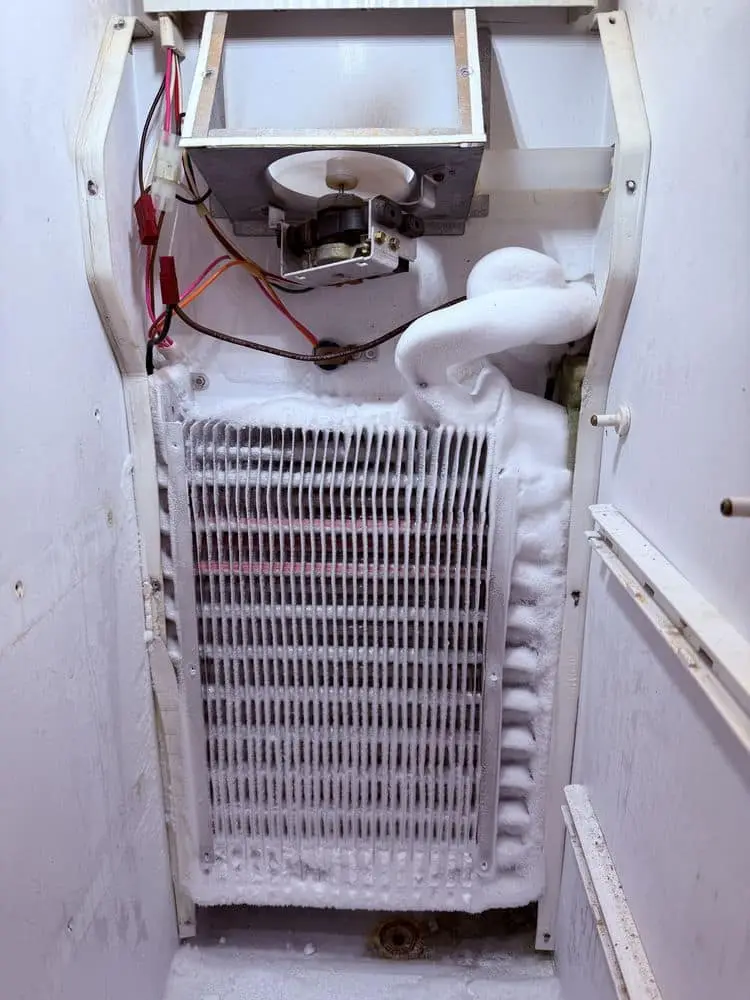
This is the single most common noise complaint we get, and it is nearly always the same thing. Behind the rear panel of the freezer sits the evaporator coil and the evaporator fan. When the automatic defrost cycle quits running, ice builds on that coil until it reaches the fan blade. The blade then clips the ice on every rotation, which produces a buzz, a rattle or a sound people describe as a playing card in bicycle spokes.
Open the freezer door and it goes silent, because the door switch cuts that fan. Close it and the noise returns a few seconds later. That test is close to conclusive.
Here is the part that catches people out. The fan is not usually the broken component. It is the victim. The real failure is upstream in the defrost circuit, which means the defrost heater, the bi-metal thermostat, the evaporator thermistor or the control board. Replace the fan and leave the defrost fault alone and the new fan will be hitting ice again within a month. We wrote a full guide on reading that ice, which is worth the ten minutes if this is your symptom: frost building up in your freezer.
The tell that confirms it: the fresh-food section starts drifting warm while the freezer still feels fine. That's because on most refrigerators the fresh-food compartment is cooled by air blown off that same iced-over coil. If your fridge is already warm, our refrigerator not cooling guide picks up from there.
Clicking every few minutes
Two very different situations share the word "clicking," so separate them by what the food is doing.
Clicking and everything is still cold. Relays on the control board switching, the air damper between compartments opening and closing, a mechanical defrost timer stepping over. Normal. A single tick a few times an hour is nothing.
Click, a low hum for three to eight seconds, silence, then the same thing two to five minutes later, and the refrigerator is warming up. That is a compressor that is trying to start and failing. The start relay energizes, the compressor stalls, the overload protector senses the current and opens to protect the windings. Everything cools down, the overload resets, and the cycle repeats.
Three things cause it. The start relay or start capacitor has failed, which is a small part and often the whole repair. The compressor windings have shorted or gone open, which is a sealed-system job. Or the compressor is mechanically seized, which on most refrigerators means the repair-or-replace conversation. From the outside the three sound identical. A technician separates them by checking the relay, reading winding resistance and measuring the starting current draw, and that takes about fifteen minutes.
What you should not do is keep letting it cycle for days. Every one of those attempts is a locked-rotor current surge through the windings. If it has been clicking since yesterday, unplug it and call. Our sealed system and compressor repair page explains what that side of the work involves.
Humming, droning or vibration from the bottom rear
If the sound keeps going with both doors wide open, stop looking inside the box. It is coming from the machine compartment at the bottom back, or on a built-in, from the grille area up top.
Most often it's the condenser fan. That motor sits in the dirtiest, warmest part of the appliance and its bearings wear. A worn condenser fan motor drones, and the drone usually gets worse as the motor warms up. Sometimes it's simpler than a motor: a dust ball, a dropped zip tie or a piece of cardboard packaging in the blade path will buzz convincingly.
Compressor mounting grommets are the other regular. The compressor sits on four rubber isolators that harden with age, and once they do, ordinary compressor vibration transmits straight into the steel base and then into the floor. The sound is a low drone you feel more than hear, and it's loudest in a kitchen with hard floors, which is most of the homes we work in from Irvine down through Mission Viejo and Laguna Niguel.
Then there's the one nobody guesses. A condenser coil packed with dust makes the compressor run longer and hotter for the same cooling, so the appliance is simply audible more of the day. People report it as "it got louder" when nothing actually broke. Pulling the grille and vacuuming the coil is on our refrigerator maintenance checklist for exactly that reason.
Squealing, chirping and whining
Bearings. Nearly always bearings, in one of the two fan motors.
Use the door test again. A squeal that cuts out when you open the freezer is the evaporator fan motor. A squeal that carries on, and is louder if you kneel at the back of the unit, is the condenser fan motor. Either way the noise tends to be intermittent at first and worse when the motor is cold, then it becomes constant over a few weeks.
This is the failure I get asked about most in terms of "can I just oil it." Please don't. These are sealed sleeve or ball-bearing motors and there is no service port. Spraying penetrating oil through the housing washes out what lubricant is left, quiets it for maybe two weeks, and then the motor locks up. If it's the evaporator fan that seizes, you lose all cold-air circulation and the fresh-food section goes warm within hours. The motor is not an expensive part and it is a straightforward swap for a technician.
One exception worth knowing. A chirp or short squeak only when the door opens or closes is usually just a dry door hinge or the gasket dragging. A little food-safe silicone on the hinge pin handles that.
Knocking, banging and thumping
Rhythm tells you which one this is.
Two or three knocks, then nothing for an hour or two. Ice maker. The harvest arm shoves the cubes out and they hit the bin, then the fill valve opens. Normal, even when it is loud enough to wake someone at night.
One sharp bang in the wall or the water line right after the fridge fills. Water hammer, not a refrigerator fault. The inlet valve closes fast and the column of water in the supply line slams. An arrestor on the line or a slightly throttled shutoff valve fixes it.
A rapid ticking or slapping that runs the whole time the compressor runs. Something is in the condenser fan blade path, or the blade is cracked and hitting its shroud.
A heavy thud when the compressor starts or stops. Mounting grommets again, or the compressor shifting on a base that has lost a bolt.
A buzz from the back for ten seconds at a time
This one is underrated because it sounds serious and is usually trivial. The water inlet valve is a solenoid. When the ice maker calls for water it energizes, and if water can't actually flow, the coil sits there buzzing for the full fill time and then shuts off.
Reasons water can't flow: the household shutoff behind or under the cabinet is closed, the saddle valve is partly clogged, the water filter is overdue and heavily restricted, or the fill tube has frozen. Same buzz for all of them. If you are not using the ice maker at all, lifting the ice maker's shutoff arm or switching it off in the control panel stops the calls and stops the buzz.
If the ice maker matters to you, work through ice maker not working instead of just silencing it.
Rattles, vibration and the cabinet itself
Not every noise is a component. A few of these show up on almost every noise call.
- Leveling. A refrigerator should sit dead solid with a slight rearward tilt so the doors swing closed. If you can rock it at all, the feet need adjusting. Rocking plus compressor vibration equals a rattle that moves around and is impossible to locate.
- The drip pan. It sits loose in a track under the compressor, and once it shifts it buzzes against the base every time the compressor runs. Sliding it back in seats it.
- Clearance. Manufacturers want an inch or so at the back and above. Pushed tight to the wall, the cabinet uses the wall as a soundboard, and the condenser runs hotter into the bargain.
- Things on top. A cookie sheet, a cereal box, a bottle on the top shelf resting against the liner. Feels too obvious to check. Check it anyway, it is a real percentage of these calls.
- Floors. Some of the older homes and upstairs kitchens in Tustin Foothills and around Laguna Hills have enough floor flex that a perfectly healthy compressor turns the subfloor into a drum. Anti-vibration pads under the feet solve it.
Safe checks you can do in ten minutes
All of these are homeowner-safe. Nothing here needs a meter and nothing here needs the back panel off with the power on.
- Do the door test. Open the freezer, listen, close it, listen. Inside versus outside is more than half the diagnosis.
- Locate the sound by ear. Kneel at the front, then at the back. Front and low points at the compressor area, back and high on a built-in points at the top grille fan.
- Empty the top of the unit and check that nothing inside is touching the rear liner.
- Rock the cabinet gently. If it moves, level it with the front feet until it doesn't.
- Pull the bottom grille and look at the drip pan and the condenser. Unplug first. Vacuum the dust, reseat the pan, and make sure nothing has fallen into the fan.
- Note the timing. Constant, every few minutes, or once every couple of hours? Write it down. It's the most useful thing you can tell the technician on the phone.
- Check the water supply and filter date if the noise is a periodic buzz from the back.
- Check compartment temperatures with a thermometer in a glass of water. 37°F in the fresh-food section and 0°F in the freezer. A noise plus drifting temperatures is a different and more urgent problem than a noise on its own.
Our before the technician arrives guide has the rest of what speeds up a visit, including where to find the model number.
What not to do
- Don't chip ice off the evaporator with a knife or screwdriver. The refrigerant tubing runs directly under it, and a puncture turns a defrost repair into a sealed-system repair.
- Don't oil a sealed fan motor. Covered above. It always ends the same way.
- Don't swap a start relay because a video said so. If the compressor is actually the problem, the new relay fails too and you have learned nothing except that you are out a part.
- Don't take the freezer rear panel off with the refrigerator plugged in. The defrost heater terminals are live in there.
- Don't run it for days while it clicks. Repeated locked-rotor starts are how a relay problem becomes a compressor problem.
- Don't ignore a burning smell. Unplug it and call. A failing fan motor or a relay arcing at its terminals smells like hot plastic before it does anything worse.
What only a technician should handle
The line is pretty clear. Anything that needs the power on and a meter in your hand, anything behind the freezer's rear panel, and anything on the refrigerant side.
- Testing the start relay, start capacitor and overload, and reading compressor winding resistance and starting amp draw.
- Replacing either fan motor, which means pulling the evaporator cover or the machine-compartment assembly.
- Diagnosing the defrost circuit, including heater continuity, bi-metal operation, thermistor resistance against a temperature chart, and whether the board is even commanding a defrost.
- Anything involving refrigerant. Cutting into a sealed system requires recovery equipment and EPA certification, and "just adding some" isn't a thing on a hermetically sealed refrigerator.
- Control board diagnosis. Boards get blamed constantly and are the actual fault far less often than people expect.
When to stop using it and call
Call promptly if the buzzing stops only when the door opens, if it clicks every few minutes and the food is warming, if a squeal has gone from intermittent to constant, if the compressor now runs nonstop, or if the noise showed up together with a temperature change.
Unplug it and call the same day if the breaker trips when the refrigerator starts, if you smell burning plastic or hot insulation, if the compressor shell is too hot to keep a hand on, or if there's a loud grinding you can hear from another room. Those are not noise complaints anymore.
Keeping it quiet
Nothing exotic, and I'd skip anyone who tells you a refrigerator needs quarterly attention.
- Vacuum the condenser coil twice a year, or three times if you have a shedding dog. This is the highest-value ten minutes in refrigerator ownership and it directly reduces run time and noise.
- Reseat the drip pan whenever you have the grille off.
- Keep an inch of air at the back and the top, and don't box a freestanding unit into a tight cabinet cutout.
- Recheck the leveling after any move, any floor work and any remodel.
- Change the water filter on schedule. A restricted filter is behind a lot of inlet valve buzzing.
- Fix a frost problem while it is still small. Ice against the fan is the failure that turns into three other failures.
Repair or replace?
Most noise repairs are worth doing without much thought. Fan motors, relays, grommets, drip pans and defrost components are ordinary parts on ordinary refrigerators, and they restore an appliance that is otherwise fine.
The conversation changes with a confirmed failed compressor, and it changes further on a unit past its first decade with other things already worn. Built-in and integrated columns from Sub-Zero, Thermador, Viking and Liebherr are a separate calculation entirely, since replacement means cabinetry work on top of the appliance. Our repair or replace guide lays out how we think about it. Whatever the answer is, our technician gives you the quote on site before any work starts.
What we do when we arrive
The visit starts with listening, because you can waste an hour with tools in your hand on a problem your ears would have solved. We run the door test, isolate the sound to the freezer compartment or the machine compartment, and check compartment temperatures against the controls. From there it's the condenser and its fan, the compressor and its relay with a meter, the evaporator compartment if the sound points inside, and the cabinet, pan and leveling last. You get told what failed and what it costs before anything is replaced, most refrigerator repairs are done the same day from parts stocked on the truck, and everything carries a 90-day parts and labor warranty.
We are factory authorized for LG and factory authorized for Liebherr. For Samsung we are certified technicians. We provide professional service for Sub-Zero, Thermador, Viking, Bosch, GE, Whirlpool, Frigidaire and the other brands in South Orange County kitchens. See our refrigerator and freezer repair service page, or the local pages for Irvine, Tustin and Lake Forest. We cover the corridor from Irvine and Tustin down through Lake Forest, Mission Viejo, Laguna Hills, Laguna Woods, Aliso Viejo, Laguna Niguel, Ladera Ranch, Rancho Santa Margarita, San Juan Capistrano, Dana Point and San Clemente. Check the full service area if you're not sure.
Frequently Asked Questions
What refrigerator noises are normal?
A steady low hum from the compressor, a soft whoosh of air from the fans, water gurgling or trickling through the tubing after the compressor stops, occasional popping and cracking as plastic parts expand and contract, a short sizzle during the defrost cycle when meltwater hits the warm heater, and the clatter of ice dropping into the bin. Inverter and linear compressors used by LG and Samsung also change pitch as they speed up and slow down instead of switching hard on and off. None of those need a repair.
Why does my refrigerator buzz or rattle until I open the door?
That is the classic signature of the evaporator fan blade striking ice behind the freezer's rear panel. Opening the door cuts power to that fan on most models, so the noise stops the moment you open it and starts again a few seconds after you close it. The ice is there because the automatic defrost system is no longer clearing the coil, so the real repair is in the defrost circuit, not the fan.
My refrigerator clicks every few minutes and then goes quiet. What is that?
A click followed by a low hum that quits after a few seconds, repeating every two to five minutes, is usually the compressor start relay trying to start the compressor and the overload protector shutting it down. A relay is a small part and often the whole fix. The same pattern can also mean the compressor windings have failed, which is a far bigger job, so the two have to be told apart with a meter before anything gets replaced.
Is a loud refrigerator dangerous, or can I just live with it?
Most noises are a warning, not a hazard, but two are worth acting on right away. A fan hitting ice means the defrost system has failed and the fresh-food section is about to start running warm. A relay clicking on and off every few minutes means the compressor is being restarted under load over and over, which shortens its life. Stop using the refrigerator and call if the breaker trips, if you smell burning plastic, or if the compressor is too hot to touch.
Why does my refrigerator squeal or chirp?
A squeal, chirp or high whine almost always comes from a fan motor bearing that is drying out. If the sound stops when you open the freezer door, it is the evaporator fan inside. If it continues with the door open and gets louder at the back of the cabinet, it is the condenser fan underneath. Do not spray penetrating oil into a sealed motor. It quiets the noise for a couple of weeks and then the motor seizes.
My refrigerator suddenly got louder but still keeps food cold. Should I wait?
A sudden jump in noise on a refrigerator that still cools usually means a fan bearing, a loose fan blade, a dirty condenser making the compressor work harder, or the beginning of an ice problem. Cooling is the last thing to go, so waiting is how a fan motor turns into a fan motor plus a spoiled load of food. Getting it looked at while it is still cold is the cheaper version of the same repair.
Related Pages
- Refrigerator & Freezer Repair in Orange County
- Refrigerator Repair in Irvine
- Refrigerator Repair in Tustin
- Refrigerator Repair in Lake Forest
- Sealed-System & Compressor Repair
- Frost Building Up in Your Freezer?
- Why Is My Refrigerator Not Cooling?
- Freezer Not Cooling or Freezing
- Refrigerator Leaking Water
- Ice Maker Not Working
- Refrigerator Maintenance Checklist
- Repair or Replace?
- Before the Technician Arrives
- Factory Authorized LG Repair
- Factory Authorized Liebherr Repair
- Irvine · Tustin · Lake Forest · Mission Viejo · Laguna Hills · Aliso Viejo · Laguna Niguel · Dana Point · San Clemente