
Refrigerator Freezing Food in the Fresh-Food Section? Causes and Fixes
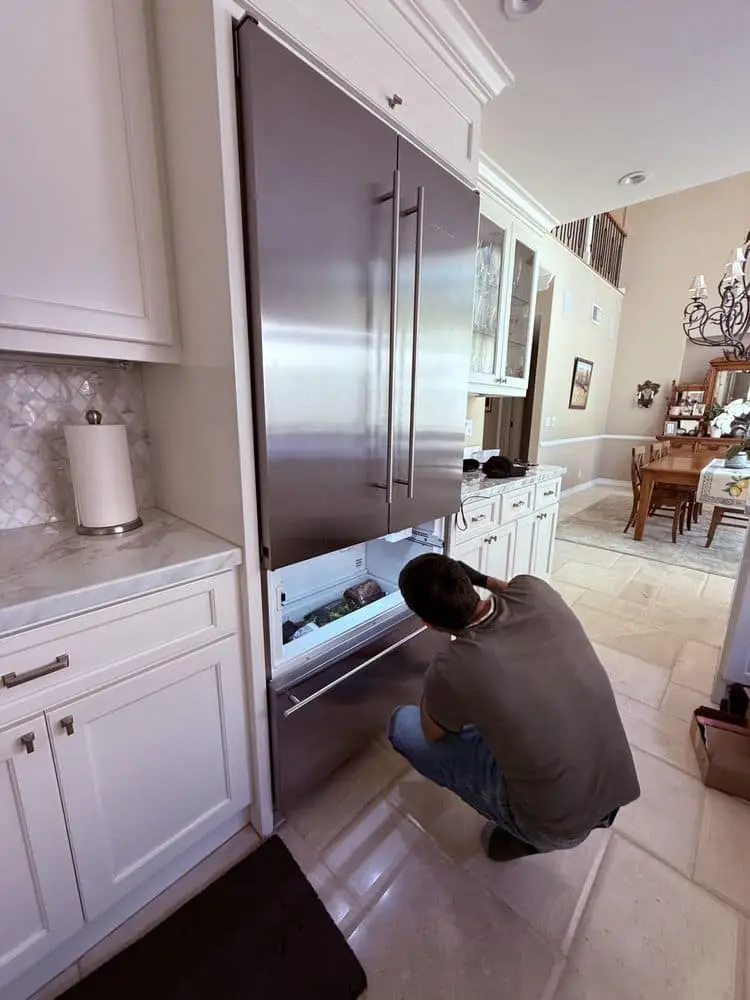
A refrigerator that freezes food gets ignored longer than one that stops cooling. Warm milk is an emergency. Frozen lettuce is an annoyance, so people move the lettuce and carry on. Then the eggs crack, a bottle of kombucha splits in the door bin, and the bag of spinach has turned to green slush twice in a week.
It's worth dealing with for a plain reason. The same part that freezes your produce today is the part that stops regulating entirely a few months later, and then you have a warm fridge and a full trash can. We see this one steadily in Irvine, Tustin and Lake Forest, and it is nearly always one of six causes. Three of them you can sort out yourself this afternoon. Three need a meter.
What temperature is the fresh-food section supposed to hold?
Target 37 to 38°F in the middle of the compartment and 0°F in the freezer. Food safety guidance puts the ceiling at 40°F. The floor is physics: water freezes at 32°F, and anything with high water content, so greens, cucumbers, berries, milk, freezes within a degree or two of that.
So a fridge set to 34°F isn't running cold by mistake. It's running with two degrees of margin in a box where the air coming out of the vent can be in the mid-20s during a cooling cycle. The compartment average can read a perfectly respectable 36 while the back of the top shelf is sitting below freezing for ten minutes at a stretch. That gap between average and local temperature is behind most of the complaints we take.
One more number worth knowing. The display on the door is a setpoint, not a measurement. On most models it is not showing you what the sensor reads, it is showing you what you asked for. A fridge can display 38 and hold 31 in the crisper without the display ever changing.
How does a refrigerator decide how cold the fridge side gets?
Almost every household refrigerator makes cold in exactly one place. An evaporator coil behind the back panel of the freezer gets cold, a fan blows air across it, and that air is pushed into the freezer. Some of it is then routed through a duct into the fresh-food section.
The part that meters that flow is an air damper, also called a baffle or a diffuser. It's a small plastic housing with an insulated flap, driven either by a little stepper motor or, on older units, by a bimetal coil. A thermistor in the fresh-food compartment tells the control board how cold the air is, and the board opens and closes the damper and starts and stops the evaporator fan to hold the setpoint. That is the whole control loop. Three parts and a duct.
Higher-end and many newer French-door models work differently. They have two evaporators, one per compartment, and a solenoid valve in the refrigerant circuit that decides which coil gets refrigerant. Liebherr and Sub-Zero have used separate circuits for years, and LG and Samsung use dual-evaporator layouts on a good number of their French-door models. On those, there is no damper to stick. Instead the valve can hang in the position that keeps feeding the fresh-food coil. Different part, same symptom on the shelf.
Knowing which layout you have matters because it changes what we test. If the freezer and fridge go cold and warm together, it's single-evaporator with a damper. If they behave independently, it's dual.
Symptoms to likely causes
| What you see | Likely causes |
|---|---|
| Only the back row of the top shelf freezes, rest of the fridge fine | Food sitting in the vent airstream, setting too low, normal contact freezing against the rear wall |
| Crisper drawers freeze, upper shelves normal | Damper stuck partly open, fresh-food thermistor drifted, crisper humidity slide closed with a near-empty compartment |
| Everything freezes, including door bins and the butter compartment | Setpoint or a Power Cool / Max Cool mode left on, thermistor failure, control board no longer closing the damper |
| Fridge freezes and the freezer is building frost too | Door seal leaking humid air, the unit running almost continuously, defrost system starting to fail |
| Freezes some days, normal others | Damper flap binding intermittently, thermistor with an intermittent connection, a door not latching every time |
| Started right after you adjusted the freezer colder | Single-evaporator interaction. Lowering the freezer sends more cold air through the same duct |
| Fridge freezes, freezer is warm or normal, French-door or built-in unit | Dual-evaporator model with a stuck refrigerant valve or a failed compartment sensor |
The six causes we actually find
1. The setting, or a mode nobody turned off
This is the single most common cause and it costs nothing to rule out. Somebody bumped the control, a child pressed buttons, or the fridge was set to 34 during a heat wave and never put back. Check it first.
The bigger trap is the boost modes. Power Cool, Max Cool, Super Cool, Quick Cool, Turbo Cool, Quick Ice. They run the compressor and fan flat out and hold the damper open, and on most models they are supposed to time out after a few hours. When they don't, or when nobody notices the icon is still lit, the fridge spends days in a mode built for cooling down a load of warm groceries. Turn them all off and give it 24 hours before you conclude anything.
Vacation and energy-saver modes cause the opposite complaint, but they're worth a look while you're in the menu.
2. Food parked in front of the vent
On most fridges the cold air enters the fresh-food section through a slotted vent on the back wall, usually in the upper third. Put a clamshell of greens flat against that vent and it gets vent air, not compartment air. Same for a carton of eggs on the back of the shelf, and same for anything touching the rear wall, which is the coldest surface in the box.
The fix is a few inches of space. Leave the back row for cans and jars that don't care, keep produce toward the front of the shelf, and don't block the vent with a sheet pan or a pizza box. If moving food solves it and the fridge was set to 34, raise it to 37 as well so you have real margin.
3. The air damper is stuck open
When the fix isn't the setting or the food, this is the next suspect on single-evaporator units. The damper is a flap, and flaps fail in two ways. The stepper motor or the bimetal that drives it quits, or ice forms in the duct and physically holds the flap open.
Here's the part that catches people out. The ice version has a different root cause. Moisture gets into that duct because a door is leaking or because the defrost system is no longer clearing the evaporator properly, and the ice is a symptom. Replacing the damper on a unit like that buys a few weeks. Our technician checks the frost pattern on the evaporator before condemning a damper, because if frost is the reason, the repair belongs in the defrost circuit instead.
You can sometimes hear a healthy damper. Stand in front of an open fridge in a quiet kitchen and you may catch a soft motorized click and a whir from the duct area as it actuates. Hearing it is a good sign. Not hearing it proves nothing, since on many models it only moves when the board calls for it.
4. The fresh-food thermistor has drifted
A thermistor is a resistor whose resistance changes with temperature. The board converts that resistance to a temperature using a lookup chart. When the thermistor ages, gets moisture into its leads, or develops a bad crimp at the connector, the resistance stops matching the chart. The board now believes the compartment is 41°F when it's really 33, so it keeps the damper open and the fan running. Everything it's doing is correct based on bad information.
This is my first suspect when the whole compartment freezes evenly and no mode is active. It's also the cheapest of the real repairs and about the fastest. We measure the thermistor's resistance, compare it against the manufacturer's chart at the temperature we measure in the compartment, and the two either agree or they don't. No guessing.
Worth saying plainly: do not try to test this with a cheap meter and a guess at what the reading should be. Those charts are model-specific and a reading that looks reasonable can be two full compartment-degrees off.
5. The door gasket is leaking
A tired gasket normally makes a fridge warm. The freezing version happens earlier, while the unit can still keep up. Humid Orange County air leaks past the seal, the compartment load goes up, and the compressor and evaporator fan now run 45 or 50 minutes an hour instead of 20. A shelf that gets cold vent air for twice as long freezes, even with the setpoint untouched.
Two easy checks. Close the door on a dollar bill and pull it out. Do that at six or eight spots around the perimeter. Where it slides out with no drag, the seal isn't sealing. Then look for a thin fuzzy line of frost on the freezer side near a door corner, which is condensation freezing right where air is getting in.
Gaskets go hard and take a set, especially on units that sit in afternoon sun from a west-facing window. Sometimes they just need cleaning, since built-up residue keeps the magnet from pulling the seal flat. Warm water and dish soap, then dry it. If the rubber is split, deformed or has given up its magnetism, it gets replaced.
6. Control board, or a stuck valve on dual-evaporator models
The board is the last suspect, not the first, and an honest technician works through the cheap parts before going near it. But boards do lose the output that drives the damper motor or hold a fan relay closed, and when that happens the damper never closes no matter what the sensor reports.
On dual-evaporator French-door and built-in units the equivalent failure is the three-way refrigerant valve hanging in the fresh-food position. That one shows up as a cold-to-freezing fridge with a freezer that is normal or drifting warm, which is a pattern you don't get on a single-evaporator unit. This is sealed-system adjacent work and it's not a homeowner job. See our sealed-system and compressor repair page for what that work involves.
What can you check yourself, safely?
All of these are door-open, no-tools-required checks. Nothing here involves removing a panel or touching wiring.
- Measure it properly. Fill a cup with water, stand a thermometer in it, put it on the middle shelf, and read it 24 hours later. Water buffers the swings from the door opening, so you get the temperature food experiences rather than a snapshot of a cooling cycle. Do the same in the freezer with a thermometer between two frozen packages.
- Read the setpoint and the icons. Write down both numbers. Turn off Power Cool, Max Cool, Super Cool and Quick Ice. If the setpoint is below 37, raise it to 37 and wait a full day.
- Note exactly where things freeze. Top shelf back, crisper, door bins, one drawer only. That detail cuts our diagnosis time more than anything else you can tell us on the phone.
- Clear the vents. Hand's width of space at the back wall in both compartments. Nothing flat against the vent slots in the fresh-food section, nothing jammed in the vent between compartments in the freezer.
- Dollar-bill the gasket at several points around both doors, and clean the seal while you're there.
- Check the crisper humidity slides. Closed slides trap cold and moisture in a drawer. Open them and see whether that single drawer stops freezing.
- Don't run it near-empty. A nearly empty fridge has no thermal mass, so it overshoots hard on every cycle. Jugs of water on a shelf genuinely stabilize it.
- Confirm the door closes every time. A fridge on an out-of-level floor, or one with a bin stopping the door from latching, runs much longer than it should.
If the fridge is back in range after 24 hours with the setting at 37, the modes off and food out of the airstream, you fixed it. That's a genuinely common outcome and there is no repair to pay for.
What should only a technician do?
The line is the back panel. Once a panel comes off you're near 120-volt wiring in a damp cabinet, a sealed refrigerant circuit, and connectors that cost real money to break.
- Thermistor testing. Resistance measured and compared against the model's chart at a known temperature. On multi-sensor units each one gets checked, including the evaporator sensor.
- Damper assembly. Removing the housing, confirming whether the flap is driven or iced, and testing the motor rather than replacing on a hunch.
- Reading the frost pattern. Where ice sits on the evaporator tells us whether this is a damper problem or a defrost problem wearing a damper costume.
- Defrost circuit. Heater, bi-metal or thermostat, and the adaptive defrost logic on the board.
- Control board diagnostics and service-mode tests, which let us command the damper and fan directly and watch what responds.
- Dual-evaporator valve and anything in the sealed system. Refrigerant work needs certification and equipment. It is not a DIY area under any circumstances.
One thing I'd tell anyone tempted to shortcut this: don't let somebody replace the main control board first. It's the most expensive part in the cabinet and the least likely cause of a fridge that freezes food. Thermistor and damper come first, every time.
Does frozen-then-thawed food still count as safe?
Safety and quality are separate questions. Food that froze inside a refrigerator never left refrigeration temperature, so it didn't spend time in the bacterial danger zone. On safety grounds it's generally fine.
Quality is where you lose. Lettuce, cucumbers, celery and berries break down at the cell level when they freeze and come out limp. Tomatoes go grainy. Milk separates and comes back together with a shake. Eggs that froze and cracked their shells go in the trash, because the shell was the barrier and it's gone. Glass bottles of anything carbonated can split in a door bin, and that's a cleanup you only want once.
If you store temperature-sensitive medication in the fridge, treat a freezing episode seriously and ask your pharmacist about that specific product. Some are ruined by freezing even once.
How do you keep it from happening again?
Most of the prevention here is habit rather than maintenance.
- Leave the setpoint at 37°F and stop adjusting it seasonally. The control loop handles ambient changes.
- Treat boost modes as a timer, not a setting. Turn them off when the groceries are cold.
- Keep produce off the back wall and out of the vent airstream. Back row is for jars.
- Clean the door gaskets a couple of times a year and look for hardening or splits while you're down there.
- Clean the condenser coil once a year. Twice is a waste of a Saturday unless you have pets shedding into it.
- Keep the fridge reasonably full. Half-empty is the worst case for temperature stability.
- Put a cheap thermometer on the middle shelf and glance at it when you reach past it. You'll catch a drift weeks before it ruins anything.
Our full routine is on the refrigerator maintenance checklist, and the broader household version is the appliance maintenance checklist.
When is it time to call?
Call once you've given it a day at 37°F with the modes off and the vents clear and it's still freezing food. At that point the control loop is the problem, and the control loop needs a meter.
Call sooner if any of these are true. The freezer is building hard ice as well as the fridge freezing, which points at defrost and will end in a warm fridge. The compressor never seems to stop. A drawer or compartment is frozen solid rather than just too cold. Or you have a built-in or dual-evaporator unit, where the parts involved aren't the ones a homeowner can rule out.
What we do on the visit: measure actual air temperature in both compartments, compare it with what the board reports, test the fresh-food and evaporator thermistors against the manufacturer's chart, check the damper or the compartment valve, read the frost pattern on the evaporator, and inspect both gaskets. You get the explanation and a quote before any work starts, and most of these repairs are done the same day from parts on the truck. Repairs are covered by our 90-day parts and labor warranty.
We are factory authorized for LG and factory authorized for Liebherr. For Samsung we are certified technicians. We provide professional service for Sub-Zero, Viking, Thermador, Bosch, GE, Whirlpool, Frigidaire, KitchenAid and most other brands in South Orange County kitchens. Start at our refrigerator and freezer repair page, or the local pages for Irvine, Tustin and Lake Forest. If you want to speed up the visit, before the technician arrives lists what helps.
Frequently asked questions
What temperature should the fresh-food section of a refrigerator be?
Aim for 37 to 38°F in the middle of the fresh-food section and 0°F in the freezer. Food safety guidance says keep the fridge at or below 40°F. Water freezes at 32, so a fridge running at 34 or 35 has only two or three degrees of margin, and the air coming out of the vent is colder than the average in the box. That is why a setting of 34 freezes the back row of shelves while the door bins stay fine.
Why is my refrigerator freezing food even though the setting has not changed?
Because the setting is not what controls the temperature. A thermistor measures the air and the control board decides how long to hold the air damper open and how long to run the evaporator fan. If that thermistor drifts and starts reading a few degrees warm, the board keeps feeding cold air into a compartment that is already cold enough. Nothing on the display changes. The other common version is an air damper whose motor or foam flap has failed in the open position, so cold air flows into the fresh-food side nonstop.
Why does food freeze only on the back shelf of my fridge?
That is the airstream, not a failure. Cold air enters through a vent on the back wall, usually in the upper third of the compartment, and the air leaving that vent can be in the mid-20s even when the compartment averages 38. Anything sitting directly in front of it or pressed against the back panel gets that air first. Move the greens and the eggs forward by a few inches and the problem usually disappears without any repair.
Is food that froze and thawed in the fridge still safe to eat?
Safety and quality are two different questions here. Food that stayed cold the whole time, froze, and thawed in the refrigerator has not been in the danger zone, so it is generally safe. The texture is another matter. Lettuce and cucumbers turn to mush, tomatoes go grainy, and eggs that froze and cracked should go in the trash because the shell is no longer a barrier. Milk that froze and thawed separates but is fine once shaken.
Can a bad door gasket make a refrigerator freeze food?
Indirectly, yes. A leaking gasket usually makes a fridge warm, not cold, but the first stage looks different. Humid air leaking in makes the compressor and the evaporator fan run far longer than normal, and a compartment that gets cold air for 50 minutes of every hour instead of 20 will freeze the shelves nearest the vent. Check the gasket by closing the door on a dollar bill and pulling. If it slides out with no drag, that section of seal is not sealing.
Should I replace a refrigerator that freezes food in the fresh-food section?
Usually not. This failure sits almost entirely on the cheap side of the parts list. A thermistor, an air damper assembly or a door gasket are all routine repairs, and the sealed system and compressor are not involved, which is what normally pushes a refrigerator toward replacement. The repair-or-replace conversation only starts if the fault turns out to be the main control board on an older unit or a stuck evaporator valve on a dual-evaporator model. Our repair or replace guide walks through how we weigh it.
Related Pages
- Refrigerator & Freezer Repair in Orange County
- Refrigerator Repair in Irvine
- Refrigerator Repair in Tustin
- Refrigerator Repair in Lake Forest
- Sealed-System & Compressor Repair
- Why Is My Refrigerator Not Cooling?
- Frost Building Up in Your Freezer?
- Freezer Not Cooling or Freezing
- Refrigerator Making Strange Noises?
- Refrigerator Leaking Water
- Refrigerator Maintenance Checklist
- Liebherr Refrigerator Owner's Guide
- Repair or Replace?
- Before the Technician Arrives
- Factory Authorized LG Repair
- Factory Authorized Liebherr Repair
- Irvine · Tustin · Lake Forest · Mission Viejo · Laguna Hills · Aliso Viejo · Laguna Niguel · Dana Point · San Clemente