
The 2-Minute Dryer Vent Test to Do Before Holiday Guests Arrive

Here is the direct answer. Put the dryer on an air-only or fluff setting, start it, and go stand at the outside vent hood for a minute. If the air pushing out is strong enough that you can feel it on your palm from a few inches away, and the little damper flaps are standing open rather than fluttering, the duct is clear enough. If the air is lazy and the flaps barely move, you have a restriction, and the holidays are the worst possible week to discover it the hard way.
We take this call every year in Irvine, Tustin and Lake Forest in the two weeks around Thanksgiving. The dryer worked fine in October. Then the guest room sheets, four tablecloths and a pile of bath towels go through it in one weekend, and suddenly a load needs two cycles. Nothing broke. The duct was already most of the way blocked, and the heavy wet laundry is what finally pushed it past the line.
Why does holiday laundry break dryers that were fine last week?
Three things change at once. The items get heavier and more absorbent. A bath towel holds several times the water of a t-shirt, and a cotton tablecloth is not far behind. Terry cloth and flannel also shed much more lint than knit cotton, so the duct collects faster during exactly the week you are using it hardest.
The second change is the pace. Normal laundry is a load here, a load there, with hours in between. Holiday laundry is back to back, sometimes all day. The duct never cools, the lint already in it dries out, and the dryer's own safety thermostats start cycling the heat on and off to protect the machine, which is what makes the cycle run long without feeling obviously broken.
The third is simply that nobody looks at the vent hood. It is behind a hedge, up on a roof, or on the side yard nobody walks through. The duct has been slowly filling for two or three years. The holiday load is the last straw, not the cause.
How do I run the 2-minute test, step by step?
- Find the outside hood first. Follow the duct direction from behind the dryer. On a ground floor laundry room it usually exits the nearest exterior wall. In a second-floor laundry closet, common in newer homes around Irvine and Lake Forest, it often runs up and out through the roof or out a gable end, so look up before you give up.
- Pull the lint screen and clean it. Do this before the test so you are measuring the duct and not the filter.
- Set the dryer to air dry, air fluff or no heat, whatever your model calls it, and start it empty. No heat means what you feel outside is airflow only.
- Go outside and hold a hand about six inches in front of the hood. A healthy dryer pushes a stream you can clearly feel there, enough to flutter a tissue held at arm's length. The damper flaps should be pushed fully open and stay open.
- Look at the hood itself. Lint fur around the flaps, a bird screen or mesh grate packed grey, or a flap stuck half closed by a buildup at the hinge are all restrictions you can see from the ground.
- Go back in and feel the laundry room. After a few minutes of running, the room should not feel noticeably warmer or damp. Warm and humid means exhaust is leaking out of the duct before it gets outside, usually at a loose clamp or a torn flex section.
That is the whole test. Two minutes, no tools, and it tells you more about the next two weeks of laundry than anything on the control panel.
What does each result actually mean?
| What you feel or see | What it usually means |
|---|---|
| Strong steady air, flaps wide open, hood clean | Duct is clear. If the dryer is still slow, the problem is inside the machine, not the vent. |
| Weak, lazy air, flaps at half mast | Restricted duct. Lint buildup along the run, a crushed section, or a long duct with too many elbows. |
| Almost no air at the hood, dryer sounds normal | Heavy blockage, a collapsed flex duct behind the dryer, or the hood has been painted or screened shut. |
| No air anywhere and the drum turns quietly | Blower wheel problem inside the dryer, a broken blower hub or debris in the housing. Technician job. |
| Lint visibly blowing out, hood coated | Duct is working but the lint screen is torn or seated wrong, or lint is bypassing the trap housing. |
| Laundry room hot and humid during a cycle | Exhaust is leaking indoors. Loose clamp, disconnected joint, or a split in the flexible duct behind the dryer. |
| Dryer runs, shuts off early, restarts after cooling | A safety thermostat is cycling on high heat. Treat this as urgent, not as a quirk. |
| Burning or scorched smell at any point | Stop the dryer, unplug it or shut off the gas, and call. Do not run another load. |
What does a restricted vent cost you besides time?
A dryer is a heater plus a fan. The fan's job is to carry moisture out of the drum. When the duct restricts the air, the moisture stays in, so the load stays wet, and the dryer answers by running longer at the same heat. Everything in the hot path ages faster. The heating element, the high-limit thermostat, the one-shot thermal fuse that most machines carry as a last resort, and the drum belt that keeps turning for an extra 40 minutes per load.
That is the mechanical side. The safety side is lint itself. The U.S. Fire Administration's report on clothes dryer fires in residential buildings, using 2008 to 2010 data, put the national count at about 2,900 fires a year, with failure to clean as the leading contributing factor at 34 percent. National figures from a three-year window are not a forecast for your house, and we are not going to pretend otherwise. What they do tell you is where the risk concentrates: lint is the fuel, and a duct that cannot clear heat is what gives it a reason to ignite. Cleaning the path removes both halves at once.
There is one more cost that people notice immediately. A dryer fighting a blocked duct dumps its heat into the laundry room instead of outside, so in a closet laundry the room gets uncomfortable and the humidity ends up in the drywall. If your laundry closet door has started to swell in the frame, look at the vent before you blame the door.
What can I safely clean myself?
Quite a lot, as long as you stay on the easy side of the wall.
- The lint screen. Pull it every load. Once a season, wash it with warm water and a little dish soap, then let it dry fully. Fabric softener and dryer sheets leave an invisible film that blocks air even when the screen looks clean. The water test shows it: hold the screen under a tap, and if water pools on the mesh instead of running straight through, it needs a wash.
- The lint trap housing. The slot the screen sits in collects a surprising amount. A narrow vacuum crevice tool or a flexible lint brush reaches most of it.
- The flexible duct behind the dryer. Unplug an electric dryer first. On a gas dryer, leave the gas line alone and only pull the dryer out as far as the connector allows without strain. Loosen the clamp, slide the duct off, and vacuum both the duct and the dryer's exhaust port. This first four feet is where the worst buildup usually is, because it is where the air slows down and turns.
- The outside hood. Brush or vacuum the flaps and the opening. If there is a fine mesh screen in the hood, lint will pack it solid. Screens belong on a kitchen hood, not a dryer vent, and most dryer manufacturers say to remove them.
- The floor under and behind the dryer. Lint that escapes a split duct settles here and gets drawn back into the machine's air intake.
While the dryer is pulled out, check the duct material itself. White vinyl or thin foil accordion hose is the worst kind. It crushes behind the machine, it catches lint in every ridge, and it is not rated for the job. Rigid or semi-rigid aluminum is what should be there. If the dryer sits close to the wall and the duct is kinked into an S behind it, a short rigid elbow kit fixes a problem you would otherwise keep cleaning forever.
What should I leave to a technician?
The line is about access and about gas.
- Any duct run you cannot see both ends of. A duct inside a wall or ceiling can be crushed by a drywall screw, separated at a joint, or blocked by a bird's nest. Clearing it properly takes a rotary brush on a drive rod, and pushed the wrong way that tool separates joints instead of cleaning them.
- Roof terminations and second-floor closets. Long vertical runs are common in newer South Orange County homes, and they collect lint at the top where the air slows. This is a ladder and a proper brush kit, not a shop vac from the laundry room.
- Booster fans. Some long runs have an inline fan. When it fails, the duct behaves like a severe blockage even though it is clean.
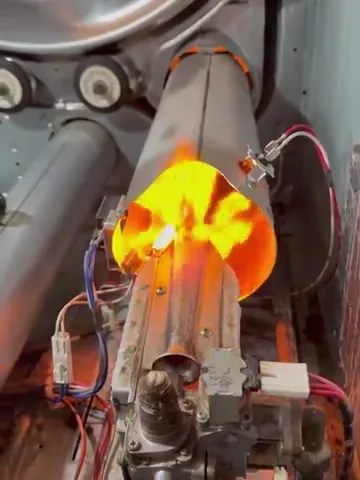
- Anything on a gas dryer past pulling it a foot from the wall. The flexible gas connector is not a handle. Disconnecting and reconnecting it, testing the burner, the igniter or the gas valve coils is technician work, and a leak test afterward is part of the job.
- Electric dryers that trip a breaker, or that have a scorched smell, a burned terminal block or a damaged cord. A dryer runs on 240 volts, and the terminal block at the back is a known hot spot.
- Blower wheels, thermal fuses, elements and sensors. A blown thermal fuse is worth saying twice: it is a symptom. Replacing it without finding the airflow problem that blew it just buys you a few more loads.
Does it work differently on a gas dryer?
The airflow test is identical, because the fan and the duct do not care what makes the heat. What changes is the consequence of getting it wrong. A gas dryer burns fuel inside the cabinet and relies on the exhaust path to carry combustion byproducts outside with the moisture. A blocked duct on a gas dryer is not only a drying problem.
So if your dryer is gas and the airflow test comes back weak, clean what is easy, and then get the rest of the duct looked at rather than living with it. Do not vent a gas dryer indoors, ever, and do not use one of those indoor lint-bucket kits sold for apartments. Those are for electric dryers at best, and they put all the moisture back into your house either way. More on the heat side of gas dryers is in our guide to a dryer that runs but does not heat.
How do I know the problem is the vent and not the dryer?
Run the test, then compare. If the airflow at the hood is strong and the clothes still come out damp after a full cycle, the duct has been cleared as a suspect and you are looking at the machine. The usual candidates are a moisture sensor coated in softener residue, which tells the control the load is dry when it is not, a heating element with one open coil that still heats but at half power, a thermostat cycling early, or a blower wheel slipping on its hub.
One quick confirmation anyone can do: run a timed cycle at high heat instead of an automatic sensor cycle. If a timed 50-minute cycle dries the load fine but the sensor cycle shuts off early with the clothes damp, the sensor or its control is the problem and the heat is fine. That one observation saves real diagnostic time, so mention it when you call.
What is the right maintenance schedule?
- Every load: clean the lint screen. This is not optional and it is not enough on its own.
- Every few months: wash the lint screen with soap and water, and vacuum the trap housing.
- Twice a year: pull the dryer out, vacuum behind it, inspect the flex duct for crushing and splits, and check the clamps.
- Once a year: run the 2-minute airflow test at the outside hood and clear the hood. Make it the same week every year, and late autumn is the sensible week to pick.
- Every two to three years, or sooner for a long or vertical run: have the full duct professionally cleaned. Households with pets, long-haired family members or heavy towel use land at the short end of that range.
- Any time the dryer moves, after a remodel, or after a new floor goes in, check that the duct behind it did not get kinked when the machine was pushed back.
Our broader appliance maintenance checklist puts the dryer alongside the rest of the house, and if the laundry room is about to get busy, this is the one line item on it with a hard deadline.
When should I stop using the dryer and call?
- Any burning, scorched or hot-plastic smell during or after a cycle.
- The dryer shutting itself off mid-cycle and restarting only after it cools.
- Clothes coming out hot enough to be uncomfortable to handle, especially if they are still damp.
- A breaker that trips when the dryer runs.
- Almost no air at the vent hood with the machine running normally.
- A gas dryer with weak exhaust that you cannot trace to something you can reach.
- Lint visibly accumulating inside the cabinet or around the drum seal.
What we do when we arrive
The technician measures airflow and exhaust temperature rather than guessing from how it feels, checks the duct path end to end as far as it can be reached, inspects the blower wheel and housing, tests the thermostats, thermal fuse, element or gas burner depending on the machine, and checks the moisture sensor and the control's read of it. You get the explanation and the quote before any work starts, and the repair carries a 90-day parts and labor warranty. We are factory authorized for Speed Queen and factory authorized for LG, two of the brands we see most in South Orange County laundry rooms, and we service Whirlpool, Maytag, GE, Electrolux, Samsung and Bosch dryers as well. Details are on our dryer repair page.
We cover the corridor from Irvine south, including Tustin, Lake Forest, Mission Viejo, Laguna Hills, Aliso Viejo, Laguna Niguel, Rancho Santa Margarita, San Juan Capistrano, Dana Point and San Clemente. If the dryer is the appliance standing between you and a house full of guests, say so when you call and we will work with the timing. We are 5.0 on Yelp if you want to see how these visits go. Call (949) 267-7771.
Frequently Asked Questions
How do I know if my dryer vent is clogged?
Run the dryer on a no-heat air or fluff setting and go outside to the vent hood. You should feel a steady push of air you can hold your hand in, and the damper flaps should stand open. Weak or lazy air, flaps that barely lift, or lint stuck in the hood all mean the duct is restricted. Inside, the other signs are clothes that need a second cycle, a laundry room that feels hot and humid after a load, and a load that comes out hot and still damp.
Can I do the dryer vent test with the heat on?
You can, but use the air-only setting if your dryer has one. Without heat you are feeling airflow and nothing else, so a weak stream is unambiguous. With heat on, warm air feels stronger to the hand than it is, and you can fool yourself into thinking a half-blocked duct is fine.
How dangerous is a lint-clogged dryer vent?
The U.S. Fire Administration counted about 2,900 clothes dryer fires in residential buildings per year in its 2008 to 2010 data, and failure to clean was the leading contributing factor at 34 percent. Those are national numbers over a three-year window, not a prediction for your house. The practical takeaway is simple: lint is the fuel, a restricted duct is what lets heat build up around it, and cleaning the path is the one thing that removes both.
Why does the dryer get worse during the holidays?
The load changes. Tablecloths, cloth napkins, guest bedding, bath towels and the sheets off a sofa bed are heavy, absorbent items that carry far more water and shed far more lint than a normal week of t-shirts. Then they go through back to back, so the duct never gets a cool quiet hour. A duct that was 60 percent clear in October hits its limit in late November.
Should I clean the dryer vent myself or hire someone?
The outside hood, the lint screen, the first few feet of flexible duct behind the dryer and the lint trap housing are all fair game for a homeowner with a vacuum and a brush. A long rigid duct that runs through a wall, a second-floor laundry closet, a roof termination or a run with a booster fan is not. If you cannot see both ends of the duct, or the dryer is gas, bring in a technician.
My dryer still takes two cycles after I cleaned the vent. Now what?
Then the restriction was not the whole story, or not the only one. A crushed section of duct inside the wall, a damper flap held shut by a bird screen packed with lint, a failing blower wheel, a partially open heating element or a drifted moisture sensor all produce the same long cycles. That is a diagnosis call, and it is quick once someone can measure the dryer's exhaust temperature and check the blower.
Related Pages
- Dryer Not Heating? The 240V Breaker Trap, Vents, Elements and Igniters
- Dryer Repair in Orange County
- Maintenance That Prevents Most Repairs
- What to Do Before the Technician Arrives
- How to Prepare Your Oven for Thanksgiving
- Oven Stops Working on Thanksgiving Day
- Repair or Replace? How to Decide
- Understanding Appliance Warranties
- Factory Authorized Speed Queen Repair
- Factory Authorized LG Repair
- Irvine · Tustin · Lake Forest · Mission Viejo · Laguna Hills · Aliso Viejo · San Juan Capistrano · San Clemente