
AC & Air Conditioning Repair in Orange County, CA
- ✅ Insured · EPA 608 Certified Technicians
- ⭐ 5.0★ Yelp · 5.0★ Google
- 🛡️ 90-Day Parts & Labor Warranty
- 📅 20+ Years of Experience
- ❄️ EPA 608 Universal Certified
Quick answer
Alpha & Omega repairs residential air conditioners across Orange County, blowing warm, won't start, frozen refrigerant lines, water around the indoor unit, and the AC service call is free, so a diagnosis costs you nothing. Our work is limited to minor service and repairs under $1,000: capacitors, contactors, thermostats, coil cleaning, drain lines and small refrigerant repairs. New systems and replacements go through our licensed HVAC partner. Repairs carry a 90-day parts and labor warranty; if your unit runs but only blows warm air, start with why an AC blows warm air.
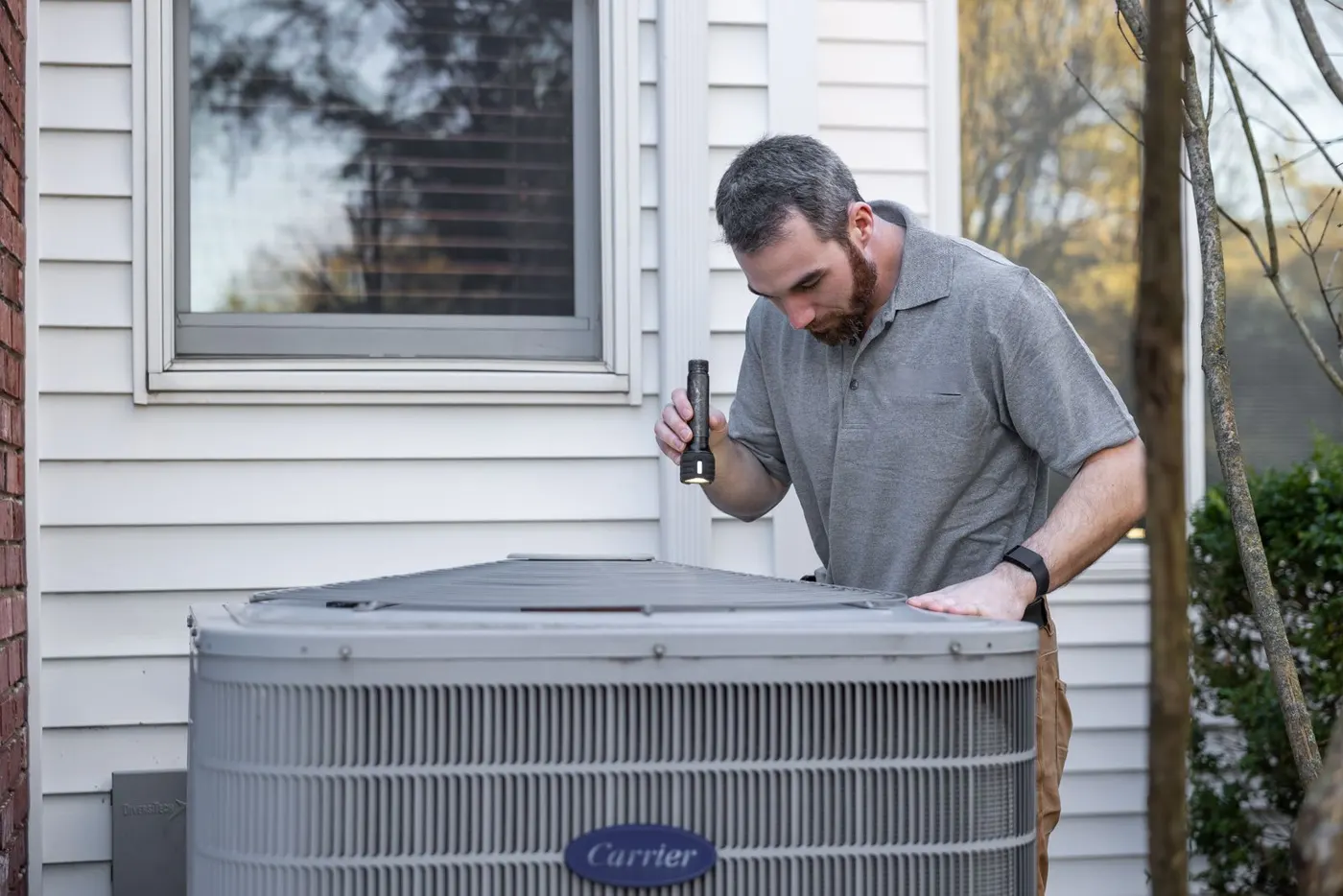
When an Orange County summer hits triple digits inland, a dead air conditioner stops being a comfort problem and starts being a health one, especially in a house with kids, seniors, or pets. We repair residential air conditioning systems across Irvine and Orange County: central AC, heat pumps, mini-splits, and package units. Same-day service is usually available, and we carry the parts that fail most often, capacitors, contactors, and fan motors, on the truck.
AC Problems We Fix
- AC running but blowing warm air, the most common summer call. Usually a failed run capacitor, a burned contactor, a stuck condenser fan, or low refrigerant from a leak.
- AC won't turn on at all, tripped breaker, blown low-voltage fuse on the control board, failed thermostat, or a safety switch that opened (often the condensate float).
- Ice on the refrigerant line or indoor coil, restricted airflow from a clogged filter or dirty coil, a weak blower, or an undercharged system. Shut it off and run the fan only. Running it while iced can destroy the compressor.
- Water leaking from the indoor unit, a clogged condensate drain line, cracked drain pan, or a frozen coil melting off. Common in Orange County, where dust and algae plug drain lines every couple of seasons.
- Weak airflow from the vents, dirty filter, failing blower motor or capacitor, collapsed flex duct, or a badly leaking duct run in the attic.
- Outside unit hums but the fan doesn't spin, classic failed capacitor or seized condenser fan motor. Don't let it keep humming, that's hard on the compressor.
- Short cycling, the system starts and stops every few minutes. Can be an oversized system, a dirty coil, low charge, or a failing pressure switch.
- Breaker trips every time the AC starts, a hard-starting compressor, a shorted fan motor, or a genuine electrical fault. Stop resetting it and get it diagnosed.
- Burning or musty smell when it runs, overheating motor, or mold in the evaporator/drain pan.
- Loud grinding, screeching, or rattling, failing motor bearings, a loose blower wheel, or debris in the condenser.
Which System Do You Have, and What Breaks on It
"My AC is broken" covers at least five different machines. It helps to know which one is in your attic, garage, or side yard, because the failure list is different for each one.
Central split system with a gas furnace
This is the common setup in Irvine, Tustin, and Lake Forest. A condenser outside, an evaporator coil sitting on top of a gas furnace indoors, and one blower that moves air for heating and for cooling. Parts are standard and nearly everything on it is repairable.
The catch is the shared hardware. Cooling runs through the furnace control board and the furnace blower, so a cooling complaint often turns out to be a furnace part. A blown 3 amp fuse on that board kills the thermostat, and what the homeowner sees is a dead air conditioner. We replace run capacitors, contactors, condenser fan motors, blower motors, float switches, and thermostats on these systems week after week. Coil leaks and compressor failures happen too, and those are the calls where the conversation turns to whether the system is worth keeping.
Heat pump with an air handler
Newer construction skips the gas furnace entirely. The outdoor unit runs in reverse in winter, and an air handler with electric backup strips replaces the furnace. Three parts exist here that a standard AC doesn't have: the reversing valve, the defrost board, and the auxiliary heat relay.
A reversing valve that won't shift is the fault people misread. The system cools fine all summer, then in December it blows room-temperature air while the thermostat reads "heat." The refrigerant is fine. The valve just isn't moving. Easy way to tell what you own: if there's no gas line to the indoor unit and the only warm air comes from the air handler, you have a heat pump, and both seasons depend on that one outdoor unit. Which is why a heat pump that sounds rough in August is worth looking at before the first cold week. More on that in HVAC warning signs worth acting on.
Ductless mini-split
Mini-splits turn up in converted garages, ADUs, offices built over a garage, and additions that never got a duct run. They're efficient and they last. They're also the system most often wrecked by skipped cleaning. The indoor blower wheel spins inches from a wet coil, so it grows a biofilm that smells like a damp sponge and strangles airflow. Spraying something through the vent does nothing. The head has to be bagged and washed, or taken apart.
Three more things are specific to mini-splits. The condensate line drains by gravity or through a small pump, with no backup pan under it, so a plugged drain shows up as water running down your wall. Flare fittings at the lineset can start weeping years after install if they were over-torqued. And the indoor and outdoor boards talk to each other over a data line, so a communication fault shuts the whole head down while the compressor is perfectly healthy. If you can read the error code off the display or count the blinks on the indoor LED before you call, that's real diagnostic time saved.
Window and through-wall units
Rentals, older cottages, and garage conversions still run these. The usual failures are the fan motor, the capacitor, the slinger ring that throws condensate onto the condenser, and a coil frozen solid behind a filter nobody has rinsed in two years. We do these repairs. We also tell you when a twelve-year-old window unit isn't worth a part order, because it often isn't.
Package units
Some condos, townhomes, and manufactured homes use one cabinet holding the compressor, both coils, and the blower, usually on the roof or on a pad at the side of the building. Older ones have belt-driven blowers, so a squeal on startup is often just a belt. Access is the hard part: many sit behind an HOA roof-hatch policy, and we need to know who unlocks it before we show up. For rooftop equipment on a restaurant or retail space, see commercial HVAC and rooftop AC repair.
Where the equipment lives changes the repair
An air handler in the attic drains through a plastic line that has to stay clear, and the only thing standing between a plugged line and your bedroom ceiling is a float switch that costs almost nothing. In a garage or hallway closet the same system is easier to service and a drain backup makes a mess on concrete instead of drywall.
Outside matters too. A condenser jammed into a narrow side yard or set against a block wall breathes its own hot exhaust. Head pressure climbs, and the unit trips off on a 98-degree afternoon while running normally at 8 a.m. That one gets diagnosed as an electrical fault a lot. It's usually clearance and a filthy coil.
The Parts Behind Most No-Cool Calls
Run capacitor
One dual capacitor usually serves both the compressor and the condenser fan. Tolerance is about 6 percent, so a 45/5 microfarad capacitor reading 32 on the compressor side is out of spec even when it looks untouched. The classic symptom is an outdoor unit that hums without starting, or a fan that will run if you nudge it with a stick through the grille. A domed or leaking top settles it. This is the cheapest failure in the whole system and the one most likely to be fixed on the first visit.
Contactor
The thermostat sends 24 volts to a coil that pulls two contacts together and feeds 240 volts to the compressor. Those contacts pit, arc, and eventually weld. In Orange County we also pull ant nests out of contactors every summer. They're drawn to the magnetic field and get crushed between the contacts, and the unit either won't start or won't stop. A welded contactor that keeps running after the thermostat is satisfied is how indoor coils end up iced over.
Condenser fan motor
Bearings dry out, the motor gets hot, and the internal overload opens. The pattern is a unit that cools for twenty minutes, quits, then works again after an hour. A replacement has to match rotation, horsepower, speed, and capacitor rating. A motor spinning the wrong way still moves air, just not enough of it, and the system will cool a little while slowly cooking the compressor.
Blower motor, and why ECM matters
Older systems use a PSC blower motor with its own capacitor, and both are stocked parts. Variable-speed systems use an ECM motor with a control module bolted to it, and in our experience the module fails more often than the motor does. Worth knowing before someone quotes you a whole blower assembly.
Filters feed into this. A MERV 13 filter in a return built for a cheap fiberglass pad will starve a 1990s blower, and the result reads exactly like low refrigerant. If you want better filtration than the system was designed for, the fix is more filter area, not a denser filter in the same slot.
Condensate float switch
This one isn't a failure, it's a safety doing its job. When the drain pan fills, the switch opens the thermostat circuit and shuts the system off before water reaches your ceiling. So "the AC just died and nothing seems wrong with it" is very often a full pan and a plugged drain line. Clearing the line and the trap fixes it, and if the line plugs again inside a season we look at pitch and at the algae growing in it.
Low voltage, boards, and thermostats
A 24 volt transformer and a small board fuse run the entire control side. A thermostat wire rubbed through at a staple shorts that circuit and the fuse blows, so a system can go dead from a wire, not from a part. Blank smart thermostat on a system without a C wire is its own category: the thermostat has been stealing power through the control circuit for years and finally couldn't. We cover that pattern in AC thermostat problems.
What the Temperature Split Tells Us
One reading separates "low on refrigerant" from "can't move air," and you can take it yourself. Put a thermometer in the return grille and another in a supply register near the air handler, after the system has run 15 minutes. Supply air on a healthy system runs roughly 16 to 22 degrees colder than return air.
A split of 8 to 10 degrees with strong air at the vents points at charge or at a compressor that isn't pumping. A split over 25 degrees with weak air at the vents points the other way, at the filter, the blower, or the ducts, and that system is on its way to freezing the coil. Humidity and outdoor temperature shift the numbers, so we confirm with pressures and superheat before anyone touches a refrigerant port. But if you have that number when you call, we start the visit two steps ahead. Related reading: AC not cooling and AC freezing up.
Airflow Faults That Look Like a Broken Air Conditioner
Plenty of no-cool calls have nothing wrong with the refrigeration side at all. The equipment is fine and the duct system can't deliver.
- Crushed or disconnected flex duct. Attic temperatures here run well past 140 degrees in August, the tape lets go, and a branch run ends up blowing cold air into the insulation instead of the back bedroom.
- Undersized return air. Houses from the 1960s and 70s that had cooling added later often have one small central return for the whole system. The blower can't pull enough air through it, so the split goes high and the coil ices.
- Closed registers in unused rooms. Shutting vents doesn't save anything on a single-speed system. It raises static pressure and makes the rest of the house worse.
- Dirty blower wheel. Dust cakes between the blades and the wheel simply stops grabbing air. Cleaning it is a real job and it makes an obvious difference.
- Stuck zone damper. On two-zone systems a failed damper motor can leave half the house with no air and a thermostat that never satisfies, which then reads as short cycling. See AC short cycling.
Low Refrigerant Always Means a Leak
Refrigerant isn't fuel and it doesn't get consumed. It cycles through a sealed loop for the life of the system, so a unit that's low after eight years has an opening somewhere. The usual suspects are a leaking Schrader valve under the service cap, a lineset rubbed through where it passes a bracket or a stucco wall, a cracked braze joint, or the evaporator coil itself.
Coil leaks are the ones that frustrate everybody. Formicary corrosion puts pinholes through thin-wall copper from the inside, and it was common on coils built through the 2000s and early 2010s. The symptom is a system that needs charge every single season and tests clean everywhere else.
How we work it: pressures, superheat, and subcooling first, then an electronic detector and soap on the suspect joints, and dye only when a leak is too slow to find any other way. During a heat wave we'll add charge to get a house livable, and we'll tell you straight that it's a bandage. Our technicians hold EPA Section 608 Universal certification, and knowingly venting refrigerant year after year isn't work we'll keep repeating.
Worth knowing if your system has some age on it: R-22 hasn't been produced since 2020, so only reclaimed stock is left, and new equipment sold since 2025 ships with R-454B or R-32 instead of R-410A. A small R-22 repair is still a repair. A big R-22 leak usually turns into a replacement decision instead.
Repair or Replace, and How We Decide
We repair air conditioners. We don't sell equipment and nobody here earns anything on a replacement, so the answer you get isn't a sales position.
Repair wins when the failed part is an accessory: capacitor, contactor, fan motor, blower, float switch, thermostat, drain line, control board. It wins on almost anything if the system is under 10 years old. It usually wins on a clean R-410A system even at 14 or 15 years, as long as the compressor and coils are sound.
Replacement usually wins when the compressor itself has failed past 12 years, when the evaporator coil leaks on an R-22 system, or when a unit has been flooded or physically crushed. It also wins when ductwork is the actual problem, because a new condenser bolted to bad ducts cools exactly as poorly as the old one did.
Our own scope stops at minor service and repairs under $1,000 in labor and materials. For a new system, a full coil or compressor replacement, or duct work, we hand you to our licensed HVAC partner and step back. Either way a technician quotes on site before any work starts, and the decision stays yours. Want to push the replacement date out? A yearly AC tune-up and the items in our Southern California AC maintenance checklist do more for compressor life than anything else you can buy.
Quick Checks Before You Call
- Set the thermostat to COOL and drop it 5° below room temperature, a system in AUTO or FAN-ON confuses a lot of diagnoses.
- Replace a dirty filter. A clogged filter causes more no-cool calls than any single part.
- Check the breaker, and note whether there are two: one for the indoor air handler, one for the outdoor condenser.
- Look at the outdoor unit: is the fan spinning, and is the coil packed with dust, leaves, or cottonwood?
- Check the thermostat batteries if the screen is blank.
What a Repair Visit Looks Like
- We confirm the symptom, then check thermostat calls, voltage at the disconnect, and the control board, not just the obvious part.
- We take refrigerant pressures and temperature split before quoting anything sealed-system related.
- You get the price before we start. No surprise line items afterwards.
- Common parts, capacitors, contactors, fan motors, float switches, thermostats, are on the truck, so most repairs finish the same visit.
- Repairs carry a 90-day warranty on parts & labor, with up to 5 years on select parts, confirmed on-site by the technician.
Systems & Brands We Service
Central split systems, heat pumps, ductless mini-splits, and package units: Carrier, Trane, Lennox, Goodman, Rheem, American Standard, Bryant, York, Daikin, Mitsubishi, Fujitsu, LG, and most other brands you'll find on an Orange County roof or side yard. Our technicians are EPA Section 608 Universal certified for refrigerant work.
Service Area
Air conditioning repair in Irvine (we're based there), Tustin, Lake Forest, Mission Viejo, Costa Mesa, Newport Beach, Anaheim, Santa Ana, Huntington Beach, Orange, and throughout Orange County, each city page covers the AC problems we see most there. Want to avoid the breakdown entirely? See AC maintenance & tune-up. Air conditioner completely dead? Start with AC not turning on, what to check first; ice on the lines or water on the floor, see AC freezing up and AC leaking water. Running a restaurant, office, or retail space? See our commercial HVAC & rooftop AC repair page. For heating and full-system service, see HVAC repair & maintenance, or read the guide on why an AC stops cooling. Everything we service in one place, by city: Irvine, Tustin, Lake Forest.
Frequently Asked Questions
Why is my AC running but not blowing cold air?
Nine times out of ten it's one of four things: a failed run capacitor, a burned contactor, a condenser fan that isn't spinning, or low refrigerant from a leak. A technician can tell them apart in minutes by checking the capacitor, the voltage at the contactor, and the pressures, but only the first three are cheap fixes, so it's worth diagnosing rather than guessing.
How fast can you get out for AC repair in Orange County?
Same-day service is usually available, and in a July heat wave we try to prioritize households with seniors, infants, or medical needs. Call (949) 267-7771 and tell us what the system is doing.
Is it worth repairing an old AC or should I replace it?
Rough rule: if the system is under 10 years old, repair almost always wins. Past 12 to 15 years, if it's on R-22 refrigerant, or if the compressor itself has failed, replacement usually makes more financial sense. We'll tell you honestly which side of that line your system is on, we don't sell you a system you don't need.
Can you just add refrigerant to my AC?
Refrigerant doesn't get used up, if it's low, there's a leak. We can add charge to get you cooling today, but without finding and fixing the leak you'll be calling again in a few months, and venting refrigerant is against EPA rules. We'd rather locate the leak.
Do you cover the repair with a warranty?
Yes, 90 days on parts and labor as our baseline, and up to 5 years on select parts. Your technician confirms the exact coverage on-site before the work starts.
What is a normal temperature difference between the return and the vents?
Roughly 16 to 22 degrees colder at a supply register than at the return grille, measured after the system has run about 15 minutes. Eight to ten degrees with strong airflow usually means the charge is off or the compressor is weak. Over 25 degrees with weak airflow means the problem is the filter, the blower, or the ducts, and that coil is heading toward freezing.
My AC shut itself off and there is water in the drain pan. Did something break?
Probably not. That is the condensate float switch doing exactly what it is there for. When the pan fills because the drain line is plugged, the switch opens the thermostat circuit and stops the system before water reaches your ceiling. Clearing the line and the trap brings it back. If it plugs again within the same season, the pitch of the line or algae growth needs attention.
Do you service ductless mini-splits?
Yes, on the service and repair side: cleaning the indoor blower wheel and coil, drain and pump problems, capacitors and fan motors, thermostat and control faults, and small refrigerant repairs. If you can read the error code off the indoor display or count the blinking LED before you call, it shortens the visit. New mini-split installs go to our licensed HVAC partner.
How do I tell whether I have a heat pump or an air conditioner with a gas furnace?
Look at the indoor unit. If there is a gas line running to it and a flue pipe, that is a furnace, and the outdoor unit only cools. If there is no gas connection and winter heat comes from the air handler itself, you have a heat pump, and the same outdoor unit works all twelve months. Heat pumps add three parts that a standard AC does not have: a reversing valve, a defrost board, and an auxiliary heat relay.
Is R-22 still available for my 1990s system?
Reclaimed R-22 is still legal to buy and use, and production stopped in 2020, so what is left is limited and costly. Small repairs on an R-22 system still make sense. A leaking evaporator coil or a failed compressor on R-22 usually turns into a replacement discussion instead, and we will show you the reasoning rather than just telling you to replace it.
Can you replace my system if it turns out to be beyond repair?
We stay with minor service and repairs under $1,000 in labor and materials. New systems, full coil or compressor replacements, and duct work go to our licensed HVAC partner, who handles the permits and the code side. You are never pushed into it. A technician quotes on site before any work starts.