
KitchenAid Refrigerator Not Cooling: What Usually Fails
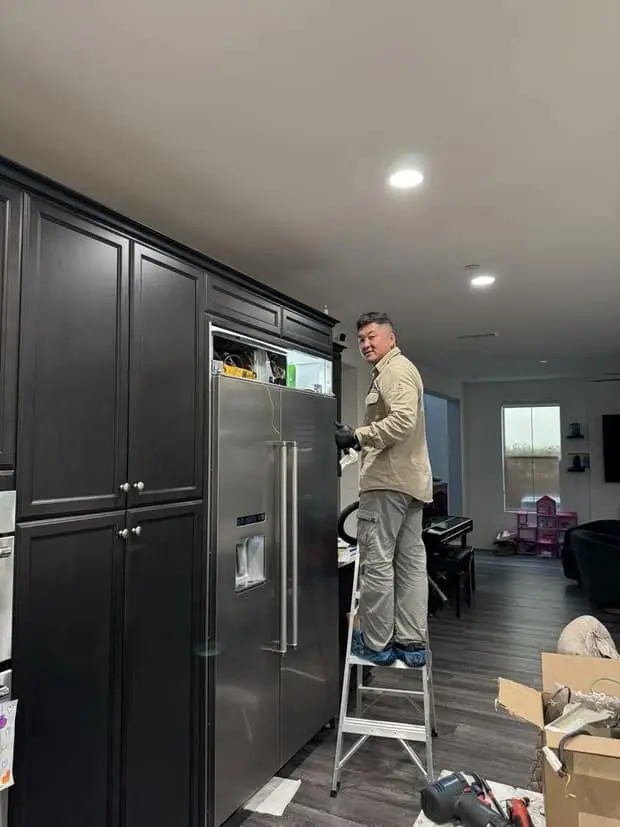
When a KitchenAid refrigerator stops cooling, the cause is almost never the brand doing something strange. KitchenAid refrigerators are built by Whirlpool, and inside they share a lot of design and many parts with Whirlpool and Maytag units. That's good news. The failures are well known, parts are easy to get, and most no-cool problems on these fridges come down to airflow, frost or a fan. This guide goes through what usually fails, in the order we check it on a service call in Irvine, Tustin and Lake Forest, and marks what you can look at yourself before you book anyone.
Which KitchenAid do you have? It changes where we look
KitchenAid sells three broad kinds of refrigerators, and the layout decides where the trouble hides. Freestanding French-door and side-by-side models have the condenser coil and compressor at the bottom rear, behind a toe grille or a rear access cover. Counter-depth models are the same idea with less room to breathe, which makes them more sensitive to dust and tight cabinetry.
Built-in KitchenAid units, the 36, 42 and 48 inch ones that sit flush with the cabinets, are different. The machine compartment is on top, behind the grille above the doors. The condenser there pulls air through that grille, so a dusty top grille is the built-in version of dirty coils. The model and serial tag is usually inside the fresh-food compartment on the side wall or near the top. Write that model number down before you call any service company. It saves a lot of guessing.
Freezer cold, fridge warm, or both warm?
Before you move anything, figure out the pattern. On most KitchenAid refrigerators the cold is made at one evaporator coil behind the freezer back wall, and a fan pushes some of it through an air damper into the fresh-food side. If one link in that chain breaks, the two compartments behave differently, and that tells you a lot.
| What you see | Most likely causes |
|---|---|
| Freezer cold, fresh-food side warm | Evaporator fan, frost on the evaporator (defrost failure), air damper stuck closed, blocked vent |
| Both sides warm, compressor area hot, fridge runs all the time | Dusty condenser or top grille, condenser fan stopped, door not sealing |
| Both warm, clicking every few minutes, compressor never really runs | Start device or overload, control board relay, compressor |
| Both warm, compressor runs quietly, nothing gets cold | Sealed-system leak or restriction |
| Frost on the freezer back panel, weak airflow, water under the crispers | Defrost heater, defrost thermostat, or frozen drain |
| Display says normal, thermometer says otherwise | Thermistor out of range, control board |
| Ice bin area frosty or ice melting into clumps on a French-door model | Ice compartment door seal, ice compartment fan or airflow |
Is it just a setting or showroom mode?
Check this first because it takes thirty seconds. Many KitchenAid refrigerators have a showroom or demo mode that keeps the lights and display on with the cooling off. A store delivery, a power blip or a curious kid at the touch panel can leave it there. Your manual shows how to switch it off for your exact model, and KitchenAid posts manuals online if you can't find the paper one.
Then set the fresh-food side to about 37°F and the freezer to 0°F, and put a cheap fridge thermometer in a glass of water on the middle shelf. Leave it a few hours. The panel usually shows the setpoint, not the real temperature. If the panel says 37 and the glass says 50, you've learned something real.
Dirty condenser coils: still the first thing we check
The condenser is where the fridge dumps the heat it pulled out of your food. Wrap it in dust and pet hair and it can't do that job. The compressor runs longer and hotter, and cooling slowly fades, worst on hot afternoons. On a freestanding KitchenAid, pull the toe grille and look underneath with a flashlight. On a built-in, the grille above the doors usually tilts or lifts out, and the coil and its fan sit right behind it.
What you can do: unplug the fridge, then vacuum the coil gently with a brush attachment and a long coil brush. Don't bend the fins and don't poke at wires. Once a year is enough for most homes. With a shedding dog or a tight cabinet, twice. If the coil was packed solid, give the fridge a day before deciding it didn't help.
Condenser fan: the hot-compressor clue
Next to the compressor there's a small fan that pulls air over the coil. If it stops, even a clean coil can't shed heat. The pattern is a compressor area that feels very hot, cooling that drops off through the day, and sometimes a compressor that shuts itself off on its overload and restarts later. People describe it as "it works at night and quits in the afternoon."
What you can do: with the fridge running, look or listen at the condenser fan. On built-ins you can usually see it behind the top grille. If the compressor is running and the fan isn't spinning, stop there. Running a fridge for days with a dead condenser fan cooks the compressor, and that turns a routine fan motor into a much bigger repair.
Evaporator fan: freezer okay, fridge warm
The evaporator fan sits behind the freezer back panel and moves the cold air around. When it dies, the freezer may still feel cold near the coil while the fresh-food side warms up first. Before it quits completely, a failing fan often chirps, squeals or makes a ticking scrape that changes when you open the freezer door. A fan that's iced in makes no sound at all.
What you can do: open the freezer and press the door switch with your finger, or hold the light switch in, depending on the model. Within a few seconds you should hear the fan and feel air near the back wall vents. Silence or scraping means the fan needs attention. If you also see heavy frost on that back panel, the frost probably stopped the fan, which brings us to defrost.
Defrost failures: the most common deeper problem
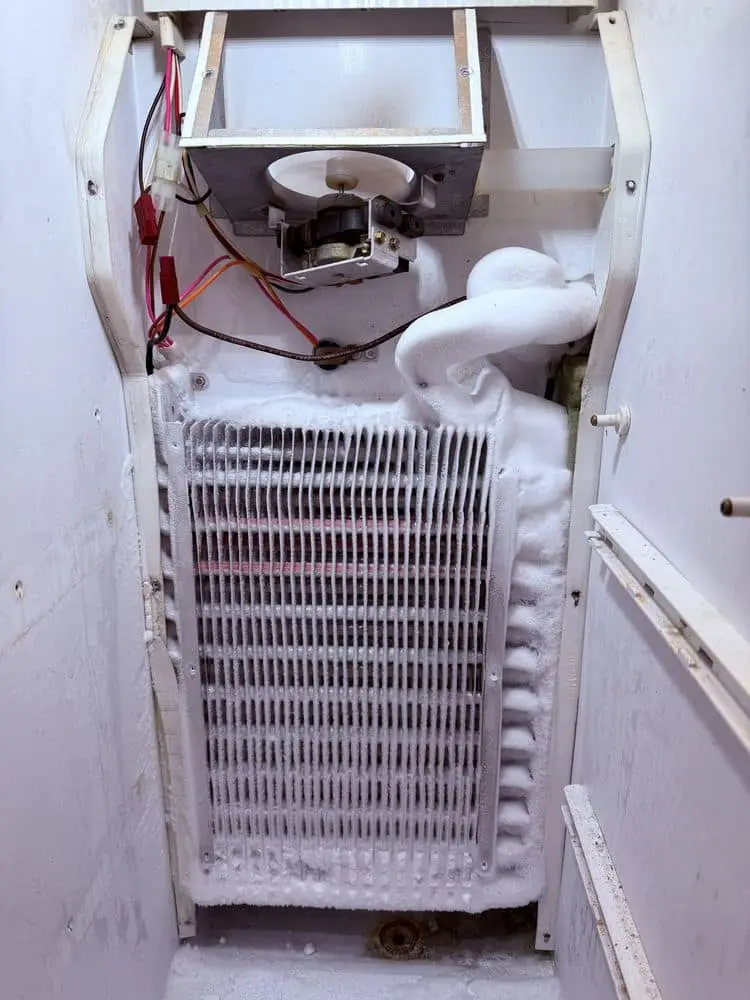
Frost-free means the fridge melts its own frost a few times a day with a heater under the evaporator. A defrost thermostat ends each cycle, and on newer units the control board decides when to start one. If the heater burns open, the thermostat fails, or the board stops calling for defrost, frost keeps building until the coil is one block of ice. Air can't get through it, and the fresh-food side goes warm while the freezer still looks frosty and cold.
There's a second version we see on Whirlpool-built fridges: the defrost runs, but the drain under the evaporator freezes or clogs. The melt water has nowhere to go, it refreezes as a sheet of ice, and sometimes it shows up as water under the crisper drawers or a puddle on the floor. Our refrigerator leaking water guide covers that side of it.
What you can do: look at the freezer back wall. Thick frost, or ice that looks poured, is the giveaway. A manual defrost is a fair test: unplug the fridge, empty it into coolers, open the doors, towels down, and give it a full day. If it cools well afterward and fades again in one to three weeks, the defrost system is the cause and needs a real repair. Don't chip at the ice with a knife or blow a heat gun at the coil. That's how people puncture an evaporator, and then it's a sealed-system job.
The air damper between freezer and fridge
On many KitchenAid French-door and bottom-freezer models, a small motorized damper opens and closes to let freezer air into the fresh-food side. If it sticks closed, or ices shut, the freezer is fine and the fridge slowly drifts warm, even with a healthy fan and no frost. If it sticks open, you get the opposite problem: frozen lettuce and milk. That symptom has its own guide, refrigerator freezing food.
What you can do: make sure no food is pressed against the vents on the fresh-food back wall or ceiling. Past that, testing the damper motor and its signal from the board is technician work.
Door seals and the French-door ice compartment
A door gasket that doesn't seal lets warm, damp air in all day. The compressor runs nonstop, frost builds faster than the defrost can clear it, and the fresh-food side loses. Do the dollar-bill test: close the door on a bill at several spots and pull. Where it slides out with no drag, the seal isn't touching. Wipe the gasket with warm soapy water first, because sticky residue often keeps it from seating.
French-door KitchenAid models with ice in the door have one more weak spot: the ice compartment. It has its own small door and seal, and cold air is ducted to it. If that seal is torn or the little door doesn't latch, you get frost in the ice area, clumped or melting ice, and extra moisture in the fresh-food side. It's worth a look whenever the complaint involves both cooling and ice. Our ice maker guide goes deeper on the ice side.
Sensors and the control board
KitchenAid refrigerators run on thermistors, small sensors that report each compartment's temperature to the main control board. If a thermistor drifts, the board thinks the fridge is cold when it isn't, so it never runs the compressor long enough. Boards can also lose a relay for a fan or the compressor, and from the outside that looks just like a dead fan.
What you can do: only compare the display with your thermometer. Testing thermistor resistance against the chart for your model and reading the board's diagnostic mode is what we do on the visit. It's also why we don't recommend ordering a board online on a hunch. A new board doesn't fix a bad sensor or a frozen damper, and boards usually can't be returned once installed.
Compressor and sealed system: real, but less often than people fear
A lot of calls start with "I think the compressor is gone." Sometimes it is. More often it's something cheaper that looks the same from across the room. A compressor that clicks, hums for a few seconds and clicks off again every few minutes may have a failed start device or overload rather than a failed compressor. Our compressor problems guide explains how we tell those apart.
A compressor that runs, gets warm and makes no cold points at the sealed system: a refrigerant leak or a restriction. Refrigerant doesn't get used up, so low refrigerant always means a leak somewhere. Nobody should "top it off" and leave. Sealed-system work needs EPA certification, recovery equipment, brazing and a vacuum pump. We handle it through our sealed system repair service, and we'll tell you honestly whether it makes sense on your unit. On a newer built-in it usually does. On an older freestanding model, the repair or replace question is fair to ask.
What you can check yourself, start to finish
- Showroom or demo mode off, settings at 37°F and 0°F, a thermometer in a glass of water on the middle shelf.
- Vents clear in both compartments, nothing jammed against the back walls.
- Dollar-bill test on every door, plus the ice compartment door on French-door models.
- Unplug, then vacuum the condenser coil and fan. Bottom on freestanding units, behind the top grille on built-ins.
- Listen for the condenser fan while the compressor runs, and for the evaporator fan with the freezer door switch pressed.
- Look for frost on the freezer back wall. If it's there, a full-day manual defrost as a test.
Leave to a technician: anything electrical past the plug, the control board and thermistors, the damper motor, defrost circuit testing, the compressor start parts and the whole refrigerant loop. A fridge mixes 120-volt wiring with moisture and a pressurized system. The list above is where the safe part ends.
When should you stop and call?
- The fridge is above 40°F on a thermometer for more than a few hours after your checks.
- Clicking every few minutes, and the compressor never stays on.
- A burning smell, or a breaker that trips when the fridge starts.
- Frost that comes back within days of a manual defrost.
- Oily residue near the compressor or tubing, or frost on just one spot of a refrigerant line.
- A built-in unit where the top grille or panels don't come off easily. Forcing trim on these costs more than the visit.
Keep the doors shut while you wait. Per USDA guidance, a closed refrigerator holds a safe temperature for about 4 hours, a full freezer about 48 hours and a half-full one about 24. If the power went out and the fridge didn't come back right, our guide to a fridge after a power outage covers what to check first.
How do you keep a KitchenAid from doing this again?
- Vacuum the condenser once a year, twice with pets or a tight built-in cabinet. On built-ins, don't block the top grille with trays or decor.
- Wipe the door and ice compartment gaskets every few months. Replace one that's torn or hard instead of living with it.
- Keep a thermometer inside. Catching 42°F early usually means a fan or a dusty coil. Catching 55°F a week later means spoiled food and a stressed compressor.
- Change the water filter on schedule if you use the dispenser. A clogged filter doesn't stop cooling, but it's the next call we get.
- Cover leftovers and let hot food cool a bit first. The extra moisture ends up as frost on the evaporator.
The full schedule is in our refrigerator maintenance checklist. For causes that apply to every brand, see the general refrigerator not cooling guide.
What we do on a KitchenAid no-cool visit
We offer Professional KitchenAid Repair across South Orange County. The technician measures real temperatures in both compartments, reads the frost pattern on the evaporator, tests both fans, the damper and the defrost circuit, checks the thermistors and the board, and only then looks at the compressor and sealed system if the readings point there. You get the diagnosis in plain words and a quote before any work starts. Common Whirlpool-family parts like fan motors, defrost parts and thermistors often ride on the truck, so many of these repairs are finished the same visit. Every repair carries our 90-day warranty on parts and labor.
Most of our refrigerator calls come from Irvine, Tustin and Lake Forest, then Mission Viejo, Laguna Niguel, Aliso Viejo, Ladera Ranch and the rest of the corridor down to San Clemente. More on the brand is on our KitchenAid appliance repair page, and local details are on the Irvine refrigerator repair page.
Frequently Asked Questions
Why is my KitchenAid refrigerator not cooling but the freezer is cold?
Because the cold is made in the freezer and blown into the fresh-food side. When the freezer is fine and the fridge is warm, the usual causes are a failed evaporator fan, frost choking the evaporator after a defrost failure, an air damper stuck closed, or a vent blocked by food. Check the freezer back wall for frost and listen for the fan with the door switch pressed.
Is there a reset button on a KitchenAid refrigerator?
There's no single reset button that fixes cooling. Unplugging the fridge for a minute restarts the control board and clears a stuck mode, which is worth trying once. If cooling comes back only after a long unplug and then fades over a week or two, that points at the defrost system, not at something a reset can fix.
How do I clean the condenser coils on a built-in KitchenAid?
On built-in models the condenser is on top, behind the grille above the doors. Unplug the fridge or switch it off at the breaker, remove or tilt the grille following the manual, and vacuum the coil and fan gently with a brush attachment. Don't bend the fins or pull on wiring. If the grille doesn't come off easily, leave it to a technician.
Are KitchenAid and Whirlpool refrigerator parts the same?
KitchenAid refrigerators are made by Whirlpool, and many fans, defrost parts, thermistors and boards are shared with Whirlpool and Maytag models. That keeps parts available. The exact part still depends on the model and serial number, so check the tag inside the fresh-food compartment before ordering anything.
How long can food stay in a KitchenAid that stopped cooling?
Per USDA guidance, a refrigerator with the doors kept closed holds a safe temperature for about 4 hours. A full freezer holds about 48 hours and a half-full one about 24. Move meat, dairy and leftovers to a cooler with ice if the repair won't happen the same day.
Is a KitchenAid refrigerator worth repairing?
Usually yes when the cause is a fan, a defrost part, a damper, a sensor or the condenser, and almost always on built-in models. A sealed-system leak or a failed compressor on an older freestanding unit is where comparing repair against replacement makes sense. The technician quotes on site before any work, so you can decide with real numbers.
Related Pages
- Professional KitchenAid Repair
- Refrigerator Repair in Irvine
- Refrigerator Repair in Orange County
- Sealed-System & Compressor Repair
- Refrigerator Not Cooling: 10 Common Causes
- Frost Building Up in Your Freezer?
- Refrigerator Freezing Food in the Fresh-Food Section?
- Refrigerator Compressor Problems: Start Relay vs Compressor
- How Long Should a Refrigerator Last?
- Is an Extended Warranty on a Refrigerator Worth It?
- Irvine · Tustin · Lake Forest · Mission Viejo · Laguna Niguel · Ladera Ranch · San Clemente
Still warm after your checks? Call us at (949) 267-7771 with the model number from the tag inside the fridge. We're 5.0 on Yelp, and the technician quotes the repair on site before any work begins.