
Furnace Not Heating: What to Check Before You Call
Heating season in Irvine is short and it arrives all at once. The furnace sits unused from April to November, then one evening the temperature drops into the forties, somebody moves the thermostat to Heat, and nothing useful happens. Maybe the fan runs and the air is cool. Maybe the burners light for five seconds and give up. Maybe the thing is silent.
Good news first. Most of what we find on these calls is small. A filter nobody changed since spring, a thermostat on the wrong mode, an igniter that cost very little compared to the panic it causes. The furnace is also the one appliance in the house that burns fuel indoors, so there's a clear line between what you should check and what you should leave alone. This guide walks both sides of that line.
First: what exactly is it doing?
Before you open anything, stand where you can hear the furnace and watch one complete attempt. Set the thermostat about five degrees above room temperature and give it ten minutes. A modern gas furnace follows the same sequence every time, and knowing where it stops tells you most of what you need.
- The thermostat calls for heat. You should hear a faint click at the furnace within a second or two.
- The inducer fan starts. This is a small fan that pulls combustion gases through the heat exchanger and out the flue. It sounds like a whir, quieter than the main blower.
- The pressure switch closes. No sound, but nothing past this point happens until it does.
- The igniter glows. On most furnaces built since the mid 1990s this is a hot surface igniter that takes roughly 20 to 45 seconds to come up to temperature. Older units have a standing pilot or a spark igniter instead.
- The gas valve opens and the burners light with a soft whoosh.
- The flame sensor proves the flame within a few seconds. If it doesn't, the valve closes again.
- The main blower starts 30 to 60 seconds later, once the exchanger has warmed up. That delay is normal and it's why the first air out of the vents is cool.
Now match what you saw against the table below.
Symptoms and what they point to
| What you observe | Most likely causes |
|---|---|
| Nothing at all. No click, no fan, no lights on the board | Power at the service switch or breaker (1), door safety switch left open (1), failed transformer (9) |
| Blower runs constantly, air is room temperature, no burner noise | Thermostat fan switch on ON instead of AUTO (2), no heat call reaching the board (2) |
| Inducer fan whirs, then everything stops. Igniter never glows | Pressure switch not closing: blocked flue, full condensate trap, cracked hose (6) |
| Igniter glows, burners light, shut off after three to seven seconds, repeats | Flame sensor coated with oxide or soot (5) |
| Igniter glows but burners never light | Gas shut off at the valve or meter (4), failed gas valve (4), gas pressure problem (4) |
| Igniter never glows at all, everything else runs | Cracked hot surface igniter (3), igniter circuit on the board (3) |
| Heats for five to ten minutes, quits, blower keeps running, tries again later | Limit switch opening on high temperature: matted filter, closed registers, weak blower (7, 8) |
| Loud boom or bang a few seconds after it lights | Delayed ignition from dirty or partly blocked burners. Shut it off and call (10) |
| Board LED blinking a repeating pattern, nothing running | Lockout after failed ignition attempts. Read the code (9) |
| Heat pump system: air from the vents is barely warm, outdoor unit running | Reversing valve, defrost cycle, low charge, auxiliary heat not engaging (11) |
1. Is it actually getting power?
A furnace has more off switches than people expect. There's the breaker in the panel, usually a single 15 amp breaker labeled furnace or air handler. There's a separate service switch that looks like an ordinary light switch mounted on or beside the cabinet, often in an attic or a garage. In Irvine and Tustin attics that switch sits near the hatch, and it gets flipped by anyone who went up for Christmas boxes.
Then there's the door interlock. Most furnaces have a plunger switch that cuts power when the blower access panel is off. If somebody pulled the panel to look at the filter and set it back crooked, the furnace is dead until the panel seats properly.
Safe to check yourself: yes. Find the service switch and confirm it's on. Check the breaker. Press the blower access panel firmly until it clicks into place. If the board has an LED, look for any light at all. No light with the panel seated and the breaker on means the problem is upstream of the furnace or in its transformer.
2. The thermostat, and the ON versus AUTO trap
The call we hear most in the first cold week isn't a broken furnace. It's a fan switch. A thermostat set to Heat with the fan on ON runs the blower continuously, which pushes room-temperature air through the house all day and feels like cold air coming out of the vents. Move the fan to AUTO and the blower only runs when there's heat behind it.
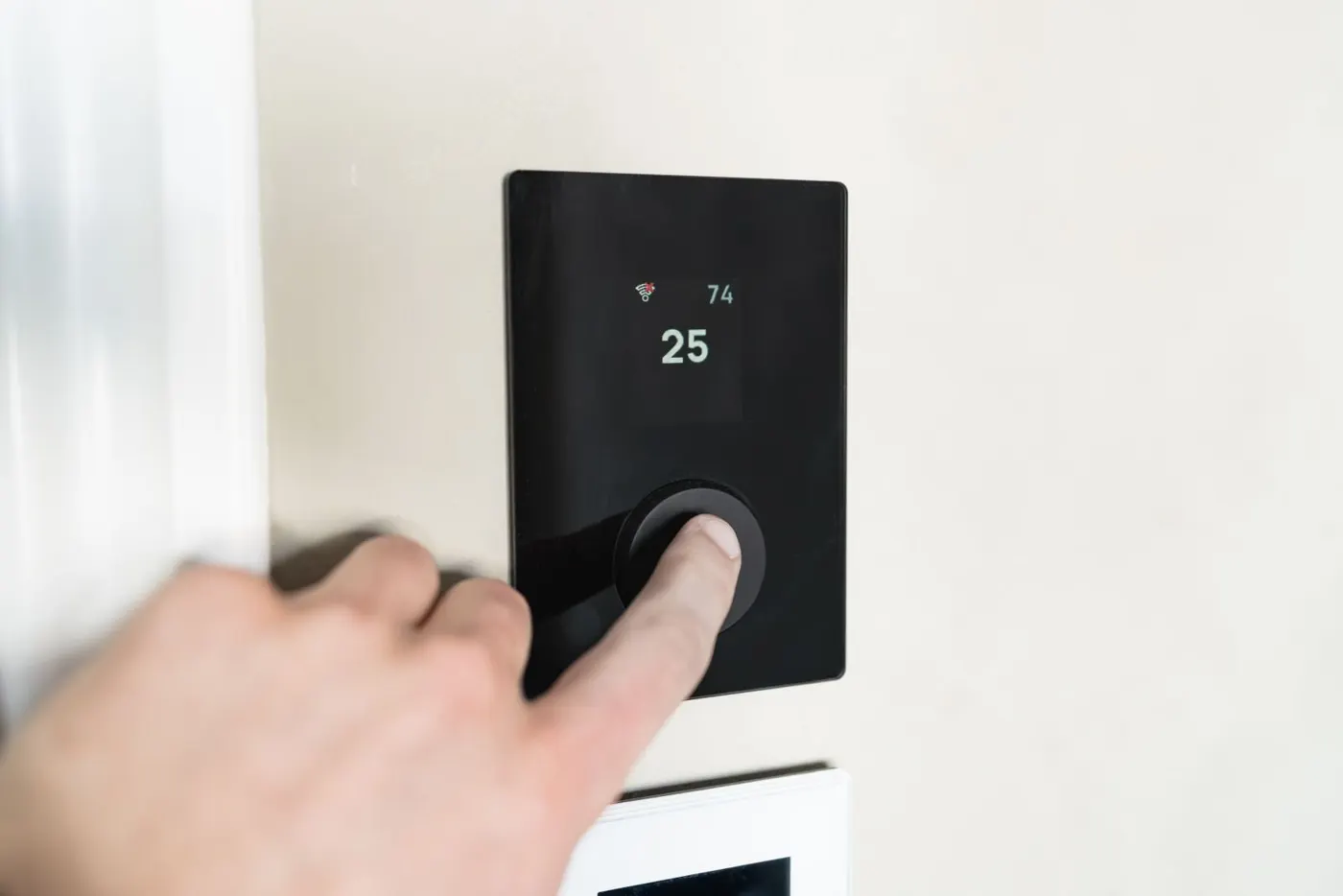
Three other thermostat faults produce a furnace that won't fire. Dead or dying batteries, which is the single cheapest fix in this entire guide. A heating schedule or a geofence in the app holding the setpoint low while someone stares at a display they think is the setting. And a loose or corroded low-voltage wire behind the plate, which in an attic run can be a wire chafing on a sheet metal edge where nobody has looked in fifteen years.
If the house has a newer communicating or smart thermostat, add one more. Those need the right system type configured, and a thermostat set up for a heat pump on a gas furnace, or missing the W wire on the terminal block, will run the fan and never call for heat. Our AC not turning on guide covers the same low-voltage checks from the cooling side.
Safe to check yourself: yes, all of it. Fresh batteries, mode on Heat, fan on Auto, setpoint well above room temperature, no schedule or hold overriding you. Give it ten minutes before deciding it failed.
3. A cracked hot surface igniter
This is the part that fails most on furnaces in this part of the county. A hot surface igniter is a thin element of silicon carbide or silicon nitride that glows bright orange when 120 volts pass through it, and the burners light off that glow. It's brittle. Thousands of heat and cool cycles put hairline cracks in it, and a cracked igniter either glows weakly, glows in patches, or doesn't glow at all.
The symptom is clean: the inducer fan runs, you wait, and no orange glow appears behind the burner compartment slot, and then the board gives up and tries again. Two or three tries and it locks out.
Honest advice from the field: when we replace an igniter on a furnace that's fifteen years old or more, we check the flame sensor and the burners at the same time. Those three parts age together, and coming back three weeks later for the sensor isn't doing anybody a favor.
Leave to a technician: yes. Igniters carry line voltage, they shatter if you touch the element with bare fingers, and they sit inches from the gas burners. Confirming it's the igniter also means watching the sequence with the panel off, which is not a homeowner job on a gas appliance.
4. Gas isn't getting there
If the igniter glows properly and the burners still never light, gas is the next suspect. The furnace has its own shutoff valve in the gas line near the cabinet, a quarter-turn handle or a lever. It gets closed during other work and sometimes not reopened. We've found it closed after water heater replacements, after kitchen remodels, and once after an earthquake shutoff valve tripped at the meter.
Other gas-side causes are not homeowner territory: a failed gas valve coil, incorrect manifold pressure, a gas line too small for a system that was upsized at some point.
Safe to check yourself: partly. You can look at the furnace shutoff valve and see whether other gas appliances in the house work. If the stove and the water heater are fine, gas is reaching the house. If nothing gas-fired works, check the meter for a tripped seismic shutoff and call the gas utility rather than resetting it yourself.
If you smell gas at any point, stop. Don't flip switches, don't light anything, get everyone outside and call the gas utility from there. That is not a repair call, it's an emergency call.
5. A sooty flame sensor
Here's the failure that confuses homeowners most, because the furnace looks like it's working. The igniter glows, the gas valve opens, the burners light with a proper whoosh, and then three to seven seconds later it all shuts down. Thirty seconds or a few minutes later it tries the whole thing again.
The flame sensor is one plain metal rod sitting in the burner flame. The control board sends a small AC voltage down it and looks for a microamp-level current flowing through the flame itself, which only conducts when it's actually burning. It's a clever safety design: no flame means no current, and the board closes the gas valve within seconds rather than letting raw gas into the exchanger. The problem is that the rod slowly builds a film of white oxide and combustion residue, and that film blocks the current. The flame is right there, burning, and the board can't see it.
Furnaces in South Orange County are good candidates for this one because they run so little. A system that fires a few hundred times a year still accumulates the film, and it gets discovered on the first cold night rather than gradually in October.
Leave to a technician: yes. Cleaning a flame sensor is a five-minute job for someone with the furnace shut down and the right abrasive, and the microamp reading afterward is what proves it's fixed. It also means working in the burner compartment of a gas-fired appliance, which is where the line sits.
6. A blocked flue, a full condensate trap, or a pressure switch that won't close
Before the igniter gets any power, the board has to see the pressure switch close. That switch is a safety: it proves the inducer fan is actually moving combustion gases out of the house. If it doesn't close, nothing else in the sequence happens, which is why this failure looks like "the fan runs for twenty seconds and then it quits."
What keeps it from closing:
- A blocked or partly blocked flue. Bird nests are the classic one, and on rooftop and attic flues in Lake Forest and Mission Viejo we find them more often than you'd guess.
- On a high-efficiency condensing furnace, a plugged condensate drain or a full trap. These furnaces produce water as a normal byproduct, and when it can't drain it backs up into the exchanger or the pressure switch hose.
- A cracked, kinked or disconnected rubber hose running to the switch. They harden with age.
- A weak or failing inducer motor that spins but doesn't pull enough draft.
- A float switch in the secondary drain pan, on attic installations, cutting the control circuit because the pan has water in it.
Safe to check yourself: a little. If the furnace is in an attic, look at the drain pan under it. Water in that pan is worth reporting and it may be the whole answer. Beyond that, flue and combustion work is a technician's job, because a blocked flue means combustion gases have somewhere else to go.
7. The filter nobody changed
I'd check this before anything mechanical. The furnace needs a specific volume of air moving across the heat exchanger to carry heat into the house. Choke the airflow and the exchanger surface temperature climbs past what the high limit switch allows, the switch opens, and the board closes the gas valve while leaving the blower running to cool things down. The furnace then sits, cools, and tries again later.
From the hallway that's a furnace heating for a few minutes and quitting. Mechanically it's a furnace protecting itself from a filter.
The restrictions we find, roughly in order of how often. A filter that went from dusty to matted, usually one that sat in the system all summer. Supply registers closed in unused bedrooms, which doesn't save anything and does starve the system. A return grille behind a sofa or a headboard. A thick high-MERV filter installed in a system built for a cheap one. A crushed flex duct in the attic. After a Santa Ana event, filters across South Orange County load up noticeably faster, and we see a wave of airflow calls a week or two later.
Safe to check yourself: yes, and do this first. Fit a clean filter of the size and type the system was built for, point the airflow arrow toward the furnace, open every supply register, and clear two feet around the return grille. Run it and watch a full cycle. If it heats all the way through now, that was it, and a filter schedule keeps it away. Our AC maintenance checklist covers the same filter habit from the cooling side, since it's the same air handler doing both jobs.
8. Blower motor, capacitor, and the limit switch behind them
A blower that can't move air has the same effect as a blocked filter. The exchanger overheats, the limit switch opens, the gas shuts off. The usual causes are a run capacitor that has drifted out of tolerance on a PSC blower motor, a motor with worn bearings dragging, a wheel packed with dust so it moves far less air than its speed suggests, or a failed module on an ECM variable-speed motor.
The tells: a hum at the air handler with little or no air at the vents, a blower that starts slowly or needs a push, airflow that has felt weak for months, or a burning smell from an overheating motor.
A limit switch that keeps opening is also worth taking seriously rather than working around. It's protecting the heat exchanger from temperatures that crack metal, and a cracked exchanger is a combustion-safety problem and a replacement conversation, not a repair.
Leave to a technician: yes. Capacitors hold a charge after the power is off, blower assemblies sit in the high-voltage section, and a limit switch should never be bypassed to make a furnace run.
9. Lockout, blink codes, and how many times to reset
Control boards count failures. After three or four unsuccessful ignition attempts the board stops trying and goes into lockout, usually for an hour or until power is cycled. That's deliberate, because the alternative is a furnace dumping unburned gas into a heat exchanger over and over.
Every one of those boards has an LED that blinks a fault code, and a legend printed on the inside of the access door or on a label next to the board. The codes differ by manufacturer, but the categories don't: pressure switch failed to close, limit switch open, failed to prove flame, flame present with the valve closed, reversed polarity on line and neutral, low flame current, open rollout switch.
Write down the number of blinks and what the legend says next to it. That one line of information tells a technician which step of the sequence failed, and it genuinely shortens the visit.
How many resets: one. Switch the furnace off at the service switch, wait a minute, switch it on, and watch a full cycle. If it heats and keeps heating, you got lucky and you should still have it serviced before the cold sets in. If it locks out again, leave it off and call. Resetting repeatedly on a furnace that keeps failing is running an ignition sequence over and over on a system that has already told you something is wrong.
10. When to stop troubleshooting entirely
Most of this guide is about saving yourself a service call. This section isn't.
- You smell gas. Leave the house, don't touch switches, call the gas utility from outside.
- A carbon monoxide alarm sounds. Get everyone out, open doors on the way if you can do it without delay, call 911 from outside. Don't go back in to investigate.
- A loud boom or bang shortly after the burners light. That's delayed ignition, where gas accumulates before it catches. Shut the furnace off at the service switch and leave it off.
- Soot, scorch marks or rust streaks around the burner compartment or the flue connection. Those point at a combustion problem.
- Flames rolling out toward the front of the burner compartment instead of burning back into it.
- A furnace that keeps tripping its breaker. More than once is an electrical fault, not a nuisance.
- Any part of this that involves bypassing a safety switch to keep the heat on. If a switch keeps opening, it's reading something real.
Gas furnaces are safe equipment when their safeties work. The sequence above exists precisely so a fault becomes a no-heat call instead of a dangerous one. Respect that and the worst outcome is a cold night.
11. If it's a heat pump, the rules change
Plenty of newer homes around Irvine Great Park, Portola Springs and Baker Ranch have heat pumps instead of gas furnaces, and some have a heat pump paired with a small gas or electric backup. A heat pump in heating mode runs the same outdoor unit as the AC with the refrigerant flow reversed, so "not heating" has a different cause list.
Air from the vents on a heat pump is genuinely cooler than furnace air, often 90°F to 105°F instead of 120°F or more. People new to heat pumps report that as broken when it's normal. Real faults look like this: a reversing valve stuck in cooling, a refrigerant charge low enough that there's no heat to move, a defrost cycle that runs too often, auxiliary heat strips not engaging on a cold morning, or an outdoor unit with ice on the coil that isn't clearing.
One thing worth knowing: emergency heat on a thermostat runs the backup only and costs considerably more to operate. It's a bridge until the system is looked at, not a setting to live on. AC blowing warm air covers the reversing valve from the cooling direction, which is useful background.
Why furnaces here fail on the first cold night
Appliances fail when they're used, and a South Orange County furnace is used in bursts. Ours sit idle from roughly April through November, then get asked for heat on the first evening that drops into the forties. Everything that aged quietly over seven months shows up in one week.
A few patterns we see specifically in this corridor. Attic installations are common in Irvine and Tustin tract homes built from the 1990s on, and attic units collect dust and heat and get checked less often than a garage unit would. Homes in Lake Forest, Foothill Ranch and Portola Hills sit closer to the hills and get colder nights than the coastal side of the county, so their furnaces log more hours and the wear parts go sooner. Along the coast toward Dana Point and San Clemente, salt air works on the metal in the cabinet and on the exterior flue cap.
The practical consequence is scheduling. If you only get one call out a year on the heating side, make it in October, not in the middle of a cold snap when every heating contractor in the county is booked.
What keeps a furnace reliable
- Change the filter on a schedule, not when you remember. Monthly if you have pets or a dusty street, every three months otherwise, and always after a wind event.
- Run the furnace for fifteen minutes in early October before you actually need it. Finding a problem on a 65°F afternoon is a different experience from finding it at 11pm in December.
- Have the flame sensor cleaned and the flame current measured at a service visit. It's a few minutes of work on the most common no-heat cause.
- Keep every supply register open and the return grille clear. Closing vents to steer heat is the most common self-inflicted airflow problem we find.
- On a high-efficiency furnace, have the condensate drain and trap cleared annually. On attic units this also prevents a ceiling stain.
- Keep the area around the furnace clear. Storage boxes stacked against an attic or closet unit block combustion air and make the access panel hard to seat.
- Test your carbon monoxide alarms when you change the filter. California requires them in homes with any fuel-burning appliance, and a dead battery in one is not a small thing.
- Don't ignore a single episode that "fixed itself." A safety switch opened and reset, and safety switches open for reasons.
When to call us
Call when the burners won't light, when they light and drop out after a few seconds, when the board is blinking a code, when it locks out again after one reset, or when the heat has been weak all season and you'd rather sort it out before December. Have three things ready: what the furnace does during a full cycle, the blink code if there is one, and the brand and approximate age off the label inside the access door.
We handle minor heating service and repairs, the igniters, flame sensors, switches, blower motors, capacitors, thermostats and tune-ups. Anything bigger, a new system, a replacement, ductwork or a heat exchanger, goes to our licensed HVAC partner so it's permitted and done to code. The technician quotes the job on site before any work starts, and nothing happens until you say yes. Repairs come with a 90 day parts and labor warranty.
If the complaint is really about an oven rather than a furnace, our oven not heating guide covers igniters, elements and sensors on ranges, and 5 signs your HVAC needs service is the one to read if the system still works but something feels off.
Frequently Asked Questions
Why is my furnace blowing cold air?
Cold air from the vents while the system is running usually means the blower is working and the burners are not. Either the burners never lit, or they lit and then shut down while the fan kept going. The usual reasons are a sooty flame sensor, a cracked hot surface igniter, gas shut off at the valve, or a blocked flue or condensate trap opening the pressure switch. One more possibility has nothing to do with the furnace: the thermostat fan switch left on ON instead of AUTO runs the blower around the clock with no heat behind it.
What is the most common reason a furnace stops heating?
On the calls we take in Irvine, Tustin and Lake Forest, two parts come up over and over. The first is the hot surface igniter, a thin silicon carbide or silicon nitride element that cracks from thousands of heat cycles and then glows weakly or not at all. The second is the flame sensor, a single metal rod in the flame path that builds up a film and stops reading flame, so the control board shuts the gas valve a few seconds after the burners light. Before either of those, check the air filter. A matted filter overheats the heat exchanger and trips the limit switch, and it looks exactly like a broken furnace.
My furnace lights for a few seconds then shuts off. What does that mean?
That pattern has a name in the trade: flame sensor dropout. The igniter glows, the gas valve opens, the burners light, and then about three to seven seconds later everything shuts off and the cycle repeats. The control board needs to see a tiny current through the flame to prove it is burning. A flame sensor coated in white oxide or soot cannot carry that current, so the board assumes there is no flame and closes the valve. It is a safety system doing its job. Cleaning or replacing the sensor is a short job, but it means opening the burner compartment of a gas appliance, so it is technician work.
Can a dirty air filter stop a furnace from heating?
Yes, and it is the first thing to rule out. The furnace needs a set volume of air moving across the heat exchanger to carry heat away. Choke that airflow and the exchanger surface temperature climbs past the limit switch setting, the switch opens, and the control board shuts off the gas while the blower keeps running to cool things down. You get a furnace that runs for a few minutes, blows cool, quits, and tries again later. Replacing the filter and opening every supply register fixes a real share of these calls, especially on attic and closet units that sat unused since spring.
What do the blinking lights on my furnace mean?
Nearly every furnace built since the 1990s has an LED on the control board that blinks a fault code, and the legend is printed on the inside of the access door or on a label beside the board. Common codes point to a pressure switch that did not close, a limit switch that opened, failure to prove flame after a set number of tries, a flame present with the gas valve closed, or a reversed line and neutral. Read the code and the legend and write both down before you call. It tells the technician which half of the sequence failed and often shortens the visit.
Should I reset my furnace by turning the power off and on?
One reset is reasonable. Most control boards lock out after three or four failed ignition attempts and stay locked until power is cycled or an hour passes. Switch the furnace off at the service switch beside the cabinet or at its breaker, wait a minute, switch it back on, and watch one full cycle. If it heats and keeps heating, note the date and get it serviced before winter. If it locks out again, stop there. Repeated resets on a furnace that keeps failing just run the ignition sequence over and over on a system that already told you something is wrong.
Do you repair furnaces in Irvine and South Orange County?
We handle minor heating service and repairs: thermostats, igniters, flame sensors, limit and pressure switches, blower motors and capacitors, filters and tune-ups. These are jobs under $1,000 in labor and materials. Bigger work such as a new system, a full replacement, ductwork, a heat exchanger or a major repair goes to our licensed HVAC partner so it is permitted and done to code. The technician looks at the furnace, tells you what it needs and what it comes to, and nothing happens until you say yes. Repairs carry a 90 day parts and labor warranty. We cover Irvine, Tustin, Lake Forest and the rest of South Orange County down to San Clemente.
Related Pages
- HVAC Repair & Service in Orange County
- AC & Air Conditioning Repair
- AC Maintenance & Seasonal Tune-Up
- AC Repair in Irvine
- AC Repair in Tustin
- AC Repair in Lake Forest
- 5 Signs Your HVAC Needs Service
- AC Maintenance Checklist for Southern California Homes
- AC Not Turning On
- AC Blowing Warm Air: 10-Minute Triage
- AC Short Cycling: On and Off Every Few Minutes
- Oven Not Heating
- Before the Technician Arrives
- Irvine · Tustin · Lake Forest · Mission Viejo · Laguna Hills · Aliso Viejo · San Clemente