
Double Oven and 48-Inch Range Problems During Holiday Cooking (Turkey and Pies at Once)
Thanksgiving is the one day a year a double oven earns its price. Turkey in the big cavity, pies and sides upstairs, four burners going and a 20-pound bird that cannot be rescheduled. It is also the day the weak link in a 36 or 48-inch range finally shows itself, because this is the only time all year the appliance gets asked to do everything at once.
We get these calls around Irvine every November, and the pattern is consistent. The complaint is rarely "the oven is broken." It's "the bottom one works and the top one doesn't," or "it heats but convection isn't doing anything," or "it was fine and then it just shut off." Those are three different faults with three different answers, and this page is about telling them apart before you call anyone.
Why does a double oven fail differently from a regular one?
Because it isn't one appliance. It's two ovens sharing a cabinet, a power feed and usually a control board, and that sharing is what makes the diagnosis interesting.
Each cavity has its own bake element or gas igniter, its own broil element, its own temperature sensor, usually its own convection fan and element, and its own door latch. What they share is the 240 volt supply, the cooling blower in most designs, and the control board, where each cavity gets its own set of relays.
So the question that sorts most of these calls is simple. Does the problem affect one cavity or both?
One cavity misbehaving proves the shared parts are fine. Power arrived, the board booted, the blower runs. The fault lives in the parts that cavity owns alone. Both cavities misbehaving the same way points at what they share, and on an electric unit that means the power feed first.
A 48-inch professional range adds its own wrinkles. The large cavity and the small one are very different sizes, so they behave differently even when both are healthy. A dual-fuel model needs gas for the burners and 240 volts for the ovens, which means it has two ways to be half-dead. And the whole assembly sits in a cabinet opening with a cooling path that somebody may have blocked with a towel or a sheet pan on the warming drawer.
Symptoms and what they point to
| What you observe | Most likely causes |
|---|---|
| Lower cavity heats, upper one stays cold (or the reverse) | That cavity's bake element or igniter (1), its temperature sensor (1), a failed relay on the board (1), a broken wire at the cavity terminal (1) |
| Both cavities display normally, neither one heats | Half-tripped 240V breaker (2), lost leg at the panel or a burned lug (2), main control board (2) |
| Small upper cavity on a 48-inch range overshoots and burns the tops of pies | Normal size difference plus an overshoot you can rack around (3), or sensor drift if the gap is over about 25°F (3) |
| Convection fan spins, food still browns unevenly and cooks slow | Open convection ring element (4), convection relay (4) |
| Oven heats but the convection fan never runs | Fan motor seized or open (4), motor relay (4), motor bearing stiff with baked grease (4) |
| Meat probe reads far off the instant-read thermometer | Probe tip on bone (5), damaged probe cable or plug (5), worn probe jack contacts (5) |
| Oven runs fine for an hour or two, then shuts down or throws a code | Cooling blower weak or blocked vents (6), control board overheating behind the trim (6), door not sealing and dumping heat into the cabinet (7) |
| Door sits slightly open at the top, heat escapes, browning is uneven | Tired hinge springs on a heavy pro door (7), compressed or hardened door gasket (7) |
| Gas burners light but the electric oven is dead (dual fuel) | The 240V side of the feed only (2), oven control board (2). Burners run on 120V ignition, so they survive it |
| Both ovens take forever to preheat when started together | Normal for two cold cavities (8), but check for a weak element if one alone is also slow |
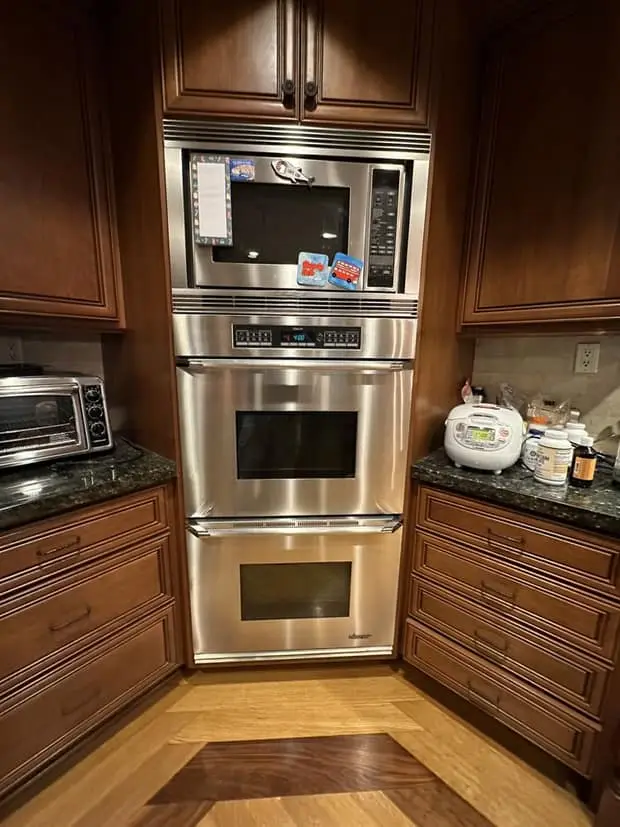
1. One cavity heats, the other doesn't
This is the call we take most, and it's good news in the sense that it narrows things fast. The working cavity has already proven the power, the board's power supply and the user interface are all healthy.
What's left in the dead cavity, roughly in the order we find it:
- The bake element on an electric oven. On exposed elements you can often see the failure as a blister or a break. On the hidden elements common in newer double ovens the element lives under the cavity floor and you can't see it at all, which is why people assume the board died.
- The igniter on a gas cavity. A weak igniter glows orange but never draws enough current to open the safety valve, so you get a glow, a wait and no flame. It's the most common gas oven failure by a wide margin.
- The temperature sensor. Most US ovens use an RTD that reads roughly 1080 to 1100 ohms at room temperature. Drift sends the cavity to the wrong temperature. A short or an open usually throws a code instead.
- The relay on the control board. Each cavity's element is switched by its own relay, and relays fail one at a time. A board can run the lower oven perfectly for years with the upper relay welded open.
- A burned wire or terminal at the back of the dead cavity. High-current connections run hot and eventually get brittle.
If you have a broil element in the dead cavity, try broil for a minute. Broil working while bake does nothing is a useful split: it tells us the cavity has power and the board is awake, which points at the bake element or its relay rather than at anything shared.
Safe to check yourself: run each cavity separately on bake at 350°F for ten minutes with an oven thermometer inside, and write down what each one does. Try broil in the dead one. Note any code. That is enough to tell a technician which parts to bring.
2. Both cavities power up but nothing gets hot
Stop and look at the breaker before anything else. This one catches people every year.
An electric double oven runs on 240 volts, delivered as two 120 volt legs through a double-pole breaker. The clock, the lights, the display and the fan only need one leg. The heating elements need both. Lose a leg and you get a fully functional-looking oven that cannot make heat in either cavity, which looks exactly like a dead control board and costs nothing to rule out.
A double-pole breaker can also trip in a way that doesn't look tripped. The handle sits near the on position and the internal contacts are open on one side. Push it firmly to full off, wait a few seconds, then push it firmly to full on. That's the proper reset, and it resolves a real share of these calls.
If a proper reset doesn't bring the heat back, don't keep cycling it. A lost leg also comes from a loose or burned lug in the panel, a failed breaker, or a burned connection in the junction box behind the oven, and those are not homeowner work. We cover the full version of this in why an oven won't turn on.
The dual-fuel version of this is worth knowing. On a 48-inch dual-fuel range the surface burners ignite on 120 volts while the ovens need the full 240. If your burners light normally and both ovens are dead, that is not a coincidence, it's the same lost-leg symptom wearing a different hat.
3. The small cavity runs hot, and why that's partly normal
On a 48-inch range the big oven might hold 4 to 5 cubic feet while the companion cavity holds half that or less. Less air mass means it climbs faster, overshoots more at the top of each cycle, and recovers faster when the door opens. In a double wall oven the upper cavity also sits above a cavity full of heat, and some of that heat migrates up through the shared structure.
So a modest difference between the two is physics, not a fault. The useful question is how much.
Put an oven thermometer on the center rack, set 350°F, and leave it 20 minutes after the preheat beep so the cycle settles. Then read it. Within about 25°F of the setpoint is within normal territory for a residential oven. Past that, in either direction, something is off: a sensor drifting, a door not sealing, or a calibration offset somebody entered years ago and forgot. Our guide to oven temperature problems walks through the measurement and what the calibration offset can and cannot fix.
The practical holiday workaround for a hot small cavity: put the pies on a lower rack, use a light-colored or insulated sheet pan under them, and drop the setpoint 15 to 25°F. That's not a repair. It's how you get through Thursday while you wait for one.
4. Convection that isn't doing anything
Convection is the feature people buy a double oven for and the one that fails most quietly, because the oven still bakes. It just bakes badly while telling you it's in convection.
True convection, which most professional ranges and better double ovens have, puts a ring-shaped heating element around the convection fan at the back of the cavity. The fan pulls cavity air across that element and pushes it back out, so the air arriving at the food is already hot. That's what makes a convection oven cook evenly on three racks.
Two failure patterns, two different answers:
- Fan spins, cooking is slow and uneven. The ring element has gone open. The fan runs on its own circuit so it doesn't care, and the oven falls back to the bake element while the display still says convection. Food on the upper rack browns, food on the lower rack doesn't.
- Heat is fine, fan never runs. The motor, its relay, or a bearing that's gotten stiff from years of grease vapor. You can sometimes hear a seized motor try: a hum with no air movement.
There's a third thing that isn't a fault at all. Many ovens run convection with an automatic temperature reduction, typically 25°F below what you set, and some apply it only in certain modes. If your convection results changed after someone reset the oven or changed a setting, check the manual for that behavior before assuming a part failed.
Safe to check yourself: set convection bake, wait for preheat, then open the door briefly and look and listen for the fan. That's all. Don't reach in.
5. The meat probe that lies about the turkey
A probe that reads 30 degrees off is a real problem on exactly one day of the year, and it tends to be discovered at the worst moment.
Before blaming the probe, check placement. The tip belongs in the thickest part of the thigh, angled in, not touching bone. Bone conducts heat faster than meat and will tell you the bird is done when the meat around it isn't. We've seen more "broken probes" caused by bone contact than by actual failures.
If the placement is right and the number still doesn't make sense, the probe itself is the usual suspect. It's a thermistor on a thin steel cable, and the cable gets kinked, pinched by a closing door, or slowly cooked at the plug. Resistance drifts and the oven believes it. On most ovens the probe is a replaceable part, and the jack in the cavity wall is a separate part when the contacts wear out.
What to do on the day: verify with an instant-read thermometer in the same spot. If they disagree by more than a few degrees, cook to the instant-read, pull the probe out of the equation, and deal with it after the holiday. USDA guidance for whole poultry is 165°F in the thickest part of the thigh, and an instant-read is as valid a way to get there as the built-in probe.
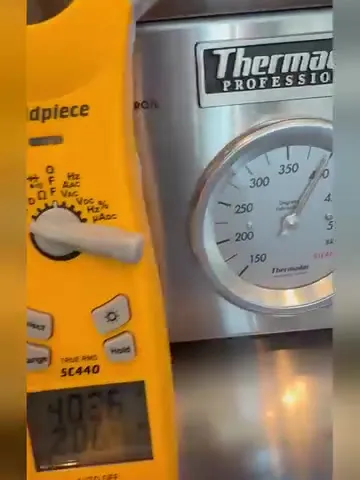
6. The oven that quits two hours into the cook
This is the one that ruins holidays, and it's the one most people never see coming, because the oven behaves perfectly in any short test.
Every built-in oven and professional range has a cooling blower that pulls room air through the cabinet and over the control board, then exhausts it through a vent, usually a slot above the oven door or under the cooktop bullnose. That board sits a few inches from a cavity running at 350°F for six hours. The blower is the only thing keeping it alive.
When the blower is weak, the bearings are noisy, or the vent path is blocked, board temperature climbs slowly through the cook. Then one of three things happens: a thermal protection code, a spontaneous shutdown, or, on the worst day, a cooked relay that doesn't come back.
Things that block the path, all of which we've found on real calls: a sheet pan stored flat on top of a warming drawer, a cabinet trim kit installed without the spacer, a towel draped over the vent slot, and years of grease on the blower wheel that cut its airflow in half.
Safe to check yourself: find the vent slot and clear anything within a few inches of it. With the oven preheating, hold your hand near the slot and feel for moving air. No airflow at all during a long bake is worth a call before the holiday, not after.
And since it comes up every November: this is not the week to run self-clean. That cycle holds the cavity near 800 to 900°F for hours, which is harder on the thermal fuse, the door lock and the control board than anything else the oven does. Should you run self-clean before Thanksgiving covers what breaks and the hand-cleaning method to use instead.
7. Heavy doors, tired hinges and the gasket nobody checks
A professional range door is heavy. The hinge springs that hold it closed are under load every time the oven is hot, and after ten or twelve years they relax. The door then sits a few millimeters open at the top, which you won't notice by looking, and heat streams out past the gasket.
What you see instead is uneven browning, a cavity that never quite reaches setpoint, longer preheats, and a cooktop or a trim panel that runs hotter than it used to. Plus, on a double oven, heat leaking out of the lower cavity into the cabinet, which makes the cooling blower work harder.
The dollar-bill test still works. Close the door on a bill at several points around the perimeter and pull. It should drag at every spot. Where it slides out freely, the seal is gone there. Also run your fingers along the rope or woven gasket when the oven is cold and feel for flat, hard or missing sections.
Gaskets are a reasonable repair. Hinges are too, but they're a two-person job on a 48-inch door and the springs are under enough tension to hurt someone. We don't recommend pulling a pro range door yourself.
8. Running both cavities at once, realistically
Both ovens at once is what the appliance is for, and the circuit is sized for it. The things that actually bite are timing and air.
Two cold cavities starting together preheat slower than one, sometimes noticeably. Plan for that. Start the big cavity first, give it a head start, then bring the second one up.
Convection in both cavities moves a lot of air and dries the room out faster than you'd expect, which matters if you're also proofing dough. And the cooking times printed on recipes assume a cavity that isn't being opened every ten minutes by somebody checking on something else.
One real electrical note: don't add a portable countertop oven or an air fryer on the same kitchen circuit as the range's 120V convenience outlet on the day. We get a handful of calls every holiday that are just a tripped 20 amp kitchen circuit, nothing to do with the range at all.
What you can safely check yourself
- Run each cavity separately at 350°F with an oven thermometer and record what each one does, including how long preheat takes.
- Photograph any error code before you clear it. On double ovens the code often names the cavity, which saves a diagnostic step.
- Reset the double-pole breaker properly, once: full off, pause, full on.
- Check the cooling vent path and clear anything sitting against it.
- Dollar-bill test both door gaskets and feel the gasket for flat or missing sections.
- Verify the meat probe against an instant-read thermometer.
- Check whether a calibration offset was entered at some point. Most ovens show it in a settings menu, and it is a common leftover.
- Look up the model number now, from the plate behind the door or on the frame, and write it down. On built-ins and pro ranges, the model number is what determines how fast a part arrives. Before the technician arrives lists the rest.
What only a technician should do
- Any work behind the rear cavity panel: elements, sensors, convection assemblies. The terminals there carry 240 volts and the panel often has to come out with the oven partly pulled.
- Pulling a built-in double oven out of its cabinet. They're heavy, top-biased, and the supply connection is in the junction box behind them.
- Control board diagnosis and relay replacement.
- Anything on the gas side of a range: igniters, safety valves, manifold pressure, orifices after an LP conversion. If you smell gas or hear a bang when the oven lights, stop using it and read what a gas smell or a loud pop means.
- Door hinges and spring assemblies on a professional range.
- Tracing a lost 120 volt leg back into the panel.
How to not have this problem in November
Test the whole appliance three to four weeks before you host. Not the day before, because that's a part order with no time behind it.
The test is an hour of your afternoon. Both cavities to 350°F, separately and then together. Thermometer in each. Convection on in both, confirm the fan runs. Broil for one minute in each cavity. Meat probe against an instant-read in a glass of hot water. Every surface burner lit and checked for an even blue flame, which our gas burner guide covers if any of them act up. Dollar bill around both doors. Write down anything that's off.
That hour is the difference between a part ordered on November 3rd and a cold oven on November 26th. Professional ranges and built-in double ovens use parts that distributors don't always stock locally, and that's the real risk, not the repair itself. Our Thanksgiving oven checklist has the full version for single ovens, and everything on it applies twice here.
The other habit worth keeping: clean up spills while they're fresh, and keep the convection fan area free of baked-on grease. Grease on the fan wheel and in the cooling blower is what turns a healthy appliance into a slow one over ten years.
When to call us
Call when one cavity stays cold after you've confirmed the other works, when convection isn't doing its job, when the oven shuts itself off mid-cook, when a code keeps coming back after a reset, or when the gap between the thermometer and the setpoint is more than about 25°F.
Call sooner rather than later if you're hosting. A double oven or a 48-inch range is not a same-afternoon parts run, and the first week of November is a very different conversation than the Tuesday before Thanksgiving.
We do professional repair on Wolf, Thermador, Viking, Monogram, Dacor and similar professional ranges and built-in double ovens, and Bertazzoni, Thor Kitchen and ZLINE are brands we are factory authorized to service. The technician quotes on site before any work starts, nothing happens until you say yes, and repairs carry a 90 day parts and labor warranty. We work across Irvine, Tustin, Lake Forest and the rest of South Orange County down to San Clemente. If you'd rather read about one appliance at a time, oven and range repair in Irvine covers what we fix here.
If the oven has already quit with guests on the way, go to what to do if your oven stops working on Thanksgiving Day first. That one is written for the clock you're on. And we're 5.0 on Yelp if you want to see how these calls tend to go. Call (949) 267-7771.
Frequently Asked Questions
Why does one oven cavity work and the other one stay cold?
Because the two cavities share almost nothing except the power feed and, on many models, one control board. Each has its own bake element or igniter, its own broil element, its own temperature sensor and often its own relay on the board. When one cavity heats normally and the other doesn't, the shared parts are proven good, so the fault is in that cavity's own element, igniter, sensor, wiring or relay. The relay is the detail people miss: the board can be fine for one cavity and dead for the other, because they run on separate relays soldered to the same board. A quick split that helps us: if broil works in the dead cavity but bake does nothing, the cavity has power and the board is awake, which points at the bake element or its relay.
Can I run both ovens at the same time for Thanksgiving?
Yes, that's what they're built for, and the circuit is sized for it. What people run into isn't electrical, it's temperature. Both cavities will hold their own setpoints, but preheat takes noticeably longer when both start cold at once, so give the big one a head start. The other thing that happens is heat. The kitchen gets hot enough that the cooling blower runs the whole time, and if that blower is weak or its vents are blocked, the control board behind the trim climbs in temperature through the cook and the oven shuts itself down a couple of hours in. That's the failure mode worth checking for before you host, because it doesn't show up in a short test.
Why does my upper oven run hotter than the lower one?
Some difference is normal and physical. Heat from the lower cavity migrates upward through the shared structure, so the upper oven starts in a warmer environment. On a 48-inch range the small cavity also holds far less air, so it climbs and overshoots faster than the big one does. Measure it before you decide it's broken: oven thermometer on the center rack, 350°F, read it 20 minutes after the preheat beep so the cycle has settled. Within about 25°F of setpoint is normal territory. Past that, you're looking at a drifting temperature sensor, a door that isn't sealing, or a calibration offset someone entered and forgot about.
The convection fan spins but food cooks like regular bake. What's wrong?
On most true convection ovens there's a separate ring-shaped element around the convection fan, and that element is what makes convection convection. If the ring element has gone open, the fan still spins because it runs on its own circuit, and the oven falls back to the bake element while the display still says convection. Food browns on the top rack and doesn't on the bottom, and everything runs slow. The opposite case, heat with no fan, points at the fan motor, its relay, or a motor bearing seized by grease baked in over years. Both are behind the rear cavity panel and both are technician work.
Why is my meat probe reading the wrong temperature on the turkey?
Check placement before you blame the probe. The tip belongs in the thickest part of the thigh without touching bone, and bone reads hot while the meat beside it is still cold. If placement is right, the probe itself is the usual failure. It's a thermistor on a thin cable, and the cable gets kinked, pinched by the door, or cooked at the plug end until its resistance drifts. Probes are a replaceable part on nearly every oven that has one, and the jack in the cavity wall is a separate part when its contacts wear. On the day, compare the probe to an instant-read thermometer in the same spot. If they disagree by more than a few degrees, cook to the instant-read, 165°F in the thickest part of the thigh per USDA guidance, and replace the probe after the holiday.
Both cavities light up but neither one heats. What does that mean?
On an electric double oven that pattern is the classic half-tripped 240 volt breaker. The oven runs on two 120 volt legs. The controls and lights only need one leg, the heating elements need both. Lose a leg and the display works perfectly while nothing gets hot in either cavity. Switch the double-pole breaker fully off, pause, and switch it fully back on, since a breaker that looks closed can have one side open. If the elements still don't heat after a proper reset, stop there. A lost leg also comes from a burned lug in the panel, a failed breaker, or a burned connection in the junction box behind the oven, and that's technician or electrician work. On a dual-fuel range the same fault shows up as working burners and two dead ovens, because the burners only need 120 volts to spark.
Do you repair Wolf, Thermador, Viking and Monogram ranges in Irvine?
Yes. We do professional repair on Wolf, Thermador, Viking, Monogram, Dacor and similar professional ranges and double wall ovens, and Bertazzoni, Thor Kitchen and ZLINE are brands we are factory authorized to service. We cover Irvine, Tustin, Lake Forest, Mission Viejo, Laguna Hills, Aliso Viejo and the rest of South Orange County down to San Clemente. Have the model number ready when you call, because on built-ins and professional ranges it determines how fast the part arrives, and that's usually what sets the repair date. The technician quotes on site before any work starts and repairs carry a 90 day parts and labor warranty.
Related Pages
- Oven & Range Repair in Irvine
- Oven & Range Repair in Orange County
- Oven & Range Repair in Tustin
- Oven & Range Repair in Lake Forest
- How to Prepare Your Oven for Thanksgiving
- Oven Temperature Problems: Uneven Heat and Wrong Temperature
- Why Is My Oven Not Heating?
- Oven Won’t Turn On? Breaker, Control Lock and Reset
- What to Do If Your Oven Stops Working on Thanksgiving Day
- Should You Run Oven Self-Clean Before Thanksgiving?
- Gas Range Burner Won’t Light or Burns Yellow?
- Gas Oven Smells Like Gas or Pops When It Lights?
- Before the Technician Arrives
- Irvine · Tustin · Lake Forest · Mission Viejo · Laguna Hills · Aliso Viejo · San Clemente