
Thermostat Problems That Look Like a Broken AC or Furnace
A good share of the no-heat and no-cool calls we take in Irvine never reach the equipment. The furnace is fine. The condenser is fine. A thermostat with two dead AAA cells, a fan switch somebody bumped, or a 3 amp fuse the size of a fingernail is holding the whole house hostage.
That is not an argument for ignoring the thermostat. It is the opposite. The thermostat is a $100 part commanding a $6,000 system, and when it misbehaves it imitates failures that cost real money to chase. This guide is about telling the difference before anybody opens a cabinet.
How do you tell a thermostat problem from a broken system?
There is one test and it takes about three minutes. Set the mode deliberately, push the setpoint ten degrees past where the room is right now, and then go listen.
- At the thermostat. Does the display react at all? Does a flame, snowflake or "heating/cooling" indicator appear?
- At the furnace or air handler. Within a second or two you should hear a soft click as a relay picks up, then the inducer fan on a furnace or the blower on an AC call.
- Outside, on a cooling call. The condenser contactor clacks in and the fan starts within a few seconds.
If the system reacts and then fails later in its sequence, the thermostat did its job. Go read furnace not heating or AC not cooling, because the fault is in the equipment. If nothing anywhere reacts, the thermostat or the 24 volt circuit feeding it is where to look, and that is the rest of this page.
One more clue that costs nothing. Try the other mode. A thermostat that cools fine but will not heat, or heats fine but will not cool, is rarely a dead system, because heating and cooling leave the thermostat on different wires. That pattern points straight at the thermostat, its configuration or one broken conductor.
Symptoms and what they point to
| What you observe | Most likely causes |
|---|---|
| Screen completely blank, no backlight, no response to buttons | Dead batteries (2), blown low voltage fuse on the control board (5), blower door switch open (5), tripped float switch (5) |
| Screen works, setpoint changes, nothing at the equipment | Mode or schedule override (4), broken low voltage conductor (9), failed relay inside the thermostat (9) |
| Blower runs nonstop, air is room temperature in both seasons | Fan switch on ON instead of AUTO (3), stuck fan relay (3) |
| Heats fine, will not cool. Or cools fine, will not heat | Wrong system type configured (7), one broken wire in the bundle (9), compressor lockout delay (4) |
| Starts and stops every three to five minutes | Thermostat location (8), cycle rate or differential set too tight (10), and the non-thermostat causes in our short cycling guide |
| One part of the house is always wrong, thermostat says it is satisfied | Thermostat placement (8), zoning damper or airflow problem, not the thermostat itself |
| Smart thermostat reboots, drops Wi-Fi, or clicks the system on and off by itself | No C wire, power stealing through the heating or cooling wire (6) |
| Display reads a temperature that is clearly not the room | Internal sensor drift (11), sun or lamp heat on the plate (8), draft from the wall cavity behind it (8) |
| Heat pump blows cool air when set to Heat | O/B reversing valve setting wrong for the brand (7), or a real heat pump fault |
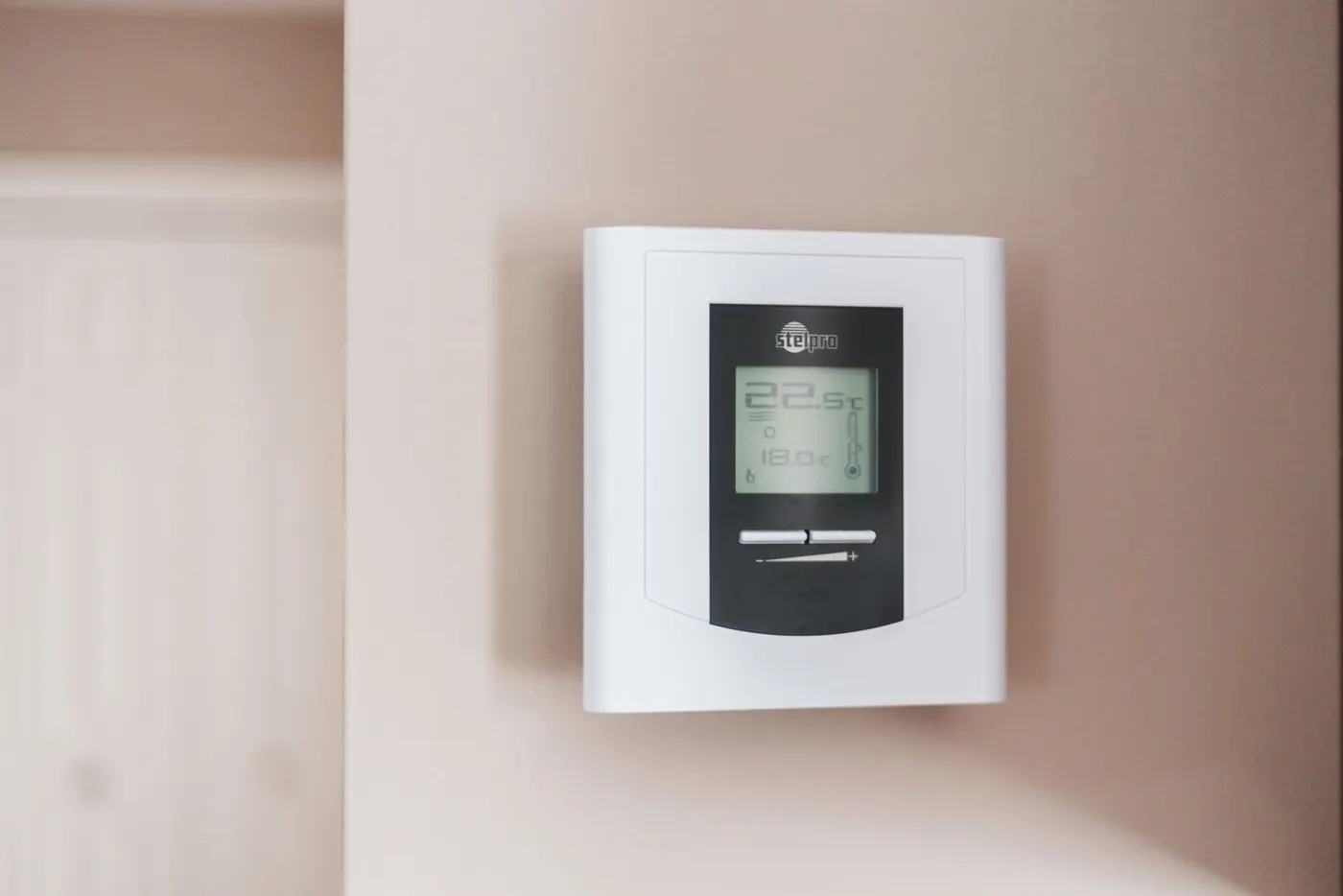
1. The blank screen, and what it actually means
A dark thermostat looks like the worst case and is usually the cheapest one. Thermostats get their power two ways. Some run on batteries alone. Some run on 24 volts from the furnace or air handler through a wire called the common, or C. Plenty run on both, with batteries as backup.
So a blank screen is a power question, not an equipment question. Either the batteries are gone or the 24 volt supply stopped, and those lead to completely different places. Press any button. Nothing at all, not even a flicker, means no power is reaching the display.
Safe to check yourself: yes. Pull the thermostat face off its wall plate (most snap off with a gentle pull from the bottom) and look for a battery compartment. If there is one, that is your first move.
2. Batteries, the cheapest fix in heating and cooling
I replace more thermostat batteries than I replace thermostats, by a wide margin. Most battery thermostats take two AA or AAA alkaline cells and want them once a year. Many show a low battery warning for weeks before they quit, and that warning is easy to scroll past.
Two details people miss. Use alkaline, not rechargeable, because the lower cell voltage on rechargeables makes some thermostats behave erratically rather than simply dying. And on a thermostat with both batteries and a C wire, weak batteries can still cause a glitch, because the thermostat may fall back to them during a brief power event and come back confused.
Safe to check yourself: yes, and do it first. Fresh cells, correct orientation, snap the face back on firmly until it seats. Give it a minute to boot before you decide it failed.
3. The ON versus AUTO trap
This is the single most common thermostat complaint we hear, in both seasons, and it is not a fault at all.
The fan setting has two positions. On AUTO the blower runs only while the system is heating or cooling. On ON it runs continuously. In July, a thermostat on ON pushes room temperature air out of the vents between cooling cycles and the house feels like the AC quit. In December the same setting feels like the furnace is blowing cold.
There are reasons to run ON deliberately, mostly even temperatures across a two story house or better filtration. But it is a choice, not a default, and somebody usually set it by accident while poking at a touchscreen.
If the fan still runs nonstop with the switch on AUTO, that is different. Either the fan relay on the control board is stuck closed or the green G wire is shorted somewhere in the run. Both are technician work, and neither is urgent beyond the electricity it burns.
Safe to check yourself: yes. Fan to AUTO, wait for the current cycle to finish, and see whether the blower stops.
4. Mode, setpoint, schedule, hold and geofence
Programmable and app-connected thermostats introduced a category of fault that is not a fault. The equipment is healthy, the thermostat is healthy, and software is holding the setpoint somewhere nobody wants.
What we actually find on these visits:
- A schedule from the previous season still running. A setback that made sense in August at 2pm is unwelcome in December at 6am.
- A permanent hold somebody set during a vacation and never released.
- A geofence or "away" mode in the app that thinks the house is empty because a phone is off or the app lost its login.
- Eco or savings features that cap how far the system will run.
- A compressor short cycle delay. After the system stops, most thermostats refuse to restart the compressor for three to five minutes to protect it. That silence after you change the setpoint is normal and gets reported as a dead AC several times every summer.
- Auto changeover with a deadband so wide that neither heating nor cooling ever starts.
Safe to check yourself: yes, all of it. Put the thermostat in plain Heat or plain Cool rather than Auto, cancel any hold, push the setpoint well past room temperature, and wait a full five minutes before concluding anything.
5. The 3 amp fuse nobody knows about
Here is the one that surprises homeowners. The 24 volt circuit that powers your thermostat is protected by a small blade fuse on the furnace or air handler control board, usually 3 amp and sometimes 5. It looks exactly like a car fuse because it is one.
When that fuse blows, the thermostat goes dark and the entire system stops responding. It looks like a failed thermostat or a dead furnace, and it is neither.
Fuses do not blow for no reason. Something put the 24 volt circuit to ground. The usual culprits, in the order we find them: a thermostat wire pinched or stripped during an install, a chafed conductor in an attic rubbing on a sheet metal edge, water in the condensate line shorting a float switch, a failed contactor or transformer, or somebody touching two bare wires together while swapping a thermostat.
Two related things cut the same circuit without blowing anything. A blower door safety switch left unseated after a filter change kills 24 volts entirely. And a condensate float switch, standard on attic installations across Tustin and the Irvine tract homes, opens the circuit on purpose when the drain pan fills. That is the system protecting your ceiling, and the right response is to clear the drain, not to bypass the switch.
Leave to a technician: mostly. You can seat the blower panel properly and check whether an attic drain pan has water in it. Replacing the fuse is the easy half of the job, finding the short is the half that matters, and swapping fuses repeatedly on a circuit that keeps failing wastes parts and tells you nothing.
6. The C wire problem on smart thermostats
Smart thermostats changed what a thermostat needs from the wall. An old mercury stat needed nothing. A modern Wi-Fi thermostat with a lit display, a radio and a processor needs a steady 24 volt supply, which means a dedicated common wire.
Homes built around here in the 1980s and 1990s often have four or five conductors in that bundle and no spare. The installation goes in anyway, and the thermostat survives by "power stealing," pulling a trickle through the heating or cooling wire without actually starting the equipment. On some systems that works for years. On others it produces exactly the symptoms that make people think the AC is broken:
- The system clicks on and off by itself for a few seconds at a time.
- The thermostat reboots or loses Wi-Fi on its own schedule.
- The display dims or blanks during a cycle.
- The furnace blower kicks in with no heat call behind it.
My honest opinion after enough of these: if the trouble started the week a new smart thermostat went in, assume the install until proven otherwise. The fix is usually running a proper common wire or fitting the manufacturer's add-a-wire module at the air handler. On some newer systems with communicating controls there is a further catch, because those thermostats and boards speak a proprietary protocol and a third-party smart thermostat may not work on them at all.
7. Configured for the wrong kind of system
Every modern thermostat asks what it is connected to during setup, and a wrong answer there produces a healthy system that behaves badly.
The ones we correct most:
- Heat pump set up as a conventional furnace, or the reverse. A heat pump uses an O or B terminal to flip the reversing valve, and conventional gas heat uses W. Get it wrong and the system cools when you ask for heat.
- O versus B polarity. Some brands energize the reversing valve in cooling, some in heating. A single wrong menu choice reverses the seasons.
- Auxiliary and emergency heat not configured, so the backup strips never engage on the coldest mornings and the house never catches up.
- Dual fuel systems where the thermostat does not know there is a gas furnace behind the heat pump and switches at the wrong outdoor temperature.
Newer homes near Irvine's Great Park neighborhoods, Portola Springs and Baker Ranch increasingly come with heat pumps rather than gas furnaces, so this category has grown. If your air from the registers is noticeably cooler than a furnace would deliver, around 90°F to 105°F, that is normal heat pump behavior and not a thermostat fault.
Leave to a technician: mostly. Installer menus vary by brand and a wrong entry can energize things that should not be energized together.
8. Where the thermostat hangs
A thermostat measures one spot on one wall and governs the whole house from it. Put that spot somewhere unrepresentative and the system chases a number nobody lives in.
What throws a reading off:
- Direct sun for part of the day, especially on a west-facing hallway wall. The plate warms, the thermostat thinks the house is hot, and the AC runs through the afternoon while the bedrooms get cold.
- A lamp, a TV or a media cabinet below it. Heat rises into the housing.
- A supply register blowing on it. The thermostat satisfies in four minutes, shuts off, and the house never evens out. This is a classic short cycling cause.
- An exterior wall, where the wall itself runs cooler in winter and warmer in summer than the room.
- A draft through the wire hole. The hole behind the plate opens into a stud cavity, and attic air moves down through it. Stuffing that hole with a bit of insulation is a legitimate five-minute fix we do on service calls.
- A kitchen, where a 400°F oven and a pot on the burner raise the reading for hours.
A thermostat should sit on an interior wall, roughly five feet up, in a room people actually use, away from sun, drafts and supply air. Moving one is a small job and occasionally it is the entire answer to "this house has never been comfortable."
9. A loose, corroded or broken low voltage wire
The wire from the thermostat to the equipment is thin, usually 18 gauge, and it was stapled into place when the house was framed. Thirty years later a few things have happened to it.
Screw terminals back out slowly with temperature cycling, so a conductor that was tight in 1998 can be loose now. Attic runs chafe on sheet metal edges. Rodents chew. Remodels nick a bundle inside a wall. And the single most common one in this trade, a wire pushed back into the wall during a thermostat swap and never landed on the right terminal.
The symptom depends on which wire. Lose R and everything dies. Lose C and a smart thermostat starts acting strange. Lose Y and cooling stops while heating is perfect. Lose W and the reverse. Lose G and the blower never runs on a cooling call, which usually ends in a frozen evaporator coil, covered in our AC freezing up guide.
Leave to a technician: yes, past a visual check. You can look at the back of the thermostat plate and see whether a wire is obviously loose or unlanded. Beyond that, tracing a low voltage fault means working at a live control board, and shorting two of those wires is exactly what blows the fuse from section 5.
10. When the thermostat causes short cycling
Short cycling is a system that starts and stops every few minutes instead of running steady ten to twenty minute cycles. Most causes have nothing to do with the thermostat, and we walk through the full list in AC short cycling. But two thermostat causes are real and worth ruling out first because they cost nothing.
The first is placement, covered above. Supply air hitting the thermostat is the textbook version.
The second is the cycle rate or differential setting, buried in the installer menu on most thermostats. The differential is how far the room must drift from the setpoint before the system starts. Set it too tight, say half a degree, and the system restarts constantly. Set to a normal one degree or the manufacturer's default cycles per hour, it runs longer and less often, which is easier on the compressor and more comfortable.
One thing to be clear about. Short cycling that started suddenly in a system that ran fine for years is more likely a capacitor, a dirty filter, low charge or a safety switch than a thermostat setting nobody touched.
11. When the thermostat itself has actually failed
Thermostats do fail, just less often than they get blamed. What a genuine failure looks like:
- Reading drift. The display says 72°F and a separate thermometer on the same wall says 78°F. Tape a cheap thermometer beside it for an hour and compare. A few tenths is normal, six degrees is not.
- A relay that will not close. The display behaves perfectly, the setpoint changes, the heating or cooling icon appears, and the equipment never hears anything. Older mechanical stats and cheap builder-grade units do this.
- Buttons or touchscreen dead or erratic with fresh batteries and good 24 volt supply.
- Corroded terminals, which we see on units in coastal homes toward Dana Point and San Clemente where salt air gets everywhere.
- Age. A mercury bulb thermostat still working in 2026 is doing fine, but it has no accuracy to speak of and should be handled as hazardous waste when it comes down, not thrown in a bin.
The way a technician proves it is simple and is also why it is not a homeowner test. With the system powered down at the breaker, the thermostat is taken off the plate and a jumper is placed briefly between the right terminals to call the equipment directly. If the system runs on the jumper and will not run on the thermostat, the thermostat is the fault. Done on the wrong terminals or with power on, the same test blows the fuse or damages a board, so this is one to leave to someone doing it every day.
What you can safely check yourself, in order
- Fresh alkaline batteries if the thermostat takes them.
- Mode set to plain Heat or plain Cool, not Auto, and the setpoint pushed ten degrees past the room.
- Fan switch on AUTO.
- Hold, schedule, eco and away all cancelled in the app or on the panel.
- Wait five full minutes. Compressor protection delays are real.
- Air filter checked while you are waiting, because a matted filter imitates half the faults on this page.
- Blower access panel pressed in until it seats, since the door switch kills 24 volts.
- If the unit is in the attic, a look at the drain pan. Water in the pan means the float switch did its job.
- A thermometer taped beside the thermostat for an hour to check its reading.
- Note what the system does and does not do, then stop.
What only a technician should touch
Low voltage is not the same hazard as line voltage, but the equipment it controls is, and the mistakes are expensive rather than dramatic. Leave these alone:
- Jumpering terminals at the thermostat or the control board to force the system on.
- Replacing a blown 24 volt fuse without finding why it blew.
- Bypassing a condensate float switch to get cooling back on a hot afternoon. That switch is standing between an attic air handler and your ceiling.
- Installer-menu configuration on heat pumps, dual fuel systems and communicating equipment.
- Any work inside the furnace or air handler cabinet, where line voltage, gas and a charged capacitor all live.
- Rewiring a thermostat bundle, which is where most of the no-heat calls in the week after a DIY smart thermostat install come from.
Why we see these calls the way we do in South Orange County
Our climate makes the thermostat more suspect here than it would be in a place with real seasons. Heating runs in short bursts from late November into February and cooling runs hard from June into October, so each system sits idle for long stretches and then gets asked for everything on one day. A thermostat fault that developed quietly in March is discovered on the first cold evening in Lake Forest in December.
Attic equipment is the norm in the tract homes built across Irvine and Tustin from the 1990s on, which puts the thermostat wiring in the hottest, dustiest part of the house and puts a float switch in the circuit. Both show up in the fault list above. Homes closer to the hills in Foothill Ranch and Portola Hills get colder nights than the coastal side of the county, so their heating runs more hours and schedule problems get noticed sooner. Along the coast toward Laguna Niguel, Dana Point and San Clemente, salt air works on terminals and contacts in a way it does not inland.
And the smart thermostat wave hit this county hard. A lot of them went in during remodels and during the last few hot summers, often by a homeowner or a handyman on houses whose wiring predates the idea of a C wire. We are still finding those installs.
Keeping a thermostat out of trouble
- Change the batteries once a year on a fixed date. Pick the same weekend you change smoke alarm batteries and stop thinking about it.
- Review the schedule twice a year, when heating season starts and when cooling season starts. Last season's program is the most common "broken" thermostat we see.
- Run each mode for fifteen minutes before you need it. Test heat in early October, test cooling in May. Finding a fault on a mild afternoon beats finding it at 11pm in a cold snap.
- Keep lamps, electronics and furniture away from the thermostat wall, and keep the supply register near it aimed elsewhere.
- Have the condensate drain and float switch checked at a service visit, especially on attic systems. That one item prevents both a water stain and a mystery dead thermostat.
- If you are buying a smart thermostat, confirm you have a C wire first. It is a five-minute check and it decides the whole install.
- Photograph the existing wiring before you remove an old thermostat. Every technician does this, and it has saved more installs than any tool in the bag.
Thermostat acting up, or is it the system?
Call us at (310) 600-8152 and tell us three things: what the thermostat display does, what the equipment does when you change the setpoint, and whether it is heating, cooling or both that fail. That usually narrows it to the thermostat, the wiring or the system before we arrive. We are 5.0 on Yelp, family-owned in Irvine, and the technician quotes the work on site before anything starts.
We handle minor heating and cooling service: thermostats, low voltage faults, capacitors, contactors, float switches, condensate drains, filters and tune-ups, the jobs under $1,000 in labor and materials. New systems, replacements, ductwork and major repairs go to our licensed HVAC partner so they are permitted and done to code. Repairs carry a 90 day parts and labor warranty.
Frequently Asked Questions
How do I know if my thermostat is bad or my AC is broken?
Watch what happens inside and outside at the same time. Move the setpoint well past room temperature and listen. If you hear a click at the air handler and the outdoor unit starts, the thermostat sent its signal and the problem is downstream in the system. If nothing anywhere reacts, no click, no fan, no outdoor unit, the thermostat or the 24 volt circuit feeding it is the first suspect. A thermostat that works in one mode and not the other also points at the thermostat or its wiring rather than at the equipment, because heating and cooling use different wires on the same terminal block.
Why is my thermostat screen blank?
On a battery thermostat the answer is usually batteries, and that is worth two minutes before anything else. On a thermostat powered by the system through a C wire, a blank screen points at the 24 volt supply: a blown low voltage fuse on the furnace or air handler control board, the blower door switch left open after a filter change, a tripped condensate float switch in an attic, or a loose wire behind the thermostat plate. The fuse is a small automotive style blade fuse, normally 3 or 5 amp, and it blows when two low voltage wires touch. Replacing it without finding the short just blows the next one.
Why does my fan run constantly but no cold or warm air comes out?
That is almost always the fan switch set to ON instead of AUTO. On ON the blower runs around the clock whether or not the system is heating or cooling, so room temperature air moves through the house and feels wrong in both seasons. Move the fan to AUTO and the blower only runs when there is heating or cooling behind it. If the fan still runs nonstop on AUTO, the fan relay on the board may be stuck or the G wire is shorted, and that is a technician visit.
Can a thermostat cause short cycling?
Yes, and it is one of the few short cycling causes a homeowner can spot. A thermostat mounted in direct sun, above a lamp, next to a supply register or on an exterior wall reads a temperature the rest of the house never sees, so it satisfies early and calls again a few minutes later. A thermostat with its cycle rate or differential set too tight does the same thing. That said, short cycling also comes from a dirty filter, a failing capacitor, low refrigerant charge or an oversized system, so rule the thermostat in or out before you assume it. Our AC short cycling guide walks the rest of the list.
Do smart thermostats need a C wire?
Most of them do. A Wi-Fi thermostat with a bright display draws more current than a battery or an old mercury stat ever did, and it needs a constant 24 volt common to run on. Many Orange County homes wired in the 1980s and 1990s have only four or five conductors in the wall and no spare. Some thermostats ship with an add-a-wire adapter at the air handler, and some try to power themselves by pulsing the heating or cooling wire, which can make the system click on and off by itself, drop the Wi-Fi, or reboot the display. If a smart thermostat has acted strangely since the day it went in, the C wire is the first thing to check.
My thermostat says heat is on but the house is cold. What is wrong?
The display showing heat only means the thermostat believes it is calling for heat. It does not prove the furnace received or acted on that call. Check whether the blower is actually moving warm air at a register, and go look at the furnace for a blinking fault code on the control board. If the furnace is running through its sequence and failing, the thermostat did its job and the fault is in the furnace. If the furnace shows no reaction at all, the W wire, the low voltage fuse or the thermostat itself is where to look. Our furnace not heating guide covers the furnace side step by step.
Do you replace thermostats in Irvine and South Orange County?
Yes. Thermostats, low voltage wiring faults, blown control board fuses, float switches and similar small heating and cooling work are jobs we handle, the minor repairs under $1,000 in labor and materials. Larger work such as a new system, a replacement, ductwork or a major repair goes to our licensed HVAC partner so it is permitted and done to code. The technician checks the thermostat and the system together, quotes on site before any work starts, and nothing happens until you say yes. Repairs carry a 90 day parts and labor warranty. We cover Irvine, Tustin, Lake Forest and the rest of South Orange County down to San Clemente.
Related Pages
- AC Repair in Irvine
- HVAC Repair & Service in Orange County
- AC & Air Conditioning Repair
- AC Maintenance & Seasonal Tune-Up
- AC Repair in Tustin
- AC Repair in Lake Forest
- Furnace Not Heating: What to Check Before You Call
- AC Not Turning On
- AC Short Cycling: On and Off Every Few Minutes
- Why Is My AC Not Cooling?
- AC Freezing Up: Ice on the Coil
- HVAC Warning Signs: Before It Fails
- AC Maintenance Checklist for Southern California Homes
- Before the Technician Arrives
- Irvine · Tustin · Lake Forest · Mission Viejo · Laguna Hills · Aliso Viejo · San Clemente