
AC Maintenance Checklist for Southern California Homes: Fall Prep and Spring Start-Up
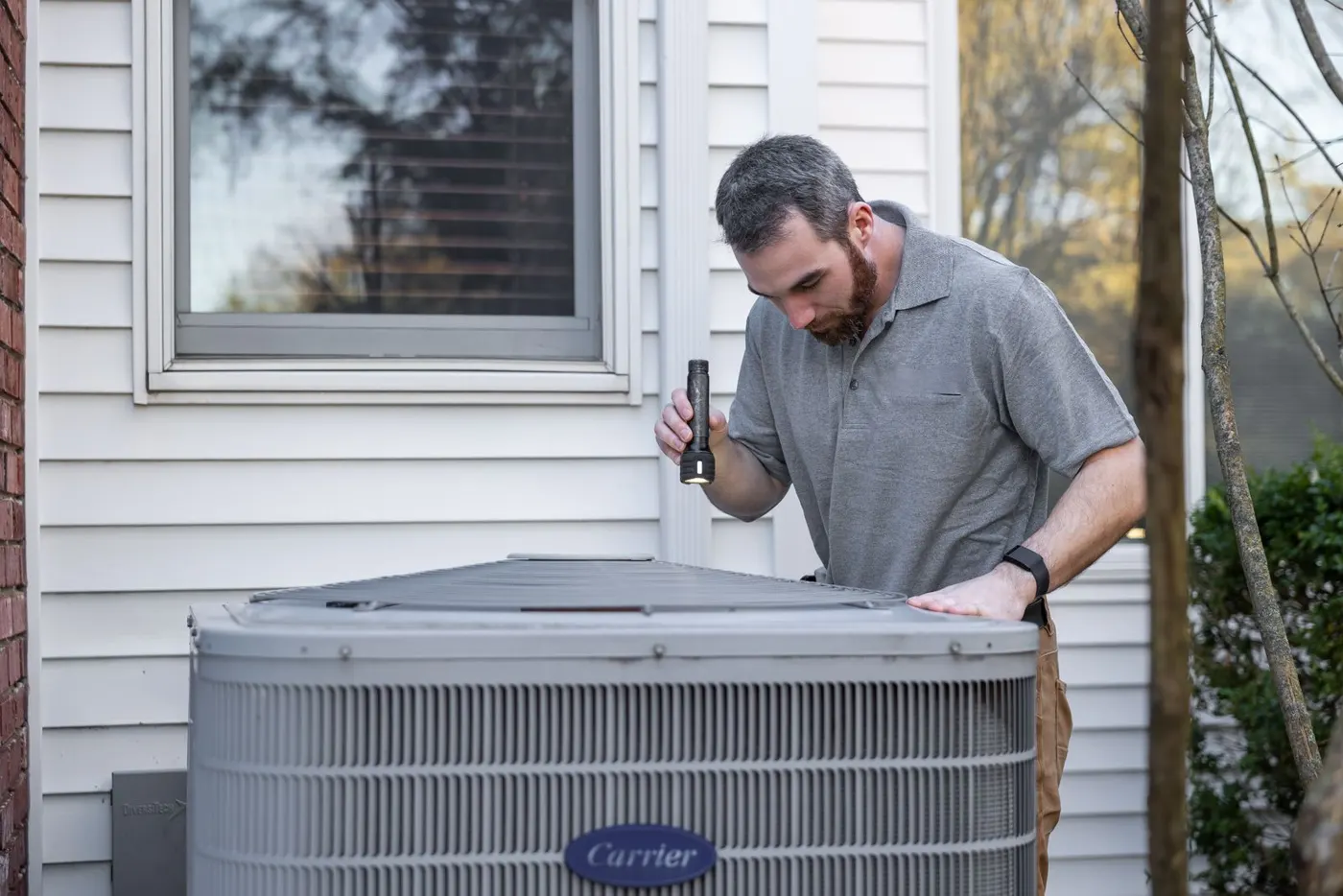
Air conditioning maintenance advice written for the rest of the country does not quite fit here. Southern California systems do not get a real off-season, they do not face freeze damage, and they rarely go a full winter unused — but they do run long hours through a cooling season that stretches from April into October, and they breathe air that carries wind-blown dust inland and salt along the coast. That combination produces a predictable set of failures, and almost all of them are preventable.
This guide is the checklist we would give a homeowner in Irvine, Tustin or Lake Forest who wants to stop paying for the same avoidable breakdown every few summers. It is organized the way the year actually runs: what to do monthly, what to do at the spring start-up before the first heat wave, what to do in a short fall pass once the cooling season ends, and where the line sits between what you can safely do and what needs a technician with gauges and a meter.
Why the Southern California schedule is different
Four local factors drive everything below.
- A long, split season. Our hottest stretch often arrives in September and October, not July. A system that was tuned in March has already run five or six months by the time the worst heat lands — which is exactly when weak components give out.
- Santa Ana wind events. A two-day wind event can load a filter that looked fine and pack an outdoor coil with dust, seeds and dry plant debris. We see a wave of weak-cooling and short-cycling calls a week or two after a big one, and a large share of those are pure airflow problems.
- Coastal salt. Within a couple of miles of the water — Dana Point, San Clemente, parts of Laguna Beach and Laguna Niguel — salt aerosol corrodes condenser fins, copper tubing and electrical contacts. Corrosion is slow and silent: the system keeps running, the air is cool but never cold, and the electricity bill climbs.
- Attic and closet air handlers. Much of the newer housing stock in Irvine, Tustin, Lake Forest, Ladera Ranch and Rancho Santa Margarita puts the air handler in the attic. That makes the condensate drain and its float switch a maintenance item with real consequences — a clogged drain either shuts the system down or, if the safety does not catch it, sends water through a ceiling.
The maintenance schedule at a glance
| How often | What it covers |
|---|---|
| Monthly, April–October | Look at the filter; replace when the media looks grey and matted. Confirm all supply registers are open and nothing is stacked against the return grille. |
| After any Santa Ana wind event | Check the filter regardless of when you last changed it; look at the outdoor coil for a packed layer of dust and debris and clear anything blown against the cabinet. |
| Quarterly (coastal homes) | Rinse the outdoor coil with fresh water, power off at the disconnect. Salt does its damage between rinses, so frequency matters more than thoroughness. |
| Spring, before the first heat wave | Full homeowner start-up below, plus the professional tune-up: electrical testing, refrigerant charge verification, coil cleaning, condensate drain flush, airflow and temperature split. |
| Fall, after cooling season | Short pass: rinse the season's dust and salt off the coil, fresh filter, clear the cabinet, and test the heating changeover before you need it. |
| Annually | Condensate drain cleared and float switch tested; capacitor value and compressor amp draw measured; blower wheel and evaporator coil inspected. |
Monthly: the filter, and only the filter
If you do one thing on this page, do this one. Restricted airflow is the root cause behind a startling share of summer AC failures, and it rarely presents as "the filter is dirty." It presents as weak cooling, as a frozen indoor coil, as a system that cycles on and off every few minutes, or as water dripping from an attic unit when the ice finally melts. The coil needs a specific volume of air across it to transfer heat; choke that airflow and the coil runs colder and colder until it frosts, and once frost starts it snowballs.
Three practical notes. First, judge the filter by looking at it, not by the calendar — a one-inch pleated filter in a house with two dogs and an open patio door may be finished in six weeks, while the same filter in a closed-up condo can run three months. Second, use the size and type the system was designed for. A very thick high-MERV filter dropped into a system built around a cheap one restricts airflow all by itself, and we have measured systems that cool measurably worse after a well-intentioned filter upgrade. Third, note which way the airflow arrow points before you pull the old one out.
While you are there: open every supply register in the house, including the ones in rooms nobody uses. Closing vents does not save cooling — it raises static pressure and starves the coil. And check that nothing has been pushed up against the return grille, which in a lot of South Orange County floor plans sits in a hallway exactly where a bookcase or a stack of boxes ends up.
Spring start-up: the homeowner checklist
Do this on a mild day in March or April, before you actually need the system. The whole point is to find problems while a technician can still come out on a scheduled appointment.
1. Fresh filter, then clear the air path
Start with a new filter of the correct size and type. Walk the house and open every register. Clear the return. If you have a zoned system, make sure the zone dampers are not stuck from sitting all winter — a zone that never opens shows up as one wing of the house that will not cool.
2. Clear two to three feet around the outdoor unit
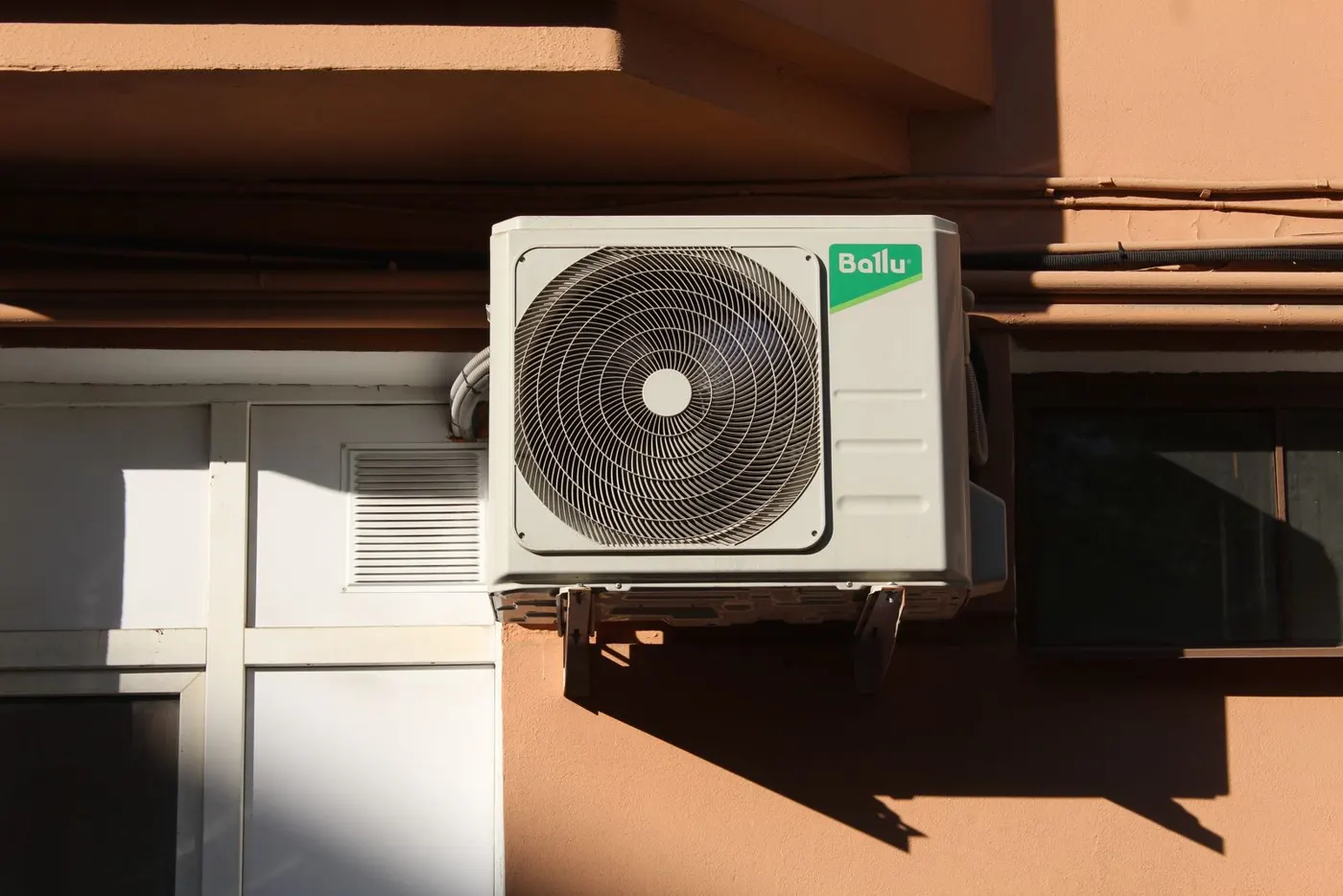
The condenser rejects the heat your house collected, and it does that by pulling air through the coil on all sides and throwing it out the top. Bougainvillea, a new hedge, a trash can, patio furniture, a stack of tile left over from a remodel — anything within a couple of feet chokes it, and anything covering the top grille is worse, because the unit then re-breathes its own hot exhaust. Look up as well as around: we find condensers tucked under low eaves and side-yard overhangs with nowhere for the discharge air to go.
3. Rinse the outdoor coil — power off, gentle, outside in
This is the highest-value thing a homeowner can do for the system, and it is safe if you do it in the right order. Shut the system off at the thermostat, then pull the disconnect switch in the box on the wall beside the outdoor unit. With the power off, use a garden hose on a normal spray — not a pressure washer — and rinse the coil from the outside surface, working the water through the fins. Dirt collects on the outside of the fins, so rinsing from outside in pushes it back out the way it came. Keep water off the electrical compartment. Let it dry, restore the disconnect, and restart at the thermostat.
A pressure washer or a hard jet will fold the aluminum fins flat, and flattened fins block airflow permanently — the repair is a technician with a fin comb, or a new coil. Coil cleaning chemicals are also best left to a technician who knows what the fins are made of, especially on coastal units where the metal is already thin from corrosion.
4. Look at the condensate drain
Find where the condensate line ends — usually a small PVC pipe discharging outside near the foundation, at a planter, or into a trap under a sink. On attic systems there is also a secondary drain that exits somewhere visible under an eave, deliberately placed so that water dripping from it is a warning sign you cannot miss. Note where both are now, while everything is dry, so that a drip in August means something to you.
You can clear leaves and debris away from the outlets. Pouring things down the drain line, disassembling the trap, or vacuuming the line is technician territory — get it wrong on an attic system and you have water in a ceiling instead of a clogged pipe. If you have ever come home to the system dead on a hot day for no apparent reason, a float switch on a clogged drain is a leading suspect; our guide to AC leaking water indoors covers where that water comes from.
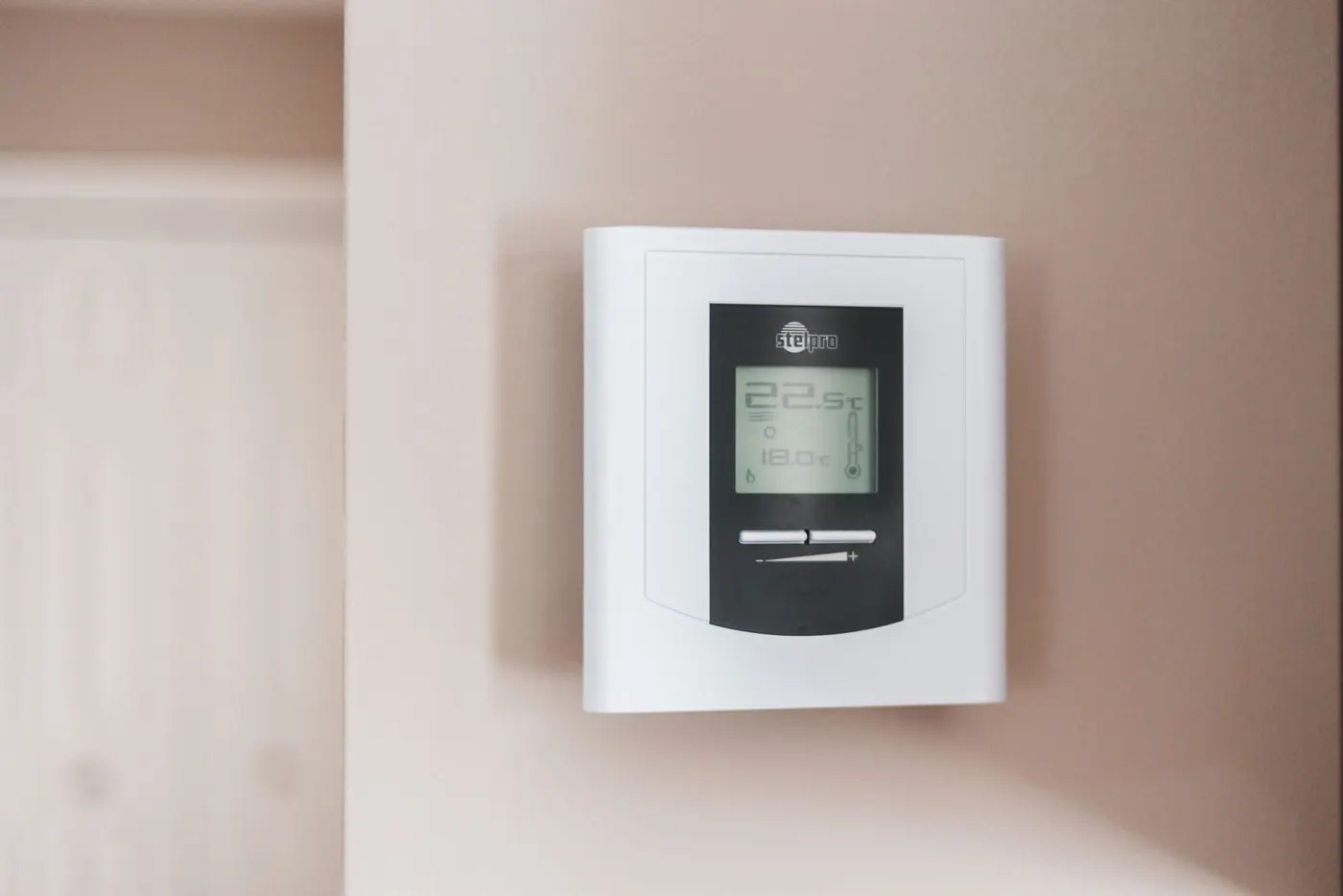
5. Thermostat: batteries, settings, surroundings
Replace the batteries if it takes them, even if it has not complained yet. Confirm the mode is Cool and the fan is on Auto — leaving the fan on On re-evaporates moisture off the coil between cycles and makes the house feel clammy. Look at what has appeared near the thermostat since last summer: a new lamp, a media cabinet, a TV, a change in furniture that put a supply register blowing across it. A thermostat reading a false spike satisfies early and restarts a few minutes later, which is the most common cause of short cycling that has nothing wrong with the air conditioner.
On smart and communicating thermostats — common in newer Irvine and Tustin homes — check the schedule and any geofencing before the season starts. A setup that made sense last year with a different work pattern will quietly cool an empty house or leave a full one warm.
6. Run it and pay attention
Set the thermostat well below room temperature and let the system run a full cycle while you listen and feel. What you want: the outdoor unit starting promptly without a hum or a clunk, the outdoor fan up to speed immediately, steady cold air at the registers within a few minutes, and no new noises. What you do not want: a delay or a grinding start at the condenser, a fan that needs a push, a rattle that was not there last year, a musty smell that lasts more than a minute, or air that is only mildly cool after ten minutes of running.
A rough field check: the air coming out of a supply register should be meaningfully colder than the air going into the return — a difference you can feel clearly with a hand at each. If it is barely different, something is wrong, and that is the moment to call rather than in August. Our AC not cooling guide walks through the ten causes in the order a technician rules them out.
Fall prep: the pass most people skip
In colder climates fall AC prep means protecting a unit from freeze and snow. Here it means something different and, honestly, more useful: getting a summer's worth of accumulated dust and salt off the equipment before it sits on the metal for months, and making sure the heating side works before the first cold night.
- Rinse the outdoor coil again. Same procedure as spring, power off at the disconnect. This is the rinse that matters most near the coast — salt left on the fins over a damp winter does more corrosion damage than salt that lands and gets washed off a few weeks later.
- Fresh filter going into heating season. The same blower and the same filter serve the furnace or the heat pump's indoor unit. A filter left over from a hot September is not a good start to the heating season.
- Clear the cabinet and look for nesting. Leaves, seed pods and bougainvillea litter on top of the unit; rodents in the base pan or the electrical compartment, which is a real and expensive problem when they find the wiring. Signs are droppings, insulation dragged into the cabinet, or chewed line-set insulation.
- Check the insulation on the large copper line. The thick foam sleeve on the suction line between the outdoor unit and the house degrades in UV and cracks open. Bare or crumbling insulation costs efficiency and lets the line sweat; it is an easy item for a technician to replace at a visit.
- Test the heat before you need it. Switch to Heat and run it for ten or fifteen minutes on a cool evening. Expect a brief burn-off smell the first time from dust on the heat exchanger or the strips; expect it to go away. If it persists, or you get a burning-plastic smell, a repeated breaker trip, or a system that lights and then shuts down after a minute, shut it off and have it looked at. Our HVAC warning signs guide covers the signals worth acting on.
- Do not wrap the outdoor unit. A sealed cover traps moisture against the coil and the contactor and accelerates exactly the corrosion you are trying to prevent, and it is an invitation to rodents. Nothing about a Southern California winter threatens a condenser, and if your system is a heat pump the outdoor unit runs all winter anyway.
Coastal versus inland: what actually changes
Two homes the same age with the same equipment age very differently depending on how far they sit from the water, and the maintenance emphasis should follow.
Near the coast — Dana Point, San Clemente, Laguna Beach, the ocean-facing parts of Laguna Niguel and Aliso Viejo — the dominant failure mode is corrosion. Condenser fins thin and crumble, the copper develops pitting, contactor points corrode and weld shut, and fan motor bearings rust out early. The symptom is deceptive because nothing breaks outright: the system runs, the air is cool but not cold, run times get longer year over year. Rinse with fresh water quarterly rather than twice a year, ask a technician to look specifically at coil and contactor condition at the annual visit, and expect electrical components to have a shorter life than the manual suggests.
Inland — Irvine, Tustin, Lake Forest, Mission Viejo, Rancho Santa Margarita and the canyon-adjacent neighborhoods — the dominant factor is dust and wind-blown debris, and heat. Coils pack rather than corrode, which is better news because a rinse genuinely restores them. But head pressure on a 100°F afternoon against a dirty coil is what trips compressor overloads and finishes off capacitors already weakened by heat. The priority inland is filter discipline, coil cleanliness after wind events, and having the capacitor measured before summer rather than replaced during it.
What only a technician should do
The checklist above stops at a deliberate line. Beyond it, the risk is not just to the equipment.
- Anything electrical inside the outdoor cabinet. It carries 240 volts, and the run capacitor stores a charge that remains after the disconnect is pulled. Capacitor testing, contactor inspection and replacement, voltage and amp-draw measurement, and compressor electrical checks are technician work.
- Anything on the refrigerant side. Charge verification takes gauges, a thermometer and the system's own design data. Low refrigerant is never a "top-up" item — refrigerant is in a sealed loop, so if the charge is low there is a leak, and adding refrigerant without finding it wastes money and vents refrigerant into the air. Handling refrigerant requires EPA certification.
- Condensate drain flushing and float-switch testing. Straightforward for a technician, messy and occasionally destructive for a homeowner on an attic system.
- Evaporator coil and blower wheel cleaning. Both live inside the cabinet, both need it every few years, and a blower wheel caked with dust can cost a serious share of the system's airflow. Removing and reinstalling them correctly is not a homeowner job.
- Gas-side and combustion checks on the heating half. Basic homeowner involvement ends at running a test cycle and noticing smells or noises. Anything involving the burners, the heat exchanger or the gas valve needs a qualified technician — if you smell gas, leave and call the gas utility from outside first.
- Duct inspection and repair. A disconnected or crushed flex duct in an attic is invisible from inside the house and will defeat every other thing on this list.
Signs your maintenance is overdue
| What you notice | What it usually points to |
|---|---|
| Run times noticeably longer than last summer for the same weather | Dirty coils (indoor or outdoor), restricted airflow, or a charge that has drifted because of a slow leak |
| Upstairs rooms that used to keep up and no longer do | Airflow: filter, blower wheel, a duct problem, or closed and blocked registers |
| Outdoor unit louder every year, or a hum or clunk at start-up | Fan motor bearings, a weak run capacitor, or a contactor on its way out |
| Musty smell for more than a minute after start-up | Biological growth on a dirty evaporator coil or in a slow-draining pan |
| Water stain or drip near an indoor unit, or from the secondary drain outside | Clogged primary condensate drain — the secondary is doing its job as a warning |
| An occasional breaker trip on hot afternoons | High amp draw from a dirty condenser, a failing capacitor, or a compressor working against high head pressure |
| Ice on the copper lines or the indoor coil | Past the maintenance stage — restricted airflow or low refrigerant. See AC freezing up |
| Cycles on and off every few minutes | Airflow, a safety control tripping, a thermostat problem or a weak capacitor. See AC short cycling |
What a professional tune-up covers
A proper seasonal visit is measurement, not just cleaning. We inspect and clean both coils, check the filter and the airflow path, test the run capacitor against its rated value, inspect the contactor points, measure voltage and the compressor's amp draw, flush the condensate drain and test the float switch, verify the refrigerant charge against the system's design conditions — to see whether it is correct, not to add any — and take the temperature split across the indoor coil to confirm the system is producing the capacity it should. What that sequence buys you is a list of what is drifting before it fails, with numbers attached.
You get the findings and a quote before any work begins, and every repair carries a 90-day parts and labor warranty. We handle minor AC service and repairs for homeowners across Irvine, Tustin, Lake Forest, Mission Viejo, Laguna Hills, Laguna Woods, Laguna Niguel, Aliso Viejo, Laguna Beach, Ladera Ranch, Rancho Santa Margarita, San Juan Capistrano, Dana Point and San Clemente, with larger HVAC projects handled through our licensed HVAC partner. See AC maintenance and tune-up for what a visit covers, AC and air conditioning repair if something is already wrong, or the local pages for AC repair in Irvine, Tustin, Lake Forest and Mission Viejo.
When to stop maintaining and start calling
- A breaker that trips more than once — stop resetting it.
- A hum or buzz at the outdoor unit with the fan not turning.
- Any burning or hot-electrical smell, or scorch marks at the disconnect.
- Ice on the refrigerant lines that comes back after a new filter and a full thaw.
- Water standing in the secondary drain pan, a dripping secondary outlet, or a damp ceiling below an attic unit.
- A gas smell anywhere near the furnace — leave the house and call the gas utility from outside before anyone else.
- Cooling that has faded over weeks rather than failing suddenly, which is the classic signature of a refrigerant leak and needs a leak search, not a recharge.
If the system is already misbehaving rather than merely due for service, start with the symptom: AC not cooling, AC blowing warm air, AC not turning on or AC short cycling. And if maintenance is on your mind generally, the same logic applies to the rest of the house — our refrigerator maintenance checklist and the broader appliance maintenance checklist cover the routine care that prevents most of the calls we run.
Frequently Asked Questions
How often should an air conditioner be serviced in Southern California?
Once a year professionally is the baseline, and spring — before the first real heat wave — is the right time for it. Southern California adds a second checkpoint most parts of the country do not need: a short fall pass after cooling season, because a summer of dust and, near the coast, salt has just been baked onto the outdoor coil. The homeowner half of the job is more frequent: check the filter monthly during heavy-use season, and always after a Santa Ana wind event regardless of the calendar.
What can I do myself and what needs an HVAC technician?
You can change the filter, open every supply register, keep the return grille clear, clear two to three feet of space around the outdoor unit, rinse the outdoor coil gently with a garden hose from the outside in with the power off at the disconnect, check the thermostat batteries and settings, and run a test cycle before the season starts. A technician handles anything electrical or refrigerant: capacitor and contactor testing, amp draw, refrigerant charge verification, condensate drain flushing and float-switch testing, blower and coil cleaning inside the cabinet, and safety controls. The outdoor unit carries 240 volts and its capacitor stays charged after the power is off.
Does an AC tune-up actually prevent breakdowns?
It prevents a specific and predictable set of them. The failures that strand people on the hottest afternoon of the year — a run capacitor that has drifted out of tolerance, a pitted contactor, a condensate drain about to trip a float switch, an outdoor coil so packed that head pressure trips the compressor overload — are all measurable or visible months before they fail. A tune-up does not stop a compressor from wearing out or a refrigerant line from developing a leak, but those are the minority of summer emergency calls.
Why do coastal homes need more AC maintenance than inland homes?
Salt air is corrosive to the aluminum fins and copper tubing of an outdoor coil, and to the electrical contacts inside the cabinet. In San Clemente and Dana Point we regularly find condensers whose fins have corroded to the point they cannot shed heat — the system still runs, the air is cool but not cold, and nothing reads as broken. Rinsing the coil with fresh water several times a year rather than once is the single highest-value habit near the water. Inland in Irvine, Tustin and Lake Forest the enemy is dust and wind-blown debris instead, which is easier to remove but arrives in bulk after Santa Ana events.
Should I cover my outdoor AC unit for the winter?
No — not in this climate, and not with a full wrap anywhere. A sealed cover traps moisture against the coil and the electrical components and makes corrosion worse rather than better, and it gives rodents an attractive dry place to nest among the wiring. Southern California winters do not threaten a condenser, and many systems here are heat pumps that need the outdoor unit running all winter. Clearing leaves and debris off the top grille is the whole job.
How do I know if my AC maintenance is overdue?
The early signals are gradual, which is why they get missed: run times that have crept longer season over season, upstairs rooms that no longer keep up in the afternoon, an outdoor unit that has gotten noticeably louder each year, a musty smell on start-up, an occasional breaker trip, or water or a stain near an indoor unit. Ice on the refrigerant lines and a system that cuts out repeatedly are past the warning stage and need diagnosis rather than maintenance.
Related Pages
- AC Maintenance & Seasonal Tune-Up
- AC & Air Conditioning Repair in Orange County
- AC Repair in Irvine
- HVAC Repair & Service
- Why Is My AC Not Cooling? 10 Most Common Causes
- AC Short Cycling: On and Off Every Few Minutes
- Ice on Your Air Conditioner
- AC Leaking Water Inside
- AC Not Turning On
- 5 Signs Your HVAC Needs Service
- Refrigerator Maintenance Checklist
- Appliance Maintenance Checklist
- Irvine · Tustin · Lake Forest · Mission Viejo · Dana Point · San Clemente