
AC Blowing Warm Air? The 10-Minute Homeowner Triage
It is 3 PM, the house is 84°F, the vents are pushing air, and the air is warm. Before you call anyone, there are eight things you can check in about ten minutes that either fix the problem outright or tell you exactly what to tell the technician. This page is that checklist. It is deliberately focused on the "air is moving but it's warm" symptom; if the system is completely silent, see AC not turning on, and for the full list of causes behind weak cooling see AC not cooling. We run this triage on warm-air calls across Irvine, Tustin and Lake Forest all summer.
The One Question That Splits the Problem in Half
Walk outside to the condenser. Is the top fan spinning?
- No, and it is silent → the outdoor unit is not getting power or not being told to run: thermostat, breaker, disconnect, contactor, float switch.
- No, but it hums or clicks → the capacitor has almost certainly failed. Very common in Orange County summers.
- Yes, spinning normally → the system is running but cannot move heat: frozen evaporator, dirty condenser, low refrigerant, or a heat pump stuck in heat mode.
Note the answer and work through the matching steps below.
Minute 1–2: Thermostat Mode and Fan Setting
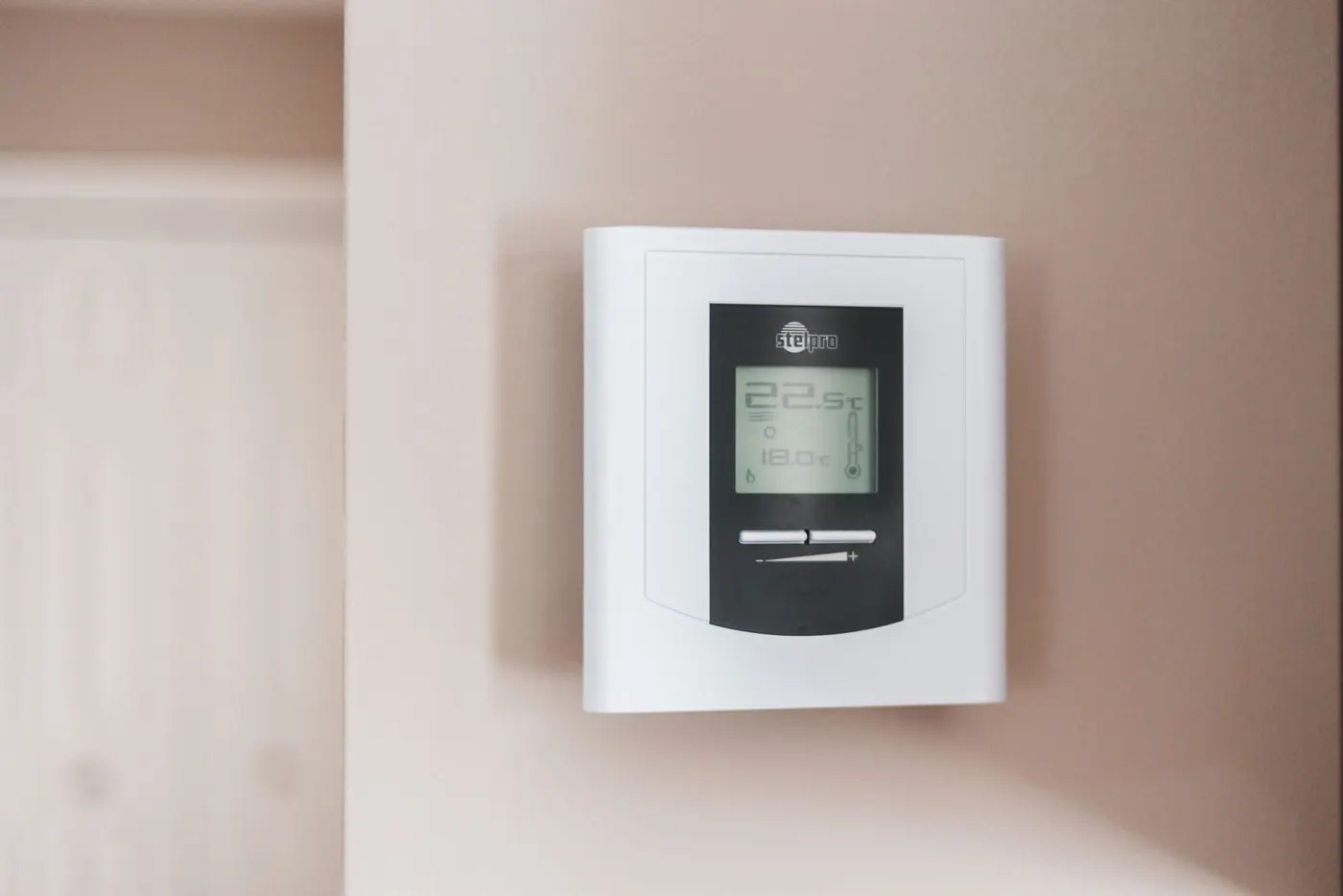
The most common "warm air" call we run has nothing wrong with the AC. Check three things: the mode is COOL (not HEAT, not OFF, not a schedule that switched to "away"); the fan is on AUTO, not ON, on ON the blower runs continuously and pushes room-temperature air through the vents between cooling cycles, which feels exactly like a broken AC; and the setpoint is at least 3–5 degrees below the current room reading. If the screen is blank or dim, replace the batteries. On smart thermostats (Nest, Ecobee, Honeywell Home) check the app for an eco or away mode that is quietly holding the setpoint at 78–80°F. Give the system five minutes after any change, most have a compressor delay.
Minute 3–4: Breakers and the Outdoor Disconnect
The air handler or furnace and the condenser are on separate breakers. If the condenser's 30–50 amp double-pole breaker trips, the blower keeps running and the air goes warm. Open the panel and look for a breaker sitting in the middle position; switch it fully off, then on. Then check the gray disconnect box on the wall next to the condenser, the pull-out block can be missing or backwards after a gardener or a pool tech bumped it. Also check that any fuses inside the disconnect are good. If the breaker trips again within minutes, stop resetting it. A repeat trip means a shorted compressor, a failed capacitor pulling locked-rotor amps, or a chafed wire, that is a service call, not a reset.
Minute 5: The Capacitor
If the outdoor unit hums or clicks but the fan does not spin (or spins only if you nudge it with a stick, do not use your hand), the run capacitor has failed. It is a cylinder the size of a soda can that gives the fan motor and compressor their starting kick, and it fails predictably in heat: a condenser on the west side of a house in Irvine or Anaheim Hills that bakes in the afternoon sun cooks capacitors. You cannot safely test or replace it yourself without discharging it, but you can diagnose it from the symptom. A capacitor replacement is one of the quickest and least expensive repairs we do, and we carry the common sizes on the truck. Turn the system off at the thermostat while you wait so the compressor stops trying to start.
Minute 6: Ice on the Lines or the Indoor Coil
Look at the larger, insulated copper line where it enters the condenser, and at the air handler in the attic, garage or closet. Frost or a sleeve of ice means the evaporator coil is frozen; a frozen coil passes almost no air, and what does come through is barely cool. Causes are low airflow (dirty filter, closed vents, weak blower) or low refrigerant. Switch the system to FAN ONLY and let it thaw, this takes 2–4 hours, and expect some water at the air handler as it melts. Replace the filter, open all vents, then try cooling again. If it freezes again, the problem is refrigerant or the blower and needs a technician. Details in AC freezing up.
Minute 7: The Air Filter
Pull the filter. If light does not pass through it, replace it. A choked filter cuts airflow across the coil, which lowers cooling first and freezes the coil second. One-inch filters last 30–60 days in a house with pets or in Orange County's dusty inland cities; four-inch media filters last 6–12 months. This step overlaps with the ice check because a dirty filter is the number one reason coils freeze.
Minute 8: Dirty Condenser After Santa Ana Winds
Stand at the condenser with the unit running and feel the air blowing out the top, it should be noticeably hot. If it is barely warm and the fins are gray with dust, cottonwood fluff or jacaranda debris, the coil cannot shed heat. This is standard after a Santa Ana wind event in Tustin, Orange, Yorba Linda, Anaheim Hills and Mission Viejo. With the power off at the disconnect, rinse the fins gently with a garden hose from the inside out (never a pressure washer), and clear plants and fencing to at least two feet on all sides. A badly matted coil needs a proper chemical cleaning, but a rinse often restores most of the cooling on the spot.
Minute 9: Low Refrigerant
The system runs, the condenser fan spins, the air at the vents is only a few degrees below room temperature, and there may be frost on the small copper line or a hiss at the coil. That is the signature of low charge. Refrigerant does not get used up, low means a leak, so the fix is leak detection, repair and recharge by an EPA 608 certified technician, not a can of refrigerant from the auto parts store. The AC repair cost guide covers what leak repairs and R-410A or R-22 recharges typically run.
Minute 10: Heat Pump Stuck in Heating Mode
If your home has a heat pump, and most all-electric homes built in Irvine, Tustin Legacy, the Great Park neighborhoods and newer Lake Forest and Rancho Mission Viejo tracts since about 2018 do, the air may be not just warm but genuinely hot. That is the reversing valve failing to shift into cooling. Its solenoid coil is a common failure, and sometimes the valve body sticks. Symptoms: hot air on COOL, the outdoor coil frosting up in summer, or the system cooling for a few seconds after a defrost cycle and then heating again. A stuck reversing valve is a technician repair and one of the bigger heat-pump jobs; a failed solenoid coil alone is much cheaper and much faster. Do not confuse this with "auxiliary heat" flashing on the thermostat, that is a settings issue, not a valve.
What to Tell Us When You Call
Three facts speed up the repair: whether the outdoor fan spins, whether you saw ice on the lines, and whether the breaker tripped. With that, we know what to load on the truck. Same-day visits are normal across Irvine, Tustin and the rest of Orange County. The free diagnostic includes testing the capacitor and contactor with a meter, checking motor amperage, putting gauges on the system for pressures, superheat and subcooling, and on heat pumps testing the reversing valve. Every repair comes with a 90-day parts & labor warranty. If you would rather not do the warm-air drill again next August, our spring tune-up catches weak capacitors, dirty coils and low charge before the heat does.
Frequently Asked Questions
Why is my AC blowing hot air instead of cold?
Either the outdoor unit is not running (tripped breaker, pulled disconnect, failed capacitor or contactor), the thermostat is not calling for cooling (wrong mode, fan set to ON), or the system is running but cannot remove heat (frozen evaporator, dirty condenser, low refrigerant). On a heat pump, a reversing valve stuck in heat mode will blow genuinely hot air. Go outside and check whether the condenser fan is spinning, that one observation splits the causes in half.
My thermostat is on COOL but the air is warm. What now?
Set the fan to AUTO instead of ON, drop the setpoint 5 degrees below the room temperature, and wait five minutes. Then go outside: if the condenser fan is not turning, check the breaker and the disconnect box. If it is humming but not spinning, the capacitor has likely failed. If the fan spins and the air is still warm after 15 minutes, look for ice on the copper lines and check the filter.
Can a tripped breaker make the AC blow warm air?
Yes, and it is one of the most common causes. The indoor blower runs on its own breaker, so the fan keeps blowing room-temperature air while the outdoor condenser sits dead on a tripped 30–50 amp breaker. Reset it once. If it trips again, stop, a repeatedly tripping condenser breaker means a shorted compressor, a bad capacitor or a wiring fault that needs a technician.
Why does my heat pump blow warm air in cooling mode?
The reversing valve directs refrigerant one way for heat and the other for cooling. When its solenoid coil fails or the valve sticks, the heat pump stays in heating mode no matter what the thermostat says. This is more common than people expect on the all-electric heat-pump homes built in Irvine, Tustin Legacy and the Great Park area since about 2018. A stuck valve is a technician repair, the valve has to be recovered, cut out and brazed in, so it is one of the bigger heat-pump jobs.
Should I turn the AC off if it is blowing warm air?
If you see ice on the refrigerant lines or the indoor coil, switch the system to FAN ONLY and let it thaw for several hours; running it frozen can damage the compressor. If the outdoor unit is humming loudly and not starting, turn it off at the thermostat, a compressor trying to start against a dead capacitor is drawing locked-rotor amps. Otherwise, there is no harm in leaving the fan running while you wait.