
Refrigerator Repair in Laguna Niguel, CA
- ⭐ 5.0★ Yelp · 5.0★ Google
- 🛡️ 90-Day Parts & Labor Warranty
- 📅 20+ Years of Experience
- 📍 25–30 Minutes from Irvine
Quick answer
We repair refrigerators and freezers across Laguna Niguel 92677, from Bear Brand Ranch, Ocean Ranch and Monarch Point down through Marina Hills, Beacon Hill, Rancho Niguel, Kite Hill and the condo communities off Alicia Parkway and Golden Lantern. We work out of Irvine, 25 to 30 minutes up the 5 or the 73, so a morning call usually gets a same-day visit. Three things drive most of our calls here, and none of them is the one people expect. Salt in the air eats the outdoor-facing hardware. Marine-layer humidity, not heat, is what loads up defrost systems and leaves water under the crispers. And a lot of these hillside houses have built-in or panel-ready columns that can't simply be rolled out of the cabinetry. The technician quotes the repair on site before any work starts, and every repair carries a 90-day parts and labor warranty.
Laguna Niguel is roughly two-thirds HOA master plan built between 1985 and 2000, and the city runs uphill from the coast. That matters more than it sounds. A refrigerator in a 1990s house on the Niguel Summit ridge and the same model in a townhome off Paseo de Colinas fail in different ways, because one breathes damp salt air through the garage and the other sits in a 33-inch opening with no clearance. Call or text (949) 267-7771 with the brand, the model number and what the unit is doing, and the technician can load the likely parts before leaving. Neighborhood and ZIP coverage is on our Laguna Niguel service area page.
Does the ocean air really wear out a refrigerator?
The outdoor-facing parts, yes. The sealed box in your kitchen doesn't care about the ocean, but everything that moves air or carries current does.
Salt lands as a film and then pulls water out of the air, so it stays damp between fogs and keeps working on metal around the clock. Aluminum condenser fins sit pressed onto copper tubing, and two dissimilar metals with a salty wet film between them corrode faster than either would alone. What we actually pull out of these houses:
- Condenser fins turned chalky and partly blocked. Coils here load up with a salt and dust paste that a dry brush won't move. The unit runs longer for the same temperature and the compressor gets hot.
- Condenser fan motors that have seized or gone noisy. The shaft and bushings sit in the same damp air. A fan that stopped turning is one of the most common reasons a Laguna Niguel refrigerator runs warm in the afternoon and recovers overnight.
- Corroded compressor terminals and start relay pins. White or pale green powder on a terminal means resistance where there should be none. That heats up, and sooner or later it burns the connector or the relay.
- Garage units first. A garage near the water takes in damp outside air every time the door goes up. The second refrigerator and the chest freezer out there age roughly twice as fast as the kitchen unit.
What's worth doing: unplug the unit, pull the toe grille and clear the condenser twice a year rather than once if you're within a mile or two of the water. A vacuum with a brush head and a soft coil brush is enough. Don't put a hose or a pressure washer near it, don't scrub fins with a wire brush, and don't spray anything on an electrical terminal. If you see corrosion on a terminal, stop and have it looked at before it turns into a no-start.
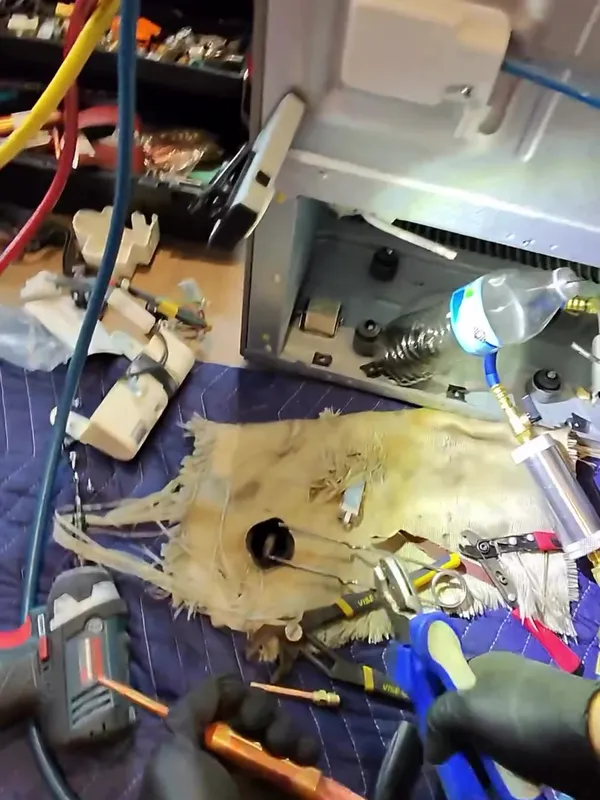
Why is my refrigerator sweating, and where is this water coming from?
Laguna Niguel mornings are humid most of the year, and humidity is behind a whole family of complaints that have nothing to do with heat.
Condensation on the door faces or around the center strip between French doors is physics, not failure. Humid air touches a surface below its dew point and leaves water there. Before calling anyone, turn energy-saver mode off. On most models that setting switches off small anti-sweat heaters built into the door frame, which is exactly the wrong thing in this climate. Then check the gaskets with the paper test: close a sheet of paper in the door at several points, and if it pulls out with no drag the seal is gone there. Mildew on a gasket cleans up with warm soapy water and a towel. Skip the bleach, it hardens the rubber and the seal goes bad faster.
Water inside the cabinet is a different story:
- Water under the crisper drawers or on the floor at the front. Almost always the defrost drain. Humid air means more frost every door opening, more meltwater each defrost cycle, and that drain line grows a biofilm that eventually plugs it. Water then backs up over the drain pan lip and runs forward. See refrigerator leaking water.
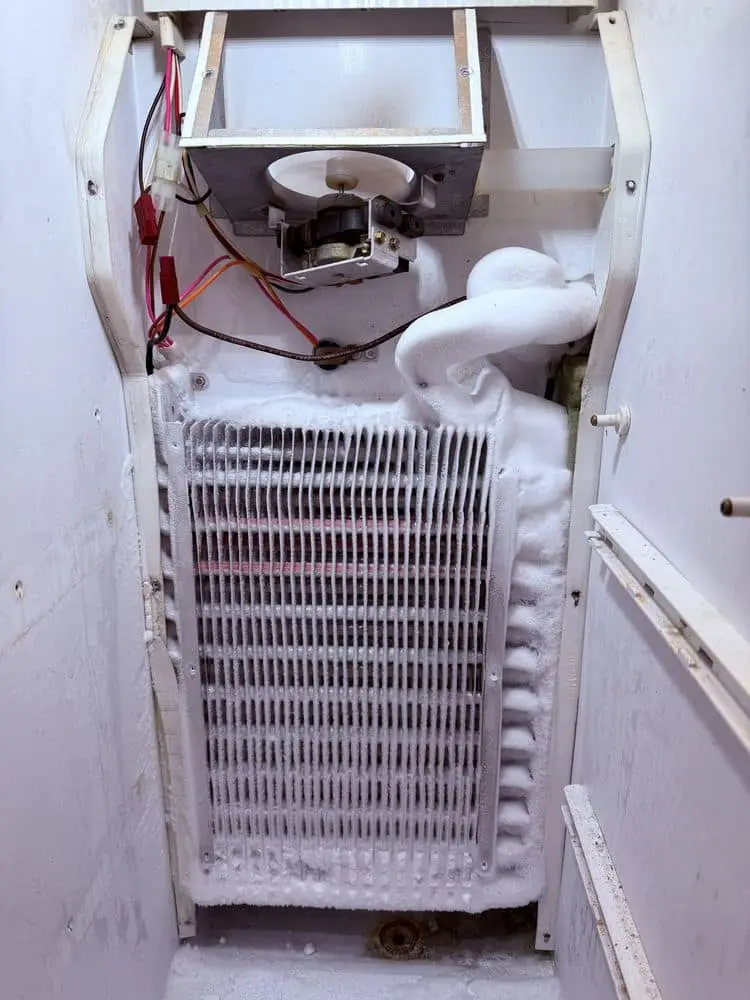
- Frost on the back wall of the freezer. The defrost system isn't keeping up: heater, sensor, thermostat or control board. Humid air loads it harder here than inland, so a marginal defrost heater shows itself sooner in Laguna Niguel than it would in Mission Viejo. Our freezer frost buildup guide walks it through.
- Freezer cold, refrigerator warm. On most units the fresh-food side is cooled by air coming from the freezer. Frost blocking that duct, a dead evaporator fan or a stuck damper will do it.
Never chip ice off the evaporator or a drain with a screwdriver. One puncture in an aluminum tube turns an afternoon job into sealed system repair.
Built-ins and panel-ready columns on the ridges
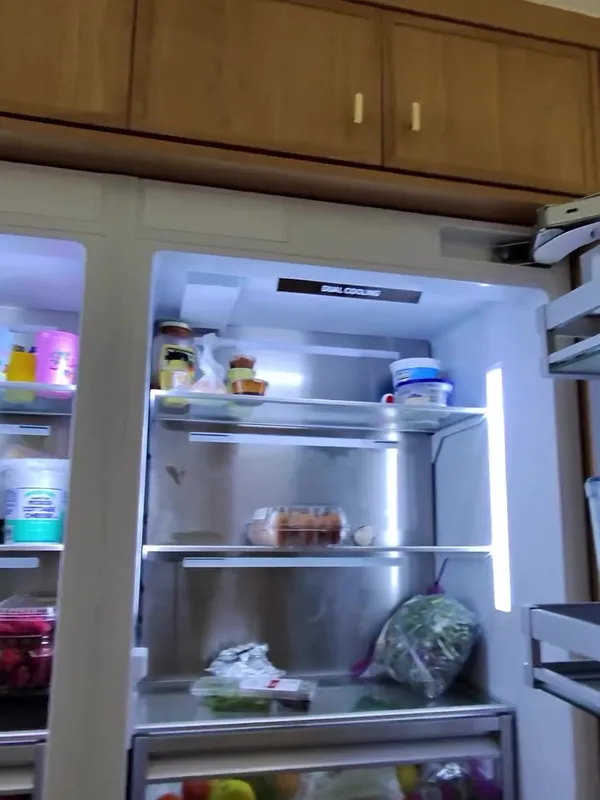
Bear Brand Ranch, Ocean Ranch, Monarch Point, Laguna Sur and the larger Niguel Summit homes went up or got remodeled when built-in refrigeration became the default in that price range. We see a lot of panel-ready doors, separate refrigerator and freezer columns, under-counter drawers in islands and butler's pantries, and wine storage next to the kitchen.
Things worth knowing about these units:
- The condenser is at the top. On most built-ins the compressor, condenser and fan live behind a grille above the doors, out of sight and out of mind. A condenser packed with dust and lint makes the unit run warm for months before any part fails. Pop the grille once a year and look.
- Two systems in one cabinet. Many built-ins and all column pairs run separate refrigeration for fresh food and freezer. The freezer holding 0°F while the refrigerator drifts to 50°F usually means one system is down, not that the whole unit is finished.
- It doesn't roll out. A built-in is bolted to the cabinetry, often with a custom panel on the door and a water line to the ice maker. Pulling one yourself is how door panels get bent and water lines get kinked. Let a technician do it.
- Some parts have to be ordered. Fans, relays, thermistors, valves and defrost parts for common models ride on our truck. Evaporator assemblies, control boards and door hardware for premium built-ins sometimes come from the distributor, and we tell you when they're due.
We are experienced with Sub-Zero, Thermador, Viking and Miele built-ins, and we are Factory Authorized for Liebherr. If a Sub-Zero is running warm, Sub-Zero refrigerator not cooling covers the usual causes, and Viking units have their own page. A wine cabinet that can't hold temperature is a close cousin of these units, see wine cooler repair.
Condos and townhomes off Alicia Parkway, Golden Lantern and Paseo de Colinas
The other half of our Laguna Niguel work is in stacked condos and the 1970s and 1980s townhomes around Rancho Niguel, Beacon Hill and Sea Country. Different problems entirely.
The kitchens were framed for a refrigerator about 30 to 33 inches wide. When a counter-depth or French-door unit goes into that opening during a remodel it fits, barely, and then the condenser recirculates its own hot air because there's no gap at the sides or top. Most manufacturers ask for roughly half an inch at each side and an inch at the top and back. Pull the unit out, measure the opening at its narrowest point and measure the unit including hinge caps. In a fair number of these kitchens the real fix is trimming the cabinet above the unit or opening up the toe grille, which is carpentry, not a fan motor. We'll tell you when that's the answer.
Two more things specific to these buildings. Water shutoffs are often on a shared riser, so find the valve that serves your unit before you ever need it in a hurry, and if an ice maker line is weeping, shut it off rather than tightening it harder. And if you rent, call your property manager before booking anyone, because most leases route appliance repairs through management and a repair you arrange yourself may not get reimbursed. We work for homeowners, landlords and property managers, and when an owner books us we coordinate access with the tenant and leave an itemized invoice.
One thing about the hillsides
Half of Laguna Niguel is built on a slope, which shows up in two practical ways. Kitchens are often a flight of stairs up from the driveway, so if a repair is borderline, factor in what delivering a replacement through that turn actually involves before you decide. Our repair or replace guide shows how we do that math. And on the split-level and tuck-under lots, the garage refrigerator is usually on the lower floor where nobody goes for a week at a time. Garage outlets are GFCI-protected and the reset button may be on another wall entirely, so a tripped GFCI can quietly switch off a freezer full of food. Plug it straight into the wall, never into an extension cord or a power strip, and look at it now and then. Freezer not cooling goes through the checks in order.
What the symptom usually points to
- Not cooling, lights and display fine. A blocked condenser, a stopped condenser or evaporator fan, a failed start relay, or a defrost failure that has iced the evaporator over. Near the water, add a corroded fan motor to that list. See refrigerator not cooling.
- Warm in the afternoon, fine in the morning. Classic airflow or condenser problem. The unit can keep up while the house is cool and loses ground when it isn't.
- Food freezing in the fresh-food section. A stuck damper, a failed thermistor or a control problem. See refrigerator freezing food.
- Small, hollow or slow ice. Start with the water filter and use the correct part for your model. South county water is hard, scale builds on the inlet valve seat, and water then seeps into the fill tube between cycles and freezes into a plug. Ice in the fill tube means the valve, see ice maker not working.
- Clicking every few minutes and still warm. Usually a start relay or overload failing to start the compressor. Stop unplugging and replugging it, that doesn't help and can make it worse.
- Runs constantly and never gets cold. Check airflow and the condenser first. If both are clean, a refrigerant leak or a weak compressor is on the table, and that needs recovery and charging equipment rather than a parts swap.
- Error code on the display. Photograph it. Codes differ by brand and model, and the code tells us what to bring.
Safe checks before you call, and what not to do
Worth doing first:
- Measure the real temperature. Stand an appliance thermometer in a glass of water on a middle shelf for a few hours. Target 37°F in the refrigerator and 0°F in the freezer. The number on the door panel is a setting, not a measurement.
- Check power. Look at the breaker and press reset on every GFCI outlet on that circuit, including ones in the garage and bathrooms.
- Look at the condenser. Unplug the unit, pull the toe grille or the top grille on a built-in, and clear what you can reach. Our refrigerator maintenance checklist shows where to look.
- Turn energy-saver off if the doors are sweating, and do the paper test on the gaskets.
- Check the mode. Showroom, demo, vacation and Sabbath modes all cause calls that cost nothing to fix.
- Note the clearance. If the unit is wedged into its opening, measure the gap at the sides, top and back and tell us the number when you call.
Not worth doing, ever:
- Don't hose or pressure wash a refrigerator condenser, and don't spray cleaner onto electrical terminals.
- Don't take a wire brush to corroded aluminum fins. They tear, and a torn fin pack moves less air than a dirty one.
- Don't chip ice off an evaporator, a drain or a fill tube with anything metal.
- Don't pull a built-in or panel-ready refrigerator out of its opening yourself.
- Don't leave a leaking water line under pressure. Shut the supply valve until it's repaired.
- Don't buy a refrigerant recharge kit. A refrigerator low on refrigerant has a leak, and it needs a diagnosis, not a top-up.
Refrigerator brands we repair in Laguna Niguel
We are Factory Authorized for LG and Liebherr, and our technicians are Samsung-certified, see Samsung appliance repair. We are experienced with Sub-Zero, Thermador, Viking and Miele built-ins, and we professionally service GE, GE Profile, Monogram, Café, KitchenAid, JennAir, Whirlpool, Maytag, Bosch, True Residential, U-Line and the other major brands found in these kitchens.
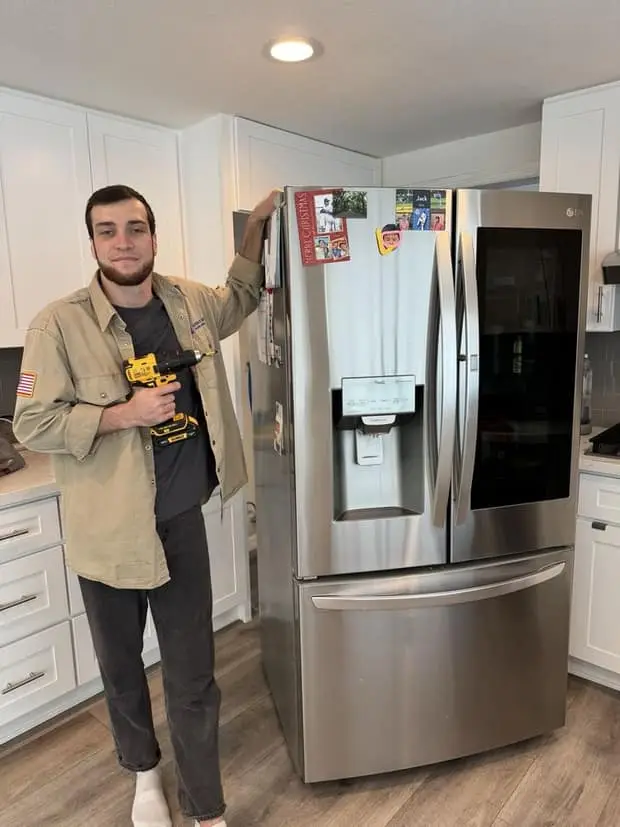
What to expect when you call
- Call or text (949) 267-7771. Give us the brand, the model number, what the refrigerator is doing, and your neighborhood or gate.
- A technician diagnoses on site and quotes the repair before any work begins. Nothing gets replaced until you approve it.
- Many repairs finish on the first visit. Fans, relays, thermistors, water valves and defrost parts for common models are on the truck. Built-in and premium parts sometimes get ordered.
- Every repair carries a 90-day parts and labor warranty. If a repair stops making financial sense, the technician will say so out loud.
Our before the technician arrives checklist saves time on the visit. If the unit is only a year or two old, read understanding appliance warranties first, because the manufacturer may owe you the repair. Hosting Thanksgiving? A packed refrigerator works harder than an empty one, so check its temperatures a couple of weeks ahead along with your oven.
Frequently asked questions
How fast can you get to a refrigerator in Laguna Niguel?
Usually the same day if you call in the morning. Laguna Niguel is 25 to 30 minutes from our Irvine base on the 5 or the 73, and we run south-county routes every day. A refrigerator that has quit cooling goes to the front of the list because food is at stake. Same-day is not a guarantee. If the day is full we say so on the phone and give you the first real slot.
Does ocean air really wear out a refrigerator in Laguna Niguel?
On the outdoor-adjacent parts, yes. Salt settles as a film that pulls moisture out of the air and stays damp, so it keeps corroding long after the fog burns off. We see it on condenser fins, condenser fan motor shafts, compressor terminals and the pins on start relays, mostly in garage refrigerators and in units near a door or window that stays open. Homes a mile or two from the water in Monarch Point, Laguna Sur and Niguel Summit show it first. Clearing the condenser twice a year instead of once is the practical answer, and white or green powder on an electrical terminal means a technician should look at it before it burns.
Why are my refrigerator doors sweating and the gasket getting mildew?
That is the marine layer rather than a broken refrigerator. Humid air that touches a surface below its dew point leaves water behind, and in Laguna Niguel the morning humidity is high enough to do that on door faces and around the center mullion. First make sure energy-saver mode is off, since that setting switches off the small anti-sweat heaters in the door frame. Then check the gasket with the paper test, wash it with warm soapy water and dry it, and skip the bleach because it stiffens the rubber. Sweating inside the cabinet or water under the crispers is a different problem: that is usually a blocked defrost drain.
Do you repair built-in and panel-ready refrigerator columns in Bear Brand Ranch and Ocean Ranch?
Yes, that is a large part of what we do in Laguna Niguel. We are experienced with Sub-Zero, Thermador, Viking and Miele built-ins, and we are Factory Authorized for Liebherr. On most built-ins the condenser and fan sit behind a grille at the top of the unit where nobody looks, and a packed condenser makes the unit run warm long before a part actually fails. A built-in is bolted to the cabinetry and tied to a water line, so leave it in place and let a technician pull it.
Can you work in HOA condos and townhomes off Alicia Parkway and Golden Lantern?
Yes, we are in those communities weekly. Tell us the gate and the HOA access rules when you book and we will follow them, and we can send paperwork to a property manager. These kitchens were framed in the 1970s and 1980s for a 30 to 33 inch refrigerator, so clearance is tight and the unit often has to come out through one doorway. If you rent, call your property manager before you book anyone, because most leases route appliance repairs through management.
How is the repair priced, and is it guaranteed?
The technician diagnoses the refrigerator and quotes the repair on site before any work starts, so nothing is replaced until you approve it. Every repair carries a 90-day parts and labor warranty. If the refrigerator is only a year or two old, check the manufacturer's warranty before you pay for anything.
Beyond Laguna Niguel
We repair refrigerators in Irvine, Tustin, Lake Forest, Mission Viejo, Aliso Viejo, Laguna Hills, Dana Point and the rest of South Orange County, and the county-wide page is refrigerator repair. In Laguna Niguel we also handle air conditioning repair and oven and range repair.