
Freezer Repair in Irvine and South Orange County
- ⭐ 5.0★ Yelp · 5.0★ Google
- 🛡️ 90-Day Parts & Labor Warranty
- 📅 20+ Years of Experience
- 🧊 Upright, Chest, Garage & Built-In Columns
Quick answer
We repair standalone freezers in Irvine, Tustin, Lake Forest and the rest of South Orange County. Frost-free and manual-defrost uprights, chest freezers, garage freezers, built-in freezer columns and freezer drawers. Four groups cover most of what we find. The defrost cycle has quit and the evaporator has iced over, so the cabinet is cold at the back and soft on the shelves. Air is getting in past a door or lid gasket and the cabinet is frosting over. The unit is sitting in a garage that runs hotter than its rated ambient range. Or the sealed system has lost refrigerant and needs sealed system work. We are Factory Authorized for LG and Liebherr, our technicians are Samsung-certified, and we are experienced with Sub-Zero, Viking, Thermador and Miele freezer columns. The technician diagnoses the unit and quotes the repair on site before any work starts, and every repair carries a 90-day parts and labor warranty.
A standalone freezer is the one appliance in the house that nobody looks at. The kitchen refrigerator tells on itself within hours, because you open it every morning and the milk is warm. A chest freezer in the garage can go warm on a Tuesday and you find out Saturday, standing over several hundred dollars of meat that thawed and refroze while you were at work.
That changes how we triage these calls. With a freezer, the first question is not what broke. It is how long it has been that way and what state the food is in, because the answer decides whether this is a service call for next week or something we want to look at today.
Call or text (949) 267-7771 with three things: the brand and model number off the tag, what a thermometer between two packages actually reads, and whether the unit is a chest, an upright or a built-in column. Those three answers rule out half the list before we load the truck.
Which Kind of Freezer Do You Have?
Sort this out before anything else, because the three types fail in completely different ways and half the advice on the internet applies to only one of them.
Frost-free upright. Looks like a refrigerator with one door. Inside there is an evaporator coil behind a rear panel, a fan that pushes air over it, and a defrost heater that melts the frost off a few times a day. More moving parts, more things to fail, and almost all of them are replaceable.
Chest freezer. A lid on top, no fan inside, no heater. The refrigerant tubing is bonded into the cabinet wall itself, so the whole wall is the evaporator. That design is why chest freezers hold temperature so well in a power outage and why they run for twenty years. It is also why a leak in one is usually the end of the appliance.
Built-in freezer column or freezer drawers. Panel-ready, fitted to a cabinet opening, usually paired with a matching refrigerator column. Sub-Zero, Liebherr, Thermador, Viking and Miele are what we see in South County kitchens. These are the most repairable freezers in the house and the most expensive to replace, so the math almost always favors fixing them.
Not sure which you have? Open it and look at the back wall. A removable panel with screws and a fan behind it means frost-free. A smooth plastic or metal liner with nothing to remove means the coil is in the wall.
The Freezer Runs but the Food Is Going Soft
This is the single most common freezer call we take, and it is almost never refrigerant.
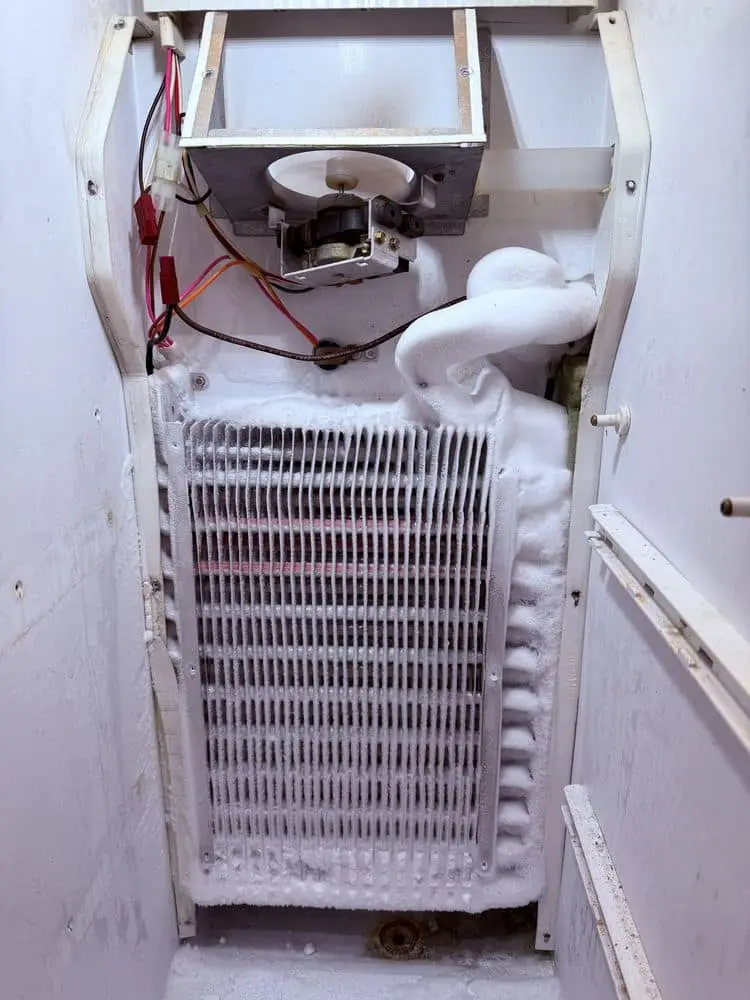
On a frost-free upright, the normal cause is that the defrost cycle has stopped. The heater fires for twenty to thirty minutes several times a day to clear the evaporator. When it quits, frost keeps building on that coil until the fan cannot push air through it anymore. The compressor is still running, the coil is still cold, but the cold is trapped behind a block of ice. You get a freezer that feels cold if you reach to the back and a top shelf sitting at 20°F.
Three parts are on the list and they get tested in order: the defrost heater itself, the defrost thermostat or bimetal that tells it when to stop, and the timer or adaptive defrost board that decides when to start. A heater reads open on a meter in about two minutes. I would rather test all three than swap the board on a guess, because the board is usually the most expensive one and usually not the problem.
The second cause is the evaporator fan. Same symptom from a different direction. The coil is clean and cold, nothing is moving the air, and the cabinet stratifies. A fan going bad usually announces itself first with a whir or a tick that changes when you open the door, since the door switch cuts the fan on most models.
Third is a thermistor or cold control that has drifted. The control thinks the cabinet is at 0°F and shuts the compressor off while a thermometer on the shelf reads 15°F. Cheap part, common failure, and the only way to catch it is to compare a real measurement against the display.
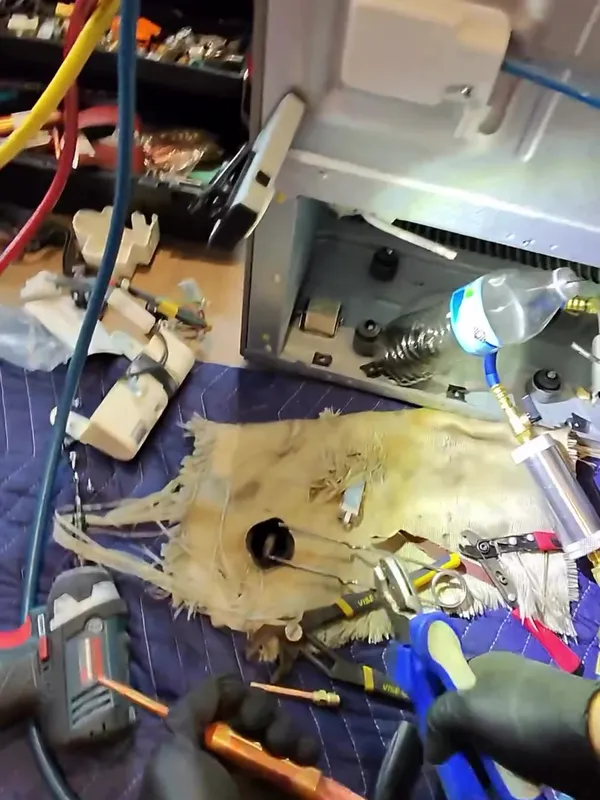
Only after air is ruled out does refrigerant come up. A freezer low on charge does not hold 0°F and never will, and it got that way because of a leak. That means recovery, a new filter drier, a vacuum and a weighed charge, which is what sealed system repair covers. Nobody should be putting a can of refrigerant into it. Our guide to a freezer not cooling walks the same list in symptom order if you want to work through it yourself first.
Is It a Garage Freezer? Check the Ambient Range
Half the freezers we service in Orange County live in a garage, and a good share of those calls end with nothing replaced.
Every freezer has an ambient temperature range in its manual, usually somewhere in the 55°F to 110°F band unless the unit was sold as garage-ready. An Irvine garage with the door closed on a September afternoon, with a Santa Ana pushing the outside air past 100°F, goes well over the top of that. What happens next is predictable. The condenser cannot reject heat into air that is already hot, the compressor stops cycling off and just runs, and the cabinet still drifts up into the teens. The appliance is working exactly as designed and losing anyway.
What actually helps, in order: vacuum the condenser coil, which on a garage unit is usually furred with dust and dryer lint. Give it four inches of clear air at the back and the sides, because people push these against a wall and stack boxes around them. Then watch it through one hot week.
If it still cannot hold 0°F in a garage that runs over 105°F, the problem is the room. A vent or a small fan moving air through the garage changes more than any part we could install. Running a freezer past its ambient ceiling for a few summers is how compressors die early, and that is a repair worth avoiding rather than paying for.
The cold end of the range matters less here than it does in Chicago, but it is still worth reading. A unit rated down to 55°F ambient and sitting in an unheated garage on a 45°F January morning can run short and strange cycles.
Frost Everywhere, or Frost in One Spot?
Where the frost is tells you more than how much of it there is.
Even, light frost on the walls of a chest freezer is normal and expected. There is no heater in there. Every flake of it came from humid room air, and the fix is a manual defrost once or twice a year. Once it reaches about a quarter inch it starts costing you efficiency and shelf space, and that is the point to empty it out and let it thaw.
Frost concentrated at one end of the lid, or one corner of a door, is a seal. The gasket there has gone flat or the lid is not closing square, and room air is streaming in at that spot all day. Test it with a sheet of paper. Close the lid on it at eight or ten points around the frame and pull. If it slides out with no drag anywhere, you found your leak.
A solid sheet of ice on the back panel of a frost-free upright is the defrost system, not the gasket. Different problem, covered above.
Ice on the floor of the cabinet, under the bottom basket, usually means the defrost drain is blocked. Melt water from the defrost cycle is supposed to run out through a tube to a pan near the compressor. When that tube ices up or clogs with debris, each cycle leaves a little more water behind, and it freezes into a slab. We clear the drain and check the heater that keeps that tube open on units that have one. Our freezer frost buildup guide goes through all of these patterns with the checks for each.
What Actually Fails on a Standalone Freezer
- Defrost heater, bimetal or board. Frost-free uprights and built-in columns only. The most common real failure we find, and the reason for most soft-food calls.
- Evaporator fan. Cold coil, no air movement, stratified cabinet. Often noisy before it stops.
- Condenser fan or a dust-packed condenser. The unit runs constantly and still reads warm. On garage units this is the first thing we clean.
- Cold control or thermistor. Drifted sensing, so the control shuts down early or runs forever. Shows up as a display that disagrees with a thermometer.
- Door or lid gasket. Flattened, torn, or pulled loose at a corner. On chest freezers, lid hinge springs sag with age and stop pulling the lid down square, which does the same thing as a bad gasket.
- Door switch and door-ajar alarm. A switch stuck closed leaves the light on and the evaporator fan off. Garage units get bumped by car doors and bikes, and a door left a half inch open overnight will frost the whole cabinet.
- Start relay and overload. A click every few minutes, a short hum, then silence, and no cooling. That is almost always a start component, not a dead compressor. Our compressor problems guide explains how the two get told apart on a meter.
- Defrost drain and drain heater. Blocked drain means ice in the bottom of the cabinet and sometimes water on the garage floor.
- Ice maker, on units that have one. Built-in freezer columns and some uprights have an ice maker with its own fill valve, mold heater and sensing arm. Those fail independently of the freezer and get diagnosed separately, which our ice maker guide covers.
- Refrigerant leak. Last on the list, not first. On a frost-free unit it is repairable. On a chest freezer with tubing in the wall, usually not.
Everything Thawed Overnight and the Unit Looks Fine
We get this call most often about garage freezers, and the cause is frequently not the appliance at all.
Garage and outdoor receptacles are GFCI-protected. A GFCI trips on nuisance leakage, on a bit of moisture, or when something else on that circuit draws hard, and when it does, the freezer goes quiet with no light and no alarm. The reset is often on a different wall, or upstream in a bathroom or at the panel. Check every GFCI outlet in the garage and the breaker before anything else. Same for a freezer on a switched outlet, which happens more than you would think in converted spaces.
The other version is a real power outage. If the door stayed shut, a full freezer holds roughly 48 hours and a half-full one roughly 24. That is the USDA rule and it is the one to use. Anything still carrying ice crystals, or reading 40°F or below, can be refrozen. Anything that sat above 40°F for more than two hours goes out. Food that thawed and refroze looks completely normal from the outside, so go by the packages and not by the display. Our after a power outage guide covers the restart sequence and what to do if the unit will not come back on.
One piece of advice I give every garage freezer owner: put a wireless thermometer with a phone alarm inside it. They cost very little, they take two minutes to set up, and they turn a thousand-dollar loss into a Tuesday afternoon service call. I would do that before I would buy any extended coverage.
Checks Worth Doing Before You Call
- Measure it properly. Thermometer between two frozen packages in the middle of the load, four hours, then read it. Not the display.
- Note the room temperature where the unit sits, especially in a garage. Take it in the afternoon, not the morning.
- Check the power all the way back. Breaker, every GFCI in the garage, and whether the outlet is on a wall switch.
- Vacuum the condenser. Behind or underneath, depending on the model. Unplug it first.
- Paper-test the gasket at eight or ten points around the door or lid.
- Look at the back wall. A solid ice sheet on a frost-free upright points straight at the defrost system and saves us diagnostic time.
- Photograph the model tag. Inside the door frame, on the side wall, or on the back. Text it to us and we can check parts before the visit.
And what not to do:
- Do not chip ice off the evaporator with a screwdriver or an ice pick. Those coil walls are thin aluminum, and one puncture turns a heater replacement into a sealed-system job or a new appliance.
- Do not use a hair dryer or a heat gun inside a plastic liner. It warps and cracks, and the crack is not repairable.
- Do not buy a refrigerant recharge can. A freezer low on charge has a leak, and adding gas without finding it wastes the money twice.
- Do not keep resetting a unit that clicks and quits every few minutes. That does nothing for a failed start relay and it can cost you the compressor.
- Do not refreeze food that has been above 40°F for hours because it still feels cold. Cold is not the same as safe.
Brands We Repair
We are Factory Authorized for LG and for Liebherr, whose freezer columns are common in South County built-in kitchens. Our technicians are Samsung-certified, so Samsung freezers and freezer drawers are covered. We are experienced with Sub-Zero, Thermador, Viking and Miele freezer columns and drawers.
On the full-size and garage side we professionally service Whirlpool, GE and GE Profile, Frigidaire, Electrolux, Maytag, Amana, KitchenAid, Kenmore, Haier, Danby, Avanti, Insignia, Midea and Summit uprights and chest freezers, along with U-Line and Marvel under-counter units.
Repair or Replace a Freezer
Four honest answers, because these are not all the same appliance.
A built-in freezer column or a set of freezer drawers is worth repairing nearly every time. It is fitted to a cabinet opening, often panel-matched to the kitchen, and replacing one means matching dimensions and panels all over again. Parts for the built-in brands are available. A heater, a fan, a board or a gasket puts the unit back in service for years.
A full-size frost-free upright under about ten years old is usually worth fixing too. Heaters, bimetals, fans, boards, controls and gaskets are all stocked parts, and the labor is straightforward.
A chest freezer with a cold control, a relay, a gasket or a hinge spring problem is an easy repair and we do them. A chest freezer with a refrigerant leak in the wall tubing is the one case where we usually say replace, because there is no serviceable coil to open up and repair. Same answer for a compact unit under about 7 cubic feet with a dead compressor. The parts and labor land too close to the price of a new one.
Our repair or replace guide shows the arithmetic we actually use on these calls. If the unit is still young, check understanding appliance warranties first, because sealed-system coverage on freezers often runs five years or longer and the manufacturer may owe you the repair. Before you buy a used one as a stopgap, our notes on buying a used refrigerator in Orange County apply to freezers the same way.
Where We Work
We are based in Irvine and run South County routes every day. Irvine gives us the most freezer calls of any city we serve, and the split is clear by neighborhood. The older tracts in Woodbridge, Northwood, University Park and Turtle Rock have garage chest and upright freezers that have been running fifteen or twenty years, so we see defrost parts, relays and gaskets. Portola Springs, Great Park, Cypress Village and Eastwood are newer, with built-in columns and freezer drawers in the kitchen, so the calls there skew toward fans, sensors, ice makers and control boards.
In Tustin, Tustin Ranch and Tustin Legacy look much like the newer Irvine villages. Old Town has the opposite problem, with freezers tucked into garages and service porches that were never built for them and run hot in September.
In Lake Forest, including Foothill Ranch and Portola Hills, the garage freezer is close to standard equipment and those garages sit further inland, so the ambient problem is sharper there than it is near the coast.
Beyond those three we cover Mission Viejo, Laguna Hills, Laguna Woods, Laguna Niguel, Aliso Viejo, Laguna Beach, Ladera Ranch, Rancho Santa Margarita, San Juan Capistrano, Dana Point and San Clemente. Closer to the water the air is milder but saltier, and we see more corrosion on condensers and on the sheet metal around them. The full list with ZIP coverage is on the service areas page.
Restaurant, market, caterer or church kitchen? A reach-in, a prep table or a walk-in is built differently and runs harder, and that work goes through commercial freezer repair.
What to Expect When You Call
- Call or text (949) 267-7771. Tell us the brand and model number, whether it is a chest, an upright or a built-in column, what a thermometer reads between two packages, and how long it has been that way.
- A technician diagnoses on site and quotes the repair before any work starts. Nothing gets replaced until you approve it.
- Many repairs finish on the first visit. Defrost heaters, bimetals, fans, relays, controls and common gaskets ride on the truck. Boards and door assemblies for built-in and premium units are usually ordered, and we tell you when they are due.
- Every repair carries a 90-day parts and labor warranty.
If the cabinet is warm right now, keep it shut. Every time you open it you spend hours of the holdover time described above. Move what matters most into the kitchen freezer, put a thermometer in, and leave the lid down until we get there. The before the technician arrives checklist covers the rest.
Frequently Asked Questions
What temperature should a standalone freezer hold?
0°F, or a little below. That is the number the USDA uses, and it is the point where frozen food stays safe indefinitely and loses quality slowly. Anything above about 5°F and you start to see it in the food before you see it on a thermometer. Ice cream goes soft first, then bread and pastry get freezer burn on the edges, then meat starts to look dry and gray. Do not read the number off the display and stop there. Lay a thermometer between two frozen packages in the middle of the load, leave it four hours, and read that instead. The display shows a setpoint, and on a freezer it is often wrong by several degrees once the sensor has aged.
My garage freezer runs nonstop in the summer and the ice cream is soft. Is it broken?
Maybe not. Pull the manual and find the ambient temperature range for the unit. Most freezers are specified for a room somewhere in the 55°F to 110°F band, and an Irvine garage with the door shut on a Santa Ana afternoon runs past the top of that. The condenser has nowhere to dump heat, the compressor never gets to shut off, and the cabinet still drifts into the teens. Nothing has failed yet. Clean the condenser, give the unit four inches of clear air at the back and sides, and if the garage still runs over 105°F, the honest answer is that the appliance is in the wrong room. Leave it there through a few summers and you will be buying a compressor.
Is heavy frost in a chest freezer normal?
Light frost is normal. Heavy frost means air is getting in. Almost every chest freezer is manual defrost, so there is no heater and no timer inside. Every bit of frost you see came from humid room air that got past the lid gasket or walked in while the lid was open. A quarter inch of even frost on the walls after a year is routine and you defrost it. Thick frost that built up over two months, or frost concentrated at one end of the lid, is telling you the gasket is not sealing or the lid is not closing square. Check it with a sheet of paper closed in the lid at several points. If it slides out with no drag, that is your leak.
The power was out for most of a day. Is the food still safe?
If the door stayed shut, a full freezer holds its temperature roughly 48 hours and a half-full one roughly 24 hours. That is USDA guidance and it is the right rule to go by. You refreeze anything that still has ice crystals in it or still reads 40°F or below. Anything that has been above 40°F for more than two hours goes in the trash, and no, you cannot tell by smell on frozen meat. The trap here is a freezer that came back on and looks fine while the food inside thawed and refroze. Check the packages, not the display.
Why does my frost-free upright have ice on the back wall?
Because the defrost cycle has stopped running. A frost-free upright puts a heater on the evaporator and fires it for twenty to thirty minutes a few times a day to melt the frost off. When the heater opens up, or the defrost thermostat that controls it fails, or the board that times it quits, frost keeps building on the coil until air can no longer pass through it. The giveaway is a freezer that still feels cold near the back wall while the food on the shelves softens. That is not a refrigerant problem and a top-up will not help it.
Is a chest freezer worth repairing?
It depends on what failed. A cold control, a start relay, a lid gasket or a lid hinge spring is a straightforward repair on almost any chest freezer and it is worth doing. A refrigerant leak is the other case. Most chest freezers cool through tubing bonded into the cabinet wall rather than a serviceable coil you can reach, and once that tubing leaks there is usually nothing to open up and repair. On a compact unit under about 7 cubic feet we will often tell you to replace it instead, and we will say that on the phone rather than charge you to hear it in person. Built-in freezer columns are the opposite. Those are nearly always worth fixing.
Related Pages
Refrigerator-freezer combinations are on the refrigerator repair page, with city pages for Irvine, Tustin, Lake Forest, Mission Viejo and Laguna Niguel. If the diagnosis lands on refrigerant or a compressor, see sealed system repair. For symptom-by-symptom walkthroughs, start with freezer not cooling, freezer frost buildup or a freezer running too cold or cycling. Wine and beverage cabinets are a different animal and live on the wine cooler repair page. To keep a freezer out of trouble, the refrigerator maintenance checklist and the broader appliance maintenance checklist both apply.