
Refrigerator Compressor Problems: Symptoms, Start Relay vs Compressor, and What Repair Involves
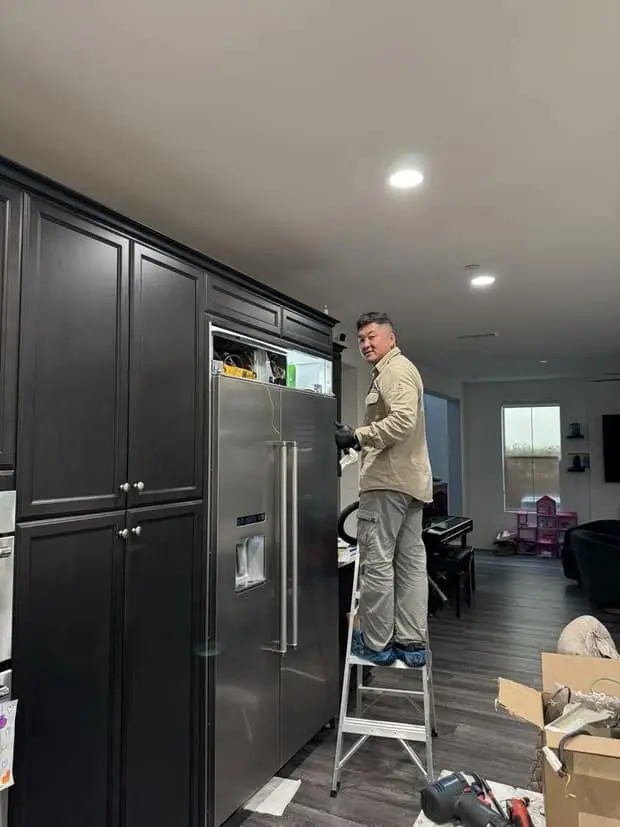
"The compressor is gone, you need a new fridge." We hear that sentence repeated to us in Irvine kitchens most weeks, usually from someone who heard it over the phone before anyone measured anything. Sometimes it is true. More often the compressor is fine and a part clipped to its side has failed, or the compressor is running perfectly and the cold is being lost somewhere else entirely.
This guide is about telling those cases apart. What a compressor does, which symptoms actually point at it, which four parts imitate it, what you can safely observe at home, what a proper replacement involves, and how to decide whether it is worth doing. If your refrigerator is simply warm and you have not narrowed anything down yet, start with why a refrigerator is not cooling and come back here when the trail leads to the compressor.
What does the compressor actually do?
The compressor is a motor and a pump sealed inside a welded steel dome at the back of the refrigerator, or behind the top grille on a built-in column. It takes low-pressure refrigerant vapor from the evaporator coil, squeezes it, and pushes it hot into the condenser where the heat leaves the cabinet. That pressure difference is what makes cold possible. Everything else in the refrigerator, fans, dampers, defrost heaters, boards, only moves that cold around or keeps it from being wasted.
Two details matter for diagnosis. The dome is welded, so a compressor is never opened, serviced or rebuilt in the field. It is replaced as a unit. And a compressor is a motor that has to start under load, which is the part that goes wrong.
There are three kinds in home refrigerators. An older single-speed reciprocating compressor runs flat out or not at all, and needs a start relay to get going. An inverter compressor is driven by a variable-frequency board and has no start relay at all. A linear compressor, used widely by LG, is a different mechanism again and gets its own diagnosis, which we cover in LG linear compressor failure and warranty. Knowing which type you have changes what can fail.
How do I know it is the compressor and not something else?
Stand at the back of the refrigerator with the grille off and spend two minutes watching. Note three things: what you hear, whether the compressor dome is hot, warm or cool to a careful touch, and whether the condenser fan next to it is spinning. Those three observations do most of the sorting.
| What you observe | What it usually means |
|---|---|
| Click, hum two to five seconds, click, silence. Repeats every three to five minutes. Dome warm. | Compressor tried to start and the overload tripped. Start relay, overload protector, or a compressor drawing locked-rotor current. |
| Completely silent, dome cool, lights and interior fans still work | Open overload, failed relay, open compressor winding, a control board that is not calling for cooling, or demo mode. Not always the compressor. |
| Runs constantly, dome very hot, box slowly warming | Condenser side. Dust-packed coil or a stopped condenser fan. The compressor is a victim here, not the cause. |
| Runs smoothly, dome warm, condenser warm, no cold at all | Sealed system. Refrigerant leak, restriction, or a compressor that turns but no longer pumps. |
| Runs, but the condenser line stays near room temperature | Little or no refrigerant being moved. Leak, or internal valve failure. |
| Loud rattle or knocking from the dome that changes when you rock the cabinet | Usually hardened mounting grommets, not internal damage. See what each refrigerator noise means. |
| Breaker trips, or the lights dim, when the compressor tries to start | Stop. Unplug it. This is a shorted winding or a short to ground. |
Read that table honestly. Only two of those seven rows point mostly at the compressor, and one of them tells you to stop touching it.
Click, hum, click every few minutes: what is happening?
This is the sound of a failed start, and it is worth understanding because it is the symptom that gets misdiagnosed most.
A single-speed compressor motor cannot get itself turning on the run winding alone. A start relay clipped to the side of the dome briefly energizes the start winding, then drops out once the motor is up to speed. Next to it, an overload protector watches current and temperature and cuts power if either runs away. When a start attempt fails, the motor sits there drawing locked-rotor current, which is several times its normal running current, and within a few seconds the overload opens. Click, hum, click. A few minutes later it cools enough to reset and tries again.
Three different faults produce that identical sound:
- The relay has failed. PTC relays degrade with every start and eventually stop passing enough current to the start winding. Older clip-on current relays can stick or burn their contacts. This is a small part and a short repair.
- The overload has failed and is opening early on a compressor that would otherwise start fine.
- The compressor itself is seized or has a winding fault. Here it does not matter how good the relay is.
There is no way to hear the difference. A technician separates them in a few minutes with a meter: resistance across the common, start and run pins compared against the manufacturer's values, continuity from each pin to the dome (any reading there means a short to ground and a dead compressor), and the actual current drawn during a start attempt against the locked-rotor and rated-load figures printed on the compressor label. Replacing a relay on a compressor with shorted windings just burns the new relay, which is why the measurement comes first and the part second.
One note about the internet's favorite shortcut. A hard-start kit can force a weak compressor to turn over, and techs do carry them. On a refrigerator that is buying time at best. It raises starting current on a motor that already struggles, and we would rather tell you the compressor is failing than sell you six more months of it. If someone installs one without explaining that, ask why.
The four things that get blamed on the compressor
Before any compressor gets condemned, these come off the list first. Every one of them has walked in the door as "bad compressor."
1. A stopped condenser fan or a filthy condenser coil
The compressor can only push heat into the condenser if the condenser can get rid of it. Pack that coil with dust and pet hair, or let the little fan beside it seize, and head pressure climbs until the compressor runs hot, long, and finally trips its own overload. Symptom: a dome too hot to keep a hand on, cooling that fades through the afternoon, a fridge that works a little in the morning and not at all by evening. This is the most common thing we find, it is reversible, and left alone long enough it genuinely does kill the compressor.
2. The inverter or linear drive board
On an inverter refrigerator there is no start relay to fail, because a board generates a variable-frequency drive signal for the compressor. When that board fails the compressor never turns, the dome stays cool, and the symptom is a silent machine with working lights. That reads exactly like a dead compressor and is a completely different part. Model-specific service mode and test-point voltages are how it gets confirmed.
3. Ice on the evaporator from a failed defrost system
Here the compressor runs beautifully and the box still goes warm, because the evaporator is buried under a block of ice and air cannot pass through it. The freezer may still feel cold while the fresh-food side warms up. If you see heavy frost across the freezer's back panel, read frost building up in your freezer before anyone mentions the word compressor.
4. A refrigerant leak
Refrigerant is not consumed. If there is less of it than there should be, it left through a hole, and "just adding some" is not a repair. A leaking system gives you a compressor that runs quietly and endlessly, a condenser that never gets properly hot, and often a thin band of frost on the first few inches of evaporator coil with bare metal after it. The compressor is healthy in this picture. It is also slowly being damaged, because it depends on returning refrigerant for cooling and oil return.
What can I check myself, safely?
All of this is observation, not repair. Everything here is done with your eyes, your ears, a hand and a vacuum cleaner.
- Time the cycle. Use your phone. Write down how long the compressor runs and how long it is off. A three to five minute repeat of click-hum-click is a failed start. Twenty to forty minutes of running with short rests is a hard-working compressor. Those are different conversations.
- Feel the dome, carefully, for one second. Warm is normal. Too hot to touch points at the condenser side. Cool while the refrigerator is warm means it is not running at all.
- Watch the condenser fan. It should spin whenever the compressor runs. A stalled fan is the one thing on this list you should act on immediately, by not running the refrigerator until it is fixed.
- Unplug it and vacuum the condenser coil. Pull the base grille, vacuum the coil and the fan blades with a crevice tool and a coil brush, plug it back in, and give it four to six hours. On a surprising number of calls this is the whole repair.
- Check for a demo or showroom mode. Lights on, cooling off, no sound at all. Your manual shows the key combination to exit it. We have driven to houses for this.
- Read the model and serial plate, usually inside on a side wall or behind the crisper, and photograph it. That one photo decides the warranty question before anyone quotes anything.
- Smell and look. A burnt electrical smell near the compressor, scorch marks on the relay, or an oily film on the tubing all mean stop and call.
Do not pull the relay off to "test" it by shaking it, jump the compressor terminals, add refrigerant from a can, or cut a line. A refrigerator holds a pressurized charge and runs 120-volt wiring in a damp place, and many units built in the last several years use R600a isobutane, which is flammable. There is no safe home version of compressor work.
What does a compressor replacement actually involve?
It is worth knowing what you are paying for, because this is the most involved repair a refrigerator can get and the difference between doing it properly and doing it fast shows up within months.
- Confirm the diagnosis. Winding resistance, ground continuity, start current, and system pressures. A compressor is replaced because of readings, never because of a sound.
- Check warranty coverage against the model and serial. Sealed-system parts coverage frequently runs years past the general warranty.
- Recover the refrigerant with certified recovery equipment. Venting it is illegal under EPA Section 608, and with R600a it is also a fire risk.
- Cut out the old compressor and replace the filter drier. Always. The drier holds whatever moisture and debris the old system collected, and reusing it is the single most common reason a replacement compressor dies early.
- Braze the new joints under flowing nitrogen so the inside of the copper does not oxidize. Those flakes are what plugs a capillary tube three weeks later.
- Pressure test, then pull a deep vacuum down to roughly 500 microns and watch whether it holds. Moisture left in a system freezes at the capillary tube and mixes with the oil to form acid.
- Weigh in the charge to the gram, to the figure on the data plate. Household systems hold very little refrigerant, often under 200 grams, so guessing by gauge pressure alone is not good enough.
- Run it and verify: current draw, suction line temperature, condenser temperature split, and a full frost pattern across the evaporator before we leave.
Done this way, a compressor job takes a good part of a day and a truck that carries recovery equipment, nitrogen, a micron gauge and a scale. We do this work through our sealed system and compressor repair service. A shop that quotes it in twenty minutes over the phone is quoting something else.
Is it worth fixing, or should I replace the refrigerator?
Three questions settle this, and age is only one of them.
What kind of refrigerator is it? On a built-in or integrated column, a counter-depth French door, or a premium brand, the cabinet is worth several times the repair and replacing it means cabinetry work, panels and a long lead time. Repair almost always wins. On a basic freestanding top-freezer or side-by-side, the math gets much tighter.
How old is it, and what has already failed? Household refrigerators commonly give 12 to 15 years. A compressor failure at year 6 on an otherwise healthy unit is worth repairing. The same failure at year 14, on a unit that has already had a board and a fan, is the appliance telling you something.
Is the compressor still under parts coverage? This is the question that flips the answer most often, and it is the easiest one to check. Manufacturers commonly cover sealed-system components, the compressor among them, for several years longer than the rest of the appliance, with labor covered only in the first year. The term depends on brand, model and purchase date, so it gets looked up rather than assumed. Our guide to appliance warranties explains how those tiers normally read, and repair or replace walks through the broader decision across appliances.
One thing we will say plainly: a dead compressor on a refrigerator you already dislike is a fine reason to replace it. A dead compressor on a well-built unit that fits your cabinet opening is not.
What actually kills a compressor?
Compressors rarely die of old age by themselves. They die of conditions, and most of those conditions are visible for months first.
- A dirty condenser coil. The compressor runs hotter and longer than it was designed to, year after year. Vacuum it every 6 to 12 months, more often with pets. This is the whole of the prevention story in one line.
- A dead condenser fan left running for weeks because the fridge "still sort of works." It does not still sort of work. It is cooking.
- A slow refrigerant leak. The compressor depends on returning vapor to cool itself and carry oil back. Starve it and it overheats.
- Short cycling from a faulty thermistor or control, which means repeated high-current starts instead of long, efficient runs.
- A tight cabinet with no ventilation. We see this on freestanding units pushed into built-in openings during remodels. Leave the clearance the manual asks for, especially on the top grille of a built-in.
- Repeated power interruptions. Restarting against a system that has not equalized is hard on a motor. After an outage, check that the controls did not come back in a default or demo mode.
The full schedule, coils, gaskets, defrost drain, filter and ventilation, is in our refrigerator maintenance checklist.
When should I stop and call?
- The breaker trips, or the house lights dim, when the refrigerator tries to start. Unplug it.
- Any burnt smell, scorch mark or melted plastic near the relay or the compressor.
- Click-hum-click repeating for more than a day. Every failed start is another locked-rotor current spike.
- The compressor is too hot to touch and the box is warming.
- Oil residue on the tubing, or frost on only the first few inches of a line.
- A built-in, column or premium unit with any compressor symptom. Parts are model-specific and improvising is expensive.
About the food while you wait: per USDA guidance, with the doors kept closed a refrigerator holds a safe temperature for about 4 hours, a full freezer for about 48 hours and a half-full one for about 24. Move the meat and dairy to an ice chest rather than opening the door to check on them.
Why we see these calls across Irvine, Tustin and Lake Forest
Two local patterns drive most of the compressor calls we take in the corridor from Irvine down to San Clemente. The first is kitchen design. A lot of homes in Irvine, Tustin and Lake Forest were built or remodeled with the refrigerator in a tight cabinet surround, and a condenser that cannot breathe makes the compressor work harder for its entire life. The second is dust. Santa Ana wind events load the air with fine grit, it settles on the condenser coil under the grille, and a household with a dog reaches a fully matted coil in a year or two. Neither is exotic. Both are the reason we keep repeating the same piece of maintenance advice.
We cover the full South Orange County corridor for refrigerator work, Irvine first, then Tustin, Lake Forest, Mission Viejo, Laguna Hills, Laguna Niguel, Aliso Viejo, Rancho Santa Margarita, San Juan Capistrano, Dana Point and San Clemente.
What we do when we arrive
The technician measures compartment temperatures, reads the frost pattern on the evaporator, confirms the condenser fan and the coil condition, then goes to the compressor terminals with a meter: winding resistance, ground continuity and start current. If the readings clear the compressor, the diagnosis moves to the relay, the inverter board, the defrost circuit or the sealed system, in that order. We check the model and serial for sealed-system parts coverage before quoting, and you get the reading and the explanation before any work starts. All repairs carry our 90-day parts and labor warranty, and the technician quotes on site before anything is done.
See our refrigerator repair service, the local page for refrigerator repair in Irvine, or sealed system and compressor repair for the deeper work. We are factory authorized for LG and factory authorized for Liebherr, Samsung-certified, and we provide professional repair for Sub-Zero, Thermador, Viking, Bosch, GE, Whirlpool, KitchenAid and most other brands found in South Orange County kitchens.
Frequently Asked Questions
What are the signs of a bad refrigerator compressor?
There are three patterns we see most. A click, a two to five second hum, then another click and silence, repeating every few minutes. A compressor that runs continuously, gets very hot and still makes no cold. A compressor that is completely silent and cool while the lights and fans still work. The first pattern is more often the start relay or the overload protector than the compressor itself. A technician confirms it by measuring winding resistance and amp draw, not by listening.
Is it the start relay or the compressor?
You cannot tell them apart by sound, because a weak compressor and a failed start relay produce the same click-hum-click cycle. The difference shows up on a meter. The technician checks the relay first because it is a small clip-on part that fails far more often than the compressor, then measures resistance across the start, run and common pins and the current the compressor draws on startup. Replacing a relay on a compressor that has already shorted windings only burns the new relay.
My compressor is running but the refrigerator is not cold. Why?
A compressor that starts, runs smoothly and gets warm has electrically passed its test, so the fault is downstream. The usual causes are a refrigerant leak, a restriction in the capillary tube or filter drier, a condenser that cannot shed heat because the coil is packed with dust or the condenser fan stopped, or internal valve wear inside the compressor so it turns but no longer pumps. Those last two look identical from across the kitchen and need gauges to separate.
Can I replace a refrigerator compressor myself?
No. The refrigerant has to be recovered with certified equipment before anything is cut, which EPA Section 608 requires, and the joints are brazed, not screwed. Many refrigerators built in the last several years use R600a isobutane, which is flammable. A replacement also needs a new filter drier, a nitrogen purge while brazing, a deep vacuum and a charge weighed to the gram. Skipping any of those gives you a compressor that fails again within months.
Is a refrigerator compressor replacement worth it?
It depends on three things, and age is only one of them. On a built-in, counter-depth or premium column refrigerator the cabinet is worth far more than the repair and replacement means cabinetry work, so repair usually wins. On a basic top-freezer or side-by-side past roughly 12 years, with a second failure already in its history, replacement is often the honest answer. The third factor is warranty: many manufacturers cover sealed-system parts for several years beyond the general warranty, so the model and serial get checked before anything is quoted.
Does a refrigerator compressor have a separate warranty?
Often yes. Manufacturers commonly extend parts coverage on the sealed system, including the compressor, well past the one-year coverage on the rest of the appliance, while labor stays covered only for the first year. The exact term varies by brand, model and purchase date, so it has to be looked up against your model and serial number rather than assumed. We check that before quoting a compressor job.
Related Pages
- Sealed System & Compressor Repair
- Refrigerator Repair in Orange County
- Refrigerator Repair in Irvine
- Why Is My Refrigerator Not Cooling?
- LG Linear Compressor Failure and Warranty
- Refrigerator Making Strange Noises? What Each Sound Means
- Frost Building Up in Your Freezer?
- Freezer Too Cold or Cycling Oddly?
- Freezer Not Cooling or Freezing
- Repair or Replace?
- Understanding Appliance Warranties
- Refrigerator Maintenance Checklist
- Before the Technician Arrives
- Irvine · Tustin · Lake Forest · Mission Viejo · Laguna Niguel · Aliso Viejo · San Juan Capistrano · San Clemente