
Freezer Too Cold or Cycling Oddly? Thermistor, Damper and Control Issues
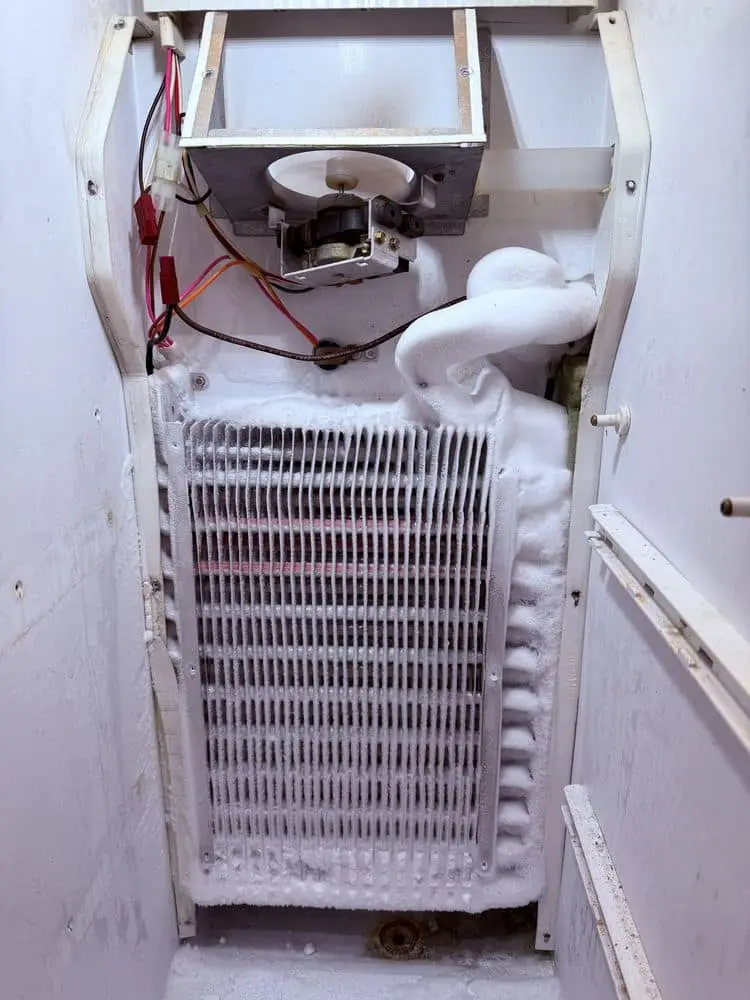
Most people call us about a freezer when the food is thawing. The opposite complaint comes in quieter. Ice cream you need two hands and a warm spoon to get into. Bread that shatters. A bag of peas with a crust of ice welded to the inside. Or the sound changed, and now the unit either never stops running or clicks on and off every few minutes like it is arguing with itself.
Both of those are worth looking at, because they come from the same place. The cooling side of the machine is working. The part that decides when to cool is not. We see this steadily in Irvine, Tustin and Lake Forest, especially on units that are six to twelve years old, and the list of causes is short enough to work through in order.
What temperature should a freezer actually hold?
Zero degrees Fahrenheit. That is the storage target food safety guidance uses, and it is also where ice cream is firm but still gives under a scoop. At -10°F ice cream goes to concrete and you will know it before any thermometer tells you.
Here is the part that trips people up. A freezer is not supposed to sit at exactly 0 the whole time. The control lets the air drift up a few degrees, then runs the compressor until it drops a few degrees below, and the swing is part of the design. A range of about -5 to +5 over a full cycle is healthy. Narrower than that usually means the unit is running more than it needs to.
And the number on the door is a setpoint, not a measurement. On nearly every model it shows what you asked for, not what the sensor reads. A freezer can display 0 and hold -14 without the display ever changing, which is exactly why a thermometer matters.
Colder is not better, either. Below about -5°F as a steady state you get three things nobody wants: extra compressor run hours, more sublimation off the surface of anything not sealed tight, which is what freezer burn actually is, and a defrost cycle that has to work harder because more moisture ends up on the coil.
How does a freezer decide when to run?
Three parts and a board. An evaporator coil behind the rear panel gets cold, a fan pushes air across it into the cabinet, and a thermistor somewhere in that airflow reports the temperature back to the control board. The board compares what the thermistor says against the setpoint and turns the compressor on or off.
A thermistor is just a resistor whose resistance changes with temperature. At 0°F a typical appliance thermistor sits in the tens of thousands of ohms, and the board is reading that value through a lookup table burned into its firmware. When the part drifts out of spec, the board is not confused. It is following bad data perfectly.
On a combination refrigerator-freezer with a single evaporator, there is a fourth player. The air damper meters how much of that cold air gets routed over to the fresh-food side. Change what the damper is doing and you change the freezer too, which is why lowering a fridge setting sometimes makes the freezer behave differently a day later. If your complaint is on the fridge side instead, that is covered in refrigerator freezing food in the fresh-food section.
Then there is defrost. Every frost-free freezer runs a heater against the evaporator on a schedule, which on modern adaptive defrost controls means roughly every eight to twelve hours of compressor run time, for twenty to thirty minutes. During that window the compressor is off and the air in the box climbs. Seeing 15 or 20°F on a thermometer in the middle of a defrost is expected behavior, not a fault.
What does normal cycling sound like?
This depends entirely on what kind of compressor you have, and it is the single biggest source of false alarms we get called out for.
Older single-speed reciprocating compressors are on or off, nothing in between. They typically run 30 to 50 minutes and rest 15 to 30, longer runs in a warm kitchen, shorter in a cool one. You hear a distinct start, a steady hum, and a stop.
Inverter and linear compressors, which is most of what LG and Samsung have shipped on French-door models for years now, work the opposite way. They vary speed and spend most of their life running quietly at a fraction of full output. Owners move into a new house, notice the fridge never shuts off, and assume something is broken. It is not. A unit like that stepping up to full speed only after a door has been open is doing exactly what it was designed to do. There is more on how the three compressor types behave in our guide to refrigerator compressor problems.
So before you time anything, find out which one you have. The model number plus a quick look at the spec sheet settles it in two minutes, and it changes the whole diagnosis.
Symptoms to likely causes
| What you see or hear | Likely causes |
|---|---|
| Thermometer reads -10°F or lower all the time, food rock hard | Setpoint too low, Power Freeze or Super Freeze mode left on, freezer thermistor reading warm |
| Freezer too cold and the fridge side is also freezing produce | Thermistor drift or a control board no longer closing the damper on a single-evaporator unit |
| Freezer too cold but the fridge side is warm | Damper stuck closed, blocked duct, or ice blocking the airflow path between compartments |
| Compressor runs and never shuts off, temperature is fine | Normal on inverter or linear models. On single-speed: dirty condenser, stopped condenser fan, leaking gasket |
| Runs nonstop and still cannot hold 0°F | Defrost failure icing the evaporator, refrigerant leak, condenser fan failure |
| Click, hum, quiet, repeating every 2 to 5 minutes | Start relay or overload protector, stopped condenser fan causing an overheat trip, failed compressor windings |
| Temperature swings 15 to 20°F several times a day | Defrost running too often or too long, thermistor with an intermittent connection, door not latching every time |
| Freezer burn on sealed packages, heavy surface frost on food | Running well below setpoint, wide cycling, or a door seal letting humid air in |
| Unit in the garage behaving differently in summer or winter | Ambient temperature outside the model's rated range, single-evaporator control reading the fridge compartment |
The causes we actually find
1. The setting, or a boost mode nobody turned off
Costs nothing to rule out, so rule it out first. Somebody bumped the control, a kid pressed buttons, or the freezer got turned down during a heat wave and never got put back.
The real trap is the boost modes. Power Freeze, Super Freeze, Quick Freeze, Turbo Freeze. They hold the compressor and fan at full output and on most models they are meant to time out after a few hours. When the timeout fails, or when nobody notices the icon is still lit, the freezer spends weeks in a mode built for pulling down a load of warm groceries. Turn everything off and give it 24 hours before you decide anything.
2. The freezer thermistor has drifted
This is the quiet one, and it is the most common real fault behind a too-cold freezer. The thermistor ages, its resistance curve shifts, and it starts reporting warmer than the air actually is. The board sees a freezer that refuses to reach setpoint, so it keeps the compressor running. The box ends up at -12 or -15 and the display still says 0.
A drifting thermistor the other direction produces the opposite complaint and lands you on our freezer not cooling page instead. Same part, same failure, different side of the curve.
There is no homeowner test for this. The check is a resistance measurement at a known temperature compared against the manufacturer's chart, and on a lot of models it also means pulling an error history out of the control board in diagnostic mode. The part itself is inexpensive and the repair is routine.
3. Ice in the wrong place
Ice does two things that look like control failures. It can build over the thermistor itself, insulating it so it reads the ice instead of the air, and it can block the duct or the damper that moves air between compartments.
That second one explains the odd combination of a freezer running very cold while the fridge side goes warm. Cold air is being made and has nowhere to go, so it all stays in the freezer. People usually blame the fridge, and the actual failure is in the freezer's defrost circuit.
Reading the frost pattern is how we tell. Hard clear ice on the back panel points at the defrost heater or its sensor. Fuzzy white frost near the door points at the seal. A slab on the floor points at a clogged drain. That whole breakdown is in frost building up in your freezer, and the repair there belongs to the defrost system, not the thermostat.
4. The defrost control is running the wrong schedule
Adaptive defrost boards decide when to defrost based on accumulated compressor run time and, on some models, how long the last defrost took to clear the coil. When that logic goes wrong you get wide, repeating temperature swings. Defrost too often and the box warms up several times a day and the food surfaces soften. Defrost too long and the same thing happens for a longer stretch.
You can see this without opening anything. Put a thermometer in the freezer and check it morning, midday and evening for two days. A healthy unit shows small drift and one brief climb. A bad defrost schedule shows a 20 degree jump three or four times a day.
5. Short cycling at the compressor
Two to five minute bursts, usually with a click and a hum right before it goes quiet, is not a thermostat problem. That is a compressor trying to start, failing, and tripping its own overload protector. The overload resets when it cools and the whole thing repeats.
The start relay and the overload are two small parts clipped to the side of the compressor housing, and in our experience they fail many times more often than the compressor. A stopped condenser fan produces an identical pattern, because the compressor overheats and trips on temperature instead. All of those need a meter to separate, and none of them get better by waiting. If you have a freezer doing this, my advice is to unplug it, move the food, and have it looked at. Letting a compressor attempt locked-rotor starts hundreds of times a day is how a cheap relay repair turns into a sealed-system job.
6. It runs forever and still will not get cold enough
Constant run plus a temperature that sits at 10 or 15°F is a different problem from constant run with good temperature. Now the machine is trying and losing.
Start with the condenser. In South Orange County, between dust, pet hair and the dry Santa Ana wind season, we pull mats off condenser coils that have not been touched since the unit was delivered. A choked coil cannot reject heat, run time climbs, and eventually the box cannot hold setpoint. Vacuuming it is a homeowner job on most freestanding units. On a built-in, the coil is usually in the top machine compartment behind a grille and it still gets pulled and cleaned properly during service.
After the coil, the suspects are the condenser fan, the door gasket, defrost failure icing the evaporator, and a refrigerant leak. The last one is a sealed-system repair and it needs recovery equipment and EPA 608 certification. Nobody should be topping off a freezer in a kitchen.
7. The garage freezer
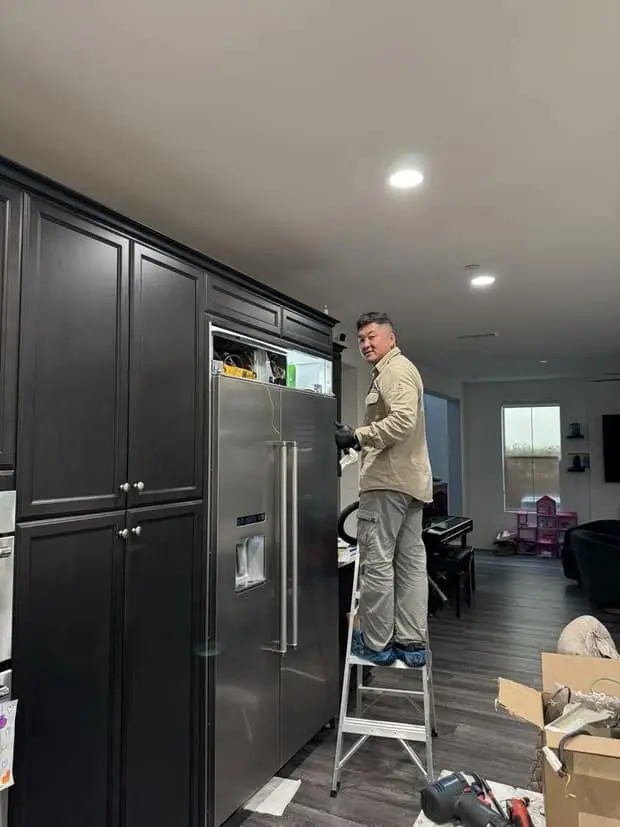
Plenty of Irvine and Lake Forest households keep a second freezer or an old fridge in the garage, and ambient temperature changes how it behaves. Standard units are rated for a room somewhere between about 55 and 110°F, model depending. A garage in the high 90s pushes the condenser hard and run time goes way up.
Cold works against you too, on combination units. If the control reads the fresh-food compartment and that compartment is already at 50°F because the garage is cool, the compressor never gets asked to run, and the freezer side slowly warms up. Garage-ready models solve this with a small heater or a second sensor. A standard one in a garage is being used outside its design and no repair will change that.
What you can safely check yourself
- Measure it properly. Put a freezer thermometer between packages in the middle of the load, not on a shelf in open air, and read it after 24 hours. Check it again at a couple of different times of day so you catch the swing.
- Confirm the setpoint and kill the boost modes. Set it to 0°F and make sure no Power Freeze icon is lit. Give it a full day.
- Test the gasket with a dollar bill. Close the door on it and pull. If it slides out with no drag, that stretch of seal is not sealing. Walk the whole perimeter, including the bottom corners where it usually goes first.
- Vacuum the condenser. On a freestanding unit, unplug it, pull the lower grille or the back panel, and vacuum the coil and the fan area. Once a year is enough in most homes, twice if you have shedding pets.
- Check airflow inside. Make sure nothing is pressed against the rear vents. A full freezer holds temperature better than an empty one, but packed hard against the air outlet it will not circulate.
- Time a cycle. Write down when the compressor starts and stops over an afternoon. Bring those numbers to the phone call, because they narrow the diagnosis before anyone opens a panel.
- Photograph the model and serial tag. Usually on the inside wall near the door or behind a drawer. Everything else moves faster once we have it.
What only a technician should do
Everything past that point involves either live voltage or the sealed refrigerant circuit, and both deserve respect.
- Thermistor and defrost sensor resistance tests against the manufacturer's temperature chart.
- Entering the control board's service mode to pull stored fault codes and force a defrost cycle.
- Testing the start relay, the overload protector and compressor winding resistance, plus locked-rotor current draw.
- Damper assembly and compartment valve testing on single and dual evaporator layouts.
- Defrost heater and bi-metal continuity, and judging whether a heater actually cleared the coil.
- Any work on the sealed system, which requires refrigerant recovery, a new filter drier, nitrogen during brazing, a deep vacuum and a weighed charge.
Topping off refrigerant is not a repair. A sealed system that is low has a leak, and the leak gets found and fixed or the same visit happens again in six months.
Keeping it from coming back
- Leave it at 0°F. Colder costs run time and gives you nothing.
- Vacuum the condenser once a year. Put it on the same weekend as something else you already do.
- Keep a cheap thermometer inside permanently and glance at it. You will catch a drift weeks before food suffers.
- Keep the freezer reasonably full but not jammed against the vents. Thermal mass helps, blocked airflow does not.
- Wipe the gasket a few times a year and check that the door actually latches when it swings shut on its own.
- Give a garage unit room to breathe and keep it out of direct afternoon sun against a west wall.
The full routine is on our refrigerator maintenance checklist, and the broader household version lives on the appliance maintenance checklist.
When is it time to call?
Call once you have given it a day at 0°F with the boost modes off, a clean condenser and a sealed door, and it still runs far below zero or still cycles oddly. At that point the control loop is the fault, and the control loop needs a meter.
Call sooner than that if the unit clicks and hums every few minutes, if it runs nonstop and cannot hold temperature, if hard ice is building on the back panel, or if the freezer is very cold while the fresh-food side is going warm. Those four all get worse on their own.
What happens on the visit: we measure actual air temperature against what the board reports, test the freezer and defrost sensors against the manufacturer's chart, pull stored fault codes, check the damper or compartment valve, read the frost pattern on the evaporator, check the start relay and compressor draw, and inspect the gaskets and the condenser. You get the explanation and a quote on site before any work starts, and most of these repairs are done the same day from parts on the truck. Everything we fix carries our 90-day parts and labor warranty.
We are factory authorized for LG and factory authorized for Liebherr. For Samsung we are certified technicians. We provide professional repair for Sub-Zero, Viking, Thermador, Bosch, GE, Whirlpool, Frigidaire, KitchenAid and the other brands in South Orange County kitchens. Start at our refrigerator and freezer repair page, or the local pages for Irvine, Tustin and Lake Forest. We also cover Mission Viejo, Laguna Hills, Aliso Viejo, Laguna Niguel, Rancho Santa Margarita, Dana Point and San Clemente. If you want the visit to go faster, before the technician arrives lists what helps.
Frequently asked questions
What temperature should a home freezer be set to?
Zero degrees Fahrenheit is the number to aim for. Food safety guidance uses 0 as the storage target, and that is also where ice cream stays firm but still scoopable. A freezer swinging between about -5 and +5 over a cycle is behaving normally, because the control has to let the box drift before it calls for cooling again. Holding -10 or -15 all the time is not safer food, it is just more run time on the compressor and more moisture pulled out of anything that is not sealed well.
Why does my freezer run constantly and never shut off?
Continuous run is either normal or one of four faults. On inverter and linear compressor models it is normal, because those run at low speed almost all the time instead of switching on and off. On an older single-speed unit it usually means the condenser coil is choked with dust, the condenser fan has stopped, a door gasket is leaking humid air, or the defrost system has stopped clearing the evaporator so the coil can no longer absorb heat. A refrigerant leak produces the same symptom and needs a technician with gauges.
Why does my freezer click on and off every few minutes?
Short cycling in two to five minute bursts, usually with a click and a hum before it goes quiet, is almost never the control board. It is a compressor failing to start and tripping its overload protector. The start relay and the overload are two small parts clipped to the side of the compressor and they fail far more often than the compressor itself. The other common cause is a stopped condenser fan, which lets the compressor overheat and trip. Both need a meter to separate, and running the unit in that state does the compressor no favors.
Can a bad sensor make a freezer too cold?
Yes, and it is one of the most common causes we find. The freezer thermistor is a resistor whose value changes with temperature, and the control board reads that value to decide when to run. When a thermistor drifts it usually reads warmer than the real air. The board sees a freezer that will not come down to setpoint, so it keeps running, and the box ends up well below zero. Nothing on the display changes, which is why people blame the setting first. A technician measures the thermistor resistance and compares it against the manufacturer chart at a known temperature.
Is it normal for freezer temperature to rise during a defrost cycle?
Yes. A frost-free freezer runs a heater against the evaporator coil every eight to twelve hours on most adaptive defrost controls, for roughly twenty to thirty minutes. The compressor is off, the heater is on, and the air in the box climbs. Seeing 15 or even 20°F on a thermometer during that window is expected, and it should fall back toward zero within an hour. What is not normal is food surfaces softening every cycle or a temperature that takes several hours to recover, which points at a defrost control running too long or too often.
Does a freezer in a hot garage cycle differently?
It does, and in Orange County garages it matters. A standard refrigerator or freezer is rated for a room between roughly 55 and 110°F depending on the model. A garage in the high 90s makes the condenser work much harder, run time goes up, and the unit can struggle to hold setpoint. At the other end, a single-evaporator refrigerator-freezer in a cold garage can let the freezer warm up, because the control is reading the fresh-food compartment and never calls for cooling. Garage-ready models have a heater or a second sensor specifically to deal with that. If yours is old enough that the question is whether to keep fixing it, our repair or replace guide walks through how we weigh it.
Freezer running too cold or cycling strangely?
Call us at (310) 600-8152 with the model number, what your thermometer actually reads, and roughly how long the compressor runs and rests. We are 5.0 on Yelp, family-owned in Irvine, and the technician quotes the repair on site before any work begins.
Related Pages
- Refrigerator Repair in Irvine
- Refrigerator & Freezer Repair in Orange County
- Refrigerator Repair in Tustin
- Refrigerator Repair in Lake Forest
- Sealed-System & Compressor Repair
- Freezer Not Cooling or Freezing
- Frost Building Up in Your Freezer?
- Refrigerator Freezing Food in the Fresh-Food Section?
- Refrigerator Compressor Problems: Start Relay vs Compressor
- Refrigerator Making Strange Noises?
- Why Is My Refrigerator Not Cooling?
- Refrigerator Maintenance Checklist
- Repair or Replace?
- Before the Technician Arrives
- Factory Authorized LG Repair
- Factory Authorized Liebherr Repair
- Irvine · Tustin · Lake Forest · Mission Viejo · Laguna Hills · Aliso Viejo · Laguna Niguel · Dana Point · San Clemente