
Wine Cooler Not Cooling? How to Read the Symptoms Before You Call
A warm wine cabinet is the quietest appliance failure in the house. When a refrigerator drifts, the milk tells you by morning. When a wine unit creeps from 55°F to 68°F, nothing announces it, and plenty of people find out weeks later because they happened to put a hand on a bottle and it felt like room temperature.
So before anything else: if the cabinet is warm right now and there are bottles in it you care about, move those bottles. A closet against an interior wall, a cool pantry floor, anywhere dark and steady beats a wine cabinet that has stopped working. You can put them back in an hour or in a week.
Then work through this in order. Most of what follows you can do yourself in an evening, and the answers you come back with decide the repair. We service wine columns, under-counter cabinets and beverage centers daily across Irvine, Tustin and Lake Forest, and the calls that go fastest are the ones where the owner already knows what the cabinet is actually holding.
What is the cabinet really holding?
Start here, because about a third of the time this step changes the whole conversation.
Put a thermometer in a glass of water and stand it on a middle shelf. Leave it four to six hours. The water gives the thermometer the thermal mass that a bottle has, so you read what the wine is experiencing rather than a spike from the last time the door opened. A dry thermometer sitting in open air will swing 8 or 10 degrees every time you look at it and tell you very little.
Now compare three numbers: the setpoint on the display, what the glass of water says, and the room temperature where the unit lives. Those three together are the diagnosis, and they split into clear cases.
- Glass matches setpoint. Nothing is wrong with the cooling. If the bottles still feel warm, they have not caught up yet, which takes a day.
- Glass is 8 to 15 degrees above setpoint, compressor clearly running. Airflow or heat rejection. Condenser, fan, clearance, gasket.
- Glass is roughly 20 degrees below room temperature and will go no lower. That is a thermoelectric unit at its physical ceiling, not a failure.
- Glass is near room temperature and the unit is silent. Power, control board, or a compressor that is not starting.
For reference, long-term storage wants about 55°F and as little swing as possible. Serving targets are separate, roughly 60 to 65°F for reds and 45 to 50°F for whites and sparkling, which is the reason dual-zone cabinets exist. Humidity in the 50 to 70 percent range keeps corks from drying, and a sealed cabinet in this climate usually manages that without help.
Steadiness matters more than hitting a number exactly. A cabinet that sits at 58°F all year is kinder to wine than one that swings between 50 and 65 twice a day, because the swing is what pushes corks and pumps air past them.
Did it ever cool, or did it stop cooling?
This is the single most useful question, and it sorts wine cooler calls into three piles that barely overlap.
It has never held temperature since it was installed
Then odds are good that no part has failed, and the cabinet is being asked to do something it cannot.
Two causes account for most of these. The first is a thermoelectric cooler in a warm room. Small units, roughly the 12 to 28 bottle countertop and slim freestanding models, cool with a solid-state module instead of a compressor, and the physics cap them at about 20°F below ambient. Put one in a garage that hits 95°F in August and it will sit in the mid 70s all afternoon while working exactly as designed.
The second is a freestanding unit built into cabinetry. Freestanding coolers vent out the back and top. Built-in models vent forward through a grille, which is why they can live inside a run of cabinets. Box a freestanding unit into a surround and the condenser ends up breathing its own exhaust: fine through the winter, then the first hot week arrives and the cabinet will not come down no matter how long the compressor runs. The fix there is carpentry or a different location, not parts, and we would rather tell you that on the phone. Both of these are laid out in more detail on our wine cooler repair page, including how to tell a thermoelectric unit from a compressor one by hand.
Worth ruling out in the same breath: showroom or demo mode. Units that came off a floor display sometimes still have it switched on, and in that mode the lights and the display behave normally while the compressor never runs at all.
It held 55°F for years and has slowly drifted up
This is the pile with real parts failures in it, and the order we check them in rarely changes.
The condenser comes first. On a built-in or under-counter unit it hides behind the front grille and in most homes it has never been touched since installation. Dust, lint and pet hair mat across the fins, the coil stops rejecting heat, run time climbs, and eventually the cabinet cannot hold setpoint at all. In South Orange County the Santa Ana wind season loads coils fast, and a bar area near a slider gets the worst of it.
Then the fans. A wine cabinet typically has a condenser fan moving air across the coil and a circulation fan moving cold air around inside. Lose the condenser fan and you get long runs and a warm cabinet. Lose the circulation fan and you get a cold patch near the evaporator while the rest of the cabinet drifts.
Then the door. Wine doors are heavy multi-pane glass, and after enough years the hinges settle and the door stops pulling square. A gap of a sixteenth of an inch at the top corner lets room air in all day long. Close the door on a sheet of paper at the top, the bottom and both sides. If it slides out with no drag anywhere along the way, that stretch of gasket is not sealing. Condensation on the inside of the glass alongside a warm cabinet is the same story.
Then the sensors. Wine units use small thermistors clipped in the airflow, and when one drifts out of spec the control board makes perfectly logical decisions from a wrong number. That is the case where the display insists on 55°F while the glass of water reads 66. The part is inexpensive and the repair is routine, but it takes a meter and the manufacturer's resistance chart to confirm.
And finally refrigerant. These cabinets hold a very small charge, so a slow leak that a full-size refrigerator would shrug off for a year takes a wine unit out of range in weeks. From the outside it looks identical to a dirty condenser: long runs, warm cabinet. The difference is found with gauges, and the repair is sealed-system work with recovery, a new filter drier, a vacuum and a weighed charge. There is no can of refrigerant that fixes this.
It was fine yesterday and today it is warm
Sudden and total is usually electrical, and the cheapest causes are first.
Check the breaker, then press reset on every GFCI outlet on that circuit. Bar, pantry and garage receptacles are normally GFCI-protected and the reset button is frequently on another wall entirely, which is why people swear the unit is dead when the outlet simply tripped. If the unit went quiet during or after a power event, the control board is the next suspect: a board that has lost one output will happily run the compressor and never start the fan, or light the display and do nothing else.
If you hear a click, a brief hum and then silence, repeating every two to five minutes, stop there and unplug it. That is a compressor attempting to start, failing, and tripping its own overload protector, which resets as it cools and repeats. The culprit is usually the start relay or the overload, two small parts clipped to the side of the compressor that fail far more often than the compressor itself. The same failure on a refrigerator is walked through in our compressor problems guide, and the logic is identical on a wine unit. Letting it attempt locked-rotor starts a few hundred times a day is the one thing in this whole article that can genuinely turn a small repair into an expensive one.
Symptoms to likely causes
| What you see or hear | Likely causes |
|---|---|
| Runs constantly, cabinet sits 10 to 15°F above setpoint | Condenser packed with dust, stopped condenser fan, freestanding unit boxed into cabinetry, failing gasket, low refrigerant charge |
| Will not go below roughly 20°F under room temperature | Thermoelectric unit at its design limit, no fault present |
| Display reads 55°F, thermometer in water reads 65°F or higher | Drifted temperature sensor, or a setpoint display that was never a reading |
| Upper zone warm, lower zone correct (or the reverse) | Circulation fan, damper feeding that zone, sensor for that zone, bottles blocking the vent |
| Both zones drift up together over weeks | Condenser or condenser fan, refrigerant leak, failing compressor |
| Silent, display blank, no fan | Tripped GFCI or breaker, failed control board, power supply |
| Click, hum, silence, every 2 to 5 minutes | Start relay or overload protector, stopped condenser fan causing an overheat trip, failed compressor windings |
| Lights and display normal, nothing ever cools | Demo or showroom mode left on, control board output, compressor not being commanded |
| Warm cabinet with water pooled in the bottom | Evaporator iced over and now thawing, clogged drain tube, unit not level, gasket pulling in humid air |
| Cold near the back wall, warm at the door | Circulation fan stopped, vent blocked by bottles, door not sealing |
| Only struggles in July and August | Ambient temperature above the model's rating, clearance too tight, condenser already marginal |
How long should it take to get cold?
Longer than people expect, and this is where a fair number of calls end with nothing wrong.
A loaded compressor cabinet left closed usually reaches setpoint within 12 to 24 hours. Bottles are mostly liquid and liquid holds heat, so a cabinet filled with room-temperature wine takes much longer than an empty one. After a door has stood open a few minutes, the air recovers in an hour or two while the wine barely moves at all, which is why a thermometer can look alarming and the bottles are fine.
The useful threshold: if the unit has run undisturbed for a full 48 hours, the grille is clean, the door is sealing, and it still sits 10 degrees above setpoint, pull-down time is no longer the explanation.
The 24-hour test that tells us the most
If you do one thing before calling anybody, do this. It takes five minutes of effort spread over a day and it usually narrows the repair to one or two parts.
- Unplug the unit and pull the front grille. Vacuum the condenser fins and the fan area. Plug it back in.
- Set it to 55°F and make sure no boost or quick-chill mode is lit.
- Move any bottles that are packed against the interior air vent. Leave the cabinet otherwise loaded as usual.
- Stand a thermometer in a glass of water on a middle shelf.
- Read it morning, midday and evening, and write the numbers down with the room temperature next to each one.
- Once, listen at the grille for two minutes and note whether the compressor is running, and whether you can hear a fan.
What the log tells us: a steady number well above setpoint points at heat rejection or charge. A number that climbs through the afternoon and recovers overnight points at ambient temperature and clearance. Wide swings point at the door or the control. A reading that matches setpoint the whole time means the cabinet is fine and the complaint is about the bottles catching up.
What the display is telling you
Wine units are stingy with information compared to a modern refrigerator, but the display still narrows things down.
- A number that never changes while the cabinet drifts. That number is the setpoint. Most wine cabinets show what you asked for, not what they measure.
- A high-temperature alarm, often HI or a flashing setpoint. The control knows it is losing. That rules out demo mode and points at cooling capacity or airflow.
- A letter and number code. These are brand-specific, so photograph it. On the premium built-in brands it often names the failed sensor outright, which decides what rides on the truck.
- Blank or scrambled after an outage. Usually the board or the circuit, not the sealed system.
- Everything normal and nothing cooling. Demo mode, a control output, or a compressor that is never being asked to run.
What you can safely check yourself
- Read the real temperature with a thermometer in a glass of water. Four hours minimum.
- Note the room temperature, especially for a unit in a garage, a pantry or a bar area with no air conditioning of its own.
- Vacuum the condenser behind the front grille. Unplug it first. Once a year is enough in most homes, twice with shedding pets.
- Check the breaker and press reset on every GFCI outlet on that circuit, including ones on other walls.
- Paper-test the gasket at the top, bottom and both sides.
- Pull bottles away from the interior vent and give it four hours.
- Level the unit. A cabinet rocking on one foot will not seal evenly and will drain badly.
- Look for demo or showroom mode in the manual's control section.
- Photograph the model tag inside the door frame plus anything on the display.
And the things not to do, all of which we have been called out to fix afterwards:
- Do not chip ice off the evaporator with anything metal. One puncture turns a fan job into a sealed-system job.
- Do not buy a refrigerant top-up can. A unit low on charge has a leak, and these cabinets hold too little for guesswork.
- Do not prop the door open to dry out the cabinet. You will ice the evaporator and end up warmer than you started.
- Do not keep cycling power on a unit that clicks and quits.
- Do not pull a built-in column out of its opening yourself. It is fastened to the cabinetry and the doors are heavy glass.
What only a technician should do
Past the checklist, the work is either on live voltage or inside the refrigerant circuit.
- Thermistor resistance tests against the manufacturer's chart at a known temperature.
- Pulling stored fault codes out of the control board in service mode.
- Testing the start relay, the overload and compressor winding resistance, plus locked-rotor draw.
- Damper and zone-valve testing on dual-zone cabinets.
- Condenser and evaporator fan motor testing, and judging whether a fan is weak rather than dead.
- Leak detection and any sealed-system repair, which needs recovery equipment, nitrogen during brazing, a deep vacuum and a weighed charge.
Will the wine be all right?
Usually, with caveats, and it depends more on how long than how warm.
Wine ages faster as it gets warmer. A couple of weeks in the low 70s is effectively a shortcut through a longer stretch of proper cellar time. Young, inexpensive bottles take that in stride. Older bottles and anything you were holding deliberately lose the most, because the time you were buying is what got spent.
The damage worth looking for is physical. A cork that sits slightly proud of the rim, sticky seepage down the neck, or a stained capsule all mean the contents warmed enough to expand and push past the cork. Air went in behind it. Those bottles are worth opening in the next few months rather than being put back into storage. Repeated swings do more harm than one warm stretch, which is the argument for fixing a drifting cabinet rather than nudging the setpoint down and hoping.
Keeping it from happening again
- Vacuum the condenser once a year. Attach it to something you already do seasonally so it actually happens.
- Leave a thermometer in the cabinet permanently and glance at it. You will catch a drift weeks before it matters.
- Keep bottles off the interior air vent. A full cabinet holds temperature well, a blocked one does not.
- Wipe the gasket a few times a year and watch for the door starting to sit low at the handle side, which is hinge sag starting.
- Do not store a standard unit in an unconditioned garage. Heat is what kills these cabinets, and the condenser pays for it.
- Keep it out of direct afternoon sun against a west-facing wall.
The wider routine for refrigeration in the house is on our refrigerator maintenance checklist, and the whole-home version is the appliance maintenance checklist.
When is it time to call?
Call once you have cleaned the grille, confirmed the setpoint, sealed the door and given it a day, and the glass of water still reads well above where it should. At that point the fault is a part, and the part needs a meter.
Call right away, without the 24-hour test, if the unit clicks and hums every few minutes, if the display is dead, if water is standing in the bottom of a warm cabinet, or if the cabinet is above 70°F with bottles in it you would not want to lose.
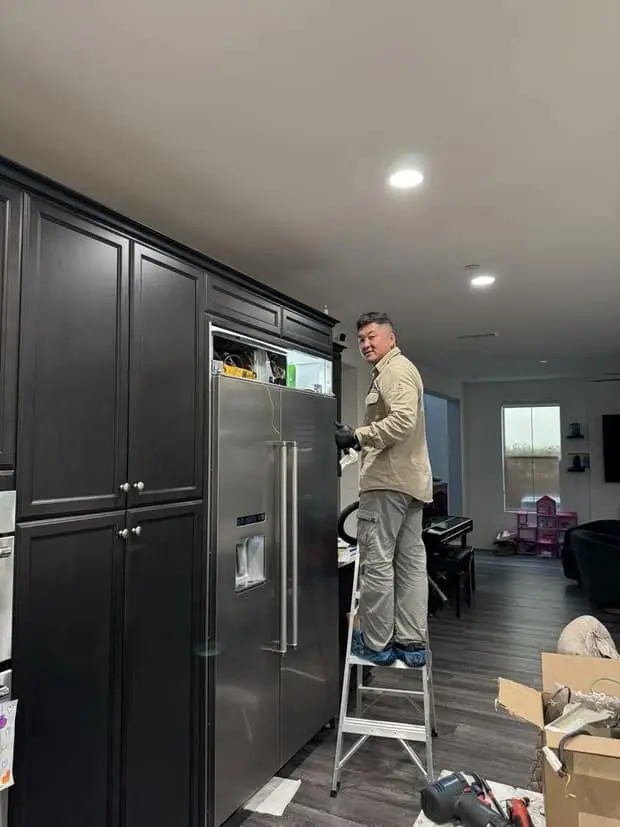
What happens on the visit: we measure actual cabinet temperature against what the control reports, test the sensors against the manufacturer's chart, pull stored codes, check both fans, read the frost pattern on the evaporator, inspect the gasket and door alignment, clean and inspect the condenser, and check the compressor start components and draw. You get the explanation and a quote on site before any work starts. Fans, sensors, relays and common gaskets ride on the truck, so many of these finish on the first visit, while boards and glass door assemblies for built-in units are ordered. Every repair carries our 90-day parts and labor warranty.
We are Factory Authorized for Liebherr, whose wine cabinets are some of the most common built-ins in South County, and Factory Authorized for Zephyr wine and beverage centers. We are experienced with Sub-Zero, Thermador, Viking and Miele wine storage, and we service U-Line, Marvel, Perlick, True Residential, Dacor, Fisher & Paykel, KitchenAid, GE and the freestanding brands too. Start on the wine cooler repair page, or see refrigerator repair in Irvine, Tustin and Lake Forest. We also cover Mission Viejo, Laguna Hills, Aliso Viejo, Laguna Niguel, Rancho Santa Margarita, Dana Point and San Clemente. A restaurant or tasting room unit goes through commercial refrigeration repair instead.
Frequently asked questions
How long should a wine cooler take to cool down to 55°F?
A healthy compressor cabinet that is loaded with bottles and left closed usually reaches setpoint within 12 to 24 hours. Bottles hold a lot of heat, so a cabinet filled with room-temperature wine takes far longer than an empty one. After a door has stood open for a few minutes the air recovers within an hour or two, while the wine itself barely moves. If a unit has run a full 48 hours undisturbed and still sits 10 degrees above setpoint, that is no longer pull-down time and something needs diagnosing.
My wine cooler display says 55 but the shelf reads 66. Which one is right?
Trust the thermometer. On most wine units the display shows the setpoint, which is what you asked the cabinet to do, not a live reading from inside. Even on models that do display a measured value, that value comes from a thermistor clipped in the airflow, and a thermistor that has drifted out of spec reports a number the control board then believes. Measure with a thermometer standing in a glass of water on a middle shelf and read it after four to six hours. A gap of 10 degrees between display and glass is usually either a drifted sensor or a cabinet that genuinely cannot reach setpoint.
Is my wine ruined if the cooler sat at 70°F for two weeks?
Probably not ruined, but it aged faster than you intended. Wine chemistry speeds up as temperature rises, so a couple of weeks in the low 70s is roughly a shortcut through a longer stretch of proper cellar time. Young, inexpensive bottles shrug that off. Older bottles and anything you were holding for years lose the most. The damage to look for is physical: a cork pushed slightly proud of the rim, sticky seepage down the neck, or a stained capsule all mean the wine warmed enough to expand and push past the cork, and those bottles are worth drinking soon rather than storing again.
Should I unplug a wine cooler that is not cooling?
It depends on what it is doing. A unit that runs continuously and still reads warm can stay plugged in while you clean the condenser and measure it, because it is not hurting itself. A unit that clicks, hums for a second and goes quiet every few minutes should be unplugged. That pattern is a compressor failing to start and tripping its own overload protector, and hundreds of failed starts a day can turn an inexpensive start relay into a sealed-system job. Move the bottles somewhere cool and dark and leave it off until a technician can test it.
Why did my wine cooler stop cooling right after a power outage?
Check the circuit first. Bar areas, garages and butler pantries are usually on GFCI-protected outlets, and the reset button is often on a different wall or in the garage rather than behind the unit. Press reset on every GFCI on that circuit and look at the breaker. If power is fine, the next suspects are the control board, which can lose one output in a surge and run the compressor while ignoring the fan, and the compressor start components. A blank or scrambled display after an outage usually means the board. The same pattern on a full-size fridge is covered in fridge food after a power outage.
Is it normal for a wine cooler to run all the time?
Long run times are normal in a warm room and during the first day after the cabinet is loaded. Constant running with a warm cabinet is not. The usual causes are a condenser packed with dust behind the front grille, a stopped condenser fan, a door that no longer seals because the heavy glass has pulled the hinges out of square, or a freestanding unit boxed into cabinetry with nowhere to send its heat. A slow refrigerant leak looks the same from the outside and needs a technician, because these cabinets hold a small charge and lose range quickly. If the unit is old enough that you are weighing the repair at all, our repair or replace guide shows the math we use.
Related Pages
- Wine Cooler Repair in Irvine and South Orange County
- Refrigerator & Freezer Repair in Orange County
- Refrigerator Repair in Irvine
- Refrigerator Repair in Tustin
- Refrigerator Repair in Lake Forest
- Sealed-System & Compressor Repair
- Commercial Refrigeration Repair
- Refrigerator Compressor Problems: Start Relay vs Compressor
- Why Is My Refrigerator Not Cooling?
- Refrigerator Leaking Water?
- Refrigerator Making Strange Noises?
- Refrigerator Maintenance Checklist
- Liebherr Owner's Guide
- Repair or Replace?
- Before the Technician Arrives
- Factory Authorized Liebherr Repair
- Factory Authorized Zephyr Repair
- Irvine · Tustin · Lake Forest · Mission Viejo · Laguna Hills · Aliso Viejo · Laguna Niguel · Dana Point · San Clemente