
How Long Should a Refrigerator Last? What a Repair Tech Sees by Type and Brand
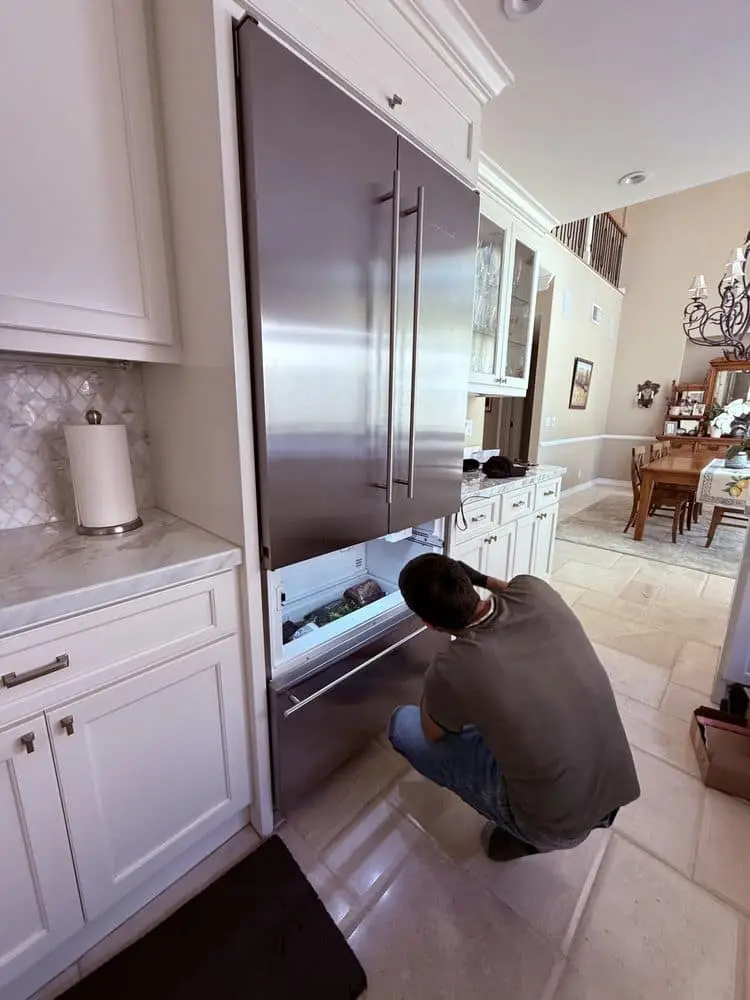
Most refrigerators last somewhere between 10 and 15 years, and plenty of them keep going well past that. That is the honest range. When people in Irvine, Tustin or Lake Forest ask us "how long should this thing last?", what they usually mean is "is my fridge old enough that I should stop fixing it?" Those are different questions, and this guide tries to answer both from what a repair technician actually sees inside these machines.
We won't hand you a chart of exact years by brand. Nobody has honest data for that, and anyone who prints "Brand X lasts 14.2 years" is guessing. What we can tell you is how the type of refrigerator, the features on it, the way it is installed and the way it is maintained change the odds. Those patterns are consistent.
How long does the average refrigerator last?
The most quoted number is about 13 years, from the National Association of Home Builders' study of how long home components last. Most industry sources land in the same 10 to 15 year band for a standard household refrigerator, and our own repair or replace guide uses a wider 10 to 20 year range because premium built-ins stretch the top end.
Treat any average with care. An average of 13 includes the fridge that died at 7 from a refrigerant leak and the one in the garage still humming at 25. What you want to know is which way your own fridge leans, and that depends on the things below.
Which types of refrigerators last longest?
From a repair point of view, the simpler the refrigerator, the fewer things there are to fail. That is not a judgment on quality. It is just arithmetic. Here is how the main types compare in our experience, described in words because the honest answer is a tendency, not a number.
| Type | What tends to wear out first | Our view on longevity |
|---|---|---|
| Top-freezer, no ice maker | Defrost parts, fans, door gaskets | The most durable design we work on. Few parts, simple controls, easy access. |
| Bottom-freezer | Defrost system, drawer slides, fans | Close to top-freezers, a little more to go wrong with the drawer. |
| Side-by-side | Ice maker, dispenser, water valve, defrost | Solid cabinet, but the ice and water system creates most of the calls. |
| French-door with ice in the door | Ice compartment frost, fans, water lines through the hinge, control boards | The most repair visits per year of any household type we see. Still very repairable. |
| Built-in and column (Sub-Zero, Liebherr, Thermador and similar) | Fans, condenser airflow, sensors, sealed system in later years | Designed for long service and usually worth repairing well past the age where a freestanding fridge is replaced. |
| Compact, garage or bar fridge | Compressor, thermostat | Shorter life, especially in a hot garage. Rarely worth a major repair. |
A word on built-ins: Sub-Zero says its refrigerators are designed and tested to last 20 years, and premium built-ins in general are engineered with that kind of service life in mind. Whether a specific unit gets there depends on maintenance, and the condenser on a built-in is the part owners forget most.
Does the brand change how long a refrigerator lasts?
Less than people think, and more by model generation than by logo. Every major brand has made models that held up well and models with a known weak spot. What we see on service calls is that the weak spot is usually a feature, not the whole refrigerator.
Samsung French-door models with the ice maker in the fresh-food door bring us a lot of ice compartment calls, which we cover in Samsung refrigerator problems we fix most. Certain LG refrigerators with linear compressors had enough compressor failures that LG extended coverage on some models, which is explained in our LG compressor guide. Whirlpool, KitchenAid, Maytag and GE models tend to bring us defrost, fan and ice maker work. None of that makes one brand "the one that lasts." A Samsung or LG that has had its weak spot fixed can run a long time, and a premium brand that is never cleaned can fail early.
If you are shopping, our honest advice is to buy the simplest refrigerator that does what you need, from a brand that has local service and parts. That gets you further than any brand ranking.
What actually shortens a refrigerator's life?
Heat is the big one. A refrigerator's job is to move heat out of the box and dump it into the room through the condenser coil. Anything that makes that harder makes the compressor run longer and hotter, and running time is what wears a compressor out.
- A dusty condenser coil. The most common cause of no-cool calls we see, and the easiest to prevent. Homes with dogs or cats clog a coil faster.
- A tight built-in space with no airflow. A freestanding fridge squeezed into a cabinet opening without the clearance its manual asks for runs hot every day.
- A garage. Summer garages in inland Lake Forest, Mission Viejo and Rancho Santa Margarita get very hot, and most kitchen refrigerators are not designed for those temperatures.
- A door that doesn't seal. Warm, humid air leaking in all day means more frost, more defrost cycles, more run time.
- Ignoring small problems. A fan that scrapes ice for months, or a fridge that has been "a little warm" since spring, puts years of extra wear on the compressor.
- Power problems. Repeated outages and surges are hard on control boards, which is one reason we cover what to do after a power outage separately.
What makes a refrigerator last longer?
Not much, honestly, and that is good news. Vacuum the condenser coil once a year, twice if you have pets. Keep the clearance around the fridge that the manual asks for. Wipe the door gaskets and make sure the doors swing shut on their own. Keep the vents inside clear. Change the water filter on schedule. Don't keep a kitchen fridge in a hot garage if you can avoid it.
The one habit we'd add from experience: keep a cheap thermometer in the fresh-food section. A fridge drifting from 37°F to 42°F is usually a fan or a coil and an easy repair. The same fridge found at 55°F a month later may have spent that month running a compressor into the ground. The full routine is in our refrigerator maintenance checklist.
How can I tell how old my refrigerator is?
The model and serial number label is usually inside the fresh-food section on a side wall, on the ceiling, or behind the crisper drawers. The manufacture date is encoded in the serial number, and each brand uses its own system. The easiest route is the manufacturer's support line or website, which can tell you the build date from the serial number. If you bought the house with the fridge in it, this is worth doing before you decide anything.
What are the signs a refrigerator is near the end?
One repair doesn't mean the end. A pattern does. These are the signs we take seriously:
- Repeated failures of different parts within a year or two, especially on a unit past 10 years.
- A sealed-system problem: a refrigerant leak or a failed compressor on an older, basic refrigerator.
- Rust through the cabinet or the inner liner cracked so the insulation gets wet.
- Parts no longer made for the model, so every repair becomes a search.
- Running constantly and still not holding temperature after the coil is clean and the gaskets are good.
Signs that are not the end, even though they feel like it: a loud fan, a fridge that is warm but the freezer is fine, an ice maker that stopped, water under the crisper drawers, or a clicking compressor that won't start. Those are usually fans, defrost parts, drains, ice maker parts or start components, and they get repaired on fridges of every age.
Should I repair or replace an old refrigerator?
Here is how we think about it on a service call. First, what failed. A fan, a defrost heater, a sensor, a gasket, a start relay or an ice maker is a moderate repair, and we'd fix it on almost any fridge that is otherwise in good shape. Second, the type. A built-in fitted into your cabinets is worth repairing far later in life than a freestanding fridge, because replacing it can mean a cabinet job on top of a new appliance. Third, the history. The first repair in ten years is different from the third repair this year.
Where we'd lean toward replacement: a sealed-system repair on a freestanding refrigerator past about 12 years old, a fridge that keeps needing different parts, or cabinet damage. The widely used rule of thumb is that if a repair costs more than half the price of a comparable new unit and the appliance is past its middle years, replacement usually makes more sense. The technician quotes the repair on site before any work, so you make that decision with a real number in front of you. More detail is in our repair or replace guide and what drives the cost of a refrigerator repair.
Is it worth fixing a 10-year-old refrigerator?
Often, yes. Ten years is the point where people start assuming they should replace, and it is also the point where a lot of perfectly sound refrigerators need their first real repair. If the cabinet is in good shape, the fridge has been reliable, and the failure is a common part, we'd repair it. If it is the kind of failure that needs the sealed system opened, or the fourth call in two years, we'd say so plainly.
Newer refrigerators are not automatically longer lived. More electronics, more sensors and more water features mean more parts that can fail. What a new fridge does usually give you is lower energy use than one from 15 or 20 years ago, so that belongs in the decision for a very old unit too.
Frequently Asked Questions
How long should a refrigerator last?
About 10 to 15 years for a typical household refrigerator. A study by the National Association of Home Builders put the average at about 13 years. Simple top-freezer models often go longer, feature-heavy models with ice and water in the door tend to need more repairs along the way, and premium built-ins are designed for a longer service life.
Which type of refrigerator lasts the longest?
From a repair technician's view, a top-freezer refrigerator without an ice maker has the fewest parts to fail and tends to be the most durable household design. Built-in premium refrigerators are engineered for long service and are usually repaired rather than replaced when something fails.
Is it worth repairing a 15-year-old refrigerator?
It depends on what failed. A fan, defrost part, sensor, gasket or start relay is usually still worth fixing on a fridge that has been reliable. A refrigerant leak or failed compressor on a 15-year-old freestanding fridge usually isn't. A built-in unit is often worth repairing at that age because replacing it is a bigger job.
Do more expensive refrigerators last longer?
Not automatically. Premium built-in units are designed for a longer life, but price on a freestanding fridge often buys features, and features like door ice makers, dispensers and screens add parts that can fail. Maintenance and installation matter as much as price.
How do I find out how old my refrigerator is?
Find the model and serial number label inside the fresh-food section, usually on a side wall, the ceiling or behind the crisper drawers. The manufacture date is coded into the serial number, and the manufacturer's support line or website can decode it for you.
What is the most common reason a refrigerator dies early?
Heat. A clogged condenser coil, poor ventilation in a tight cabinet, or a hot garage makes the compressor run longer and hotter every day. Cleaning the coil once a year and giving the fridge the clearance its manual asks for is the cheapest way to add years.
Not sure if your fridge is worth fixing?
Call us at (949) 267-7771 with the brand, the model number and what it is doing. We are 5.0 on Yelp, and we'll tell you honestly whether the repair makes sense before any work begins. Repairs carry a 90-day parts and labor warranty. We serve Irvine first, then Tustin, Lake Forest and the South Orange County corridor down to San Clemente. Start with refrigerator repair in Irvine.
Related Pages
- Refrigerator Repair in Irvine
- Refrigerator Repair in Orange County
- Sealed-System & Compressor Repair
- Repair or Replace?
- What Drives the Cost of a Refrigerator Repair
- Refrigerator Compressor Problems: Start Relay vs Compressor
- Refrigerator Maintenance Checklist
- Samsung Refrigerator Problems We Fix Most
- LG Refrigerator Compressor Failure
- Sub-Zero vs Liebherr
- Fridge Food After a Power Outage
- Irvine · Tustin · Lake Forest · Mission Viejo · Rancho Santa Margarita · Laguna Beach · San Clemente